|
|
|||||||
|
|||||||
|
TAG FOR “Animators”November 16, 2009 4:00 am
Jason Anders continues to interview cult directors, hot starlets and distinctive animators. He’s just posted a conversation with Ralph Bakshi on his Fulle Circle Blog — and whatever Ralph has to say is always worth a read. November 12, 2009 12:30 am
Artist Mark Bodnar has been having fun painting a new batch of his bizarre cartoon-inspired visions. His latest art show, “And We All Go”, will open on Friday November 6th at the La Luz de Jesus Gallery (4633 Hollywood Blvd.) in Los Feliz, and there is an opening reception Friday night from 8-11pm. The exhibit runs through November 29th - but you can see much of it online on the gallery website. Fun stuff! November 10, 2009 3:00 am
Veteran animation director Gene Deitch and his wife Zdenka were invited to the Xiamen International Animation Festival (Oct. 30th-Nov. 3rd) in China — Gene as the main foreign guest and keynote speaker, and Zdenka as a jury member. However, Communist government authorities took one look at their passports, and made the irrational assumption that because they were both in their eighties, they were unfit to travel, and decided not to issue them visas. The festival organizers wrote that they were bereft and begged Gene to at least film his keynote speech for projection at the opening ceremonies. So a crew came to Deitch’s private studio, and he “performed” a five-minute version of his talk. And Gene has graciously allowed Cartoon Brew to share it with the world. Says Deitch: “The core of my speech is a pitch for the survival and eventual return to primary favor of “drawn animation.” (Don’t provoke me by mentioning the term “2D” in my presence!) Below is the 7-minute video Gene prepared for the festival, AND below that is the full text of the actual speech he would have given. Gene Deitch: Quo Vadis Animation? Animation has come a long way since I was a boy. I was raised in Hollywood and fell in love with movie cartoons at a very early age. In those days - the early 1930s - going to the movies was a giant experience. For one admission ticket -25 to 35 cents for an adult - just ten cents for me - we could see two complete feature films, which in those days were not more than an hour-and-a-half long, a newsreel, a travelogue, an adventure serial, perhaps a comedy “Short Subject,” and a cartoon - sometimes two cartoons. For me, the cartoon was the best part, but for the movie theater owners it was just another time filler that limited the number of shows he could schedule per day. To earn their place on the program the cartoons had to be wildly funny, and they quickly became formula productions. In Europe they were called “grotesques,” and there was no attempt to imitate reality. The arrival of television changed all that. With nightly news for the growing mass TV audience, there was no further need for newsreels. Then came all sorts of soap operas, dramas, documentaries, comedy shows, travel features, sports, and of course cartoons galore. Why go to the movies when you had all that at home? And why should theater owners pay for short subjects when all the people wanted to see was the feature? So soon enough, all we got for the higher price we paid for a movie ticket was one feature film, some advertising and lots of previews of more movies. It was the visionary Walt Disney, who all the way back to the 1930s saw that cartoon shorts were doomed. He had the impossible dream of making the cartoon become the main feature attraction. To do that he believed that he had to somehow make drawn animation look more realistic. As a 13-year-old kid, I attended the premiere run of Snow White & The Seven Dwarfs at the Hollywood Pantages Theater, I witnessed the first example of a historic change-of-course for film animation. Disney felt that cartoon simplicity could not sustain a feature-length movie. So Snow White contained the dramatic lighting effects, the shadowing, the rounded shading of characters, and the amazing MultiPlane camera depth effects - the first steps toward making animated movies become more and more realistic. Once began, this became the dominating goal of animation: to become as close to a live action movie as possible. By today, with the development of computers and amazing digital procedures, computer generated animation, motion capture, and stereoscopic 3D. We’re almost there; the perfect imitation of reality with animation. Is this a success? Or is it the end of a blind alley? What next? As it happened, I began my career in animation at a studio that pioneered the opposite course. “Why should animation, potentially the greatest of all existing art forms, incorporating and blending all of them, limit itself by trying to imitate what a camera does? It was UPA, United Productions of America. A glorious name for a tiny studio founded on a simple but revolutionary idea: that the whole world of graphic art was open to animation - animation bringing magic and storytelling in every visual style, with no attempt to imitate what the camera will always do better. I am here to raise a cheer for what I prefer to call Drawn Animation. We who have been raised on the tradition of animated drawings, attempting create what Frank Thomas and Ollie Johnston called, “The Illusion of Life,” have been more and more pushed aside and given the demeaning title of “2D” animators. I am quick to remind you that anything projected onto a flat movie screen is essentially 2D. It’s a meaningless term. I repeat that the entire world of graphic art, every drawn or painted style can be animated in any fanciful way, which in turn would lead to the widest range of storytelling and endless visual variety. Whereas so-called 3D animation, with its amazing refinement, technical dazzle, and natural-looking realism, is becoming more and more alike. Drawing and painting goes back to the beginnings of humanity, and is still a limitless means of expression. It certainly should not be pushed aside in the world of cinema animation! Of course, I know that there is another branch of animation; Special Effects for essentially live-action movies. That kind of animation - recreation of dinosaurs or entire cities being blown up, and stunt performers saved from injury with the substitution of animated dummies….is hyper reality that I greatly admire and respect. It MUST be extremely realistic and visually convincing! Amazing special effects animation is now so seamlessly blended into live action movies, that we accept it as real. Such movies do not claim or pretend to be animation features. As a 48 year member of the Hollywood Academy of Motion Picture Arts & Sciences, I am one of the people who vote each year for the awards known as Oscars. In my own category of Animation, it becomes harder and harder to distinguish whether a film is in fact basically an animation or live-action movie. Today, every film contains at least some elements of both. Historically and technically, cinema animation involves the creating and manipulating still images that when projected onto the screen in very rapid sequence - faster than the human retention of vision - gives the illusion of motion. So human acting in front of a camera is by that definition not animation. Yet the technology of digital motion capture can be used to convert human acting - pantomime - into designed creatures, which does look very much like animation. So to many people - most people in a cinema audience, if it looks like animation it must be animation! I’ve given up trying to argue the point, but still have difficulty in voting for a movie in the Animation category which I know to be actually a digitalized manipulation of human acting. and not the illusion of motion created in series of still images. So what? It must soon come down to eliminating a separate Animation category, and allow us to vote for any movie on the basis of the story it tells and how skillfully and artfully it tells it, regardless of the mix of technologies used in its production. It is in fact getting harder and harder to find a clear definition of what is an animated film, and what is a live action. film! What was The Lord of The Rings, which so deftly combined animation into an essentially live action film? What are the Harry Potter films, including so many animation effects? And now we have the technology called “Motion Capture.” Which does claim to be form of animation. How do we classify Motion Capture -”Mo-Cap?” Many movies today combine all of these elements. How do we classify them? Today, nearly every film is a combination of live-action, special effects and some form of animation. When we see drawings, we’re pretty sure we are seeing animation! There must be room for the art of drawing and painting to hold onto it’s role in storytelling and the stimulation of imagination. Graphic art and design has a great influence on all of our lives, and we really cannot live a full life without it! In my on-line book, How To Succeed in Animation I make the claim that animation is potentially the greatest of all art forms, as it combines nearly all of the others. Drawing, painting, music, story telling, literature, acting, theater, singing, dancing.. you name it; all can be incorporated into this miraculous art form do cinema animation! The word animation itself means, “The breath of life.” Why should this potentially powerful medium be limited to literal realism, when the endless possibilities of magic realism are open to it? I feel this is an important topic for discussion, and I would like to hear your thoughts about it. I welcome your questions and ideas. November 4, 2009 6:55 pm
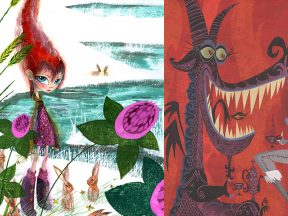
I was blown away earlier today when I discovered the work of Rebecca Dart. She has a fantastic sense for funny appealing shapes, and powerful cartoon drawing. It wasn’t surprising to learn that she works in animation, and again, no surprise to see her credits on her IMDB filled with some of the crassest TV trash imaginable. It’s hard to adequately put into words how depressing it is to know that talent of this caliber exists within our industry, and the rampant cluelessness that results in these artists producing shit like this. It’s like hiring Velázquez or Vermeer to paint the lines in a parking lot — an utter, total waste of skill and talent. Though the animation world has no appreciation or use for such skill, she’s at least able to utilize her artistic voice in the comic books she makes. (via Drawn) November 2, 2009 12:05 am
A reminder that tomorrow night Cinefamily @ The Silent Movie Theatre will present a tribute to animator Fred Wolf. We’ll screen rare clips from his movies, TV shows, vintage TV commercials (like the one above), and his award winning shorts during a live on-stage interview with Wolf himself. Wolf will discuss his career starting at Famous Studios in NYC, working with Shamus Culhane in the 50s, Herb Klynn on The Alvin Show, his collaborations with Harry Nilsson on The Point!, with Frank Zappa producing 200 Motels, and with Peter Yarrow to make Puff The Magic Dragon. We’ll also get into the Teenage Mutant Ninja Turtles, his producing commercials, shorts and feature films - and how he ended up animating the iconic opening sequence to The Flintstones! Join me Tuesday night, November 3rd at 8pm. The theatre is at 611 N. Fairfax Ave. just south of Melrose. The first 100 admissions will receive a free DVD of The Point!, and every admission will receive a free Tootsie Pop! Click here to Reserve Tickets. October 29, 2009 1:00 pm
More John Canemaker news! John will present his do-not-miss lecture/screening on the art and life of animation pioneer Winsor McCay (1867–1934) at the Wexner Center for the Arts at Ohio State University, Columbus, Ohio, next Tuesday November 3rd. As part of the lecture, Canemaker presents Gertie the Dinosaur (1914) the way it was meant to be shown – as a vaudeville act with live musical accompaniment (photo above is from Canemaker’s recent screening in Annecy). The program starts at 7:00 pm at the Wexner Center Film/Video Theater, 1871 North High Street in Columbus, Ohio. The event is part of the current Winsor McCay: Legendary Cartoonist exhibit at the OSU Cartoon Library and Museum. For tickets and information, please visit the Cartoon Museum website. October 27, 2009 12:10 pm
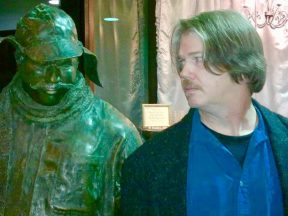
If you are a member of Asifa Hollywood, this is a killer week: you can meet Henry Selick, Peter Docter and Wes Anderson and see their films at free screenings in Los Angeles. And at each one, yours truly, Brewmaster Jerry Beck will conduct a Q&A with the filmmakers (that’s my mug above with two puppets from Coraline from my session with Henry Selick last week in Ottawa). If you haven’t RSVP’d yet - do it now. Info is posted here. Tonight at 7pm is the screening of UP with Pete Docter at the Chinese Theatre (6925 Hollywood Blvd.) in Hollywood. I know this is short notice, but they’ve opened it up to all members of the Animation Guild, students from Cal Arts and readers of Cartoon Brew. But you have to RSVP. If you can make it, call (818) 560-4350 right now to reserve your seat - it’s FREE!! See you there! October 22, 2009 9:47 am
Filmmaker Michael Sporn interviews Jennifer and Bert Klein about their ambitious new animated short Pups of Liberty and the lengths they to to finish it:
The Venture Bros. creator Jackson Publick and voice actor James Urbaniak recently appeared on “The Best Show on WFMU with Tom Scharpling.” The interview lasts a couple hours and there’s a lot of goofiness, but there’s also a lot of good discussion because the host, Scharpling, is a TV writer and producer (Monk, Tom Goes to the Mayor). The interview begins a little after an hour into the September 29 program, which can be listened to at the WFMU website.
|