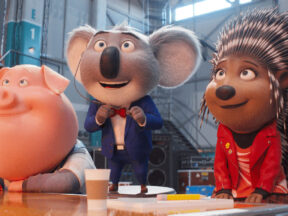
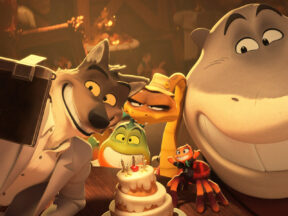
Sony Pictures Animation released the first trailer today for Cloudy with a Chance of Meatballs 2. Opening in the US on September 27, the film is directed by industry veterans Cody Cameron (director of Open Season 3) and Kris Pearn (head of story on the original Cloudy).
Author Archives: Amid Amidi
DreamWorks Will Layoff 350 Employees

DreamWorks Animation announced yesterday that they will layoff 350 employees by the end of 2013. The news of the layoffs become public in early-February when the studio told employees that it was reshuffling its production and release schedule.
DreamWorks CEO Jeffrey Katzenberg talked about the layoffs with \The Hollywood Reporter:
“These things are very, very difficult to do. I would say it’s the hardest thing I’ve had to do since we started DreamWorks. We’ve never had to lay anybody off. It was against our culture. But it’s the right thing for us today, and it makes DWA strong going forward.”
Yesterday, the studio also reported that it would take an $87-million writedown on Rise of the Guardians, which represents the studio’s biggest money-loser since 2006′s Flushed Away, which resulted in a $109-million write-down. It should be made clear that a write-down is not an actual loss of money, but a reduction of the book value of an asset.
What is the Biggest Animation Project on Kickstarter Right Now?

What is the most funded animation campaign currently running on Kickstarter? Is it:
- A short film by animation legend Ralph Bakshi
- An animated game by Oscar-winning Moonbot Studios
- A proof-of-concept film by Celebrity Deathmatch creator Eric Fogel
The answer is none of the above.
The most successful live animation campaign at the moment is Cyanide and Happiness, a long-running webcomic that aims to branch out into a series of long-form animated episodes. In the eleven days since the campaign was launched, over 7,300 backers have contributed $362,000, easily surpassing the project’s original goal of $250,000. It is already the third-highest funded animation campaign in Kickstarter’s history, and could break more records before it’s all over.
The four twenty-something creators of Cyanide and Happiness—Kris Wilson, Rob DenBleyker, Matt Melvin, Dave McElfatrick—are no strangers to animation. Before coming together to make the comic in 2004, they met each other as teenagers doing animation on Newgrounds. In 2009, they began creating brief animated segments based on their comic. Their YouTube channel has amassed neary 200 million pageviews with short-form bits and pieces of animation.
Now, they aim to do something more ambitious: a series of 10-12 minute episodes. Initially, they attempted to negotiate a TV series deal with cable networks. They wrote about the fruitless effort on their blog:
We walked away from the first two [networks] due to rights and creative control issues. We thought that we could settle those issues in the third deal, but things didn’t quite work out as we hoped. We’re starting to realize that TV as an industry just isn’t compatible with what we want to do with our animation: deliver it conveniently to a global audience, something we’ve been doing all along with our comics these past eight years. That’s just the nature of television versus the Internet, I suppose.
Now they’ve turned to Kickstarter to appeal directly to their fanbase:
We firmly believe the entertainment industry is changing, and the Internet will eventually become the only way people watch shows. Especially the people that make up our awesome fanbase. The Internet is already the largest network, available when you think about it. Why go anywhere else? By reading our comics over the years, you folks have given us the careers we dreamed of having as kids, and turned our silly cartoons into something much, much bigger than ourselves. The prospect of doing an uncensored, unaltered Cyanide & Happiness Show and giving it directly to the fans is an incredible opportunity. We’re really excited to see how far we can take things.
Besides the amount of money raised so far, there’s another noteworthy aspect, and that’s that the C&H artists developed their careers entirely online. This is different from many other high-profile animation projects on Kickstarter launched by mainstream artists whose reputations were established in entertainment mediums outside of the Internet.
It still means something to be Ralph Bakshi, John Kricfalusi or Bill Plympton—that is, being the director of numerous theatrical features, the creator of a groundbreaking TV series, or the king of American indie animation has an incalculable advantage over being an upstart. But as the Cyanide & Happiness campaign has shown, lofty reputations from other mediums can’t match the support of a well-established online following.
The C&H Kickstarter already has more backers than the combined totals of the three aforementioned animation legends, and will also achieve a higher pledge dollar amount than the combined total of those other high-profile campaigns. With this success, as well as the success of webcomic campaigns like MS Paint Adventures and Penny Arcade, the once-maligned webcomic is re-emerging as the unlikely foundation of mini-entertainment empires.
“We are at a tipping point in our industry”

A commentary worth reading by Jeffrey A. Okun, Chair of the Visual Effects Society:
“We are at a tipping point in our industry – no matter where you live or work. It has become painfully obvious that while profits abound for producers and distributors, our budgets are being squeezed to the point of jeopardizing our jobs and the quest for a reasonable life style for VFX artists.”
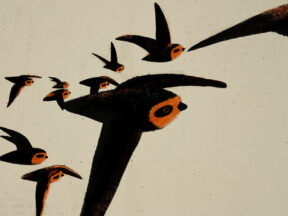
“Mysterious Swamp” by Chintis Lundgren
Brenda Chapman Becomes First Woman to Win Feature Animation Oscar [UPDATED]

A writer couldn’t have scripted a more Hollywood ending to the saga of Brenda Chapman, Pixar’s first female director. It was over two years ago when Cartoon Brew broke the story about Chapman being unceremoniously dumped from her film Brave. Last night, Brenda made history after becoming the first woman to win an Academy Award for Best Animated Feature, a prize shared with co-director Mark Andrews.
It took only twelve years of the Best Animated Feature award before the Academy recognized a film directed by a woman. By comparison, it took 82 years before the Academy awarded an Oscar to a live-action film directed by a woman. That happened in 2009, when Kathryn Bigelow won both Best Picture and Best Director for The Hurt Locker. Let us hope that Hollywood leaves behind its pathetically homogeneous history and continues to embrace diversity and fresh perspectives on storytelling.
[UPDATE]: For the record, I should point out that Vicky Jenson co-directed Shrek, which won the very first Oscar for Best Animated Feature in 2001. Sadly, Jenson did not receive an Oscar because the award was given to the film’s producer in that first year.
Hear This Uninterrupted Statement from “Life of Pi” VFX Winner
[original video link of Oscar speech removed by Vimeo]
Last night during the Oscars, the Academy organizers interrupted Life of Pi winner Bill Westenhofer’s speech just as he was about to address the crisis in the visusal effects community. The timing of the cut-off may not have been coincidental, as Variety’s David S. Cohen pointed out on Twitter:

Hollywood’s desire to silence the animation/vfx community is made more poignant by the VFX industry demonstrations that happened earlier on Sunday in Hollywood. Westenhofer supervised the visual effects of Life of Pi at Rhythm & Hues, which has already declared bankruptcy and is among the studios hit hardest by the recent industry turmoil.
Westenhofer spoke backstage at the ceremony with animation journalist Bill Desowitz, where he explained the message he wanted to deliver to Hollywood:
“At a time when visual effects movies are dominating the box office, [the] visual effects companies are struggling. And I wanted to point out that we aren’t technicians. Visual effects is not just a commodity that’s being done by people pushing buttons. We’re artists, and if we don’t find a way to fix the business model, we start to loses the artistry. If anything, Life of Pi shows that we’re artists and not just technicians.”
“Paperman” Producer Kristina Reed Kicked Out of Oscar Ceremony—For Throwing Paper Airplanes

What is with animation folks being thrown out of the Oscar ceremony? Tonight’s hot gossip is that Paperman producer Kristina Reed was kicked out of the Oscar ceremony after she began throwing paper airplanes off the mezzanine when her short was announced as a winner. The planes had lipstick kisses on them—just like the film. According to the Hollywood Reporter, “After a short protest, security brought her back to her seat about five to 10 minutes later.” Thank God we can all still throw paper airplanes at the Annecy animation festival.
Disney Sweeps Animation Oscars with “Paperman” and “Brave”; VFX Oscar Goes to “Life of Pi”

Disney swept the Oscars this year with wins for both animated short and feature. Congrats to John Kahrs and Walt Disney Feature Animation for taking home the Animated Short Oscar for Paperman. Congrats to Mark Andrews, Brenda Chapman and the Pixar crew for winning the Animated Feature Oscar for Brave.
As expected, the Oscar for Visual Effects was awarded to Life of Pi. Congrats to Bill Westenhofer, Guillaume Rocheron, Erik-Jan De Boer, Donald R. Elliott, and the crews of Rhythm & Hues and Moving Picture Company. Unbelievably, as the Life of Pi winners tried to comment on the recent situation in the VFX community, the Academy cut off their speech mid-sentence. Not classy, Academy of Motion Picture Arts and Sciences.

Oscar-winner John Kahrs and wife Gennie Rim arriving for the ceremony tonight.
For the record, Paperman is quite an accomplishment for Disney. The last time the studio won the Oscar for Best Animated Short was 1969 and the winner was this guy:

Rate Seth MacFarlane’s Performance Tonight

Love him or hate him, Seth MacFarlane is making history tonight as the first (and probably last) animator to ever host an Academy Awards ceremony. Let’s document this unique moment in cartoon history. Does his performance match up to previous Oscar hosts? Better than Billy Crystal? Steve Martin? Carson? Hope? Which of Seth’s routines killed and which fell flat? Did he make references to his animation career in a positive or negative way? Share your thoughts with the animation community as you’re watching the ceremony tonight.
(Note: Any comments not directly related to Seth’s performance will be deleted. Seriously, don’t even try.)
Burger Ad Bliss
There’s something profoundly delightful about this early-Seventies Burger King ad featuring a mustachioed octopus selling Whoppers. It’s absent the high-concept pretensions of modern advertising filled with cooler-than-thou irony and sarcasm. I’d say it’s as genuine, fun and pleasant as a fast food commercial can be. Now someone please find the color version and post it online.
(Thanks, Dann Pryce, via Cartoon Brew’s Facebook page)
Oscar-Nominated Animation Shorts Gets No Respect in People Magazine

As an animation supporter, it’s moments like this that makes you shake your head and wonder why you even try. In a single magazine paragraph, People magazine managed to perpetuate two of the most persistent misconceptions about animation—that it is a medium exclusively for kids and that it has to be ‘fun’:
Your kids can get into the spirit of awards season too, with the five animated shorts nominated for Oscars. Maggie Simpson battles a bully in The Longest Daycare (which played with Ice Age 4 last year), while Paperman (the intro to Wreck-It Ralph) features a copule brought together by paper airplanes. The rest of the mini movies are a touch more experimental but no less fun. See them all together now in theaters, or on iTunes or On Demand Feb. 19.
How To Draw Popeye

Cartoonist and storyboard artist Sherm Cohen has updated his fantastic How to Draw Cartoons Facebook page with scans of the rare 1939 book Popeye’s How to Draw Cartoons. The book has some solid common sense advice, including this bit which I liked: “Copy other characters you enjoy following in your newspaper. Don’t worry if they don’t look exactly like them. The important thing is—are you remembering to exaggerate your impression of the character you have in mind?” See the entire book HERE.
Below is a biography of Joe Musial, the artist who drew this how-to book. This bio appears in Fred Grandinetti’s Popeye: An Illustrated Cultural History:

“To This Day”, A Collaborative Animated Short about Bullying
The most talked-about online animation debut this week was To This Day, which featured the contributions of over 80 animation artists who took turns animating a spoken word poem written and performed by Shane Koyczan. The seven-and-a-half minute short has already racked up nearly 3.5 million views on Youtube, and an additional 134,000 views on Vimeo.
The anti-bullying message of the film is powerful, but the impact originates almost entirely from Koyczan’s passionate narration. The animation—and the overproduced score—serve as attractive garnish, but don’t enhance or elucidate the core emotion of the vocal performance. That’s not to say that the visuals aren’t well made because it’s clear that a lot of effort went into this. Seemingly every current animation and motion graphic style is represented, but the novelty of rapidly shifting visual styles doesn’t feel like the most effective way to support Koyczan’s narration.
The interchangeable feel of the visuals has a lot to do with the way the project was set up by Vancouver-based design studio Giant Ant. They invited dozens of artists to create 20-second pieces over a twenty-day period, and assigned multiple artists to animate the same parts of the film. Afterward, they cut together the bits and pieces that they thought worked best for each scene. As one artist who worked on the project told me:
This is an excellent example of crowdsourcing in the 21st century. Everybody works hard on tiny chunks for no pay, only the best parts of their tiny chunks go in, the rest gets scrapped, and you’ve got a beautiful result for no investment.
VFX/Animation Industry Will Protest at the Oscars Tomorrow

What better time to protest Hollywood’s woeful treatment of animation and visual effects artists than on the film industry’s biggest day—Oscar Sunday. Tomorrow afternoon, between 1pm and 4:30pm, there will be a demonstration at Hollywood Blvd and Vine Street demanding more equitable treatment of animation/VFX artists. The event organizers have also rented a plane that will circle the Oscars between 3:30 and 4:30pm carrying a banner urging a VFX union. Over 200375 people have already confirmed their attendance on the event’s Facebook page.
The instigating event of this renewed interest in artists’ rights has been Rhythm & Hues’ bankruptcy, which makes little sense considering that the work R&H produces is among the best in the industry and responsible for a significant portion of Hollywood’s profits:
Life of Pi (Fox) and Snow White and the Huntsman (Universal) together grossed almost a billion dollars worldwide. Rhythm & Hues Studios, the company that brought Richard Parker to life and created the bulk of the visual effects for these two Oscar nominated films, has just declared bankruptcy. Many of the artists who worked nights and weekends to create those effects are out of work and unpaid for weeks of work (including nights and weekends) on new tent-pole films for the same studios, Fox and Universal. It’s time for change!
A round-up of protest coverage can be found on VFX Soldier.