About Amid Amidi

test

Here Comes Science

Here Comes Science

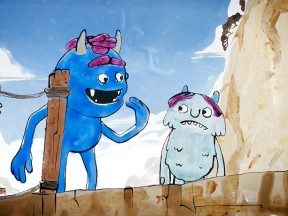
Here Comes Science is a new album of science-related children’s songs by They Might Be Giants. The dvd that is included with the package offers an animated short for each of the nineteen songs. The videos were clearly made on a budget, and some of them suffer for that, though there are plenty of good ones too. Overall, it’s worth applauding the ambitiousness of the project. Here are some of the videos that have appeared online:

“Science is Real”
Directors: David Cowles, Andy Kennedy
Character Design: David Cowles
Backgrounds: David Cowles, Andy Kennedy
Animation: Andy Kennedy, Chris Conforti, Adam Sacks, Sean McBride

“Put It to the Test”
Directors: David Cowles, Jeremy Galante

“How Many Planets?”
Director: Colourmovie

“Electric Car”
Directors: Max Porter and Ru Kuwahata

“Why Does the Sun Shine?”
Director: Hine Mizushima

“Meet the Elements”
Director: Feel Good Anwyay

ASK THE EXPERTS: Online vs. Festival

We’re launching a new–and hopefully regular–feature on the Brew today where you ask the questions, and we find the answers. I wanted to kick things off with a question that I’ve been asked repeatedly by animation students and short filmmakers, and about which there seems to be an endless amount of misinformation and confusion.

Here is the question as it was posed to us by filmmaker Eric Bates:

I’m just writing to see if you had any advice in regards to submitting a short animation to festivals versus posting online. I remember the status quo while I was a student at the Emily Carr University of Art in Vancouver, was, of course, to submit to festivals, but I remember a negative view of posting online, as if posting online took away from the credibility of the piece. Times are changing, but I’m still not so certain what is the best way to go. Do you have any views on whether posing online before showing in a festivals may be a good thing or a bad thing? Would posting online first negatively affect acceptance in a festival?

For some opinions, I decided to ask two people who program animation festivals: Chris Robinson, the Artistic Director of the Ottawa International Film Festival, and Susie Wilson, the Festival Director of Projector and a member of film selection committees at festivals like Annecy. (Also, see the UPDATE below from Mark Osborne.) Here’s what they had to say:

Chris RobinsonCHRIS ROBINSON
Dear Eric,
I don’t really see why it has to be an either/or situation. Granted, it’s nice for a festival to have a film that few people have seen because it creates excitement, but it’s really not a huge deal if it’s not a premiere. I certainly don’t punish a film because it’s been screened online. In fact, it’s quite the opposite. Amid here at Cartoon Brew posted a couple of films this year that we hadn’t received at the festival. I liked both of them, contacted the filmmaker, and invited the films to be in competition. If those filmmakers only went the festival route I might not have seen their films.

I guess the negative side of posting things online is quality. There’s nothing like sitting in a cinema with a thousand people watching a film on a big screen. People talk about the increased connection you get between artist and audience online, but nothing is more immediate that the reaction you get (or don’t get) in a cinema.

It’s also a bit of a different audience. The bulk of the audience at animation festivals are animation professionals or students. Online screenings can open you up to a slightly different audience.

Short film animators have limited opportunities to get there films out there so take advantage of everything available to you.


Susie WilsonSUSIE WILSON
No, Web exposure is not high on the list of factors I consider when programming. If a film is absorbing/funny/gorgeous (in short: good) enough, then even if it’s been seen a million times online, I’d still want it in my line up. The viewing experience is so very different from cinema to computer that even if I’m pretty sure my audience has seen it on the Web already, I’d still program it. Also, because it will be quite another film depending on what sits either side of it in the program. It’s definitely the quality of the film and what it contributes that counts, not its previous exposure. (In selection at Annecy last year, it was one of the few things all three of us agreed on!)

What do you the film-maker want for, and from, your film? It’s your answer to this question that will guide you in managing its exposure.

Some initial elements to consider:

Is the volume of viewers important to you? Quality vs. quantity. Yes, the Web might reach more people, but also think about the cinema experience which can be far superior, no matter how hi-res the computer screen or how woof the speakers.

Is your film non-narrative, experimental, abstract? If it’s a difficult piece, festival audiences can be more open. (Ok, not counting the notoriously impatient Grand Salle crowd at Annecy.) However, there can be more cohesion in groupings of films online, and the viewer can make up their own private festival. But wait, they can also stop watching it if it’s not satisfying them whereas in a cinema situation, they’d have to sit through the whole damn frustrating prickly amazing piece!

Think a year ahead when you’re planning on where to send your film and read the requirements of what you consider to be the most significant festivals in the upcoming twelve months. If they demand virgin births or non-line pedigrees, and it’s an event that will introduce you to what you consider to be an important audience, abide by their rules.

The clearer you are about where you want your film to go, the easier it will be for you to navigate all the festival and Web opportunities out there. Sit down, think about the ultimate destination, then chart your course. It’s your film, it’s your call.


A closing thought from myself: the trend clearly favors filmmakers nowadays, and most festivals don’t require filmmakers to keep their films off-line. Whenever somebody poses this question to me on the Brew, I always encourage artists to post their films online. The benefits of having your film on the Internet far outweigh the potential (and increasingly unlikely) exclusion from a handful of film festivals. (On a sidenote, the administrators of animation schools that require their students to keep their animation off the Internet should be slapped. They are performing a disservice to their students at a crucial time when these young filmmakers are trying to make a name for themselves.)

Even festivals that require films to be offline, like Sundance, are not enforcing their rules strictly. Last year, Sundance selected a number of shorts that had already debuted online. One of those, From Burger It Came, was a film that was available on Cartoon Brew TV, and at the request of the filmmaker, we removed the film for the period of the festival to comply with Sundance’s rules. However, another short film in Sundance competition, which was already an online hit, remained online throughout the festival without any repercussions.

UPDATE: Director Mark Osborne wrote to say that if you’re trying to get an Oscar nomination, then posting the film online is a bad idea. Mark says:

In regards to the issue of posting films online, please, PLEASE point out that if any one posts their film online they may DISQUALIFY themselves for Academy Award consideration. This is a very tricky issue and the Academy has made it very clear that it wants to honor theatrical production and so they are holding firm to the notion that if a film is on TV or online before it is in theaters it is not a theatrical production. (Article III-b of the Academy rules states: A short film may not be exhibited publicly anywhere in any nontheatrical form, including but not limited to broadcast and cable television, home video, and Internet transmission, until after its Los Angeles theatrical release, or after receiving its festival or Student Academy Award. Excerpts of the film totaling no more than ten percent of its running time are exempted from this rule.) I suspect this rule is why some schools don’t allow posting of films online, which is totally understandable considering this rule. And this is not to say that every film is an Academy contender, but I believe it’s better to be safe than sorry.

Bart Simpson’s Treehouse of Horror #15

Treehouse of Horro

The annual Treehouse of Horror issue is out today. It’s guest edited by Sammy Harkam, the creator of the Kramers Ergot anthology. If you can’t find it at a comic store, it’s available for purchase online at the PictureBox website. Here’s the eclectic line-up:

Among Halloween-inspired short strips by such visionary cartoonists as C.F. (Powr Mastrs), Will Sweeney (Tales from Greenfuzz), Jordan Crane (Uptight), Tim Hensley (MOME), and John Kerschbaum (Petey & Pussy), are four featured tales of inspired Simpsons lunacy: heralded artists Kevin Huizenga (Ganges, Or Else) and Matthew Thurber (1-800 Mice, Kramers Ergot) collaborate on a weird and wild story equal parts Lovecraftian eco-horror and Philip K. Dick identity comedy. Jeffrey Brown (Incredible Change- Bots, Clumsy) does a creepy and suitably pathetic story featuring Milhouse in a “Bad Ronald”-inspired tale of murder and crawl space living. Harkham and Ted May (INJURY) pull out all the stops for a tragic monster tale of unrequited love, bad karaoke, and body snatching at Moe’s Bar. Ben Jones (Paper Rad) does the comic of his life with an epic tale of how bootleg candy being sold at the Kwik-E-Mart rapidly spirals out of control into an Invasion of The Body Snatchers-like nightmare of a Springfield filled with cheap bootleg versions of familiar characters. And nobody does squishy, sweaty, and gross like up and coming cartoonist Jon Vermilyea (MOME), who outdoes himself with “C.H.U.M.M.,” a C.H.U.D.-inspired parody featuring everybody’s favorite senior citizen, Hans Moleman!

“Var jeg en vind” by Jan Rune Blom

Among the many fine people I met at the Fredrikstad Animation Festival in Norway last year was stop motion artist Jan Rune Blom. He promised to send me a link to this music video for singer Helene Bøksle when he was done with it. He didn’t let me down.

After the singer was filmed, the stills were transferred onto paper, cut out, and shot as stop motion. He tells me:

There are no digital effects or digital post production on the piece. Everything was shot on a Canon 300D SLR camera, and all pictures were imported into Final Cut for editing.I really like working with a lot of analog details and solutions. And I like the “analog feeling” of the end product. My brother Tor Harald Blom made the original 2D illustrations of trees and animals. Everything else I did myself. I spent like seven to eight months working on this.

These behind-the-scene pics on Jan’s blog give a hint of the painstaking work that went into making this piece. The results are lovely.

Season 2 of The Mighty B! Premieres Today

Mighty B
Painting by Bill Wray

Today, Nick is premiering the second season of The Mighty B! at 5:30 p.m (ET/PT). A new episode will debut everyday of this week. I’ll readily admit that I don’t understand the network’s logic of burning off five new episodes in a week, but that’s besides the point. Bill Wray, who is both painting backgrounds and co-directing episodes, tells me that he’s very proud of the second season and thinks they’ve made big strides with this current crop. He’s posting a lot of fantastic Mighty B! artwork on his blog. Bill’s enthusiasm, combined with all the funny stuff in the second season promo posted below, has convinced me that I need to check out a few episodes and see what it’s all about.

Paul Julian’s Piccoli

Piccoli

One of the rarest children’s books illustrated by an animation artist is Philippe Halsman’s Piccoli (1953), with illustrations by Paul Julian. It’s rare no longer as Michael Sporn has scanned in John Canemaker’s copy of the book, and has made available all of Julian’s stunning artwork from the book. The painting of the boy hiding under the sheets reminds me of a similar scene in UPA’s The Tell-Tale Heart, which shouldn’t be surprising because Julian was creating his exquisite paintings for that film right around the time he illustrated this book. For more Julian animation art, check out these Warner Bros. backgrounds; Pete Alvarado told me that Julian set the WB house style (and the standard) that all the other painters followed at WB in the 1940s.

TONIGHT IN BROOKLYN: Too Art for TV 4

Too Art for TV

Too Art for TV, the annual exhibit of fine art by animation artists, returns to Brooklyn tonight for its 4th edition. Masterminded by Liz Artinian, the color supervisor on The Venture Bros., the show offers a solid line-up of animation artists displaying their personal art–most of them from the New York area, but from other parts of the world as well. Opening reception is from 6-9:30pm at Erebuni (158 Roebling St. Williamsburg, NY). The show will remain up through October 17.

Insert Coin by Vurup

Vurup is a team of animation students working together in Buenos Aires, who have created their first short film called Insert Coin. The students, who hail from Argentina, Mexico and Colombia, are Gabriel Fermanelli, Leonardo Campasso, Bruno Olguin, German De Vivero, and Luz Lazzaro. Their short is a good example of how to tell a story in under one minute, and there are creative moments of drawn character animation throughout the piece. Hopefully we’ll see more from them in the future.

TOMORROW IN NY: Pitching Panel

Pitcher

Tomorrow evening, ASIFA-East is presenting the panel Animation Development: From Pitch to Production. It’s moderated by David Levy, whose excellent new book of the same name was released last week. Panelists are Carl W. Adams (co-creator, Assy McGee), Janice Burgess (creator of The Backyardigans), Fran Krause (creator), Debra Solomon (creator) and yours truly. Frankly, I think the only reason I’m on the panel is because I think the pitching and development process nowadays is wasteful, misguided, and total BS. And now that I’ve made my position clear, I don’t think I even need to show up. The fun starts at 7pm in the 3rd floor theater of the School of Visual Arts (209 E. 23rd Street).

Spark Animation ’09

Spark 09

Spark Animation ’09 is taking place next week in Vancouver. I wasn’t blown away by the line-up for the event’s first year, but this second time around they’ve brought together an exciting and diverse group of industry bigshots including DreamWorks director Conrad Vernon, David Fine of Bob and Margaret fame, Blue Sky art director Michael Knapp, Pixar production designer Ricky Nierva, The Secret of Kells co-director Tomm Moore, and feature animators like Dave Burgess and Chris Wiliams. There are also discussion panels and film screenings including $9.99, Mary and Max, The Secret of Kells, and Azur and Asmar. The event is industry-centric–no surprise because it’s being put on by SIGGRAPH–but there is a definite need for an event like this on the West Coast, and Vancouver is a lovely place to host it. The schedule and single-ticket/full pass info can be found on the SIGGRAPH Vancouver website. If any reader wants to send some notes about how it goes next week, I’d be interested in hearing about it.

Letters from Chuck

Chuck and Linda Jones

Is anybody following the official Chuck Jones blog? Because fans of Chuck should be! Chuck’s daughter, Linda, has been posting a fascinating series of letters that he wrote to her when she went off to boarding school in 1952. Even though a lot of the details are mundane, the value of sharing these letters is immense. They offer a totally new personal perspective on how Jones handled being a father at a time when he was also at the top of his game. There are also some great animation-related bits sprinkled throughout the letters, like his thoughts about working on the Roadrunner/Coyote shorts:

Been slamming through another Coyote and Roadrunner, as I may have mentioned. These are sort of money-in-the-bank type pictures. We don’t have to worry about establishing a premise or continuity or character development much or trick backgrounds. Everything’s pretty open. Just sit down and start drawing and when all the gags are roughed out, arrange them according to pace, so’s the picture will build in tempo, find myself a strong gag to end on and I’m in business. Timing is a snap because no dialogue and there’s no worry about making it too long, because I can time the gags as I go along and use just as many as I need. All in all, life could be very simple and maybe a little bit dull if all I had to do was direct coyote and r.r.s.

Read Linda’s intro to the series and then check out all of the letters. Start at the back with the first post if you want to keep proper chronology.

Danny Antonucci’s 4 “C”s to Great Cartoons

Lupo the Butcher

Danny Antonucci (Lupo the Butcher, Ed, Edd n Eddy) posted this refreshingly frank piece of advice on his Facebook page, and he’s allowed me to share it with everybody on the Brew. Even with all his years in the biz, Danny hasn’t forgotten what it’s all about:

Danny Antonucci’s 4 “C”s to Great Cartoons
1. CREATE (…new territories through art not technology)
2. CONTRIBUTE (…to the art form, not rape it for cash!)
3. CHALLENGE (…everything currently being done)
4. CHANGE (…don’t redo, copy, or repeat)
If you can’t adhere to any of these 4 “C”s, get the fuck out of animation.