Today, two of the biggest names in animation–John Kricfalusi and Bill Plympton–each announced that they were starting up classes to teach animation. Their models are very different.
John K. is calling his “Cartoon College.” It is a free, invitation-only private blog in which he’ll spend time giving individual notes to the promising artists that apply. He admits in this introductory post about the program that part of the motivation for giving away free training is selfishness:
The kind of cartoons I make require these skills, and I can’t afford to teach them during a production. Cartoon budgets go down every year and so I need people who already understand what I’m looking for and are functional. I always want to do layouts in my cartoons – it’s what separates my cartoons visually from so many others, but layout is mostly not done anywhere anymore. Nowadays, they just design the characters from a couple different angles, take them into Flash and then move the still pieces around like paper doll puppets. I can’t make my kind of custom stories and acting using that system. I need talented and SKILLED people to help. It’s worth it to me to help out before a production begins, but it will be up to you to practice and apply and critique yourselves according to what you learn. I will give some critiques and everyone here can learn from each other’s studies.
Bill Plympton is starting up his class in the real-world. Beginning September 16, for 14 consecutive weeks, he will teach a two-hour class every Wednesday evening from 6-8pm. It will take place at his studio in Chelsea, Manhattan. The cost is $1000 per person and is limited to 15 students. According to the description which he posted on Facebook, students will:
Learn how you can make amazing films that can earn money. Learn the tricks of drawing, design, layouts, storyboards, writing, humor, directing, backgrounds and editing. Learn the business of animation, budgets, funding, selling, distribution, festivals and cost-cutting tricks. Call (212) 741-0322 or email at Plymptoons (at) aol (dot) com for more information.
Great-looking experimental music video for The Fiery Furnaces’ song “Charmaine Champagne.” It was directed by Phillip Niemeyer of Brooklyn-based Double Triple. Niemeyer writes:
It’s stop motion, and it builds on a lot of things we were just discovering when we did the Spoon video. Mike Reddy, illustrator for all of the Furnaces’ records is responsible for most of the art. We shot most everything on an art store light table. We photocopied many of these assets onto office transparencies. All the color comes from either paint, markers or silkscreen. The band was photographed and these were assembled into stop motion loops — no video. No digital motion — we wanted that janky look, even on the pans. We took some process photos and posted them here.
CREDITS
Director: Phillip Niemeyer of Double Triple
Artwork: Mike Reddy
Additional artwork (action painting): Hannah Cole
Animation: Phillip Niemeyer, Alex Marie Egan, Mike Reddy, Jeremiah Dickey, Christine Nguyen
Photography: Phillip Niemeyer and Ethan Finkelstein
Joshua Smith, who has introduced me to lots of great anime over the years, wrote to let me know about some recent discoveries he made on YouTube: Kitty’s Studio (1959) and Kitty’s Graffiti (1957), two shorts animated by Yasuji Mori. I’ve embedded them below.
Joshua writes:
These were produced during a time in which Toei was just gearing up it’s attempt to become the “Disney” of Japan, a feat that probably would not have succeeded without the talent of Yasuji Mori. He was probably the greatest Japanese character animator of his generation, stressing the concepts of appeal, solid construction, and moveability in his character design and animation. As the most influential mentor at Toei, he passed his skills on to subsequent generations of Toei animators such as Yasuo Otsuka, Gisaburo Sugii, and Hayao Miyazaki.
Kitty’s Studio
He continues:
Most prewar and postwar Japanese animation up to this point was rather crude, so it’s striking to see Japanese animation at a level of quality that equals or surpasses much American short animation from the same time period. These shorts clearly contain a great deal of Western influence, but have a distinct approach that makes them feel exotic. Without further context, it seems like this style of animation appeared from a vacuum. On the weekend that sees the American release of Miyazaki’s latest film, it’s interesting to ponder what the state of Japanese animation might be like today without Mori’s influence.
Josh is spot-on when he writes about the distinct approach.The filmmaking choices in these cartoons are very odd and un-Western. In the cartoon below, the face of the main character is not shown from a three-quarter or front view until well over two minutes in the cartoon, even though he’s onscreen for much of that time. I can’t think of a single example of when that’s happened in a Hollywood theatrical short.
That’s the cover for a new project that I’ve been involved with: A Sketchy Past: The Art of Peter de Sève. It’s the first-ever monograph about Peter de Sève‘s professional work and it should be on everybody’s Christmas wishlist.
A Sketchy Past is 240 pages in a 10″ by 12″ hardcover format. It’s being released in October by French publishing house Akileos. They’re putting out two versions–one in English and the other in French. It’s not available to order yet, but Akileos has posted a preview page with details about the book and a preview PDF. It will debut officially at Galerie Arludik in Paris, which is holding a retrospective of Peter’s work in October. Events with Peter in the United States will follow shortly thereafter. As always, stay tuned to Cartoon Brew.
Having been a fan of Peter’s work for years, I was honored to be a part of this project. I’m particularly proud of the essay I contributed, and hope it’ll shed new insights into Peter’s approach and style. Make no mistake though. The main attraction here is page after incredible page of artwork. The book includes a generous number of roughs, as well as comments throughout from Peter. The artwork ranges from his New Yorker illustrations to animation work (the Ice Age series, Finding Nemo, The Hunchback of Notre Dame) to book covers and everything else in-between. The book is exquisitely designed by Lori Barra, who also designed Peter’s sketchbook that was published a few years ago. Everybody labored long and hard to get the book right, most of all Peter, who has spent the last thirty years creating these illustrations. If you’re a fan of Peter’s work, you won’t be disappointed, and if you’re unfamiliar with his work, prepare to become a fan.
Here are a few spreads from the book. Click to enlarge.
There are ninety-three films competing in the various short categories. Competition selections in Ottawa are a wonderful reason to attend and always one of the highlights of the festival. The line-up is filled with challenging, progressive and interesting uses of the animation medium. Check out the list of competing films here. I’m especially pleased that they maintain such high standards because I’m on the festival’s short film jury this year alongside filmmakers Suzan Pitt and Jim Blashfield.
Feature competition is also more robust than usual with seven films vying for the prize: Henry Selick’s Coraline, Tatia Rosenthal’s $9.99, Neil Burns’s Edison and Leo, Priit and Olga Pärn’s Life Without Gabriella Ferri, Sunao Katabuchi’s Mai Mai Miracle, Adam Elliot’s Mary and Max, and Paul and Sandra Fierlinger’s My Dog Tulip. It’s nice to see a healthy selection of features, especially after the feature debacle in Ottawa last year in which the best feature prize was inexplicably awarded to Battle for Terra.
A few months ago I shared my thoughts about the student screening at the School of Visual Arts, and in there I noted that Rebecca Sugar’s Singles was one of the highlights of SVA’s graduating class. Today we’re delighted to present the online debut of her film on Cartoon Brew TV. Frankly, I have no idea how anybody manages to become so adept at drawing and animation by the time they’re 22, but Rebecca’s done it, and the beneficiaries of her hard work are my eyeballs and yours. Click over to Cartoon Brew TV and watch her film Singles.
Today also marks the 64th anniversary of the bombing of Hiroshima, in which upwards of 100,000 Japanese people were killed instantly by an atom bomb dropped by the US military. In commemoration, here is Dan Blank‘s Shadowplay, a moving stop-motion film about the “permanent shadows imprinted on the city’s walls and streets by the intense flash, creating indelible images from the exact moment the bomb hit.” Made at NYU, it won a gold Student Emmy as well as a bronze Student Academy Award.
The Iron Giant was released ten years ago today–August 6, 1999. Wired magazine celebrates the occasion with a commentary by Scott Thill that contrasts Brad Bird’s thoughtful filmmaking to today’s “dumb” Hollywood efforts like Iron Man and Transformers:
Big guns and fiery explosions have been Hollywood’s status quo for a long time, with mindless violence selling tickets – and a warlike message, which The Iron Giant stands on its head. Hogarth dons the requisite helmet and BB gun after his future pal wrecks the nearby woods, and the boy even salutes himself in a mirror, armed in defense of America against the Sputnik-launching Russians, before galloping off to meet the “enemy.”
But after watching the Iron Giant (voiced by Vin Diesel) scream in pain while caught up in power lines, Hogarth’s compassion is activated as he realizes that his interstellar visitor can communicate. It is something Mansley could realize himself, if he wasn’t so busy pursuing his wargasm. Yet he does not, and that is Bird’s brain at work: Consumed by what philosopher Theodor Adorno once controversially called the “authoritarian personality,” Mansley is possessed by cynicism and a quest for power. He simply cannot conceive a world where robots fall from the sky to do anything other than annihilate America.
2009 appears to be the year of illustrated books by animation artists. It’s hard to keep track there are so many of them. Below are some of the latest offerings. None of the artists wrote these books, with the exception of Carter Goodrich, who illustrated his own story.
Victor Haboush passed away on May 24, 2009 at age 85. A first-generation American of Lebanese descent, he was born on April 16, 1924 and grew up in Indianapolis, Indiana.
At home with his family. Vic is third from the right.
During World War II, he took part in the D-Day landings at Normandy as a member of the Coast Guard, and later served in the Pacific theater. (His brother was mortally wounded at Leyte.) Following the War, he attended Art Center College of Design on the G.I. Bill where he studied extensively with Lorser Feitelson.
Figure drawing from art school.
On the recommendation of his Art Center classmate Eyvind Earle, he was hired at Disney in 1952 to help finish layout on Peter Pan. His first association with Disney came earlier, when he helped Earle draw this Golden Book adaptation of Peter Pan. He built up an impressive list of credits at the studio including assistant art direction on Melody and Toot Whistle Plunk and Boom, and layout on Lady and the Tramp, Sleeping Beauty and 101 Dalmatians.
(l. to r.) Victor Haboush, Tony Rizzo, Walt Peregoy and Tom Oreb at Disney in 1958
Vic was one of Tom Oreb’s closest colleagues during the 1950s and they worked together as a team, especially in Disney’s TV commercial unit. The characters in this Cheerios ad were styled by Oreb with background layout by Vic:
He described to me in 2000 his relationship with Oreb:
“Eyvind [Earle] and I were the two hot new guys, and we developed a lot of people not liking us. We’d work on the weekends, we’d throw storyboards up…a lot of the old guys just absolutely turned on us. It was really kind of brutal in a way. But guys like Tommy [Oreb], Ward Kimball, Bill Peet, Don DaGradi, they didn’t have that closed kind of thing. Tommy really married Eyvind and I. He became our friend. He looked after us. He talked us up. So the three of us became really good friends. We started hanging out together and all of that. Eyvind was kind of like Tom’s equal. They were both in the same age range. And I was the young kid. I was probably nine nor ten years younger than both of them. I just became Tom’s protege. I idolized him.”
Concept art by Haboush for an unproduced industrial film. Click for larger version.
When Oreb left Disney to work at John Sutherland Productions, Vic followed, and they worked together on films like Destination Earth and The Littlest Giant. They both soon returned to Disney to finish Sleeping Beauty, where Vic played a key role in designing the “Thorn Forest” sequence. In an interview, he spoke about his work on the sequence:
“I saw these awful drawings of the Thorn Forest, these big huge thorns, and it was a big mess. Basil Davidovich told me, ‘Vic, Woolie [Reitherman] doesn’t want anybody working on it anymore.’ But I went ahead anyways and spent the next three weeks working on this sequence. Everybody’s kind of laughing because they know that Woolie’s going to be pissed off when he sees that I’ve wasted all that time on it. The problem is that when you draw a vine, it gets smaller as it’s coming towards you, and that destroyed perspective. I worked it out where the vine overlapped itself so as it came towards you, it would be coming in front of itself and that created the depth. So I see Woolie one day and I say, ‘Woolie, I’ve solved the thorn forest,’ and he says surprised, ‘What! We should be finished with that.’ I take the work to show him in his office and he looked at them and pushed them aside. I thought ‘Oh no, here it comes,’ and he says, ‘Haboush, these are wonderful. From now on you’re the thorn forest guy.’ For the next three months, all I did was draw those stupid thorns. Bill Peet would come in and say, ‘Vic, nickel a thorn, charge a nickel a thorn, don’t ask for a raise, just get a nickel a thorn.’”
Concept art from Disney’s How to Have an Accident in the Home. Click for larger version.
Vic worked at numerous other animation studios besides Disney, including Quartet Films, early seasons of The Flintstones and The Jetsons at Hanna-Barbera, and The Incredible Mr. Limpet at Warner Bros. He was the art director of UPA’s second feature Gay Purr-ee as well as the Mr. Magoo and Dick Tracy TV series.
Concept art by Haboush from Gay Purr-ee. Click for larger version.
He told me that one of the most embarrassing moments in his career was during a short film screening at the Academy. UPA owner Henry Saperstein had submitted one of the Dick Tracy episodes for Oscar consideration, and when Vic’s name appeared onscreen as art director, he shrunk low into his seat. Working on the inferior UPA TV shows made him realize the direction the animation industry was headed and he resolved to set out on his own. In the early-1960s, he launched a studio, Spungbuggy Works, in partnership with animator Herb Stott and storyman/designer/all-around creative dynamo John Dunn. It was at this studio that he worked with Dunn to develop numerous feature and TV concepts, many of which would be later produced by Friz Freleng, who lured Dunn to his studio DePatie-Freleng.
In the mid-1960s, Vic left animation and shifted into live-action. He started his own studio, Victor Haboush & Associates, which later became The Haboush Company. Over the next thirty years, he directed and photographed over 1,500 commecials, winning numerous Cannes Gold and Silver Lions, Clios and IBAs. His campaigns included the Kibbles N’ Bits “The Hook” campaign, numerous commercials featuring Ronald McDonald for McDonald’s, the Taco Bell “Crashing Bell” series, the Hefty Bag series with Jonathan Winters, early Keebler Cookies spots, and the Schlitz Malt Liquor “Bull” campaign.
Vic on commercial sets
One of his former producers Paul Babb said, “Vic was one of the go-to guys in the 1960s, ’70s and ’80s for commercials…He was no businessman but he was an incredible artist–and not just as a director. Try putting a pencil or a paintbrush in his hand, sit back and wait for something remarkable.” Vic might have agreed with the sentiment that he wasn’t an expert businessman. He knew how to sell an idea and he knew how to execute, but he was more interested in achieving a quality result than heeding the bottom line. He often told me that his studio wouldn’t have lasted had it not been for his brother, who served as his producer for many years. Jon Derovan, who was Vic’s producer during the final decade of his career, told Shoot magazine, “Victor allowed me to be a creative producer. He brought me into the creative process beyond the nuts and bolts of the business….He was generous. He was open to good ideas no matter where they came from–and he was quick to credit the person who came up with the idea. He would never take credit for an idea that wasn’t his.”
Even while he ran the studio, he remained connected to animation and art. He employed many animators over the years including John Kimball, Robert Swarthe, Dale Case, and the unheralded Robert Mitchell. Through his company, Vic produced three shorts directed by Mitchell–K-9000: A Space Oddity (1968), the Oscar-nominated The Further Adventures of Uncle Sam (1970), and Free (1972). His company also produced another art film, Paint (1968) directed by Norm Gollin and starring LA airbrush pioneer Charlie White:
I first met Vic around the year 2000 while I was researching the life of Tom Oreb. By this time, Vic had retired from filmmaking and was painting full-time. We hit it off and formed a friendship that endured until his death.
Vic’s attitude towards life was different from the majority of older people I’ve encountered. He was young at heart, with an insatiable curiosity about the world around him and a flexible thought process. His opinions about different artists evolved over time, much like his distinctive painting process, which often involved reworking an image dozens of times until he was satisfied. He refused to live in the past. Whenever we would get together, he couldn’t wait to discuss people he’d recently met, a new place he had visited, or a new book he’d read. He was as enthusiastic about younger artists as he was appreciative of veteran artistic colleagues. When he returned to animation one final time as a development artist on The Iron Giant, he became enamored with artists like Mark Whiting and Teddy Newton, the latter whose work he felt was some of the freshest he’d seen in a long time.
Vic drawn by Teddy Newton
To fully appreciate Vic, you had to know him in person. Charismatic and energetic even in later years, his social skills were second to none. Not only could he strike up a conversation with a random stranger, but he could also get their contact info and perhaps form a long-term friendship–and remarkably, he could do all of this inbetween sips of his morning coffee. He was Malcolm Gladwell’s concept of the “connector” personified.
Iron Giant development art by Vic Haboush
I always considered him more of a pal than a teacher, but looking back on the time we spent together, he was one of the most influential mentors I ever had. His enthusiasm for art was contagious and instilled in me an appreciation for the same, from Lundeberg to Diebenkorn to Vlaminck to Pascin. Vic didn’t always have the easiest time imparting his wisdom. He once spent an entire morning trying to explain to me why Cézanne’s work was such a remarkable accomplishment. I was too dense at the time to grasp what he was saying, but it eventually sunk in.
He was one of the earliest supporters of my writing, and we spent months developing a story book together, which gave me the opportunity to see how skilled he was handling story and character. He prodded me for years to pursue writing seriously, and that too eventually sunk in. I remember during one visit I had brought my camera along and he asked me to take a photograph of him. The results were less than spectacular. The director in him emerged, and I received a firsthand taste of what he must have been like to work with on a live-action set. With the assured confidence of a master cinematographer, he directed me where to stand and where to point the camera, and he set himself up properly in the natural light. Within seconds, we had a fine portrait.
Thank you, Vic. For being a mentor, an inspiration, and a friend. It was an honor knowing you.
He is survived by his wife Monica, three children–Auguste, Cedric and Laila–and six grandchildren.
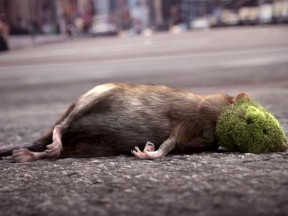
A music video for the track “Throw Me to the Rats” by the Tom Fun Orchestra. It’s directed by Alasdair Brotherston and designed by Jock Mooney, out of the UK’s Trunk Animation. I dig the quirky, humorous illustrations and choppy movement. Digital puppetry via AfterEffects and Flash is dime-a-dozen, but there’s a real energy and spontaneity when it’s created in the real world like this video. Brotherston explained in an interview:
“I had a good idea that I wanted to make a puppet theatre and film the action live in an effort to break from the perfectionism of digital animation that I was beginning to find a bit prescriptive and unspontaneous. I then decided to recruit an artist I knew from my time at Edinburgh College of Art called Jock Mooney as I knew that his illustration would be perfect for this job. He also brought some great ideas and a slightly perverted sense of humour as well as a spare room in which to do the shoot.
“The shoot itself turned out to be a bit of a nightmare and what had planned to be a fairly straightforward operation with most of the action caught in camera on set ended with myself and Jock setting up a green screen in his room and working puppets that were being held in place by jacket potatoes. Although it seems funny now, I distinctly remember being not that pleased at being holed up in a small room with blacked out windows, surrounded by several halogen lights on the hottest week of the year.”
CREDITS
Director:Alasdair Brotherston
Art Director: Jock Mooney
Producer: Shot On Site Media
Compositer: Dylan White
Puppeteers: Jenni Nylander, Natalie Ryde
Francis Thompson (1908-2003) made this striking work, NY, NY: A Day in New York, in 1957. Trained as a painter, he was interested in finding a way to capture the effects of Surrealism and Cubism in photography. He achieved that through a variety of lenses, reflectors, optical effects and editing tricks. The film works both in the abstract and narrative sense, and while it’s not animated, Thompson’s creative use of the cinema medium is fresher and more emotionally engaging than many of today’s artificial worlds created through motion graphics and digital means. Thompson was secretive about how he made the film, describing the production simply as, “a magic, secret process of bending, twisting, and turning inside out. It was a self-funded project that involved my roaming about New York City with a camera over my shoulder.”
Aldous Huxley once wrote about this film:
“And then there is what may be called the Distorted Documentary a new form of visionary art, admirably exemplified by Mr. Francis Thompson’s film, NY, NY. In this very strange and beautiful picture we see the city of New York as it appears when photographed through multiplying prisms, or reflected in the backs of spoons, polished hub caps, spherical and parabolic mirrors. We still recognize houses, people, shop fronts, taxicabs, but recognize them as elements in one of those living geometries which are so characteristic of the visionary experience. The invention of this new cinematographic art seems to presage (thank heaven!) the supersession and early demise of non-representational painting. It used to be said by the non-representationalists that colored photography had reduced the old-fashioned portrait and the old-fashioned landscape to the rank of otiose absurdities. This, of course, is completely untrue. Colored photography merely records and preserves, in an easily reproducible form, the raw materials with which portraitists and landscape painters work. Used as Mr. Thompson has used it, colored cinematography does much more than merely record and preserve the raw materials of non-representational art; it actually turns out the finished product. Looking at NY, NY, I was amazed to see that virtually every pictorial device invented by the old masters of non-representational art and reproduced ad nauseam by the academicians and mannerists of the school, for the last forty years or more, makes its appearance, alive, glowing, intensely significant, in the sequences of Mr. Thompson’s film.
My central idea in constructing the world of the film was to prove that something totally artificial and unreal could still communicate emotion and hold cinematic truth. The film makes no effort to cover up the fact that it is a computer animation, it holds an array of artifacts which distance it from reality, which tie it closer to the software it came from. This idea is in direct opposition to all current trends in animation, which take the route of desperately trying to look real, usually by realistic lighting and rendering, or by forcing a hand-made or naive appearance. At the time of writing, this trend shows no apparent signs of ceasing.