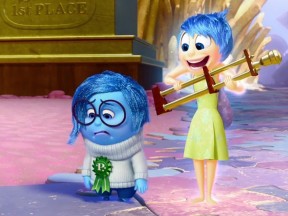
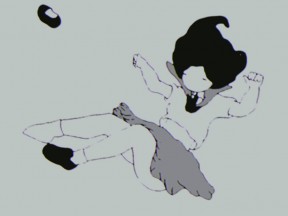
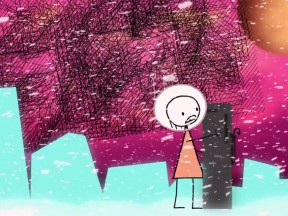
For reasons unbeknownst to me, there are not a lot of Sheridan-produced student films which have been posted online. Below are two that I’ve found so far:
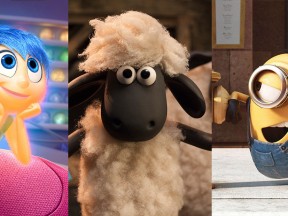
The students may not be posting their films online, but the school is presenting a screening of this year’s work on June 9 and 10 at the Bloor Cinema in Toronto (located at Bloor and Bathhurst). Admission is $5. The screening on June 9 is at 7pm and the screening on June 10 is at 9:30pm. The line-up for the screening can be found on the blog of Sheridan instructor Mark Mayerson. The trailer below, showing snippets from various student films, offers a sense of what was made in Oakville this year:
Static: An Interactive Approach to Animation is a thesis film created by Jack Lykins in SVA’s Computer Arts program. All the video and audio playback in the film is controlled by turntable, and zooms and rotations are manipulated through a MIDI interface. In other words, the filmmaker can remix their film live and create a completely original experience each time. It’s fascinating to think of the possibilities this presents; like a DJ or jazz musician, a filmmaker can now improvise within the cartoon by remixing continuity, adding new clips, and revising ideas over time. The next Tex Avery just may have to learn to use a turntable too.
A higher-res version of Static can be viewed on SVA’s website along with all the other student films produced in their computer animation and visual effects department.
A Cartoon Brew reader pointed out this blatant ad on Craigslist asking animation artists to work on a Cartoon Network pilot with no guarantee of payment unless the show gets picked up for series. The ad reads:
Deferred payment 1st episode (no-pay), action/adventure series, Cartoon Network, paid assignments and/or production contract after 1st episode.
We decided to take the bait and contact them to find out who’s blessing the Internet with this wonderful opportunity to work for free. Here’s the response from Associate Producer Sasha Tyler at McNeal Enterprises:
Pilot/series is being produced for Cartoon Network, deferred pay 1st-ep(no-pay), regular pay other eps and/or production contract, in moving forward contact the project’s executive producer Kenny Mack, let him know position your interested in, strengths, skills, availability, etc; KMack@McNealEnterprises.biz or 800 481-9754 x 4, PST.
Their website offer no information about what they do, but I found another website of theirs that displays an awfully lame and generic looking action-adventure show called The Savior Chronicles. Sounds like a good match.
The only question that remains: Is Cartoon Network stupid enough to give these amateurs a pilot deal or are they sneakily using Cartoon Network’s name to trick young and inexperienced artists into working on a lame project for free? Either way, this company’s business practices have fail written all over them.
Speaking of video games, this commercial for the Wii title Muscle Koushinkyaku (Muscle March) may just be the greatest game commercial ever. It’s Ripping Friends meets Japanese psychedelia with a polar bear thrown in for good measure.
When will the quality of video game animation rival the major theatrical animation producers? That day may already be here. Team Fortress 2 is a multiplayer on-line game created by Valve, and while the game itself doesn’t boast Pixar-quality graphics, they’ve created an impressive series of “Meet the Team” videos that tell the stories of the game’s characters.
The latest episode released last weekend, “Meet the Spy,” boasts some entertaining animation that would appear quite at home on the theatrical bigscreen. (Then again, with cinematic waste like Battle for Terra, Fly Me to the Moon and Space Chimps, bigscreen CG standards aren’t exactly what they used to be.) I don’t know much about the artists at Valve, but I’m told that the company includes veterans of studios like Pixar, Blue Sky, DreamWorks and ILM. Their experience is on full display in “Meet the Spy,” and despite my lack of interest in playing videogames, I can’t wait to see what they come up with next.
Chances are you’ve already noticed the ad for this show running on the right side of the Brew. If you’re in LA, there’s one place (and only one place) that you should be this Saturday evening: Gallery Nucleus for the gallery show opening and book release party of The Ancient Book of Sex and Science. This is the follow-up to the out-of-print 2007 release The Ancient Book of Myth and War. The same four artists are involved: Scott Morse, Lou Romano, Don Shank and Nate Wragg. The only difference is that last time all four of them worked at Pixar; now only two of them do (Morse and Shank), while Lou Romano has moved on to Laika and Nate Wragg over to DreamWorks. The opening is from 7-11pm, and paintings, sculptures, prints and books will be on display and available for purchase. For those who can’t make it, you can sign up for an online artwork preview at the Gallery Nucleus website, or better yet, pre-order the book from Amazon.
Following my post about David Ochs’s short Who’s Hungry, Brew reader Marianne Hayden sent over several links to other shorts produced at CalArts this year. That made me curious to find even more student films that have been posted online, and the result is this post, which offers a collection of ten new CalArts films spanning from first-year efforts through graduation shorts. Obviously there are dozens of films that haven’t been posted on-line yet so this is not intended to be a comprehensive look at the school’s output nor a selection of the best work coming out of the school. However, it does make for a decent representation of the quality and range of work currently being produced at CalArts. Happy weekend viewing!
Canadian animation studio Fatkat has shut its doors. The studio employed 100 people at its peak providing service work on shows like Skunk Fu!, Chaotic, and SuperNormal. Studio founder Gene Fowler has posted a long blog entry with information about the closure. In the post, Fowler says that he and a few of his friends are gathering together to launch a new studio called Loogaroo, located in Miramichi, the same city as Fatkat.
The story of the studio’s shutdown is more complicated than it appears. In his post, Fowler blames the production of a new series called Three Delivery, calling it the “most demanding and torturous production I have ever seen,” and says his “heart goes out” to the crew that had to work on the show. That show was created by Larry Schwarz (Kappa Mikey), who runs the New York studio Animation Collective, which as you may recall, was having its own problems paying artists a few months back.
Additionally, this CBC article from a few weeks ago offers juicy details about Fatkat’s finances. It says that the Canadian government had awarded over $1 million in grants to Fatkat since 2005, but had decided to withdraw its funding in the past few weeks because “Fatkat does not have the revenue stream it had anticipated.”
It never fails to excite me when I see a student film by somebody who gets it. And 23-year-old David Ochs plainly and clearly gets it. Who’s Hungry? is his freshman(!) film at CalArts, and it’s confident to the hilt. The film, a gory take on the tale of “Hansel and Gretel,” grabs your attention immediately and doesn’t loosen its grip until the credits appear at the end. Before we go any further, watch the film:
Christopher Meeks, his story teacher at CalArts, has written a blog post with some fascinating details about the film:
One of my freshman, David Ochs, last fall had asked me one day in class what the controlling idea (i.e. theme) of “Hansel and Gretel” might be, and off the top of my head, I said something like, “With true innocence comes great power.” Little did I know David wanted to redo the fairytale, and he created a fully animated five-minute film.
Meeks also offers insights about the year-end CalArts Producers’ Show screening and the risk that David took by making the film:
Freshmen, for instance, cannot create a piece over 90 seconds, and if they do, it will not be shown [at the Producers' show], with one exception. The exception is if the student body chooses it as the best film…He knew going in that the only way it could be shown is if the student body selected it. The film ended up being so fabulous that it won the Peer’s Pick Award.
If you’re curious about how the film plays to an audience, watch this recording of the raucous reaction it received at one of the school’s student screenings. ‘Nuff said.
The 17th annual edition of Anima Mundi, South America’s largest animation festival, is coming up this July in Rio and São Paulo. The deadline for short film submissions has already passed, but they are still accepting entries for Web and cell phone animated works.
The festival is progressive in its embrace of new media and has been running both of these categories for a number of years. Marcos Magalhaes, one of the co-founders of Anima Mundi, tells me that, “The Anima Mundi Web contest is celebrating its 10th edition (being one of the first of its kind on the Internet) and Anima Mundi Cell is in its fifth year. Both contests are very popular and disputed among Brazilian animators (open to beginners and professionals) but we want more international submissions this year!”
If you’ve created recent work for the Internet or cell phones, the festival will accept submissions until May 25. Entries can conveniently be uploaded online to their server. Rules and on-line entry forms for both competitions are available on their website AnimaMundi.com.br.
Juxtaposed by Alex Myung, one of the films that I’d highlighted in last week’s review of the SVA student screening, has been posted online. In the YouTube description, Alex writes, “This is a personal story and serves as a depiction of my experiences in dealing with my own adoption and acceptance of others.” He also has a blog at TheLemonFish.blogspot.com.
This is one of the most sage pieces of filmmaking advice I’ve ever run across:
“Don’t let this idea ‘Box Office’ and this idea of what pleases people bother you. Concern yourself with the best and finest thing, by God, that you know and do it to the top and give it to them to the hilt and you’ll go places and you’ll never lose.”
Who said it?
Architect Frank Lloyd Wright.
He offered this golden nugget to Disney artists during his visit to the studio in the 1939. Historian Wade Sampson has written a nice article–“Why Frank Lloyd Wright Disliked Fantasia“–which appears at MousePlanet.com. And here is the link to the transcript of Wright’s entire Disney talk.
Saturday, May 2, 2009: A lovely day as Pepperdine University graduates the class of 2009. I had only one acquaintance that was graduating but childhood friend John Lasseter, who I grew up with at the Whittier Church of Christ, received an honorary doctorate for his work in computer animation as Chief Creative Officer of Pixar Animation and Walt Disney Imagineering. Congrats John!
While researching a book that I’m currently working on, I discovered a four-page ad published in the March 4, 1940 edition of The Hollywood Reporter. The ad, taken out by the Disney studio, congratulates the crew who worked on Pinocchio. These type of ads are nothing special nowadays but this particular one is fascinating to see in the context of Disney history.
One of the commonly heard lines about why the Disney strike happened is that Walt never credited his artists publicly and wanted everybody to believe that he made his films alone. This ad proves that that statement is patently false. In fact, this ad appeared over a year before the strike happened. It credits the lead animators, voice artists, background and layout crews, storymen, musician, designers, fx animators, and even the live-action models. The first page of the ad is above, the following three pages are after the jump.
Nina Paley’s Sita Sings the Blues–now a film that everybody can (and should) watch–continues to make an impact in surprising and unexpected ways. Last week, the above Reuters photo by Krishnendu Halder appeared online with the following caption: “Members of laughter clubs attend a session during ‘World Laughter Day’ celebrations in Hyderabad, India.” The celebration in India included a huge sculpture of the mythical figure Ravana based on Nina’s design from the film.
Consider for a second the amazing nature of this photo’s contents. Nina Paley made Sita Sings the Blues in her apartment–all by her lone self, on a shoestring budget, using a desktop computer. One short year after its debut, with absolutely no promotional budget, no theatrical distribution and little mainstream media coverage, the film has traveled around the globe and fans are creating sculptures based on her work.
Nina has made it possible for everybody to see her film by placing her film into Creative Commons and allowing it to be shared without copyright restrictions. Conventional thinking leads us to believe that this type of distribution is impossible and that global visibility is only possible through millions of dollars worth of marketing and advertising. Paley, however, has entrusted the distribution to her audience and (surprise, surprise) people are watching her film and building a community around it. The success of her experiment proves that independent artists with limited means can indeed compete on a world-wide playing field, not by trying to mimic strategies of entertainment conglomerates, but by taking advantage of ideas like Creative Commons licensing and employing comprehensive online distribution strategies.