About Amid Amidi

test

Happy Holidays from Stan Lee!

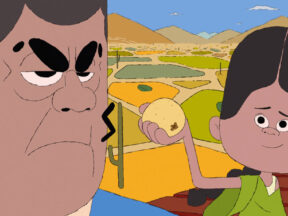
A fun holiday greeting from comic legend Stan Lee and his new YouTube channel World of Heroes. Two of the artists involved with the piece—co-director David de Rooij and background artist Jelle Brunt—produced the Cartoon Brew Student Festival winner Slim Pickings Fat Chances.

CREDITS
Written and directed: World of Heroes, Matt Cooper, David de Rooij, Danny Seckel
Music By: Matt Cooper
Animation, Cleanup & Color: David de Rooij, Pedro Vargas, Linda Tijssen
Background: Jelle Brunt
Voices: Stan Lee, Kevin McShane, Matt Cooper
Sound design: Brett Houston, David de Rooij

Was “Rise of the Guardians” A Victim of the Bill Joyce Curse?

Let’s make one thing clear upfront: this post is not intended to be an indictment of Bill Joyce’s creative abilities. Bill is one helluva of a talent. His self-produced animated short, The Fantastic Flying Books of Mr. Morris Lessmore, won the Oscar earlier this year. He’s a bestselling children’s book illustrator and author. He co-created the successful preschool series Rolie Polie Olie that ran for six seasons. He has been instrumental in jumpstarting a burgeoning tech scene in Louisiana. You could comfortably call him a Southern born-and-bred Walt Disney, and not be accused of hyperbole.

The William Joyce brand has been uniformly successful across various media platforms—except for one arena: CG animated features. The irony is that no artist has had as much personal success in having his ideas transformed into computer animated films as Joyce. He has produced three big-budget animated films at three different studios—Blue Sky’s Robots, Disney’s Meet the Robinsons, and DreamWorks’ The Rise of the Guardians. A fourth is on its way—Blue Sky’s Epic.

Deadline reported earlier this week that DreamWorks may take a $45 million write-down due to the poor performance of Rise of the Guardians. The film has grossed a paltry $72.9 million dollars after 29 days at the U.S. box office, and likely won’t break $100 million at the box office.

To put that into perspective, only two other DreamWorks CGI films have failed to reach the $100 mil domestic mark—the studio’s first CG feature, Antz, which made $90.7 million in 1998, and Flushed Away which pulled in $64.7 million in 2006. (The latter film was conceived and largely produced at the UK’s Aardman Animations.)

The performance of Rise of the Guardians falls in line with the tepid performances of Joyce’s other films. The first animated feature that he produced (and production designed) was Blue Sky’s Robots in 2005. That film grossed $128.2 domestically. It ranks as the lowest-grossing Blue Sky feature to date. (In the interest of full disclosure, I wrote the “art of” tie-in book for Robots.)

Joyce’s next feature, Disney’s 2007 effort Meet the Robinsons was based on the popular book A Day with Wilbur Robinson that he wrote and illustrated. That film grossed $97.8 million in the US, and is the lowest-grossing Disney feature in the John Lasseter-era of the studio. Neither Robots nor Meet the Robinsons performed well overseas either.

Joyce has maintained his reputation in feature film largely because the production process has been different on each film, as has his level of involvement. In the case of Robots, he didn’t write the script; he production designed the film and was intimately involved from a visual storytelling standpoint. The other two films have been based on his story ideas, but he hasn’t been involved as much visually as he was with Robots. The upcoming Blue Sky film Epic will be the first time that Joyce will both produce and production design a film that is based on one of his stories.

There’s also a strong argument to be made that Joyce’s involvement has nothing to do with the finished films. The films are only loosely based on his original ideas, and numerous other people mold the finished film besides Joyce.

For me, it begs the question: Why even use Joyce in the first place if studios deviate so wildly from his concepts. This was actually a lesson that Pixar learned the hard way. After Joyce had created concept art for Toy Story, Pixar invited him to direct an animated short at the studio. The experience didn’t end well, and all mentions of the unproduced short have been scrubbed from the studio’s official histories.

However, multiple people have told me that the experience with Joyce was instrumental in Pixar’s decision to develop film ideas in-house instead of working with outsiders and relying on pre-existing books or media properties as source material. Pixar, it has to be stressed, is absolutely unique in this regard; all other major animation studios have used pre-existing stories for their films, including Disney, DreamWorks, Blue Sky, Sony and Illumination. Pixar’s commitment to building ideas from scratch with artists who understand the medium best is among the reasons that the studio’s films are widely respected from a creative standpoint.

If this were baseball, Rise of the Guardians would have been Bill Joyce’s third strike in the world of big-budget CG-animated features. Thankfully, animation isn’t baseball, and Joyce will receive a fourth chance at CG feature success next May. Fox and Blue Sky’s Epic may prove once and for all whether there is such a thing as the “Bill Joyce curse.”

Sundance 2013 Animation Short Selections

The Sundance Film Festival has announced their short film selections for the next edition of the festival, which will take place January 17-27 in Park City, Utah. The following ten films will compete in the animated shorts category:


Benjamin’s Flowers / Sweden (Director and screenwriter: Malin Erixon) — Lovelorn and lonely Benjamin lives on the blurry borderline between fantasy and reality.


Bite of the Tail / South Korea, U.S.A. (Director and screenwriter: Song E Kim) — Life is a constant struggle for a husband and wife. She is suffering from stomach pain, and the doctor has no clue about a cure. Meanwhile, her husband is on his own journey of hunting a snake.


The Event / U.S.A., United Kingdom (Director: Julia Pott, Screenwriter: Tom Chivers) — Love and a severed foot at the end of the world.


Feral / U.S.A. (Director and screenwriter: Daniel Sousa) — A solitary hunter finds a wild boy in the woods and brings him back to civilization. Alienated by his strange new environment, the boy tries to adapt by using the same strategies that kept him safe in the forest.


In Hanford / U.S.A. (Director and screenwriter: Chris Mars) — This heartbreaking true story of a town poisoned by Cold War–era nuclear-arms manufacture is told through firsthand accounts and fantasy scenes, which empathize with the victim’s plight.


Marcel, King of Tervuren / U.S.A. (Director: Tom Schroeder, Screenwriter: Ann Berckmoes) — In this Greek tragedy – as acted out by Belgian roosters – Marcel survives the bird flu, alcohol, sleeping pills and his son, Max.


Oh Willy… / Belgium, France, Netherlands (Directors and screenwriters: Marc James Roels, Emma De Swaef) — Willy returns to his naturalist roots as he bungles his way into noble savagery.


Seraph / U.S.A. (Director: Dash Shaw, Screenwriters: John Cameron Mitchell, Dash Shaw) — A boy’s childhood scars his life.


Thank You / U.S.A. (Directors: Pendleton Ward, Tom Herpich, Screenwriters: Pendleton Ward, Tom Herpich) — A pack of fire wolves attack a snow golem in the forest and accidentally leave a cub behind after their retreat. The golem’s life is thrown into chaos as he attempts to reunite the cub with its family.


Tram / France, Czech Republic (Director and screenwriter: Michaela Pavlátová) — The humdrum daily routine of a tram conductress is jolted when the vibrations and rhythm of the road turn her on and take her on an erotic and surrealistic fantasy journey.

Their documentary shorts category also features two shorts with animation:


30% (Women and Politics in Sierra Leone) / United Kingdom, Sierra Leone (Director: Anna Cady) — Oil-painted animation brings to life the stories of three powerful women in postconflict Sierra Leone, revealing the violence and corruption women face as they fight for fairer representation in the governance of their country.


Irish Folk Furniture / Ireland (Director: Tony Donoghue) — In Ireland, old hand-painted furniture is often associated with hard times, with poverty, and with a time many would rather forget. In this animated documentary, 16 pieces of traditional folk furniture are repaired and returned home.

How To Earn $70,000 From Looney Tunes Cartoons And Not Pay Warner Bros. A Cent [Updated]

Illustrator Rob Loukotka’s ACME Corporation Kickstarter project is worth writing about for many reasons besides the fact that he’s trying to raise money. Here’s what it is: a poster of every Acme Co. item used by Wile E. Coyote in his futile pursuit of the Roadrunner. There are 126 items represented on the poster from the 43 Coyote and Roadrunner shorts that director Chuck Jones was personally involved with between 1949 and 1994.

The project wouldn’t be as noteworthy if not for how successful it’s been. Loukotka has currently sold over 2000 posters for nearly $70,000, and there are still five days left in the campaign. He is careful not to mention the Roadrunner, the Coyote, Warner Bros. or any of the cartoons in his poster. He also benefits from the fact that most of Acme products in the Chuck Jones cartoons are quite generic.

Nevertheless, Loukotka is walking a legal tightrope. He is mass producing merchandise based on a corporation’s intellectual property. If this was just a collection of random items with the name Acme on them, no one would ever buy the poster. It’s only because of the role these invented Acme items have played within a series of animated shorts that they are recognizable and of interest to the general public.

People also aren’t buying the posters because Loukotka is a popular artist. Case in point: Loukotka’s two previous campaigns on Kickstarter, which were prints based on original ideas, raised less than $5,000 each. His success with this campaign is almost entirely due to his unofficial partnership with Warner Bros.

Who knows what may happen. Corporations have been known to pursue copyright infringement cases even when characters aren’t involved. For example, Lucasfilm filed a lawsuit against British entrepreneur Andrew Ainsworth, who was selling replicas of Star Wars helmets. The company won a $20 million summary judgment against Ainsworth in U.S. courts.

I’m not a lawyer and can’t pretend to know all the legal arguments for and against such a poster. But I do find the project fascinating, especially the fact that it passed through Kickstarter’s legal vetting process. It begs the question, What other types of unofficial cartoon-related projects can be done in this manner without running afoul of copyright laws?

[UPDATE]: Further research reveals that Warner Bros. does indeed hold a trademark on the name “Acme”.

Illustrator Rob Loukotka has offered a response on Twitter saying that he believes the project is protected by fair use law:

“Una Furtiva Lagrima” by Carlo Vogele

Carlo Vogele has a knack for imbuing inanimate objects with personality. He’s told stories with lighting fixtures, socks, and now (with an assist from Enrico Caruso), fish.

It’s fitting that a meditation on the tragic destiny of fish would be illustrated using actual fish. Earlier this year, when Vogele posted the trailer for Una Furtiva Lagrima, we discovered that there are good reasons why animators don’t typically use dead fish as models. Vogele’s effort was well spent, though, resulting in a singular and strikingly original piece of animated fimmaking.

“The Life and Death of a Novelty Christmas Wreath” by Michael Ruocco

Michael Ruocco’s The Life and Death of a Novelty Christmas Wreath is a welcome antidote to the forced cheeriness of most animated holiday films. Ruocco’s decision to keep the wreath in a fixed center-screen position is an especially effective filmmaking choice that generates an unexpected amount of emotion and humor.

Alex Hirsch and Rebecca Sugar Appear On Forbes 30 Under 30 List

Forbes has published a list of 30 Under 30 in Hollywood. If you can get past the entertainment industry’s insularity and nauseating nepotism—the children of Judd Apatow, John Landis, Jeffrey Katzenberg and Larry Ellison (two of them) are all apparently up-and-comers—you’ll appreciate that two animators managed to sneak their way onto the list.

Alex Hirsch, 27, achieved the distinction for being the creator of the Disney TV series Gravity Falls, while Rebecca Sugar, 25, is hailed as the first solo female creator of a Cartoon Network TV series. Her show, Steven Universe, is currently in production and will debut next year. Congrats to both!

Cartoon Network Orders “Clarence”

Cartoon Network has greenlit Clarence, a new animated series by CalArts grad Skyler Page whose student films Crater Face and Girl Wallet have both been featured on Cartoon Brew, as have his costume-making skills.

CN has greenlit 12 fifteen-minute episodes, which according to Deadline, is about “an optimistic boy who wants to do everything because everything is amazing.” Page, who has been a board artist on Adventure Time, is the fourth CalArts grad to get his own Cartoon Network show in the last few years, following Thurop Van Orman (The Marvelous Misadventures of Flapjack), Pen Ward (Adventure Time) and J. G. Quintel (The Regular Show).

(Photo of Skyler Page via Jeff Rowe)

First Artwork Released for Disney’s Next Feature “Frozen”

Earlier this week, Disney released the first piece of concept art from their 2013 animated feature Frozen directed by Jennifer Lee and Chris Buck. The release of this image allows the animation community to begin one of its favorite traditions: judging an entire animated feature based on a single piece of still concept art. Let me start things off by saying that the artwork leaves me a little cold.

Click HERE for a super-big version of the image below.

Why Kickstarter is a No-Win Situation for Independent Filmmakers

Most of the anti-Kickstarter arguments have already been made, but no one has pulled everything together quite as well as Josh MacPhee in this piece about the economics of Kickstarter. It’s a must-read for any artist thinking of running their own crowdfunding campaign. If you think using Kickstarter is the heaven-sent solution for independent artists, this article may make you reconsider.

Trailer for “Blood of Eden,” An Iranian CG Feature

We don’t cover a lot of animation from Iran, but the quality of work that I see coming out of the country is constantly improving. This trailer for the animated feature Blood of Eden is among the more cinematically ambitious pieces of Iranian animation I’ve encountered yet.

The film, scheduled for completion next year, comes to us from Didar Pictures, a Tehran-based studio run by the three Najafi brothers—Mohsen, Morteza and Hossein. It is at least the second feature from Iran that is headed toward completion—the other, The Last Fiction, which I wrote about a couple years ago, is still in production as best as I can tell.

The Worst Oscar Night Ever, or “American pig, I have Oscar!”

Winning an Oscar is supposed to be a night you’ll always remember. For Polish animator Zbigniew Rybczynski, it was a night he’d rather forget. In 1983, he earned the dubious distinction of being the only person to win an Academy Award, and within minutes, arrested and jailed.

The troubles began the moment that presenter Kristy McNichol tried to announce his name as a nominee in the Best Animated Short category for the film Tango:

She gave up due to the difficulty of his name, and when she had to announce his name again as the winner, she butchered it into something that sounded like “Zbigniewski Sky.”

Rybczynski, dressed in a tuxedo and sneakers, came onstage with his translator. He began his speech, “Distinguished members of the Academy, ladies and gentlemen, I made this short film so I will speak very short. I feel honored to receive this award. I am dreaming that someday I will speak longer from this place…” At that moment, the orchestra cut off his speech with the ignominious Looney Tunes theme.

His translator pleaded to the audience, “It’s not over yet. He has important message.” But McNichol and co-presenter Matt Dillon were already trying to escort Rybczynski offstage. Rybczynski insisted that he couldn’t leave yet, saying, “No, no.” Rybczynski gave McNichol a kiss as she backed off. “That is Slavic custom. We are very warm people,” the translator told the confused audience. Then, continuing via the translator, Rybczynski attempted to make a point that was garbled in the translation: “And on the occasion of the film like Gandhi, which will portray Lech Walesa in solidarity.”

After speaking with reporters in the press room, Rybczynski briefly stepped outside of the Dorothy Chandler Pavilion to enjoy a victory smoke. When he tried to walk back into the building, holding an Oscar no less, a private security guard denied him entry. The overaggressive guard’s behavior escalated into a physical altercation and the police were called.

Two officers arrived, Sgt. Richard Longshore and another detective. “I had a female detective with me who spoke about 15 languages,” Longshore said. “She explained the situation to him.” A frustrated (and according to the police, intoxicated) Rybczynski looked at Longshore and yelled, ‘American pig, I have Oscar.’ Then—if you believe the police account—Rybczynski tried to kick him in the groin.

Rybczynski was arrested, and his Oscar was booked as “property.” In jail, he asked to speak to celebrity ‘palimony’ lawyer Marvin Mitchelson, the only American lawyer whose name he’d ever heard. Mitchelson later quipped that when he was first contacted, he said, “First bring me an interpreter, and then tell me how to pronounce his name.”

The district attorney’s office declined to prosecute Rybczynski, saying there had been a language problem. Rybczynski later offered his own opinion of the event, saying that “success and defeat are quite intertwined.”

“Success and defeat are quite intertwined.”

While Rybczynski’s special night was special for all the wrong reasons, the story has a happy ending. After the Oscar, he had a successful career directing dozens of experimental shorts and MTV music videos, and also spent many years developing new technologies like hi-def TV.

After years of living in the US, Rybczynski recently returned to Poland where he is heading the Wroclaw Visual Technology Studios, a hybrid school/production studio that focuses on applying new technologies to film production. Future confrontations with American law enforcement are perhaps less likely nowadays because, as this video shows, Rybczynski has also learned how to speak English.


Sources used in this story: Oscars.org, LA Times. Tango’s IMDB page, “Behind the Oscar: The Secret History of the Academy Awards” by Anthony Holden

Jazz Legend Dave Brubeck (1920-2012)

Jazz pianist Dave Brubeck, of “Take Five” fame, died last Wednesday, the day before his 92nd birthday.

Brubeck had at least a couple of animation connections. He composed music for “The NASA Space Station” episode of the animated mini-series This is America, Charlie Brown. He also inspired animators, including Oscar-winner Zbigniew Rybczyński (Tango) whose experimental student film Take Five used Brubeck’s music as a backdrop. The film can be viewed on this website.

Most significantly, Brubeck released an album in 1957 called Dave Digs Disney ($5 on Amazon). Although it may not seem particularly daring today, Brubeck took a big risk when he recorded this album.

At the time he recorded it, the Disney songbook was considered below the talents of respectable modern jazz musicians like Brubeck. Jazz critic Marc Myers wrote, “Back in the ’50s, no one in jazz took Disney movies or their soundtracks seriously. Disney Images represented Squaresville, a largely white Utopian world in which bad moods, misfortune and unconventional lifestyles simply didn’t exist.” Brubeck’s album turned out to be a huge success, and soon after, other top jazz artists like Miles Davis, Oscar Peterson, John Coltrane and Bill Evans were all recording their own versions of Disney tunes.

JazzWax’s Marc Myers has written extensively about Brubeck’s Disney record, including memories from Brubeck’s wife Iola and record producer George Avakian. Avakian told JazzWax:

“The Disney theme was Dave’s idea, and I was amazed when he called and told me what he wanted to do. I think I said, ‘Jesus, what a goofy idea.’ But anything Dave wanted short of tearing down the building was fine with me. He was taken with the tunes, and the quintet had been playing them on the road quite a bit. As you know, Dave and Paul had a quirky sense of humor…When the record came out, there were a few who said, ‘What is Dave doing recording Disney?’ The inference was that the album’s theme was somehow trite or child-like, and not nearly as serious as Dave’s earlier efforts. None of which was the case then—or now. Dave was ahead of his time tapping into the Disney songbook. Look at how many artists have done the same since.”

Below are a few cuts from the album:

“Heigh-Ho”

“Alice in Wonderland”

“When You Wish Upon A Star”

Tomorrow in NYC: Lillian Schwartz Retrospective

This should be a good one. Tomorrow evening, the Museum of Modern Art is presenting a retrospective of work by legendary computer animator Lillian Schwartz. The 85-year-old Schwartz will be present at the screening to introduce her work:

New York–based artist Lillian Schwartz (b. 1927) became a pioneer of computer-generated art in the late 1960s while a resident at Bell Laboratories, where she continued working as an artist, filmmaker, and art historian for over three decades. She was among the first American artists to employ computer language to create motion-graphics-based film and video art. Schwartz joins us to introduce a selection of her technically complex, finely executed investigations into visual perception. The program includes 2-D/3-D films from the 1970s to the present, such as Pixillation (1970), UFOs (1971), Enigma (1973), Olympiad (1973), and the newly released Before, Before (2012).

Tickets are $12 regular admission and $8 for students. Screening starts at 7pm. More details on the MoMA website.

Here’s a 1976 documentary about Schwartz’s work: