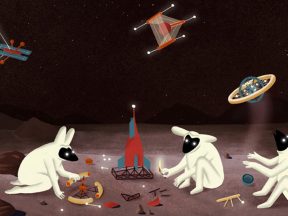
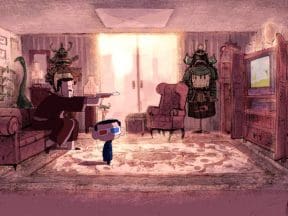
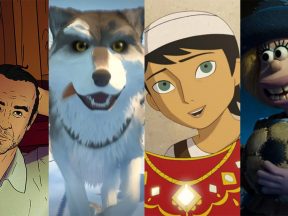
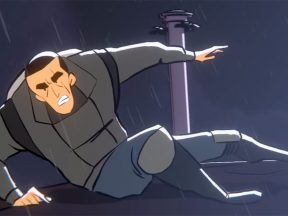
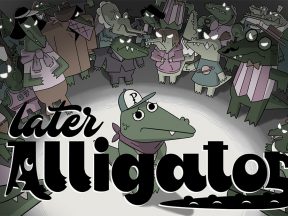
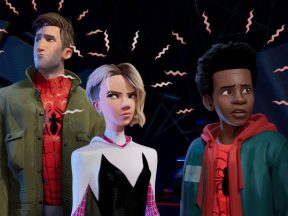
I do believe there is such a thing as over-art directing a piece of animation to the point where the message becomes buried within the polish of the artwork. Whether that’s the case with “A Year of Sun with Mr. Persol,” a glossy piece of advertising for Persol Eyewear directed by Kevin Dart and Stéphane Coëdel, is open to debate. What’s inarguable is that it’s an extremely competent piece brimming with sophisticated design and visual concepts throughout.
This 1961 episode of Tales of the Wizard of Oz harkens back to a time when animation writers didn’t speak down to kids. It’s a perfect example of children’s TV animation that works on multiple levels, encouraging kids to question their surroundings and understand the realities of the world while entertaining them at the same time.
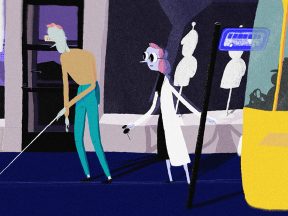
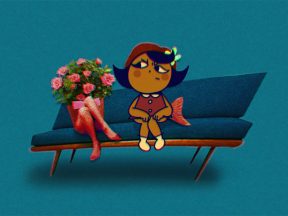
Lipsmackers by Beercan Rd. is a 2011 thesis film produced at the School of Visual Arts by Sachio Cook. The film has a quirky tone, stylishly mixing the mundane real world with fantastical elements. Some of the storytelling lacks clarity, but the overall effect (as well as the artwork) is charming. According to her LinkedIn page, Sachio works at Titmouse as an assistant animator. I hope she continues making independent films, too.
Fifteen years in the making.
35,000 hand drawn, hand-painted cels.
Shot onto 35mm movie film on a rostrum camera.
This is Neil Boyle’s The Last Belle, a recently completed short that will be playing on the festival circuit in 2012. If the mind-bending subway shot in the trailer reminds you of Richard Williams’s The Thief and the Cobbler, that’s no accident. Boyle worked as an assistant animator to Williams and the layout artist on Boyle’s short, Roy Naisbitt, also laid out the wild perspective scenes in The Thief and the Cobbler. Boyle discussed the path he’s taken to making this short on his website:
“I came into the animation industry on Who Framed Roger Rabbit and at 20 years old I was one of the youngest there. I was lucky enough to learn from the Disney veteran Stan Green (who had been assistant to the legendary Milt Kahl on many classic Disney films) and I became assistant animator to Richard Williams who was (and remains) amazingly generous with his vast knowledge of animation lore and technique. I was in the middle of all this, the archetypal kid-sponge, sucking up all the information I could. And then one day I went to bed and woke up 40 years old. Or so it seems. Then I was surrounded by a new wave of 20 year olds who – unlike me at that age – were already masters of their craft: the digital age of animation. So I had (and have) a lot more learning to do. The Last Belle is the project I’ve used to bridge the gap between old and new. A chance not just to read about the ‘old ways’, but to try them all out for real, guided by veterans of the craft.The interesting next step is to combine the old with the new and see where it takes us…”
More info and a blog with fascinating making-of details can be found on TheLastBelle.com. Enjoy it while you can because this will surely be among the last hand-drawn, cel-painted films shot on 35mm.
I can think of a few places I’d rather vacation before going to Disney World’s Art of Animation resort, like Mogadishu, Kabul and those drug cartel-operated areas of Mexico where they sew the faces of murder victims onto soccer balls.
It’s a virtual guarantee that every time Philly-based Anthony Francisco Schepperd creates a piece of animation, it’s going to be more incredible than the time before. I don’t know how he keeps topping himself, but the guy is a one-man animation monster. He delivers again with stunning drawn animation on “Two Against One,” a music video he co-directed with Chris Milk for Danger Mouse and Daniele Luppi. He animated the entire thing in TVPaint with some After Effects thrown in, but let’s face it, software doesn’t make a damn difference in his case. It’s all skill, baby.
John Canemaker‘s 2005 Academy Award-winning animated short The Moon and the Son: An Imagined Conversation is finally out on DVD. While Cartoon Brew readers are no doubt familiar with Canemaker’s tremendous body of work as an animation historian, his career as an independent animator is equally substantial, with his most impressive work being this deeply affecting 28-1/2 minute portrait of his Italian-American immigrant father and the troubled relationship he had growing up with him.
The DVD is a great self-contained lesson in filmmaking. It comes packed with a 16-minute documentary about the making of the film, the entire first rough cut which Canemaker narrated himself before John Turturro came on board, and two image galleries containing the storyboards and concept artwork. The rough cut in particular is revealing and shows how Canemaker expanded the dialogue and added to the ending, which both made the film more impactful. The storyboards in the image gallery are a wonderful addition, but I often found myself wanting to see the storyboards in greater detail since DVDs aren’t an ideal format for presenting still artwork. The DVD is available is on Amazon for $30.
“They gave me a gun, a pick, and a hand grenade, and said ‘Win at any cost,’ and I said ‘Right.’ There’s nothing I love more than winning…”
Indie filmmaker Nick Fox-Gieg has great taste in choosing material for his shorts, and More Than Winning, based on a story by Susan Murray, continues that streak.
This Thursday, January 12, Trigg Ison Fine Art (9009 Beverly Blvd, West Hollywood, CA 90048) will host the opening reception for “American Optimism: Celebrating the LA Art Scene 1935 — 1980.” The show will feature an eclectic mix of artwork by at least a dozen regional artists, including numerous works by Disney and UPA background painter Bob McIntosh, who passed away in 2010. In addition, there will be some newly discovered paintings by another fine artist with a strong animation connection–Oskar Fischinger. There’ll also be some pieces by Jirayr Zorthian, a SoCal painter who didn’t work in animation, but whose work had a strong cartoon aesthetic. Zorthian was friendly with some animators, particularly Ward Kimball. The opening is from 6-9PM, and an RSVP is required by emailing info (at) triggison (dot) com.
Since posting our 2012 animation book preview, I’ve updated the list with additional titles, and one of those books deserves its own post. It’s being released this winter in honor of the 75th anniversary of Disney’s first feature Snow White and the Seven Dwarfs. The title of the book is The Fairest One of All: The Making of Walt Disney’s “Snow White and the Seven Dwarfs” and the author is the esteemed J. B. Kaufman, whose earlier books South of the Border With Disney and Walt in Wonderland: The Silent Films of Walt Disney (with Russell Merritt) are highly valued for their original research and thoroughness.
In Kaufman’s able hands, this book has easily moved to the top of the heap as one of my most-anticipated animation books of 2012. The book will be published by the Walt Disney Family Foundation Press, and it will be accompanied by an exhibition of Snow White artwork at the Walt Disney Family Museum in San Francisco, currently scheduled to open in November.
A long-lost version of The Hobbit by animation legend Gene Deitch has resurfaced online in the past few days. Why did Gene produce this 12-minute “animatic” version instead of the feature-length version he’d originally planned with Jiří Trnka? Why did he have just one month to produce it? Why has nobody ever seen it? The crazy circumstances that led to the production are revealed in this piece that Gene wrote on his website. In short, the film was a financial ploy by Deitch’s producer William L. Snyder to earn himself a nice chunk of change. Deitch writes:
The Tolkien estate had now been offered a fabulous sum for the rights, and [William] Snyder’s rights would expire in one month. They were already rubbing their hands together. But Snyder played his ace: to fulfill just the letter of the contract — to deliver a “full-color film” of THE HOBBIT by June 30th. All he had to do was to order me to destroy my own screenplay — all my previous year’s work, and hoke up a super-condensed scenario on the order of a movie preview, (but still tell the entire basic story from beginning to end), and all within 12 minutes running time — one 35mm reel of film. Cheap. I had to get the artwork done, record voice and music, shoot it, edit it, and get it to a New York projection room on or before June 30th, 1966! I should have told him to shove it, but I was basically his slave at the time. It suddenly became an insane challenge.
The rest of the story can be read on Gene’s website. And just for the record, the delightful illustrations in the film were created by Czech illustrator Adolf Born.
Here’s a batch of recent music videos from around the globe to start off the new year. Remember to keep submitting your videos. We intend to make the music video roundup a regular feature on the Brew.
“My Heart Belongs to You” by Colin Huggins
Video directed by Lev Polyakov (US)
“Cronache di una marionetta” by Radiochimica
Video directed by Milan Kopasz (Hungary) and Pezze&Bottoni (Italy)
“Pelican” by The Maccabees
Video directed by by David Wilson (UK)
“Good Love” by the Whitaker Brothers
Video directed by Malika Whitaker (France)
A few months ago, Colorado-based filmmaker Corrie Francis Parks raised nearly $12,000 through Kickstarter to create her first professional animated short. Afterward she wrote a detailed blog post explaining how she did it. There’s lots of valuable advice in her post, including the importance of setting a realistic fundraising goal and managing the campaign after it’s launched:
Like many artists, I’m not much of a self-promoter, so I had to find ways to keep sharing the project over and over without losing my authenticity. I also wanted to share something meaningful with my potential backers. This meant creating new content by writing project updates, offering special rewards at landmark moments, making some new rewards when the funding flat-lined. One of the sand paintings I created for a special reward. I had 450 people on my email list, and after every email, I saw a jump in the pledges. I asked people to share the project with 2 of their friends in a personal email or phone call. 35% of my backers are people i don’t know, but I’m pretty sure many are a result of those emails and phone calls.
Fundraising is in many ways a full-time job. One of my next-door neighbors recently raised over $40,000 for her film project, but she had to commit a couple months to full-time campaigning. Deciding whether you want to commit the time and effort to raising money is an important decision to make before embarking on any fundraising campaign.
Let’s have one more batch of Animated Fragments to close out the year. Fragments has been one of our most popular new features in 2011, and we intend to feature plenty more bits and pieces of animation in the new year.