About Amid Amidi

test

“Heliotropes” by Michael Langan

Seattle-based Michael Langan emailed to let me know about his latest film, Heliotropes, which “documents the parallel goals of man and nature, through the most primitive and sophisticated means, to simply stay in the light.” The short, which debuted at SXSW last March, is based on a poem by Brian Christian. Langan tackles big ideas in three short minutes, exploring the recursive patterns and laws of nature that govern both natural life (sunflowers, migratory birds) and human behavior. The writer’s statement on his website offers additional perspective on the film’s meaning, but Langan’s crisply executed visual concepts stand on their own merit.

Introducing Cartoon Brew’s Animation Festival Guide

One of the questions that we get asked most frequently is, Which animation festivals should I submit my animated short to? Withoutabox offers an unedited list of thousands of regional and niche film festivals, but there’s no clear hierarchy of which festivals are important to the animation community. Considering the time and expense required to submit films, we thought it would be helpful to create a simple guide for filmmakers who wish to participate in the most significant animation festivals around the globe. So, let us introduce Cartoon Brew’s Animation Festival Guide.

We’ll update the list regularly with submission deadlines, and add more international animation festivals to the list. We encourage festival organizers to keep us up to date. Though the list will grow, it will also remain carefully curated to include only major international festivals that have diverse programming slates and invite guests and attendees from around the world. If you’re looking for a comprehensive and unedited list of every film festival in the world, there are other places to find that.

“Little Boat” by Nelson Boles

How minimalist can a lead character be in an animated short and still elicit an audience’s emotional reaction? CalArts student Nelson Boles explores the possibilities in his smartly designed The Little Boat. His sparing approach evokes the live-action short The Red Balloon which similarly imbued life into an obstinately mundane object. Boles doesn’t anthropomorphize the titular character; the dinghy’s behavior stems from its interactions with other characters in the film and its surrounding environment. And though its movement is controlled by an external force (wind), we still feel something for the boat. For instance, the shot at 2:10 that shows the boat resolutely pushing forward only to have its mast shattered in half–it’s as heartbreaking a moment as anything that could happen to a more conventional animated character with eyes, hands and legs.

“Plug, The New World” by Tsuneo Goda

I’m not sure how effectively Plug, the New World promotes Nissan’s electric vehicles, which is the soft sell purpose of the commissioned film, but it’s an undeniably creative and well made effort. The director of the short is Tsuneo Goda, who is best known as the creator of Domo, the poop-inspired mascot of Japanese broadcaster NHK-TV. There are lots of behind-the-scenes photos and making-of details on the website of Goda’s production company Dwarf.

(Thanks, David OReilly)

Pixar before Pixar

Anyone interested in the history of computer animation and the roots of Pixar is in for a treat. Headlining this post is a forty-year-old video created by Pixar co-founder Ed Catmull and classmate Fred Parke at the University of Utah. The animation of the hand, which is among the earliest examples of rendered 3D animation, was reused in the 1976 feature Futureworld. It was the first use of computer modeled animation in a feature film. The backstory of who had a copy of the entire film and why it’s posted on Vimeo is also fascinating and worth a read.

Next up is Vol Libre by Loren Carpenter. The film is considered a classic of early computer graphics and caused a huge stir when it debuted at SIGGRAPH in 1980. In fact, Ed Catmull and Alvy Ray Smith walked up to Carpenter after the screening and offered him a job on the spot in George Lucas’s Computer Division, which eventually became Pixar. Carpenter has been with the studio ever since. Here’s what he wrote about Vol Libre in the video description on Vimeo:

I made this film in 1979-80 to accompany a SIGGRAPH paper on how to synthesize fractal geometry with a computer. It is the world’s first fractal movie. It utilizes 8-10 different fractal generating algorithms. I used an antialiased version of this software to create the fractal planet in the Genesis Sequence of Star Trek 2, the Wrath of Khan. These frames were computed on a VAX-11/780 at about 20-40 minutes each.

I didn’t interview Catmull or Carpenter when I wrote The Art of Pixar Short Films, but I did speak to three of their colleagues on the technology side–Alvy Ray Smith, Eben Ostby and Bill Reeves. Of the hundreds of interviews I’ve conducted over the years, I’ll admit that these were the only times I’d ever felt intimidated. These folks are brilliant minds who are smarter than I could ever hope to be. I have a layman’s understanding of how computer animation works, but I can’t pretend to grasp the nuances of how they write code that translates ones and zeros into fantastic computer animated imagery. I’d be willing to wager that very few of the artists who work in computer animation have any clue either. The technology is taken for granted; we simply accept that these programs enable the creation of wonderful images.

The software didn’t exist four decades ago though. Watching these early pieces of computer animation only heightens my sense of awe and admiration for the scientists and technologists who have made computer animation possible. In a mere blip of time, they’ve built the technological platform that makes possible every one of today’s computer-animated and effects-laden films. Not to mention that their discoveries have led to the development of entirely new forms of entertainment like video games. They are some very smart people indeed.

(Thanks, Brian Hoary, for the Ed Catmull link)

TRAILER: “Alois Nebel”

Trailer for Alois Nebel, a new Czech animated feature directed by TomáÅ¡ Luňák. It debuts this month at the Venice Film Festival and Toronto International Film Festival, and opens soon afterward in the Czech Republic. The story looks engaging which is good because the graphic style that stems from the Waking Life school of floaty rotoscope doesn’t excite me at all. They combined the roto with a black-and-white palette, which has been a trendy look in recent indie animated features like Renaissance, Persepolis, Fear(s) of the Dark, and the semi-b&w Mary and Max. No word on international release dates, but stay tuned to the official website AloisNebel.cz.

Film synopsis if you want to know more:

The end of the eighties in the twentieth century. Alois Nebel works as a dispatcher at the small railway station on the Czech-Polish border. He’s a loner, who prefers old timetables to people, and he finds the loneliness of the station tranquil – except when the fog rolls in. Then he hallucinates, sees trains from the last hundred years pass through the station. They bring ghosts and shadows from the dark past of Central Europe.

The feature film Alois Nebel is an adaptation of the graphic novel by Jaroslav Rudiš and Jaromír 99 combining animation and live-action. The authors have chosen rotoscoping as the visual approach for the film in order to remain true to the style of the original comic book.

(Thanks to Tom for pointing out the story on Twitch)

Wacom’s Inkling Turns Pen Drawings into Digital Files

Wacom Inkling

Lots of buzz yesterday over the announcement of Wacom’s new Inkling device. It allows users to sketch directly onto paper using a real pen, and records the strokes, which can then be exported to the computer as a vector file. The consensus amongst various professional artists posting on Twitter appears to be, “Wow, this is a cool gadget, but I’m not sure how it fits into my workflow.” On the plus side, it’s priced at $200 which is a relatively affordable cost of entry for a new technology. Are you excited about the Inkling? Can you envision using it in your film production workflow?

Watch this intro to the Inkling:

The Future of 3-D Movies According to an Old Man

3D Kid

Eighty-one-year old Fred Cohen, owner of Poughkeepsie’s Overlook Drive-In movie theater, is either clairvoyant or a crotchety old man. He offered his assessment of 3-D movies in yesterday’s Wall Street Journal and it ain’t pretty:

“I’ve been in this business long enough to see it fail once. And I’ll be in it long enough to see it fail again.”

The jury is still out on how much longer Fred will have to wait.

Chipotle Taps Johnny Kelly for an Animated Short

One of the reasons I like Chipotle is their emphasis on humanely raised animals. Whether raising meat can ever be as idyllic or beautiful as depicted in this new stop motion short called Back to the Start is open to debate, but it’s an undeniably attractive piece of advertising. It was directed by designed by London-based Johnny Kelly whose hand-made approach to the art form is a perfect match for Chipotle’s message. Like George Pal’s Puppetoons, Kelly knows how to animate stylized geometric forms with organic appeal.

Behind-the-scenes production photos on Johnny Kelly’s Flickr account.

Making of video and credits after the jump:
Continue reading

“Passenger” by Africanus Okokon

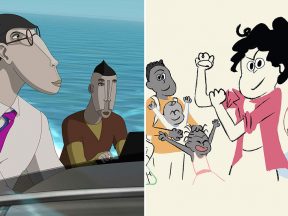
Passenger is a hand-drawn film that abstracts the nighttime driving experience into a playful, kinetic performance of color and shape. It’s a junior year film by the piquantly named Africanus Okokon. He attends Rhode Island School of Design, which was also the point of origin for Playing for Keeeps, the short that we debuted yesterday as part of our Student Animation Festival.

An Update on Sketchtravel

Here’s an animated piece by Maud Remy and Gérald Guerlais describing Sketchtravel, a sketchbook that has been sent around the globe and drawn in by over seventy artists, including Frederic Back, Quentin Blake, Juanjo Guarnido, Glen Keane, Hayao Miyazaki, and Carlos Nine. We first announced the project back in 2006. The book is finished now and will be auctioned off later this year. A reproduction of the book will also be published and it is available for pre-order on Amazon France. A new website, Sketchtravel.tv offers video interviews with the participating artists.

Ottawa Festival Emphasizes TV Creators This Year

Pen Ward, Aaron Augenblick and Thurop van Orman

I’ve attended my fair share of foreign animation festivals over the years, and have always bemoaned the lack of Los Angeles industry artists at these gatherings. In Annecy artists from throughout Europe’s animation industry show up, in Ottawa a sizable lot from the New York and Toronto industry attend, but artists from Los Angeles have been conspicuously absent at every animation festival I’ve ever attended. There might be a few stragglers, but undoubtedly they’ll be outnumbered by the LA-based development and creative execs, who pounce on any opportunity for a free “business” trip.

The apathy of LA industry artists is historical. During the legendary 1967 Montreal animation expo, which was one of the great all-time gatherings of animation talent, only one Disney animator who had worked on Dumbo and was still employed at the company, took the time to attend the screening of that film. It was, of course, the studio’s most creatively curious artist, Ward Kimball.

This all leads up to some positively encouraging news. Browsing through the schedule for the upcoming Ottawa International Animation Festival, I noticed that not only are Adventure Time and Flapjack being shown in competition screenings , the creators of both shows–Pen Ward (top photo, left) and Thurop Van Orman (r.)–will attend and participate in a discussion about their work. This interaction between Los Angeles animators and the much larger world of animation beyond the San Fernando Valley doesn’t happen nearly often enough. Considering how relatively inexpensive it is to attend one of these festivals versus the mind-expanding benefits of meeting like-minded artists and seeing innovative new animation, I’m surprised that more studios don’t encourage and finance these trips for their employees. It would certainly be a wiser investment than shipping a cartload of executives to each festival.

The appearance of Ward and Van Orman isn’t the only TV-centric event at Ottawa either. Aaron Augenblick (top photo, center) who runs Brooklyn-based Augenblick Studios (Superjail!, Wonder Showzen, Ugly Americans) will be presenting a retrospective of his work. The program isn’t exclusively TV-related, but Augenblick is best known nowadays for his studio’s consistently high quality TV output, which is no small accomplishment.

“With Thoughts” by Peter Lowey

Last May, we posted Peter Lowey‘s short Sidewalk Scribble, which was an entry in the Annecy animation festival’s YouTube contest. The film went on to win first prize in the Annecy contest, and Lowey’s rewards were trips to both Annecy and Los Angeles.

Lowey, who runs Piepants Animation in Melbourne, just wrapped a music video for Art vs. Science’s “With Thought.” In the video, he illustrates a challenging concept–human thought–which he portrays graphically as a billowy, mutating object that stems from individuals but also forms a collective consciousness. Like a cloud, the abstract form occasionally resolves itself into recognizable imagery before returning to its ethereal state. It’s an elegant piece of animated filmmaking that serves the music well.

CREDITS
Music by Art vs Science
Directed and animated by Peter Lowey at Piepants Animation
Compositing, TD, backgrounds and animation by Glenn Hatton
Backgrounds and inbetweening by Young Ha Kim