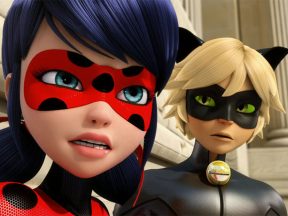
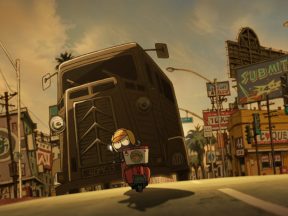
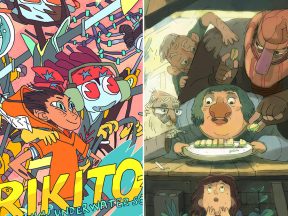
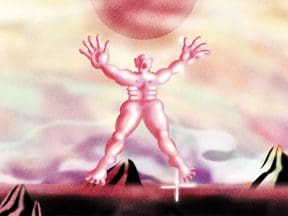
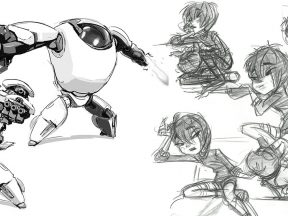
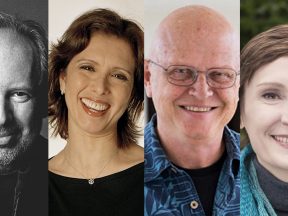
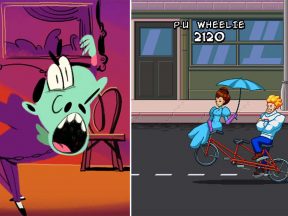
What advice would you give to a budding artist who’s considering entering the lucrative and glamorous animation industry? It’s tough telling someone where to start, but I’ve rarely seen better advice than this blog post by “Waveybrain”. The artist who wrote it has experience in both feature and TV animation, and his advice is grounded in hard-earned personal experience, which he generously shares in the post. With the school year kicking into gear, it’d be a good idea for students to read Waveybrain’s post as a reminder of what they need to learn if they want to end up with a job in the industry.
Author Archives: Amid Amidi
Syrian Cartoonist Ali Ferzat Savagely Beaten

This just might be every cartoonist’s worst nightmare: Syrian political cartoonist Ali Ferzat was kidnapped and later found bleeding on the side of a road with his hands broken. Unsurprisingly, the attack is being blamed on the security forces of Syrian dictator Bashar al-Assad. Ferzat, according to the Guardian, is “one of Syria’s most famous cultural figures,” and he has “long criticised the bureaucracy and corruption of the regime and since March has turned to depicting the uprising.” His work has also served as inspiration for animated projects in Syria.
A few weeks ago, the Syrian regime killed the singer Ibrahim al-Qashoush, the composer of a popular anti-regime song, and dumped his body in a river with his vocal chords ripped out of his throat. These desperate attempts to shut down the voices of the country’s most creative people is disheartening, but it also speaks to how much power artists wield throughout society and how much fear they can instill into governments. Even in the United States, cartoonists have been responsible for bringing down corrupt politicians with nothing but their pens. Ferzat’s story is something that every cartoonist and animator should remember the next time they make a drawing: cartoons have the power to create positive change, and there are cartoonists around the world risking their lives to do just that.
The Facebook page We Are all Ali Ferzat has been set up in his support. We applaud Ferzat’s bravery and wish him a speedy recovery.
According to a tweet, this is the last cartoon Ferzat drew before he was beaten and here’s a selection of more cartoons by him:
Animated Sheet Music by Dan Cohen
Dan Cohen takes existing sheet music and animates it to the songs. The concept bears out the cliche that the best ideas are often the simplest. Not only does animating music in this manner hold great potential as an educational tool, it also helps the listener–musically-inclined or otherwise–to appreciate the artistry of musicians. The best thing that Cohen does is to display each individual note as it is played, which really allows the listener to visualize the melodies and rhythms of a composition. It’s an especially striking effect for some of the songs, like Charlie Parker’s “Bloomdido.”
Oh, and because someone will inevitably mention High Note, yes, it’s true that Chuck Jones once made an animated short that used sheet music as a setting, and frankly it’s not nearly as interesting or entertaining as the musical visualizations that Dan Cohen has created.
(via Kottke)
“AANAATT” by Max Hattler
Max Hattler‘s “AANAATT”, a music video for Japanese artist Jemapur, is an abstract stop motion journey that disorients the viewer through novel placement of mirrors and windows. Hattler’s geometric universe functions using an internal logic of its own that isn’t immediately evident to the viewer, and thus creates a visual tension that is both mysterious and hypnotizing. The video dates back to 2008 but is appearing on-line for the first time. It ranks among the more unique examples of stop motion animation I’ve seen recently.
CREDITS
Director/Producer: Max Hattler
Animation: Max Hattler, Noriko Okaku
Assistant Animators: Philip Serfaty, Rodrigo Vives
Music: Jemapur
Commissioned by: W+K Tokyo Lab
Creative Director: +cruz
(via Motionographer)
“An Abstract Day” by Oerd van Cuijlenborg
An Abstract Day is a 2009 experimental short by Dutch animator Oerd van Cuijlenborg that has just been posted on-line. The film uses semi-abstract imagery to visualize the sounds in the daily life of a couple. (Note: Audio is NSFW so wear headphones.) The film is unique enough to stand on its own, but intentionally or not, it owes a debt to a UPA industrial film that John Hubley made called More Than Meets the Eye that represented sound in a similarly abstract manner.
CBeebies Interstitial by Matthias Hoegg
To be sure, there’s a cute voice track in this interstitial for British children’s channel CBeebies, but the piece as a whole is charming and delivers on all fronts, with sharp direction, design and animation (I love the run cycles of the brothers at the beginning). The piece, called “Sam,” was directed by Matthias Hoegg of Beakus, who also made a couple other shorts in the series earlier this year.
CREDITS
Directed, Designed by Matthias Hoegg
Animated by Amaël Isnard and Matthias Hoegg
3D Animation by Amaël Isnard
Additional Compositing by Leo Bridle
Produced by Beakus
A 60-Year-Old Article is More Relevant Than Ever

Ted Parmelee (pictured above, right) is perhaps best remembered today as the director of UPA’s The Tell-Tale Heart, but his career in animation stretched from Pinocchio through Rocky & Bullwinkle and included lots of fine work in TV commercials and industrial films inbetween.
While browsing through some files related to my book Cartoon Modern, I stumbled onto scans of an article that Parmelee had written in the mid-1950s. The piece, which I’ve reprinted below, smartly sums up many of the issues that progressive animation artists faced in the 1950s. For example, Parmelee argued that Disney’s heavy reliance on live-action was an artistic dead-end and countered every other development in art at the time:
All efforts were directed toward better drawing to produce a kind of reality from what had originally been a very simple and direct medium. They were so delighted to see it move, and pleased with a medium more plastic in the use of “time” that they became involved in trying to make it round, real and spacious as they could. This was exactly the same standard of “good” that made Aunt Matilda’s “real-genuine-oil painting” good. “The apples looked so sure-enough for real you coulda’ picked ‘em right out of the painting.” For this the artists to the Italian Renaissance for aid and borrowed the know-how of several centuries of draughtmanship. It was only natural and practical thinking. If you have a new gadget, don’t you take it out and try it on anything handy? Finally you have it doing the things it was designed for so well that it just gets monotonous, so you have it attempting things it never was built for.
There is a strong correlation between Parmelee’s critique of Disney in the 1930s and ’40s, and today’s art form — only the technique has changed. Contemporary big budget CG features exhibit increasing sophistication in lighting, textures, character animation and effects, but to what effect? Realism has again been cast as an end, when it is only a means for expressing a personal artistic vision.
Parmelee credits World War II as the impetus for animators experimenting with new filmmaking techniques, storytelling approaches and graphic styles. He also hails the arrival of the TV commercial, in which the form’s brevity allowed artists to explore different approaches for communicating with audiences.
Thankfully today’s animation medium is diverse enough that there is tons of experimentation happening, even moreso than in the 1950s. Parmelee, of course, anticipated this when he wrote that the single biggest improvement awaiting the industry “would be a decisive change in the actual physical means for making animated pictures, a more fluid kind of thing. . . a thing that provided quicker results.” Indeed, digital animation software and techniques have proven to be the savior, and offer an improvement over old production methods, especially when used by artists for the purpose of expressing themselves.
Read Parmelee’s article by clicking on the image below:
The Soviet Influence on Cuban Animation

This short video story on the BBC is ostensibly about the influence of Soviet animation on Cuban kids between the 1960s and ’90s, but it also offers an all-too-brief glimpse of the Cuban animation industry. Does anyone know if it’s filmed in a school or a studio?
(Thanks, Simon Acosta)
“Tattoo Step” by Mike Maryniuk
I’ve been a fan of Winnipeg-based Mike Maryniuk ever since I saw Cattle Call, a 2008 short he co-directed with Matthew Rankin. Mike recently posted another one of his films on-line, Tattoo Step, a high-energy experimental affair that celebrates the inherent beauty in temporary tattoos:
Made with nothing but thousands of temporary tattoos and a strip of 35mm leader. A tip of the hat to Stan Brakhage’s “Moth Light”.
“Lighthouse” by Stefan Wernik

Liberty Mutual has commissioned a handful of animated projects over the past few years as part of their long-term ad campaign The Responsibility Project. The shorts each contain thoughtful messages that explore the theme of “what it means to do the right thing.”
The latest animated piece is Lighthouse, a solid three-minute effort directed by Stephan Wernik. He tells Cartoon Brew a little bit about putting together the film:
I was the animation director as well as overseeing all aspects of production from the animatic to the compositing. A script as good as this only comes along once in a while. It was a very intimate story, but at the same time had huge crowd scenes and needed very careful handling animation wise to show the Lighthouse Keepers thought processes.
I shot a lot of reference videos and collated a library of footage of actors doing similar scenes for each shot. Funnily enough, I also studied reality TV shows like The Biggest Loser as they’re not actors and you can see real emotions. I really worked with the animators on striking the right tone for each shot. I’m really proud of what the team did in every aspect of the production. The production company was Exopolis in LA and the animation studio was ProMotion Studios in Australia.
DISCOVERIES: Childhood Sketches by Bob McIntosh
Bob Schuldt was going through his grandfather’s possessions when he discovered an envelope addressed to his grandfather from Robert J. McIntosh:
Inside it was FULL of tiny little pen drawings and a few pencil drawings of various characters and that look like they were doodles cut out and sent to a friend. The date is what amazed me, 1929. Upon removing the envelope I found hidden behind it a full color drawing with a note saying “Bout time I kept my promise, but I kept it! Happy New Year!” of two amazing characters on a piece of paper a little bigger then a postcard also signed Robert J McIntosh, 1929.
Click on the image above to see all the drawings. Bob McIntosh was, of course, a superbly skilled background painter who worked on Bambi and dozens of UPA theatrical shorts. One of Bob’s background paintings appears on the back cover of my book Cartoon Modern: Style and Design in 1950s Animation. According to the date on the envelope, Bob would have been thirteen years old at the time. It’s amazing that these childhood sketches have survived for over eighty years.
The lesson: always look through your grandparent’s belongings, and when you find something, email Cartoon Brew.
D23 Report: New Pixar Films and “Tangled Ever After”

The Disney-organized D23 Expo is going on this weekend in Anaheim and there’s been a couple of big Disney announcements. Firstly, the directors of Tangled, Nathan Greno and Byron Howard, are preparing a Disney Channel TV special for next year called, get ready for this, Tangled Ever After.
Pixar announced two new films of their own: Pete Docter (Monsters Inc., UP) is working on a 2014 film that takes place inside the human mind. An Osmosis Jones for the cerebral set? As long as I don’t have to hear Chris Rock for ninety minutes, I’m on board. Also, UP co-director and funny story man Bob Peterson is striking out on his own with a film. The 2013 pic takes place in a world where dinosaurs never died out, and (presumably) mingle with humans. Currently, the only place where that fantasy is possible is in Kentucky. I smell some marketing synergy!
(Tangled Ever After poster via /film)
Hong Kong Has a Charlie Brown Cafe

Signs of an advanced society: a restaurant devoted to a classic comic strip. This is the Charlie Brown Cafe in Hong Kong. More photos posted on this blog.
(via @magicjordanchan)
Kimballana

First, a research request, because if Cartoon Brew’s readers can’t help out with this one, I don’t know who can. I’m looking for two episodes of Walt Disney’s Wonderful World of Color that Ward Kimball was heavily involved with: “A Salute to Alaska” (1967) and “The Mickey Mouse Anniversary Show” (1968). If you have copies of these and can help out, please contact me HERE. (UPDATE: Got the Anniversary Show, only looking for the Alaska special now.)
Second, here’s a real Ward Kimball curio: a 1965 newspaper article about a panel discussion that he participated in at the Los Angeles County Museum of Art. CLICK HERE to read the article (and try to ignore the poor quality of the iPhone photo).
What’s so odd about Ward’s participation is that the topic of the debate was “Is Couture Design an Art Form?” It’s hard to imagine many other animators from that time who would have had the curiosity and interest to participate in such a discussion. The other panelists at the talk were equally respected in their fields: fashion designer Gustave Tassel, architect George Vernon Russell and silkscreen artist Sister Mary Corita. The debate over whether fashion design is art or not has long been settled (see the record-breaking success of the recent Alexander McQueen exhibit at the Met), but nevertheless, it’s fun to read their thoughts and gain some historical perspective on the issue.
Fuck Yeah John Lasseter

I think we can all agree that the drawings on Fuck Yeah John Lasseter are fan-f**cking-tastic! The humor is pretty insider-baseball, but if you’re a Pixar/Lasseter fan, you’ll get a kick out of this Tumblr.