Less people in the United States attended the movies last month than
any February since 1995. The only bright spot in Hollywood right now is animated films, which continue to perform well. Rango, the first animated feature from ILM, opened at number 1 this weekend with a FINAL $38.1 million. Gnomeo and Juliet dropped to fifth place in its fourth weekend, earning $7.2 million for a healthy total of $84 million.
The audience was fairly broad with females making up 54% and those over 25 also at 54%. [Paramount] reported that admissions were higher than those for the debut of its last March toon How To Train Your Dragon which enjoyed 3D surcharges helping it bow to $43.7M…Adiences were not as happy with the product as its CinemaScore grade was a discouraging C+.
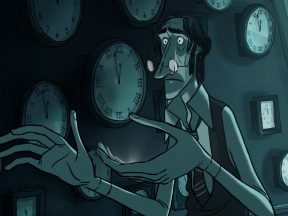
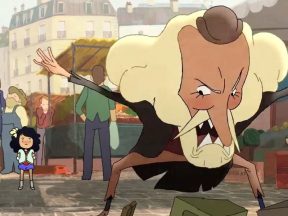
Sylvain Chomet’s The Illusionist captured $80,212 from 76 theaters boosting its total to $1.87 million. The film has failed to catch on with audiences like Chomet’s earlier film, The Triplets of Belleville which grossed $7 million in 2003.
Also of note, a collection of Oscar-nominated shorts released by Shorts International grossed $61,101 from 44 theaters raising its total to $1.2 million. I believe the total amount reflects two programs currently in theaters–animation and live-action. I don’t know of any collection of Oscar nominated shorts that has ever grossed this much money theatrically, and it exceeds Shorts Intl’s 2009 Oscar shorts edition ($644,635) and 2010 edition ($1,018,169).
Meanwhile, the worldwide total for Tangled now stands at $546 million and is still rising. It is Disney Feature Animation’s second highest grossing animated feature ever behind only The Lion King, and it has surpassed the worldwide grosses of other recent animated pics like Despicable Me, Wall-E, Cars, and How to Train Your Dragon.
On President’s Day (February 21), Titmouse asked its animators to spend the entire workday animating their own ideas. The only rule was that it had to be at least five seconds long. Both Titmouse studios (Los Angeles and New York) participated, and the results of this year’s 5 Second Day can be seen on the studio’s blog. I’ve posted a couple of my personal favorites in this post: above by Mike Roush and below by Phylicia Fuentes.
A Brew reader who preferred to remain anonymous e-mailed his thoughts about this week’s lawsuit filed against The Weinstein Company and Rainmaker Entertainment. This reader, who worked at Rainmaker Entertainment on the aborted feature, feels that the director Tony Leech, who is currently suing The Weinstein Company and Rainmaker, is partly responsible for the mess. I don’t think anybody truly knows who deserves the lion’s share of the blame, but as I hinted at earlier, it does appear that every party involved exhibited incompetence to some degree:
I was working on the Escape from Planet Earth production a few years back, while Tony Leech was on-board. Reading your latest article on the TWC [The Weinstein Company] lawsuit I had to write and provide some inside perspective.
While at Rainmaker, I read through at least 2 major rewrites and countless adjustments to the script and let me be crystal clear, Tony Leech produced some of the worst writing I had the displeasure of reading in my career.
You can’t really blame TWC, pushing for rewrites as I’m sure they were as frustrated with the underwhelming results. His inexperience as noted by TWC is a very accurate description. As a “director”, not seeing the big picture or having a vision, micro managing, and the occasional public meltdown made everyone feel like they had to walk on eggshells around Tony. You can imagine how counterproductive the situation was to improving the movie.
I recall talking to the head of the story development, a talented storyboard artist, who was frustrated for not being able to contribute a single meaningful idea to the script due to Tony’s inability to collaborate on any level. He left the project soon after.
In hindsight, perhaps the biggest TWC mistake was not negotiating Tony off the project earlier. Some major spending could have been avoided.
The stories go on and on and every day was a comedy of errors. I personally had enough after 6 months and left, I felt sorry for my friends, pouring their hearts into a production that was going nowhere. Hopefully this helps shed some light on the subject. Thanks for a great website, I visit CB often and every time it’s a treat:)
A promising first look at Tron: Uprising which will begin airing on Disney XD in summer 2012. A ten-part micro-series will precede it this fall. Charlie Bean (Ren & Stimpy, Samurai Jack, Robotboy, and of course, this short) is directing and exec producing, and the amazing Alberto Mielgo is also contributing to the project.
Yesterday, a $50 million-plus lawsuit was filed in the New York State Supreme Court against The Weinstein Company and Vancouver-based animation studio Rainmaker Entertainment. The plaintiffs, Tony Leech (co-director and co-writer of Hoodwinked!) and Brian Inerfeld, allege that they were removed from the production of their animated feature Escape from Planet Earth and that the Weinsteins, through gross incompetence, ruined the production of their film, which has yet to be finished. They also claim the Weinsteins gave them $500,000 in hush money until after the Oscars were over.
The Weinsteins, who have retained two powerful entertainment attorneys–David Boies and Bert Fields–to defend themselves, contend that it’s “a completely frivolous lawsuit” that “contains little more than false, gratuitous, slanderous, preposterous and totally irrelevant personal attacks.”
I don’t know which side is going to win the case, but every Brew reader is a winner because the plaintiffs created a hilariously detailed 60-page complaint that can be downloaded as PDF file. The torturous production process of a misguided animated feature hasn’t been this lovingly documented since The Sweatbox, the film by Sting’s wife about how Disney fumbled The Emperor’s New Groove. The punchline is that the Weinsteins have blown $19 million so far on an unproduced film with some of the most generic-looking computer animation this side of Everyone’s Hero:
The legal complaint reads like a comedy of errors–Harvey Weinstein fired his brother Bob from the film’s production; a sickly line producer was hired and died shortly thereafter; Kevin Bacon was paid $50,000 to voice a character and then paid $25,000 to not work on the film; Toy Story producer Ralph Guggenheim was hired and then fired by Harvey Weinstein for “ruining the fu*king movie.” Leech and Inerfeld also attack Rainmaker, a studio which they claim “did not have the expertise to make Escape, let alone the desire to do so within the confines of the movie’s budget.” All that may be well and true, but let’s not forget that Leech, who was directing the film in addition to writing it, is also a relative animation newbie. I’m sorry, but working on Hoodwinked! doesn’t make you John Lasseter nor does it instantly qualify you to direct a staff of hundreds, and one has to wonder how much his inexperience contributed to the film’s woes.
According to the documents, nobody could settle on a script, characters, voice actors, or even the animation studio that would make the film. That’s not a surprise for the Weinstein Company (formerly Miramax) which has a pathetic track record of distributing animated clunkers like The Thief and the Cobbler, Doogal, Freddie as F.R.O.7 and Tom and Jerry: The Movie. The lawsuit offers hints of their brilliantly poor understanding of the animation art form. One example is the “revelation” Harvey had about how pantomime acting could delineate a character’s personality–something every first-year animation student learns:
Harvey Weinstein responded by recounting something he had recently read in a book on Walt Disney, where the Seven Dwarves [sic] from Snow White are introduced to the audience for the first time. In that scene, Harvey Weinstein noted, the Dwarves put their noses on Snow White’s bed, and the manner in which they do reveals the character of each Dwarf: “And the amazing thing is, if you look at the script, it barely says anything.”
In addition to documenting a failed animation production, there is ridiculous gossip like the claim that Harvey Weinstein fell asleep during a screening of the story reels. And then, during that same meeting, he “attempted to consume an entire bowl of M&M candies despite being diabetic. When a [Weinstein company executive] sought to retrieve the bowl of candy out of obvious concerns for Harvey Weinstein’s health, he fought to keep it, and in the tumult the M&Ms scattered all over the floor. Then, instead of watching the reel, Harvey Weinstein got down on his hands and knees and began eating M&Ms off the floor.”
An anonymous artist who emailed us yesterday summed up his experience working on the film at Rainmaker when he wrote, “I had the rare pleasure of working on Escape for several years. The production itself was fodder for a movie. A true comedy of errors. Wish I had a cam rolling through it all.”
Matatoro takes on “the hermetic world of bullfighting and its public, here reinvented and reinterpreted.” The short was made at Supinfocom Arles last year by Mauro Carraro, Raphaël Calamote, and Jérémy Pasquet. The music was composed by Pierre Manchot.
The film is ambitious stylistically: its nonphotorealistic rendering style mimics ink and watercolor to good effect, and the stylized animation and layouts emphasize the theatrical nature of bullfighting. There’s never any doubt that the film was made in CG–the smooth perfection of the camera gives it away–but the filmmakers’ application of the watercolor technique allows for some of the most exciting color I’ve seen in any recent CG short.
The imagery in Matatoro is thoughtful and thoughtprovoking. The filmmakers draw visual metaphors between bullfighting and flamenco dancing, carousel rides, and the circus, but in the end, the film asks viewers to reconsider whether it resembles any of those other less violent pastimes.
Big news: ASIFA-Hollywood, the largest ASIFA chapter in the world, has chosen a new president and vice-president. Veteran artist and studio exec Frank Gladstone (above, left photo) will be taking over as president from Antran Manoogian who served in that role for over 20 years. The new vice-president is the world’s greatest Herman and Katnip expert (not to mention an editor of the site you’re reading right now) Jerry Beck. Congratulations to both Frank and Jerry!
The organization put out a press release today offering some clues about their new direction:
ASIFA-Hollywood has announced the selection of its new President, Frank Gladstone, at its February board meeting. Gladstone replaces Antran Manoogian who held the position for over 20 years.
Longtime ASIFA Hollywood vp [and TAG President Emeritus] Tom Sito chose not to run for re-election; taking his place is Jerry Beck. Also joining Gladstone as a new board officer is Jeff Wike as treasurer; Bill Turner returns as secretary.
“First and foremost, we owe Antran Manoogian an enormous amount of respect and admiration for his many years of selfless devotion to ASIFA-Hollywood,” says Gladstone. “Antran has seen the organization through a period of unparalleled growth and success, going from a small club to an organization of over 4000 members. During his stewardship, Antran established, among many achievements, a digital archive, and built the Annie Award into the most important honor in animation.”
Gladstone continued, “Though I’ve been part of ASIFA and the animation community for a long time, I am looking forward to being the ‘new face’ of the organization and to making some significant changes to the status quo. For starters, this includes updating our membership qualifications, establishing a representative voice for every animation studio and creative technique, building an advisory board of animation luminaries and revising the voting structure of the annual Annie Awards.”
In the next few weeks ASIFA-Hollywood will be holding meetings with executives from all the major studios to get their input on how we can improve our infrastructure. ASIFA-Hollywood will take this time to ask its members, both individual and corporate, to come together and advise them on how best to chart the course for decades to come. In addition they will invite many of its members to join the executive board.
Frank Gladstone has been a professional animator, producer, director, writer and teacher, first managing his own studio, and then working in management positions for Disney, Warner Bros. and DreamWorks, among others. He is currently the CEO of the animation consulting firm, Gladstone Film, teaches worldwide and is the ‘artist-in-residence’ for the ACME Network.
Xemoland by Los Angeles-based director Daniel Cardenas was among the selections at this year’s Sundance Film Festival. The short’s conventional cartoon style plays against the atypical autobiographical story of growing up in the early-Nineties which lends the film a unique tone.
Few people I know take the Oscars seriously as a barometer for what is state-of-the-art or innovative in animation, and looking at the long list of winners from years’ past, the awards have rarely reflected the development of animation as an art. Still, for one day every year, we pretend like the opinions of the Academy voters actually mean something to our community. That’s especially difficult during the years when the Academy’s choices have shown an even greater disconnect from animation than typical.
1. The Two Mouseketeers (1951) by Bill Hanna and Joe Barbera
Between 1943 and 1952, Bill Hanna and Joe Barbera won the Oscar for best animated short a remarkable seven times. Now you’re probably thinking, if the Academy deemed them worthy of recognition so many times, these guys must have been visionaries who were creating work that was truly different and interesting. And you’d be wrong. These guys made Tom and Jerry shorts, the most formulaic and workmanlike of any cartoon series produced during the Hollywood era of theatrical shorts.
Hanna and Barbera explored less and pushed fewer boundaries than any other directors during this period, and they were rewarded for playing it safe. In the year they won for Two Mousketeers–their innovation here was adding a second mouse–John Hubley created Rooty Toot Toot, which ranks among the most groundbreaking and beautiful pieces of animation ever produced within the Hollywood studio system. The Academy stopped tossing off Bill and Joe long enough to nominate Hubley’s masterwork, and then promptly awarded Hanna and Barbera their sixth Oscar. Continue reading →
A surprising number of cool visual ideas in this one-shot stop-motion short by Guy Verge Wallace. The floor that turns into a door around the :20 second mark and the neon firearms are my favorite parts.
And while we’re on the subject, a shout-out to the heroic and courageous people of Libya, who are not only fighting the good fight to topple a dictatorship, but are also using the time-honored tradition of caricature to humiliate their crackpot leader. Below are some of the best examples I’ve seen so far from Libya. If you have your own Qaddafi caricatures, share them in the comments.
UPDATE: Some fantastic contributions from Brew readers. Share yours in the comments.
Walt Peregoy is best known as the color stylist of 101 Dalmatians and headed the background department at Hanna-Barbera in the late-1960s. The Animation Guild‘s business rep and intrepid interviewer Steve Hulett spoke recently with the 85-year-old Peregoy and their conversation can be heard below. If you’ve ever heard Walt speak before, then you know what to expect, but if you haven’t, be forewarned that there’s a lot of swearing and everyone he talks about is either a son of a bitch, a buttboy, a white supremacist or a motherf**r. Unlike Charlie Sheen though, Walt’s rants are actually pretty entertaining.