About Amid Amidi

test

“Pombinha Branca” by Fernando Augusto Dias

As long as we’re exploring student CG from around the world, here is Pombinha Branca by Fernando Augusto Dias, produced while studying at Melies–School of Cinema and 3D Animation in São Paulo, Brazil. Undeniably bright and charming, it probably makes a stronger impact on Brazilians who are familiar with the nursery rhyme on which it’s based. In fact, it won the best Brazilian student film award at this year’s Anima Mundi festival.

CREDITS
Director and Animation: Fernando Augusto
Character Design: Fernando Augusto and Dalton Muniz
Musical Production: Fernando Augusto and Ítalo Lenker
Arrangements: Lua de Prata Group
Sound Designer: Herbert Perez de Lima

“Manfred” by Arjen Klaverstijn

A graduation project made by Arjen Klaverstijn at the Utrecht School of the Arts in The Netherlands. One of my most frequent bits of advice to students is to keep their films as short as possible. This is a good example: a cute, well-executed concept that shows a clear knowledge of art and design principles. It may not change the world, but it showed some personality and kept it entertaining for a minute and forty seconds. Mission accomplished. Some behind-the-scenes artwork posted on Klaverstijn’s website.

CREDITS
Director and animation: Arjen Klaverstijn
Additional artwork & consulting director: Lois van Baarle
Music composition & sound design: Thilo Schaller

R-Rated Danish Film Gets US Release 6 Years Later

Fear not, The Trouble with Terkel isn’t an ironic Studs Terkel biopic; it’s a raunchy R-rated animated comedy based on the stand-up routines of Danish comedian Anders Matthesen. (Actually, raunchy seems a bit too generous; immature is a better descriptor.) Indie distributor Indican Pictures is releasing the film in the United States on October 15, according to Box Office Mojo.

Notably, the film is rather old; it debuted in Denmark in 2004. Directors are Kresten Vestbjerg Andersen, Thorbjørn Christoffersen, and Stefan Fjeldmark. Perhaps the original Danish version was hilarious, but the American trailer looks irredeemable. The British dub is less abrasive and makes me want to at least give the film a chance. No details on how limited the film’s release will be, but I don’t anticipate it’ll be showing up in many theaters.

“Salesman Pete”

I posted the trailer to “Salesman Pete and the Amazing Stone from Outer Space!” last June. The entire film is now online. It’s directed by Anthony Vivien, Marc Bouyer, and Max Loubaresse, who dropped out of the French animation school Supinfocom to produce this film. The short is basically an extended chase scene, which is a common theme in many contemporary French student films, and unfortunately it lost my attention a quarter of the way through, but I do appreciate their aesthetic accomplishment. These guys approach computer animation with an illustrative sensibility, and in the service of engaging personality animation and storytelling, their style could be something amazing to watch. Learn more about their film at SalesmanBuck.com.

Missed Aches by Joanna Priestley

Portland-based Joanna Priestley‘s new short Missed Aches is destined to become popular in English classes across the world. A cheeky Symphony in Slang for the new century, it’s based on the poem “The The Impotence of Proofreading” by Taylor Mali, who wrote and narrated the film.

CREDITS
Sound Design by Normand Roger and Pierre Yves Drapeau
Music by Pierre Yves Drapeau with Denis Chartrand and Normand Roger
Text Animation by Brian Kinkley
Character design and animation by Don Flores
Storyboards by Dan Schaeffer
Directed, produced and animated by Joanna Priestley
Supported by The Regional Arts and Culture Council and the Caldera Institute

Taiwan’s Next Media Animation

I’ve never written a post fully expressing my appreciation for the Taiwanese animators at Next Media Animation who create news segments like the one above, but I’ve been fixated by their work since they made a splash last year with their reportage of Tiger Woods. Using the most basic CG models and animation style, they’ve developed a take no prisoners series of animated political cartoons with a sharp outsider’s point of view on American and global politics. Not every one of them is a homerun, but that is to be expected considering that they often produce two minutes of animation on a three-day turnaround to keep aligned with news cycles.

Looking beyond the simplistic, crudely rendered imagery (I like to call it honest CGI), there is plenty of creativity evident in their work. They pepper their films with visual metaphors and symbolism to make them understandable in any language, and they take storytelling liberties that are possible only in a graphic medium like animation. The work that NMA produces has been improving throughout this year, and they get my praise for being among the funniest and most creative computer animated projects currently in production.

UPDATE:: Brew reader Johnnn points out this article in the latest issue of Wired about Next Media Animation. Haven’t read it yet, but it appears to be quite in-depth.

SEPT 23: John Dilworth in NY

John Dilworth

John Dilworth (Courage the Cowardly Dog, The Dirdy Birdy) presents his work in Manhattan next week at the 92Y Tribeca (200 Hudson Street). The screening is on Thursday, September 23, at 8pm and tickets are $12 (purchase at the 92Y Tribeca website or at the door).

Dilworth events in the past have been anything-goes affairs with live music and special guests, and this one appears to be no different. The flyer for the event even promises a prize for a free head massage from the infamous French pornographic animator Pierre Delarue, whose only film to date has been The Return of Sergeant Pecker.

Who was Herbert Iwerks?

Ub Iwerks

The abundance of information on-line has a curious way of creating more mysteries than solving them. For example, everybody knows who Ub Iwerks is (ok, at least everybody who reads this site…hopefully), but who was Herbert Iwerks?

Harry McCracken found this 1932 patent application on Google Patents in which Ub identifies himself as Herbert “Ub” Iwerks. It’s a name that he’s not known for using which begs the question, why was he submitting a patent application under an alias? Animation historian David Gerstein made a guess on Harry’s blog, “His full name was–I always thought–Ubbe Eert Iwerks. But ‘Ubbe Eert’ seems to Anglicize to ‘Hubert,’ not ‘Herbert.’ Very peculiar… the signature certainly looks like his lettering style (and matches that seen on some early Disney title cards).”

Anybody else have any theories? And as a sidenote, if you find any more vintage patents by animation artists, please share them in the comments.

iPad Light Animation by BERG

Interface designers BERG used iPads to create an ingenious experiment that combines the device with photography and animation. After building CG models of a typeface, they rendered a sequence of cross sections of the letters–think David Daniels’ strata-cut animation technique adapted to CG. Now, the strata-cut technique wouldn’t typically work in CGI because the calculated precision of the computer disallows spontaneity, but BERG solved that by playing back the sequences on the iPad while dragging it through space to extrude the animation into physical space. Each frame of the film, which is subject to the effects of natural human movement, is a long photographic exposure of three to six seconds. There’s more information about its making on BERG’s blog and behind-the-scenes photos are posted on Flickr.

More than anything, this experiment by BERG is a fine example of environmental animation that breaks the confines of animation’s traditionally flat and square image frame. It points to a day that is not too far off when animation will play a vital role in the real world. Imagine being in an office lobby, and depending on where you’re standing in the lobby, you’d see a different kind of animation superimposed over the physical space to guide you around. Animation need not be restricted to a passive filmic experience, and interacting with animation in our everday lives is within reach as BERG has so cleverly hinted at in this piece.

(Thanks, Dave Follett)

“Umbra” by Malcolm Sutherland

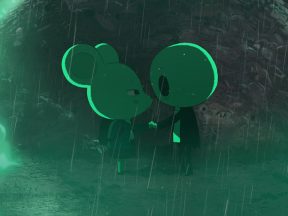
Montreal-based Malcolm Sutherland, who seemingly completes a new animated short every few minutes, debuted his latest–Umbra–last week. His creative range never fails to impress, and what is more remarkable is how fully conceived and realized each idea is. There’s something complex and introspective bubbling underneath the surface of Umbra, and it’s a film that I’ll be definitely revisiting over time.

Sutherland’s production notes: “The animation is all hand-drawn; a mix of drawing on paper and digital animation with a Wacom Cintiq tablet, assembled in After Effects 7 and edited in Sony Vegas 8. Music by Alison Melville and Ben Grossman, foley by Leon Lo, sound design/mix by Malcolm Sutherland.”

(Thanks, Kat Morris)

Dash Shaw’s New Animated Feature “The Ruined Cast”

Twenty seven-year-old indie comic artist Dash Shaw is worked on a hand-drawn animated feature called The Ruined Cast. The teaser trailer is posted above, and he’s keeping a production blog at RuinedCast.com. His project was among those selected for the Sundance Institute Directors and Screenwriters Lab, and is described as “a disconnected family thrown into chaos when the scientist father loses the test subject of his experiment with appearance-altering technology.” He discusses the project in an audio slideshow on the Sundance Institute website.

The film, which is being made in Brooklyn, is written and directed by Shaw. Other contributing artists include Jane Samborski, Frank Santoro, Lily Benson and Ray Sohn. The film is produced by John Cameron Mitchell (whose film Rabbit Hole just premiered at the Toronto Film Festival), Howard Gertler, and Biljana Labovic (who was Bill Plympton’s producer on his latest feature Idiots and Angels).

KLIK! Starts Tomorrow in Amsterdam

Raymond Scott

The animation festival KLIK! begins tomorrow in Amsterdam and continues through September 19. They presented their first edition in 2007, and they’ve evolved into a full-fledged animation festival with lots of quirky events to boot.

Among the highlights: the Dutch premiere of Deconstructing Dad, a documentary about composer Raymond Scott (pictured above), whose songs have been used in cartoons by everybody from Bob Clampett to John Kricfalusi. Scott’s son, Stan Warnow, who made the film, will be present, and afterwards composer Nik Phelps will lead a jam session “in the spirit of Raymond Scott.”

Another interesting event is the Ren and Stimpy tribute, in which Dutch animators and comic artists will present their favorite scenes from the show and talk about how it changed their lives. The event also includes a karaoke sing-a-long with the Log Song and Happy Happy Joy Joy. There’s also the Animator’s Cage, in which “you can see animators in their natural habitat, [and] watch how animators create an animated film right before your very eyes!” One more event that caught my eye is the Political Animation Competition in which recent politically-oriented animated shorts will be screened. Tickets for the entire festival are reasonably priced and available on the festival’s website KlikAmsterdam.nl.

“2 Bajillion A.D.” by David Ochs

How do you top your freshman student film when that film is the impressive Who’s Hungry? Now a sophomore at CalArts, David Ochs posted this clip from his latest project called 2 Bajillion A.D. According to the video description, it represents “what I have finished so far for my second year film at CalArts.” Ochs uses a decidedly different style from his earlier short–I sensed some Gorillaz influence in design and motion–but it is no less impressive with skillful filmmaking, characters that act naturally and believably, and well-observed, nuanced animation. Somebody pull this kid out of school and give him his own studio–he’s more than ready to take over the animation world!

(Thanks, Celia B.)

“Lisa and the Orange Juice” by Nicolas Fong

A commissioned film for Oxfam, Lisa and the Orange Juice shows how the organization helps local farmers in South America remain competitive against corporate factory farming. The film is in French, but the director Nicolas Fong communicates the message visually so that it is understandable to any viewer. The production design by the Belgian illustrator Cream is bright and appealing, and graphically reinforces the idea that local farming is better.