|
|
|||||||
|
|||||||
|
VIEW POSTS BY “eric”December 27, 2008 7:26 pm
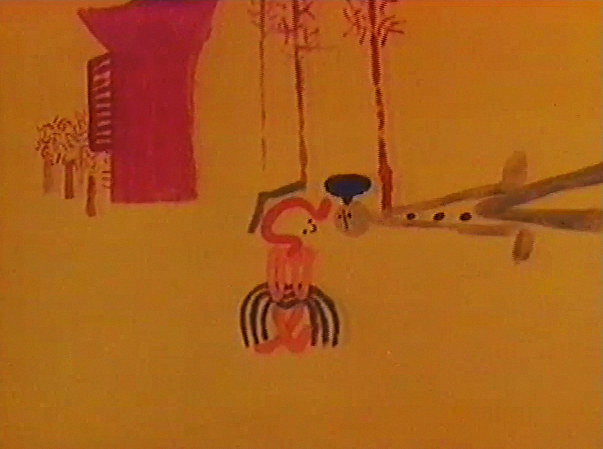
Remember when animation used to be lively? Full of verve? Even – dare I say it – playful? I’m back with another sterling example of the genius of John and Faith Hubley; this time it’s 1958’s The Tender Game, about the process of a young man and woman falling in love. There is a wealth of wonderful things to celebrate here, so let’s start with the music: Ella Fitzgerald sings the beautiful ballad, “Tenderly,” backed up and extended by The Oscar Peterson Trio. Um, wow. Bob Kurtz and I have been searching in vain for years for a clean recording of this track, which features these stellar talents at their jazzy prime. Apparently, this track was recorded during the same 1954 sessions Hubley had for his sadly uncompleted feature film, Finian’s Rainbow, where he not only had Ella and Oscar, but also Frank Sinatra, Louis Armstrong, Lionel Hampton, Nelson Riddle and his Orchestra, and a host of other jazz and big band legends. But that’s another story….. Then there’s the design. Abstract, offbeat, amorphous shapes, rendered in a style more far more painterly than cel paint, that somehow still manage to convey life, personality, and, especially, emotion. This is ably supported and abetted by fantastic character animation by the likes of Bobe Cannon, Emery Hawkins, Ed Smith and Jack Schnerk. (“Who?” I hear you cry.) Jack Schnerk was a veteran animator with a resume from both Hollywood and New York, and I had the pleasure of watching him work on Raggedy Ann and Andy in the mid-70’s. When I first saw this film, it was a 16mm print that Mike Sporn showed me from his private collection. As it unspooled, we got to the piece-de-resistance scene of the two lovers awkwardly sitting on the couch and eventually breaking down their defenses. It knocked me out then, and it still does now. Mike said, “Jack Schnerk animated that scene.” Milt Kahl it’s not. Charming, funny, honest, sensitive, and beautifully timed and observed it is. Cannon’s and Hawkins’ animation of the guy and girl trying to get each other to notice in the park is nothing short of breathtaking: funny, elegant, non-realistic, fluid, sensual, giddy, graphic, playful, expressive, and accessible – despite the abstraction, there is never a moment when we don’t know who is who or what they are feeling. The Hubleys were the absolute masters of this type of animation, and no one ever did more to marry the concepts of jazz, modern art, and the animation medium. This, and The Adventures of *, are my all-time favorite films of theirs. I could go on and on, and usually do. But action, of course, speaks louder than words so hit the screen below and see what I’m raving about in glorious sound, color and movement. October 10, 2008 4:54 pm
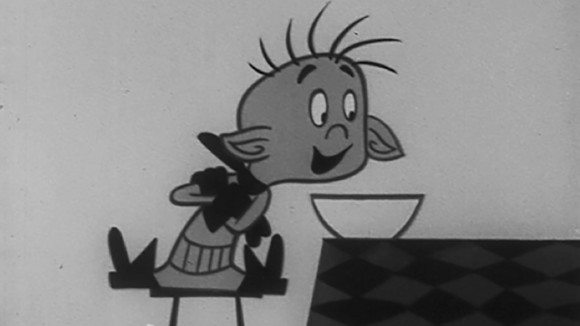
Editor’s Note: We’d like to welcome animation director Eric Goldberg in his first post as a regular Guest Brewer. One night as I was Googling around indifferently, I thought to myself, “Gosh! I haven’t seen those marvelous Hubley Marky Maypo spots in at least 30 years. I wonder if I can find them on the net…” (I always think to myself with three dots at the end…) About a second and a half later, my search yielded four of them, on a website linked to the company that still makes and sells Maypo after all these years. These spots made a huge impression on me when I first saw them on TV - I was four - and they still do to this day. I know Jerry posted these a couple of years ago, but they’re certainly worth revisiting - and if you’ve never seen them before, enjoy! Here is the original spot: I’d file them under the sub-heading of “The Pleasures of the Deceptively Simple.” Yes, they’re stylized. Yes, they’re graphic. They’re also masterpieces of communication and entertaining advertising, boasting many innovations and good old-fashioned traditional know-how. First, there’s the soundtrack: John and Faith Hubley recorded semi-improvised dialogue, charming mistakes and all, with their young son Mark, making the character sound like a real kid. Wow, what a concept! The Hubleys later used this technique in their many personal short films - with their offspring in films like Moonbird and Cockaboody, and almost as talented adults like Dudley Moore and Dizzy Gillespie in films like The Hole and The Hat. Then there’s the design and animation. UPA-style flattened (practically vertical) perspectives, graphic curlicues that somehow behave like oatmeal, and character animation - most of it by master animator Emery Hawkins - that has, despite the stylization, form, weight, timing, tons of appeal, and all the other stuff you would expect in a beautifully crafted traditional production. Here are links to three others: here, here and here. While the last spot doesn’t quite hold up for me, compared with the other three, they’re all marvelous, and, I think, worthy of some serious scrutiny. The Hubleys were masters at making the abstract appealing and accessible, and it’s great to see these ads again as the precursors and colleagues of their innovative Storyboard short films of the late 1950s and early ’60s, especially The Tender Game and The Adventures of *, decent prints of which I hope to upload in future posts. Thanks for playing.
|