(Thanks, Matthew Hunter)
Author Archives: Jerry Beck
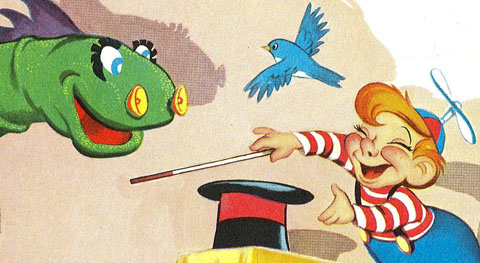
The Dolphin: Story of a Dreamer
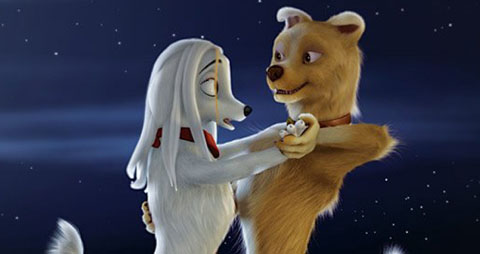
In case you were wondering, as I was, what the Oscar-qualifying feature film, The Dolphin, Story of a Dreamer, is: look no further:
UP has nothing to fear. 20th Century Fox is currently releasing the film in South America. UPDATE: Reader Eric Graf informs us that The Dolphin will play at the Laemmle Claremont 5 starting December 11 – same theater and week as A Town Called Panic, per the Laemmle Theatres website.
(Thanks, Matthew Gaastra)
Mark Bodnar exhibition

Artist Mark Bodnar has been having fun painting a new batch of his bizarre cartoon-inspired visions. His latest art show, “And We All Go”, will open on Friday November 6th at the La Luz de Jesus Gallery (4633 Hollywood Blvd.) in Los Feliz, and there is an opening reception Friday night from 8-11pm. The exhibit runs through November 29th – but you can see much of it online on the gallery website. Fun stuff!
Princess and the Frog for Geico
…because I always think of car insurance when I’m watching a Disney feature.
(Thanks, Jon Reeves)
Jerry on Internet Radio – again!

Once again, yours truly Jerry Beck will be a guest today on Stu’s Show on Shokus Internet Radio. This will be my eleventh or twelfth (I’ve lost count) visit to discuss all things animation with Stu and his listeners, live beginning at 4:00 p.m. PDT (7:00 p.m. EDT). Topics this time will include the upcoming Mighty Mouse DVD box set from CBS, forthcoming classic cartoon DVDs from Warner Bros. and your phone calls. As always, listeners will be encouraged to call in with their questions and comments on the station’s toll-free telephone number. Click here for more details. Oh, and if you miss the live broadcast today, the show is rerun in the same time slot during the next six days.
ASIFA to honor Tim Burton, Jeffrey Katzenberg and Bruce Timm

ASIFA-Hollywood has announced its Winsor McCay Award recipients for 2009: Tim Burton, Jeffrey Katzenberg and Bruce Timm. The award is given in recognition of career contributions to the art of animation.
Tim Burton, of course, has had a strong influence on the world of animation. Burton began his career as an animator (Tron, Fox And the Hound) at the Walt Disney Studios where he directed his first shorts, Vincent (in stop motion animation) and Frankenweenie (live action). He co-produced the CBS Family Dog series, and returned to Disney to make Nightmare Before Christmas (1993, directed by Henry Selick) and later co-produced the stop-mo feature James and The Giant Peach (1996). In the past decade, Burton co-directed the stop-motion Corpse Bride (2005) and created an internet animation series, The World of Stainboy (2000). Burton is currently developing Frankenweenie as a full length animated feature.
Bruce Timm forever changed the world of TV adventure cartoons with his visual take on DC Comics super heroes, beginning with his co-producing Batman: the Animated Series in 1992. Timm began his career in animation at Filmation, doing layouts on He-Man and Flash Gordon. He did storyboards for Ralph Bakshi (on Mighty Mouse: the New Adventures) and John Kricfalusi (Beany & Cecil). While working on Tiny Toon Adventures, he helped create a new take on Batman. The success of that series has led Timm to redesign the entire DC Comics universe in various Warner Bros. Animation series as Superman, Batman Beyond and Justice League Unlimited.
Jeffrey Katzenberg is the CEO of Dreamworks Animation. Katzenberg was responsible for reviving the fortunes of Walt Disney Feature Animation with his supervision of The Little Mermaid, Who Framed Roger Rabbit, Beauty and The Beast and The Lion King. Katzenberg left Disney in 1994 to team with Steven Spielberg and David Geffen to create Dreamworks SKG, where, as head of the animation studio, he oversaw the production of such hand drawn animated features as The Prince of Egypt, The Road to El Dorado and Spirit. Switching to CG production, the studio since produced a string of hits including Shrek (and its sequels), Madagascar (and its spin-offs) and Kung Fu Panda.
The awards will be presented at the 37th Annual Annie Awards scheduled for Saturday, February 6, 2010 at UCLA’s Royce Hall in Los Angeles, California.
Gene Deitch: Quo Vadis Animation?
Veteran animation director Gene Deitch and his wife Zdenka were invited to the Xiamen International Animation Festival (Oct. 30th-Nov. 3rd) in China — Gene as the main foreign guest and keynote speaker, and Zdenka as a jury member. However, Communist government authorities took one look at their passports, and made the irrational assumption that because they were both in their eighties, they were unfit to travel, and decided not to issue them visas.
The festival organizers wrote that they were bereft and begged Gene to at least film his keynote speech for projection at the opening ceremonies. So a crew came to Deitch’s private studio, and he “performed” a five-minute version of his talk. And Gene has graciously allowed Cartoon Brew to share it with the world. Says Deitch:
“The core of my speech is a pitch for the survival and eventual return to primary favor of “drawn animation.” (Don’t provoke me by mentioning the term “2D” in my presence!)
Below is the 7-minute video Gene prepared for the festival, AND below that is the full text of the actual speech he would have given.
Gene Deitch: Quo Vadis Animation? Animation has come a long way since I was a boy. I was raised in Hollywood and fell in love with movie cartoons at a very early age. In those days – the early 1930s – going to the movies was a giant experience. For one admission ticket -25 to 35 cents for an adult – just ten cents for me – we could see two complete feature films, which in those days were not more than an hour-and-a-half long, a newsreel, a travelogue, an adventure serial, perhaps a comedy “Short Subject,” and a cartoon – sometimes two cartoons.
For me, the cartoon was the best part, but for the movie theater owners it was just another time filler that limited the number of shows he could schedule per day. To earn their place on the program the cartoons had to be wildly funny, and they quickly became formula productions. In Europe they were called “grotesques,” and there was no attempt to imitate reality.
The arrival of television changed all that. With nightly news for the growing mass TV audience, there was no further need for newsreels. Then came all sorts of soap operas, dramas, documentaries, comedy shows, travel features, sports, and of course cartoons galore. Why go to the movies when you had all that at home?
And why should theater owners pay for short subjects when all the people wanted to see was the feature? So soon enough, all we got for the higher price we paid for a movie ticket was one feature film, some advertising and lots of previews of more movies.
It was the visionary Walt Disney, who all the way back to the 1930s saw that cartoon shorts were doomed. He had the impossible dream of making the cartoon become the main feature attraction. To do that he believed that he had to somehow make drawn animation look more realistic. As a 13-year-old kid, I attended the premiere run of Snow White & The Seven Dwarfs at the Hollywood Pantages Theater, I witnessed the first example of a historic change-of-course for film animation. Disney felt that cartoon simplicity could not sustain a feature-length movie. So Snow White contained the dramatic lighting effects, the shadowing, the rounded shading of characters, and the amazing MultiPlane camera depth effects – the first steps toward making animated movies become more and more realistic.
Once began, this became the dominating goal of animation: to become as close to a live action movie as possible. By today, with the development of computers and amazing digital procedures, computer generated animation, motion capture, and stereoscopic 3D. We’re almost there; the perfect imitation of reality with animation. Is this a success? Or is it the end of a blind alley? What next?
As it happened, I began my career in animation at a studio that pioneered the opposite course. “Why should animation, potentially the greatest of all existing art forms, incorporating and blending all of them, limit itself by trying to imitate what a camera does? It was UPA, United Productions of America.
A glorious name for a tiny studio founded on a simple but revolutionary idea: that the whole world of graphic art was open to animation – animation bringing magic and storytelling in every visual style, with no attempt to imitate what the camera will always do better.
I am here to raise a cheer for what I prefer to call Drawn Animation. We who have been raised on the tradition of animated drawings, attempting create what Frank Thomas and Ollie Johnston called, “The Illusion of Life,” have been more and more pushed aside and given the demeaning title of “2D” animators. I am quick to remind you that anything projected onto a flat movie screen is essentially 2D. It’s a meaningless term. I repeat that the entire world of graphic art, every drawn or painted style can be animated in any fanciful way, which in turn would lead to the widest range of storytelling and endless visual variety.
Whereas so-called 3D animation, with its amazing refinement, technical dazzle, and natural-looking realism, is becoming more and more alike. Drawing and painting goes back to the beginnings of humanity, and is still a limitless means of expression. It certainly should not be pushed aside in the world of cinema animation!
Of course, I know that there is another branch of animation; Special Effects for essentially live-action movies. That kind of animation – recreation of dinosaurs or entire cities being blown up, and stunt performers saved from injury with the substitution of animated dummies….is hyper reality that I greatly admire and respect. It MUST be extremely realistic and visually convincing! Amazing special effects animation is now so seamlessly blended into live action movies, that we accept it as real. Such movies do not claim or pretend to be animation features.
As a 48 year member of the Hollywood Academy of Motion Picture Arts & Sciences, I am one of the people who vote each year for the awards known as Oscars. In my own category of Animation, it becomes harder and harder to distinguish whether a film is in fact basically an animation or live-action movie. Today, every film contains at least some elements of both. Historically and technically, cinema animation involves the creating and manipulating still images that when projected onto the screen in very rapid sequence – faster than the human retention of vision – gives the illusion of motion. So human acting in front of a camera is by that definition not animation. Yet the technology of digital motion capture can be used to convert human acting – pantomime – into designed creatures, which does look very much like animation. So to many people – most people in a cinema audience, if it looks like animation it must be animation!
I’ve given up trying to argue the point, but still have difficulty in voting for a movie in the Animation category which I know to be actually a digitalized manipulation of human acting. and not the illusion of motion created in series of still images. So what? It must soon come down to eliminating a separate Animation category, and allow us to vote for any movie on the basis of the story it tells and how skillfully and artfully it tells it, regardless of the mix of technologies used in its production.
It is in fact getting harder and harder to find a clear definition of what is an animated film, and what is a live action. film! What was The Lord of The Rings, which so deftly combined animation into an essentially live action film? What are the Harry Potter films, including so many animation effects? And now we have the technology called “Motion Capture.” Which does claim to be form of animation. How do we classify Motion Capture -”Mo-Cap?” Many movies today combine all of these elements. How do we classify them? Today, nearly every film is a combination of live-action, special effects and some form of animation. When we see drawings, we’re pretty sure we are seeing animation!
There must be room for the art of drawing and painting to hold onto it’s role in storytelling and the stimulation of imagination. Graphic art and design has a great influence on all of our lives, and we really cannot live a full life without it!
In my on-line book, How To Succeed in Animation I make the claim that animation is potentially the greatest of all art forms, as it combines nearly all of the others. Drawing, painting, music, story telling, literature, acting, theater, singing, dancing.. you name it; all can be incorporated into this miraculous art form do cinema animation! The word animation itself means, “The breath of life.” Why should this potentially powerful medium be limited to literal realism, when the endless possibilities of magic realism are open to it?
I feel this is an important topic for discussion, and I would like to hear your thoughts about it. I welcome your questions and ideas.
Boogie
Boy, this looks strange. An upcoming hand-drawn feature from Argentina’s Illusion Studios that advertises itself as “sexist, violent and sadistic” and if you check the gallery on its website, you’ll also find it’s racist.
Looney Tunes News

Here’s some GOOD Cartoon Network news for a change. The classic Looney Tunes will be returning to Cartoon Network next Sunday. They are already running promos for a six-hour marathon on Sunday, 11/15. Then starting the next day, CN is showing an hour of Looney Tunes each weekday from 11am-noon (Eastern). It’s been nearly seven years since they had a regular TV time slot – and all it took was a disastrous experiment with a live action block to get them back.
Meanwhile, a new Looney Tunes series in production at Warner Bros. has shut down, according to the Animation Guild blog. After four months in production – with a great crew at the helm (that’s a Jim Smith gag drawing, above) – the show, tentatively titled Looney Tunes Laff Riot, will undergo a redesign. Apparently, the first completed episode was screened for higher ups who didn’t like the UPA-esque revamp. The show is expected to resume production in a few months – with new model sheets.
Production continues, however, on a series of 3 minute CGI, 3-D theatrical Looney Tunes shorts – the first one featuring the Road Runner.
If any Warner Bros. artists or Cartoon Network insiders want to write in to clarify or correct any part of this post, we welcome your comments below.
(Thanks, Jon Cooke)
Ragtime and Rubber Hose

Flip the Frog, Oswald Rabbit, Koko the Clown and Toby the Pup will return to the screen Tuesday night, at the Billy Wilder Theatre in the Hammer Museum in Westwood, CA. Ragtime pianist Reginald Robinson will play in concert with a screening of 1920s and 30s animated cartoons from the UCLA Film Archive. Films will include Koko’s Earth Control, Homeless Homer, Swing You Sinners and Room Runners in 35mm. The program is being presented in conjunction with an exhibition of original art from R. Crumb’s Book of Genesis. The screening is FREE (parking is $3.). For more information visit the Hammer Museum website.
Flipos
Sometimes I think the most creative place in TV animation is in pre-school programming. Here’s a preview of Flipos from the Chile-based PunkRobot studio. Animation director Antonia Herrera says the project is “a labor of love, made with little money and a small, talented team”. A production blog features concept art and storyboards, and the trailer is candy-cane sweet:
THIS WEEKEND: Animation Seminars at the Egyptian

Sorry for the late notice, but if you are in L.A. this weekend you might check out the animation panels going on at the Egyptian Theatre in Hollywood:
On Saturday 11/7
1:15 PM – 2:15 PM: A Crash Course on Character Animation with Eric Goldberg.
2:30 PM – 3:30 PM: Commercial Television Spots: Shortest Shorts with Bob Kurtz.
3:45 PM – 4:45 PM: The Incestuous History of Technology & Animation with Bill Kroyer.
5:00 PM – 6:00 PM: The Importance of Story in Animated Shorts with Jim Capobianco.
On Sunday 11/8
1:15 PM – 2:15 PM: The Making of Pixar’s Partly Cloudy with Peter Sohn.
2:30 PM – 3:30 PM: Short History of Animated Shorts with Tom Sito.
3:45 PM – 5:00 PM: How MTV Rocked the Animation World with Yvette Kaplan and John Andrews.
For ticket prices and more information, visit the American Cinematheque website.
Love
The soundtrack of Fantastic Mr. Fox, like all Wes Anderson films, is loaded with great music that punctuate the situations. Anyone who combines Burl Ives, The Beach Boys, The Rolling Stones and the Wellingtons’ classic Ballad of Davy Crockett in one film is okay in my book.
Anderson also pays homage to Disney’s foxy Robin Hood (1973) by using its Oscar nominated song, Love. Huston Huddleston edited this video (embed above) using a discarded, unreleased recording which his late father, Floyd Huddleston, co-wrote (with George Bruns) and his mother, Nancy Adams, sang. Huston says:
Huston has also uploaded a rare alternate country version of Phony King Of England written by Johnny Mercer, with additional lyrics by Floyd Huddleston for this version, and sung by Phil Harris, Andy Divine and the Do Gooders.
Live Action/CG Yogi Bear sounds like a boo-boo

According to today’s trades, Dan Aykroyd has been cast as the voice of Yogi Bear in Warner Bros. new CGI hybrid flick, Yogi Bear, and Justin Timberlake could be vocalizing his longtime companion, Boo-Boo. Eric Brevig, a veteran visual effects supervisor, will be directing the film.
Anna Faris (late of Cloudy with a Chance of Meatballs) will appear in the film, playing a nature documentarian who meets up with Yogi in Jellystone Park. The film is scheduled for release next year, in December 2010.
A Town Called Panic
Sixteen animated films are needed to enter and qualify in order for five animated features to be nominated for a Best Animated Feature Academy Award. This might be the film that tips the scale in favor of five nominees.
Zeitgeist Films is opening this French-Belgian co-production in New York next month and in Los Angeles in January. However, the distributor had not scheduled the required L.A. qualifying run, so filmmakers Stephane Aubier and Vincent Patar took matters into their own hands, filled out the Oscar submission forms and booked the film into L.A.’s Claremont 5 to play there between December 11th and December 17th.
The Film Forum in New York will play the film December 16th-29th. The Nuart in West L.A. will open the film on January 22nd. Check out the original TV episodes on Hulu.com.
Pssst! Be the first in LA to see A Town Called Panic this Saturday Nov 7 at 11am, as part of the AFI FEST at Laemmle’s Santa Monica 4.