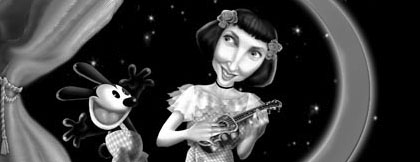
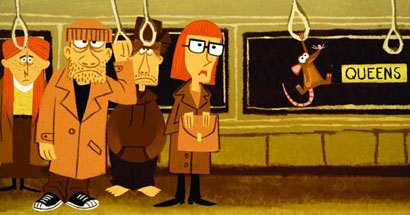
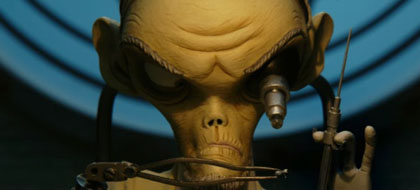
A Neil Gaiman story, designed by Gahan Wilson, directed by Steven-Charles Jaffe.
(Thanks, Mac Cauley)
A Neil Gaiman story, designed by Gahan Wilson, directed by Steven-Charles Jaffe.
(Thanks, Mac Cauley)


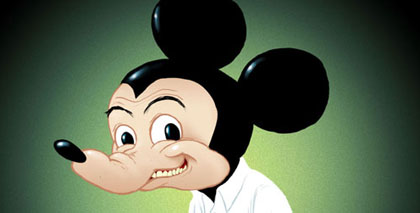
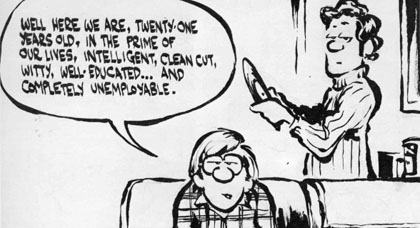
The comic strip pages have been having their way with Disney characters lately. Here are two from today’s paper: Speed Bump by Dave Coverly and Argyle Sweater by Scott Hilburn. Click on thumbnails above for larger images.
(Thanks, Kurtis Findlay)
.
Jossie Malis, an animator and illustrator living in Barcelona, has been developing an animated series online for the last 3 years called Bendito Machine. Each film pits primitive people against alien creatures and intergalactic robots, done in an Aztec designed cut-out silouette style. I like them a lot – I especially dig the soundtrack on the latest one (above).
One way Malis is producing these shorts is by selling art prints. Says Malis:
I’m working on this project without any funds or financial aid, only in my spare time. It takes a lot to compete each episode because I’m always working on other commissioned projects during most of the year. In this last installment, I have a new collaboration with Sxip Shirey, a great and fantastic musician and composer from NY.At the same time, we just started another site called Printastic.org. It’s a platform for illustrators around the world, where you can buy great quality giclée prints of his works; half of the income goes to each artist, and the rest of the money goes into Bendito Machine. We do this because we love prints and have many many friends around the world doing amazing stuff like the ones at the gallery, but also, because we want to find a way to keep doing more episodes of Bendito Machine at the same time.
You can catch up with the first two episodes at benditomachine.com.

Next Saturday, April 18th, Cal Arts is presenting a Jules Engel Centennial Celebration in downtown L.A., at the RedCat theatre. The 5pm program, “The Influence of Jules Engel on Contemporary Animation”, will include a roundtable discussion with distinguished Cal Arts Alumni including Jorge Gutierrez, Steve Hillenburg, Mark Kirkland, Mark Osborne, Joanna Priestly and Henry Selick.
That will be followed by a cocktail reception and exhibition of fine art by Jules Engel at 7pm. Ticket prices are a bit steep, but the event is a fundraiser to support The Jules Engel Endowed Scholarship Fund. For more information check the Cal Arts Website.
Here’s something we don’t post much on Cartoon Brew – medical animation:
Minnesota based Ghost Medical has been producing medical animation for 15 years. Art Director/Animator Joel Erkkinen writes:
We wanted to make something that pushed the limits of medical animation. This short was created from the ground up to showcase the talents of ghOst Productions at the 2009 American Association of Orthopedic Surgeons in Las Vegas. Instead of showing pre-existing client work in our reel, we thought it would be more fun to make a character animation, break nearly every bone in his body and then surgically repair him in under 3 minutes.
Heal was the result. While it may not win awards at Annecy or Ottawa, it’s a clever way to present a demo reel for specialized work.

Next Friday you can meet me at the Museum of Comic and Cartoon Art in New York City where I will speaking about the origins of Harvey Comics and its connection to Famous Studios. I’ll screen some cartoon clips and sign books – in particular the latest volume of Harvey Comics Classics: The Harvey Girls. The fun starts at 6:30pm. MoCCA is located at 594 Broadway, in Suite 401. More info online at the museum website. Come by and say hello.

It was announced several months ago that Warner Bros. is developing a live action feature based on Hanna Barbera’s Jonny Quest, with Zac Efron as Jonny and Dwayne Johnson as Race Bannon. LA Times blogger Geoff Boucher reported this week that, possibly due to the failure of last years Speed Racer movie, Warners is now thinking of making the JQ film, but droppping the JQ name.
Apparently the live action JQ script is so good that the studio wants to produce the film regardless of what the characters are called. But the failure of Speed Racer – another live action version of a 1960s cartoon series – still resonates with upper management. So the thinking is to just cut ties to the H-B series that inspired it. Personally, I think this is a good idea.
Dear Warner Bros.,
Please don’t make a live action Jonny Quest movie. After Scooby Doo, The Flintstones and Josie and the Pussycats we don’t need anymore of our childhood memories destroyed by bad movies adaptations. If the Jonny Quest script is as good as reported, it’ll be popular under any title.Now, is there anyway to make you reconsider your live action plans for The Jetsons and Yogi Bear?

I couldn’t let the day pass without noting the announcement of The Simpsons U.S. postage stamps.
I believe the rule is that something (a celebrity, an event, a landmark) must be 20 years old in order to rate the honor of being commemorated on a U.S. postage stamp – and The Simpsons have rightly earned this tribute. It’s kind of cool they are using Matt Groening designs over the more standardized “model sheet” look. Over at the Postal Service website you can vote for your favorite stamp or you can pre-order the set.
There will be First-Day-of-Issue Dedication Ceremony at 20th Century-Fox Studios in Los Angeles at 11:15 a.m. PT on Thursday, May 7. Matt Groening, producer James L. Brooks and several of the actors are scheduled to attend. A limited number of seats are available to the public on a first-call, first-reserved basis. Those interested in attending should call 1-866-268-3243 beginning Friday, April 10th between noon and 5 p.m. ET. For more info click here.

Ger Apeldoorn has uncovered a real find. A set of obscure comic strips, created for a local California newspaper in 1950 (The Redwood Journal-Press-Dispatch in Ukiah), that were written and drawn by Hollywood animators! Art by Gil Turner, Ray Patin, Gus Jekel, Dick Moores, Jerry Hathcock, Tom Ray, James Will, Dave Mitchell, Jack King, Jack Bradbury and (maybe) Cal Dalton has been identified. Ger is looking to find more information on this batch of mysterious strips. Check it out here.

I love 3D movies.
Thanks to a pair of 3-D film festivals held in L.A. several years ago, I’ve been lucky enough to see perhaps 95% of all 3-D films ever made. On top of that, I think the use of 3-D in recent motion pictures (Coraline for example) is perhaps the best application of the format in film history. Digital technology has -at last- perfected the technique. I’m not crazy about having to wear the extra set of glasses… nevertheless, it’s a wonderful way to experience a movie.
But it ain’t gonna last.
The current preponderance of 3-D films that Hollywood is perpetuating is simply a business trend. The medium is not being revolutionized. It is not the second coming of The Jazz Singer.
A front page article in Monday’s L.A. Times (“Taking Filmmaking To Another Dimension” 04/06/09) repeated all the hype, reported all the grosses and played up all the coming attractions that have been reported everywhere – from Variety to The Wall Street Journal – in recent weeks. It’s almost overkill. Yeah, yeah, we know… Katzenberg, Lasseter, Cameron, Zemeckis, everyone in Hollywood is on board. And they’ve declared Monsters Vs. Aliens as the watershed picture. Its opening grosses, in 3D venues, justify a sea change in production, distribution and exhibition.
But it’s all B.S.
First off, all this nonsense about how all the “old” 3D movies used red/blue anaglyph is a lie. Yes, prior to 1952 there were a few releases (like Pete Smith’s MGM “Metroscopiks” shorts) that used the technique (and don’t miss Albert Brooks’ hilarious faux anaglyph trailer for Real Life (1979) which perpetuates the myth), but all features made since the 50s use essentially the same polaroid system used today. The big difference, thanks to digital projection, is today’s 3D movies are easier to show and have perfect registration between the two images projected.
Next, the current hype about the studios’ expectations of 3-D is a 55-year old rerun. As Leonard Maltin said in this Wall Street Journal article, it’s “an absolute replica of the pronouncements and interviews that came out in 1953.” This time, however, the pronouncements are bigger and louder. Director Patrick Lussier (of the recent 3-D slasher flick, My Bloody Valentine) is quoted in the L.A. Times piece saying, “You could do My Dinner With Andre in 3-D and it would be incredibly compelling.” Maybe so, but it would be because of the script and acting, not the “immersive 3D experience”. Lussier also claims that the 3-D format is “more than a fad.”
Sorry… it’s a fad. A fad concocted and controlled by the major studios. The question is “why”? Here’s the answer: the studios are promoting 3-D films right now in an effort to convince the theaters to convert to digital projection. Once all theatres go digital, there will be no need for the studios to create expensive 35mm prints, they’ll be no more costs for reels and cans; the cost of transporting 100 pound film canisters coast to coast, the cost of storing prints in film depots and later, the cost of destroying worn prints will be eliminated. The savings to the studios will be enormous.
The theaters have resisted the move to digital because it costs tens of thousands of dollars to replace the 35mm projectors and install the new equipment. Theaters contend there’s nothing wrong with 35mm film; that audiences can’t tell the difference, so why bother to convert. Thus the studios are gung-ho for 3-D in an effort to provide something that digital can do more effectively than traditional film equipment.
There are other reasons as well: Digital distribution will cut down (or hopefully eliminate) film piracy; and 3-D films can attract people to theatres to experience a visual show they cannot (as of yet) get on cable TV, blu-ray discs or over the internet.
BUT as soon as all theaters (or a majority of them) eliminate film and go completely digital, I predict the current 3-D fad will end.
The recent 3-D propaganda, aimed at the general public and national movie chains, is really a push for digital conversion sooner rather than later. This is all well and good, but it has nothing to do with storytelling or good filmmaking.
The 3-D gimmick didn’t last in the 1950s, nor the 80s. It wasn’t because the process was more primitive – it wasn’t. Animated films (or any films) today are going to be successful in 2D or 3D, hand drawn or CGI, due to one thing: story – not special effects or 3-D. Cinemas will all go digital eventually. 3-D itself is pretty cool. It just bothers me how it’s being sold to public. Wearing glasses to the movies is not the future.
Three months ago we mourned the end of the Warner Bros. animation mural at the intersection of Barham, Pass and Olive in Burbank. Tonight, Warners threw a party on the studio backlot to unveil the new cartoon billboard to replace it. Here it is. DC super heroes now take center stage, flying over the Hall of Justice (a nod to Hanna Barbera’s Super Friends), with Bugs, Daffy, Tweety and Sylvester lurking around the edges. Though I wish the Looney Tunes got a little more space, I’m grateful Scooby Doo has been downsized. One unique feature of the mural is that a group of super villains appear along the bottom – but are only visible at night.
Peter Girardi designed the mural, Tommy Tejeda drew the superheroes with input from Bruce Timm, James Tucker and Glen Murakami. Other celebrities at the event included Julie Newmar (Catwoman) and Diedrich Bader (the current voice of Batman).

This Friday, the University of Southern California is presenting a free evening of animation-based installations and performances. The location is the brand new Spielberg-Lucas School of Cinematic Arts building where animation installations will fill the theatres, lobbies, and courtyards.
Featured artists include Professor Christine Panushka and Associate Professor Sheila Sofian, along with work by current Hench-DADA graduate students, and guest animation performance & installations by Miwa Matreyek, Jim Ovelmen and Alberto ‘Beto’ Araiza.
The event is on Friday, April 10, 2009 from 7 P.M. to 10 P.M. in the School of Cinematic Arts Complex. Admission is FREE. No reservations necessary.For more information check the USC website.
Here’s a treat. Music historian and record archivist Mike Kieffer sent me a copy of his latest find. It’s the first authorized recording made of Minnie’s Yoo Hoo in 1930 which, Mike says, “…was not released until about January 1931. However, this still predates the next earliest Mickey Mouse song, which is by the Varsity Eight from late 1931. It’s also the only instance I can recall of a piece composed by Carl Stalling issued on a commercial record, other than perhaps children’s records from the 1940s and beyond. I think the vocalist is the bandleader himself, Leo Zollo, but I’m not sure about that. The personnel is apparently unknown, as is the exact recording date, but it’s sometime in May-June of 1930.” Click on the label at left to see it larger, and you can listen to the delightful track here:
Mickey Mouse historian David Gerstein has also uncovered the earliest Mickey Mouse-based sheet music he’s aware of. Says David, “It was published in both England and Germany in 1930. The recording of it that I’ve attached (below) is one that I acquired on a bootleg CD years ago; there, it was credited to musician Leonard Henry and dated 1930 as well. Any British Brew readers who’d like to help me identify label and confirm the 1930 recording date are more than welcome.”
(Thanks to Mike Kieffer and David Gerstein)
Steve Stanchfield has done it again. An animator, educator, cartoon historian and film preservationist, Stanchfield has spent the last few years curating several first-class DVD compilations devoted to the long-forgotten New York-based Van Beuren Studios. His previous efforts include sets devoted to their Aesop’s Fables, Little King and Cubby Bear series. His latest DVD is his best yet: Van Beuren’s Toddle Tales and Rainbow Parade Cartoons. This collection features the best from Van Bueren’s latter years, 1934-1935, when Burt Gillett, Tom Palmer and Ted Eshbaugh were brought in to revitalize the cartoon shorts. They came up with Toddle Tales, which combined live action-and-animation with sometimes disturbing results, and the Rainbow Parade cartoons, which used a limited two-color palette in the most garish ways imaginable. Highlights of the set include the best versions of these cartoons I’ve ever seen (many with long lost original titles). The Sunshine Makers, in particular, never looked so good – it’s worth the price of the set alone. There are rare model sheets, home movie boxes, deleted scenes and more in the Bonus section. Stanchfield puts a lot of TLC into these DVD collections – and it shows. I recommend this highly to anyone, especially those who love 1930s-style animation.

Last week Amid posted several Disney industrial films and got quite a nice reaction, so I thought I’d try posting another one – this one not from Disney. Sometimes we dwell too much on the commercial and entertainment films produced by Hollywood and New York’s animation industry, but it was industrial and educational films like these that were the backbone of the business in the 1940s, 50s and 60s.
Rodney (posted below) is typical of the kind of bread and butter product produced by small studios that kept animators alive between larger assignments. Lee Blair’s New York studio, Film Graphics, produced this one allowing veteran animator Lu Guarnier a rare chance to direct. Don Towsley, Cliff Auguston and Preston Blair animated. Jack Shaindlin, a well known stock music composer, provides a classic 1950s score.
Cataloging the hundreds (thousands?) of ephemeral films like these is the next great frontier in researching animation. An important part of the history of the medium is contained within these – and many of them are still lost, neglected or forgotten.