|
|
|||||||
|
|||||||
|
TAG FOR “BrewTV”December 24, 2008 8:47 am
(Alternate commentary-free version: This link will allow you to watch the cartoon without audio commentary) This episode from the Cartoon Brew TV Vault features a rare episode of A Few Quick Facts, a companion series to Warner Bros. Private Snafu shorts. This cartoon was originally shown to servicemen during World War II as part of the Army/Navy Screen Magazine, a newsreel program produced from June 1943 until early 1946 by the Army Signal Corps under the supervision of director Frank Capra. This 3-part episode honors the Navy’s latest battleships; praises the American soldier’s brain; and explains the cost and care of a G.I’s shoes. A Few Quick Facts were produced by several Hollywood studios, including MGM, Hugh Harman Productions and United Film Productions (later known as UPA). The budgets were low, but the artists were allowed a lot of freedom to experiment with graphics and pioneer limited animation techniques which would soon, for good or ill, become commonplace in the industry. Jerry Beck and Mark Kausler provide audio commentary on this short. Thanks to Keith Paynter for providing this rare film to us. Special kudos to Michael Geisler for recording the commentary track, and Randall Kaplan for sound and picture editing. December 17, 2008 11:14 am
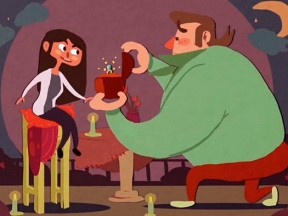
Like Me, Only Better is a film that made us laugh in Annecy last spring, and then made us laugh even harder when we saw it again in Ottawa last fall. That’s when we knew we had to find a way to share it with viewers of Cartoon Brew TV. Directed by Martin Pickles as a graduation project at the Royal College of Art in London, the film has been a big hit on the festival circuit appearing in over fifty festivals to date. Prior to studying animation, Martin had been primarily a live-action filmmaker and many of his earlier films can be seen on his film company website. Martin Pickles will be participating in the Brew comments if you have any questions for him. Here is his artist’s statement about the film:
December 9, 2008 12:11 am
As I was watching Dan Mountain’s Adventures in Broccoli at the year-end Pratt screening a few months back, I was thinking to myself that not only is this a damn good student film, it’s also something I wouldn’t mind seeing every week on television. The setup is draped in mystery—a boy wakes up in a broccoli (or is he even awake?)—and odd characters and events are introduced into his life in rapid-fire stream-of-conscious fashion. It’s somewhere between Avatar and Adventure Time with equal mixes of action and whimsy. Frankly, I wouldn’t mind seeing more of any cartoon that gives the hipster-on-a-bicycle his comeuppance. Dan Mountain will be participating in the comments section so fire away if you want to know anything. Here are some comments from Dan about how the film came about:
December 2, 2008 10:52 am
(Alternate commentary-free version: This link will allow you to watch the trailers without audio commentary) This episode from the Cartoon Brew TV Vault features three unique trailers from the “Golden Age” of anime. First up, the 1974 Japanese animated Jack and The Beanstalk (Jack to Mame no Ki). With this film, anime veteran Gisaburo Sugii made the move from animating on artistically surreal, X-rated projects like Belladonna (Kanashimi no Belladonna, 1973) to directing family-friendly feature films like Jack. This movie was released in the U.S. in 1976 by Columbia Pictures, limiting its distribution to Saturday matinees. Jack lived on despite this, gaining its widest exposure on home video and in numerous showings on HBO. However, its greatest appeal to U.S. baby boomers is its all-star cast of voice actors including Speed Racer’s Corrine Orr and Jack Grimes, and Astro Boy’s Billie Lou Watt and Ray Owens. Next, Princess Knight (Ribbon no Kishi). Osamu Tezuka began this film as a serialized manga in 1954. It became a 52-episode anime series in 1967. Aimed at girls, the premise centers on a severely conflicted heroine: a princess raised as a boy, who must hide her true sex or lose the kingdom, secretly fighting crime in male guise as the “Phantom Knight”—and donning a separate feminine identity to appear as her own sister! Joe Oriolo (TV’s Felix The Cat, Hercules, etc.) bought the series in 1970 and dubbed it in English. Unfortunately the show wasn’t widely seen in the U.S. (Oriolo also edited together three episodes and tried releasing it as feature, Choppy and the Princess); this promo-trailer also doubled as the show’s U.S. opening title sequence. Finally, it’s a shame Little Prince and the Eight Headed Dragon (Wanpaku ôji no orochi taiji, 1963) isn’t more widely known and is so difficult to see. Genndy Tartakovsky has touted this as one of his biggest influences on Samurai Jack and you can see why in this rare American TV spot (presented here in black & white). The original was presented in vivid Fujicolor (”Magicolor!”) and wide screen ToeiScope (an anamorphic 2.35:1 screen ratio - aka “WonderScope!”), two aspects hurt in the awful U.S. dub which mainly exists today in faded Eastman Color with pan-and-scan editing. What remains visible regardless is the beautiful character design and stylized animation, years ahead of what Japanese animators were doing commercially at this time. This is a little classic that deserves wider exposure. Seek out the Japanese DVD if you can. Some great model sheets of the main characters are posted here. Jerry Beck provides audio commentary on these trailers. Thanks to Michael Geisler for recording the commentary track, and Randall Kaplan for his expert sound and picture editing. November 24, 2008 4:17 am
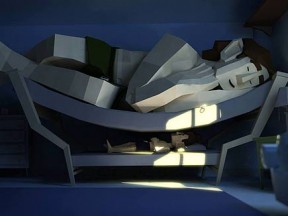
The Shoebox is a graduation film created at the Art Academy in Rotterdam by Joost van den Bosch and Erik Verkerk, better known as Ka-Ching Cartoons nowadays. The film’s original Dutch title de Kijkdoos translates literally to “the looking box” and comes from an old tradition in Holland in which children create elaborate dioramas inside shoeboxes. Since graduating from school in 2006, Verkerk and van den Bosch have worked on the animated series Skunk Fu! and created more short films of their own. The directors will be participating in the comments section so please forward any questions to them. Here are some additional details they’ve provided us about the film:
November 18, 2008 10:11 am
This week on Cartoon Brew TV, we’re reaching back to 1980 and rediscovering Paul Vester’s animated short Sunbeam. The independent short, which is an homage to early cel animation, was released in UK theaters with the feature film Chariots of Fire. It was produced at Vester’s commercial studio Speedy Films inbetween commercial gigs. Paul Vester, currently a Guggenheim Fellow, is working on a new short film, In the Woods. He is also repped for commercial work by DUCK Studios and teaches in the Experimental Animation department at CalArts. Here is a bit of background about Sunbeam from Vester:
November 10, 2008 10:29 pm
(Alternate commentary-free version: This link will allow you to watch the original cartoon without audio commentary) This week we shine a spotlight on a rarely seen Hollywood cartoon by the great Bob Clampett. It’s a Grand Old Nag (1947) is in fact Clampett’s final animated cartoon created during the golden age of Hollywood. Clampett was one of the chief architects of the Warner Bros. school of cartoon comedy. In addition to directing dozens of classic Looney Tunes (including such titles as Porky In Wackyland, The Great Piggy Bank Robbery and Coal Black and De Sebben Dwarfs), Clampett created two Warner Bros. mainstays, Tweety and Beaky Buzzard. After Clampett left Warner Bros. in 1945, he spent several months punching up stories for Screen Gems (Columbia’s ill-fated cartoon unit) while setting himself up as an independent producer. He approached Republic Pictures, which did not have a cartoon division but had a need to demonstrate a new 2-color film process: TruColor (the studio owned one of the biggest film labs in Hollywood, Consolidated Film Industries). In 1946, Clampett made a deal to produce one theatrical cartoon, budgeted for $20,000, with an option to make 35 more. Taking his cue from the kind of pictures Republic was known for—B-Westerns and rural comedies—Clampett created “Charlie Horse”, sort of a four-legged Mortimer Snerd (not unlike the personality he gave to Beaky Buzzard at Warners). The film is filled with Clampett’s gag sensibilities, from the eye-popping double takes to the punny signs that cover the action. (I’ve Always Loathed You was a take-off of Republic’s biggest film of 1946, I’ve Always Loved You; Ciro Van Snoot being referred to as “The Horse With The Inhuman Mind”, a jab at the billing for Roy Roger’s horse, Trigger, “The Smartest Horse In the Movies”). The cartoon even has a “joke” director credit (to “Kilroy”, the graffiti phenomenon of the 1940s), and though Don Towsley (Dumbo, Bambi, Fantasia) is credited as Supervising Animator, Clampett clearly has his fingerprints all over the film (and that’s literally his handwriting in the credits and in other lettering seen throughout the film). Bob used voice talents Dave Barry (as “Mr. Retake”) and Stan Freberg (as “Charlie” and “Ciro” - take note, this is Freberg’s first official screen credit!) both of whom had worked with Clampett at Termite Terrace. One credit noticeably missing is that of “story.” Rumor is that Clampett hired Michael Maltese to moonlight on the film. (In 1954, animator Paul J. Smith directed A Horse’s Tale for Walter Lantz. It’s a de facto remake, with a tell-tale story credit to Maltese.) It’s a Grand Old Nag was released on December 20th, 1947. No information exists to gauge its initial success, but it was released at a turning point in Republic’s history. Financial losses due to the war and depressed revenues at the box office were forcing Republic to tighten its belt. Early in 1948 Clampett’s multi-cartoon deal was cancelled. Undeterred, Clampett threw himself into his pioneering TV puppet show Time For Beany (bringing Stan Freberg along for the ride). Clampett returned briefly to animation in the late 50s/early 60s with a series of Beany & Cecil cartoons for ABC-TV. Charlie Horse is just a footnote in the fabulous career of Bob Clampett. One wonders what the other 35 cartoons could have been like - or where Clampett (and Republic) may have gone if things worked out differently. For now, we have this one surviving example of that alternate route - and, like the rest of Clampett’s work, it’s a refreshing blast of cartoon energy. Jerry Beck and Mark Kausler provide audio commentary on this short. Thanks to Michael Geisler for recording the commentary track, and Randall Kaplan for his expert sound and picture editing. Here is an original cel from the short:
November 4, 2008 1:19 pm
This week’s short, The Story of One-Eyed Ophelia Jackson is a 2008 graduation film by Kat Morris from School of Visual Arts. The eye-catching short, about the luckiest girl in the world, Ophelia Jackson, and her encounter with a Sea Witch, stands out for its confident drawing style and sophisticated sense of design. Recently Kat Morris has contributed to the Adult Swim series Superjail. To see more of Kat’s work, visit her blog or check out this experimental short animated in Ralph Steadman’s style. The filmmaker will be participating in the comments section so if you have any questions for her, feel free to ask. Here are some production notes about the film from Kat:
A selection of pre-production artwork from the film:
|