editors
JERRY BECK (LA)
AMID AMIDI (NY)
TAG FOR
“Classic”
Cartoon Brew's home for up-to-the-minute, unedited announcements and press releases direct from industry sources.
August 27, 2009 12:05 am


For the sake of film history, I’ll occasionally seek out odd bits of animation contained in obscure Hollywood movies and post them here – so you don’t have to. Previous postings in this series included Dave Fleischer in Trocadero (1944), and the Leon Schlesinger animation sequences in When’s Your Birthday? (1937) and She Married A Cop (1939).

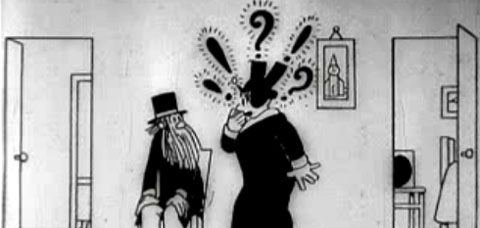
Today’s clip (below) is three sequences bunched together from United Artists 1943 screwball comedy, Hi Diddle Diddle. Leon Schlesinger provided a bit of animation at the beginning of the film (looks like McKimson animation to me, but I’ll defer to the more knowledgeable experts in our readership) and a cartoon bit in the last scene. The clip in the middle, coming in the middle of the film, sets up the end gag: An egotistical opera singer (silent screen actress Pola Negri, in a comeback role) has wall paper depicting a cartoon Richard Wagner and his family. In the final sequence, Adolphe Menjou, who’s been drinking, imagines the cartoon images (looks like from Freleng’s unit) on the wall paper coming to life and running away from the awful singing of his family (including “good witch” Billie Burke, seated at the piano bench). You don’t want to know what leads up to this; you don’t want to see this movie. It’s pretty bad. Even the animation stuff is rather lackluster. But here it is, for those of you who were ever wondering about this relatively rare sequence:

The entire flick can be seen on 50 Movie Pack: Classic Musicals, a DVD boxed set from Mill Creek Entertainment, which I recently snagged for $9. at Big Lots. The aforementioned Trocadero is on the set, as well as King Kelly of the USA (1934) which has a really odd animation sequence – which I will posting very soon.

August 22, 2009 12:05 am


Walter Lantz animated a short sequence for the Universal feature King Of Jazz (released 3/30/30). The sequence is notable as the first two-color Technicolor cartoon released in the sound era (though color cartoons predate the talkie era; and Iwerks’ Technicolor Fiddlesticks with Flip the Frog, was released later in 1930). I wanted to get this clip included on the Walter Lantz Woody Woodpecker and Friends Classic Cartoon Collection’s (Vols. 1 & 2, both highly recommended, nonetheless), but legal considerations prevented it. Musician Alex Rannie (Disney, Ren & Stimpy, etc.) spotted the clip on You Tube and sent us the link, along with several historical annotations (below).

Notes from Alex Rannie: Whilst roaming around the Interwebs I discovered that someone has posted the two-strip Technicolor animated sequence from the 1930 film King of Jazz. Since I couldn’t leave well enough alone, I jotted down a few lines about the music and related references. There’s a heck of a lot of music in this three-minute piece, and a slew of contemporary musical references that would have elicited laughter from a 1930 audience. Wish they still made animated films as jam-packed with fun and wit as this one!

Music used in the King of Jazz (1930) animated sequence:

The opening is a mash-up of “For He’s a Jolly Good Fellow” (a.k.a. “The Bear Went over the Mountain”) — whose origins can be found in “Malbrouk,” a French street song dating back to at least the mid-18th century — and the “Hunt Theme” (a.k.a. “A-Hunting We Will Go”), which may be based on a folk tune or part of an original work for piano entitled “A Hunting Scene” by Procida Bucalossi (published in London in 1884) which in turn may have been influenced by the tune “Tantivy, My Boy, Tantivy,” music by Thos. Costellow and words by Mr. Upton (published in London 1782-1792).

The chase proper (after Whiteman fires his shots) begins with a variation on a phrase from George Gershwin’s 1924 masterpiece Rhapsody in Blue, which was commissioned, appropriately enough, by Paul Whiteman.

(Editor’s Note: The information in the following paragraph misidentifies “The Mosquitoes’ Parade” as “The Whistler and His Dog.” Please see comments below for more detail.)

The chase continues to the Arthur Pryor melody “The Whistler and His Dog,” published in 1905. (Pryor was a composer and trombonist who played in Sousa’s band and collaborated with L. Frank Baum on a (sadly lost) opera. You can also hear shades of “The Whistler and His Dog” throughout Lady and the Tramp.)

When Whiteman opens his mouth he sings the African American Spiritual “My Lord Delivered Daniel” (which is also sung by Bing Crosby elsewhere in King of Jazz). (The animated Whiteman is voiced by Whiteman himself, with the lion’s “Mammy” (a reference to singer Al Jolson and his role in the seminal sound film The Jazz Singer (1927) provided by Crosby.) The song, which tells of the Biblical figure Daniel’s miraculous survival when placed in a lion’s den, was first published in 1872 (though was probably around many years prior).

As the lion sharpens his teeth (using his tongue as a strop) he is accompanied by “Mess Call,” a military bugle call signaling mealtime.

And when the lion returns his teeth to his mouth we hear an upbeat version of the usually melancholic theme from the Andante cantabile movement (Andante = walking tempo, cantabile = in a singing style) of Tchaikovsky’s String Quartet No. 1 in D major. (According to some sources, the celebrated melody of the Andante cantabile that famously brought Tolstoy to tears was based on a Ukrainian folk-song that Tchaikovsky serendipitously overheard being sung by a house-painter.)

In order to save himself, Whiteman tunes up his violin and launches into the Milton Ager and Jack Yellen song, “Music Hath Charms.” Like “My Lord Delivered Daniel,” “Music Hath Charms” is sung by Bing Crosby elsewhere in King of Jazz.

(Whiteman autographed his photos with the phrase “Music Hath Charmes” as early as 1922, but the song, “Music Hath Charms” appears to have been written specifically for King of Jazz.)

The title of the song comes from the English playwright and poet William Congreve’s play The mourning bride (1697): “Musick has Charms to sooth a savage Breast, To soften Rocks, or bend a knotted Oak,” though it’s more often garbled to read “Music hath charms to soothe a savage beast.”

“Music Hath Charms” is interrupted twice before it, and the animated sequence, ends.

The first time is when we see Oswald and a snake doing a shimmy. The music for this bit is “The Streets of Cairo, or the Poor Little Country Maid,” written by Sol Bloom “the Music Man” (and congressional representative) for the infamous dancer Little Egypt who appeared at the World’s Columbian Exposition (a.k.a. the Chicago World’s Fair) of 1893.

The second interruption occurs when the monkey on top of the palm tree becomes annoyed and we hear a brief snippet of “Aba Daba Honeymoon,” a song hit by Arthur Fields and Walter Donovan from 1914.

And then it’s back to the closing phrase of “Music Hath Charms” and the true story as to how “…Paul Whiteman was crowned the ‘King of Jazz’.”

The arranger of all this music was a recent addition to Walter Lantz’s staff, James “Jimmy” Dietrich (1894-1984). He was responsible for scoring a large chunk of the Lantz Oswalds (and for adding scores to Disney’s silent Oswald cartoons for sound re-issue) and would continue to work with Lantz through late 1937. While some animation reference books credit Dietrich as being an arranger for Paul Whiteman’s band who segued into working for Lantz while working on King of Jazz, his name doesn’t appear in any of Whiteman Orchestra rosters that I’ve run across and I’d be most eager to hear from anyone with additional information.

August 19, 2009 12:05 am


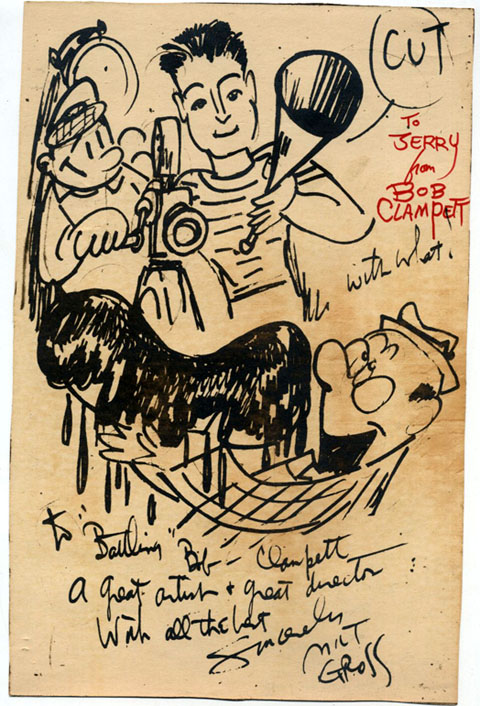
Bob Clampett was a genius.

And if you need further proof, the long-awaited Beany and Cecil: The Special Edition Vol. 2 dispenses it in spades. I just received my copy of this DVD and I cannot praise it highly enough. If you are a Clampett junkie like me, you’ve been Jonesing for this (no pun intended) for at least ten years (when the equally incredible Vol. 1 was first released).

First off, let me state that the Beany and Cecil cartoons are personal favorites of mine. They are among the funniest, and best, TV cartoons ever made – and still hold up great today. There are eleven beautifully restored B&C cartoons here, all from 35mm master elements, looking better than I ever recall them. A 12th cartoon included is a rarely seen alternate version of Beanyland (which was featured on Vol. 1). I’d normally pick a few to highlight, but they are all terrific cartoons—Cecil Meets Cecilia, Davey Cricket, Strange Objects, Ben Hare, etc. These alone would be worth the retail price. But they only represent about 1/5 of the disc’s programming.

The rest of the content is Bonus Material – so much so, I can’t even list it all. The biggest thrills for me: Storyboards (and a cut scene) from Bob’s 1947 Republic cartoon It’s a Grand Old Nag, two more Time For Beany kinescopes, more audio recordings of Bob discussing his influences and even reading a Milt Gross story! There’s also a reel of home movie footage, of Bob walking around New York City in 1945, filming Times Square billboards – including an Otto Messmer/Douglas Leigh animated billboard! A complete list of the disc’s contents is posted here.

Beany and Cecil the Special Edition Volume 2 officially goes on sale September 8th. However, you can buy Volume 2 right now, along with the long out-of-print Volume 1, from the Beany and Cecil web site. A limited supply of Volume 1 was found unopened in the family’s warehouse and they are being offered, one per customer, to anyone who buys a copy of Volume 2. Volumes 1 & 2 (purchased together) sell for $54.95 + Shipping. Do this today – you won’t be sorry.

August 14, 2009 10:48 am


Joshua Smith, who has introduced me to lots of great anime over the years, wrote to let me know about some recent discoveries he made on YouTube: Kitty’s Studio (1959) and Kitty’s Graffiti (1957), two shorts animated by Yasuji Mori. I’ve embedded them below.

Joshua writes:

These were produced during a time in which Toei was just gearing up it’s attempt to become the “Disney” of Japan, a feat that probably would not have succeeded without the talent of Yasuji Mori. He was probably the greatest Japanese character animator of his generation, stressing the concepts of appeal, solid construction, and moveability in his character design and animation. As the most influential mentor at Toei, he passed his skills on to subsequent generations of Toei animators such as Yasuo Otsuka, Gisaburo Sugii, and Hayao Miyazaki.

Kitty’s Studio

He continues:

Most prewar and postwar Japanese animation up to this point was rather crude, so it’s striking to see Japanese animation at a level of quality that equals or surpasses much American short animation from the same time period. These shorts clearly contain a great deal of Western influence, but have a distinct approach that makes them feel exotic. Without further context, it seems like this style of animation appeared from a vacuum. On the weekend that sees the American release of Miyazaki’s latest film, it’s interesting to ponder what the state of Japanese animation might be like today without Mori’s influence.

Josh is spot-on when he writes about the distinct approach.The filmmaking choices in these cartoons are very odd and un-Western. In the cartoon below, the face of the main character is not shown from a three-quarter or front view until well over two minutes in the cartoon, even though he’s onscreen for much of that time. I can’t think of a single example of when that’s happened in a Hollywood theatrical short.

Kitty’s Graffiti

August 11, 2009 4:30 pm


My friend Martha Sigall is one of the last living survivors of Termite Terrace (aka the Leon Schlesinger “Looney Tunes” Studio). She’s just posted a You Tube video in response to the number one question she gets asked all the time: Who Created Bugs Bunny? Here’s her response:

And she ought to know, she was there — as a member of the ink and paint crew. For more of Martha and her recollections, I suggest you pick up her wonderful book, Living Life Inside The Lines.

August 9, 2009 1:00 pm


Mr Bug Goes to Town

Just a quick heads-up that I’ll be introducing a double feature Max Fleischer’s two great animated features, Gulliver’s Travels (1939) and Mr. Bug Goes To Town (1941) at the Egyptian Theatre in Hollywood, California on Friday September 25th. Both will be presented in 35mm, with uncut IB Technicolor prints projected on the large screen, just as they were meant to be seen. Mark your calendar now! More details about this event will be posted when we get closer to the actual date.

August 9, 2009 12:05 am


Sam Henderson has uploaded a rare, heavily illustrated article about UPA on his Magic Whistle blog. The article, by Catherine Sullivan, appeared in the November 1955 issue of American Artist. The text is rather slim, but the images are from a variety of UPA works including commercials and industrials, as well as theatricals like The Jaywalker (pictured above). Worth a look.

August 7, 2009 10:30 am


I love this record. And I couldn’t resist showing off the label (above).

Marquis Howell (of Hobo Jazz.com and bass player for Janet Klein and her Parlor Boys) handed me this record at the show last night. He found it in a thrift shop for a buck and gave it to me as a gift. Thanks, man! I’d heard the track before, but I don’t recall ever seeing the label for it.

You can listen to the classic Daffy Duck’s Rhapsody on You Tube — as well as it’s flip side, I’m Glad That I’m Bugs Bunny, both written by Warren Foster and Michael Maltese, with incredible vocals by Mel Blanc. For more information on vintage Looney Tunes recordings, visit Golden Age Cartoons. Click thumbnails below see larger images of the labels and record sleeve.

August 6, 2009 7:37 pm


Iron Giant

The Iron Giant was released ten years ago today—August 6, 1999. Wired magazine celebrates the occasion with a commentary by Scott Thill that contrasts Brad Bird’s thoughtful filmmaking to today’s “dumb” Hollywood efforts like Iron Man and Transformers:

Big guns and fiery explosions have been Hollywood’s status quo for a long time, with mindless violence selling tickets — and a warlike message, which The Iron Giant stands on its head. Hogarth dons the requisite helmet and BB gun after his future pal wrecks the nearby woods, and the boy even salutes himself in a mirror, armed in defense of America against the Sputnik-launching Russians, before galloping off to meet the “enemy.”

But after watching the Iron Giant (voiced by Vin Diesel) scream in pain while caught up in power lines, Hogarth’s compassion is activated as he realizes that his interstellar visitor can communicate. It is something Mansley could realize himself, if he wasn’t so busy pursuing his wargasm. Yet he does not, and that is Bird’s brain at work: Consumed by what philosopher Theodor Adorno once controversially called the “authoritarian personality,” Mansley is possessed by cynicism and a quest for power. He simply cannot conceive a world where robots fall from the sky to do anything other than annihilate America.

August 3, 2009 12:05 am


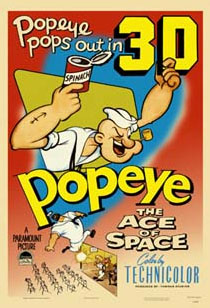
Here’s one for the hard-core cartoon historians: Recently, Brew reader Neil was replaying an old Paramount Popeye cartoon, and made a surprising audio find. On the soundtrack of Shuteye Popeye (1952), when the mouse’s audio is slowed down to about 40%, it’s clear that the track is actually a vocal outtake (perhaps director Isadore Sparber, or I suspect Seymour Kneitel) protesting that he doesn’t know what to say. Have a listen for yourself:

July 31, 2009 11:31 am


NY, NY

Francis Thompson (1908-2003) made this striking work, NY, NY: A Day in New York, in 1957. Trained as a painter, he was interested in finding a way to capture the effects of Surrealism and Cubism in photography. He achieved that through a variety of lenses, reflectors, optical effects and editing tricks. The film works both in the abstract and narrative sense, and while it’s not animated, Thompson’s creative use of the cinema medium is fresher and more emotionally engaging than many of today’s artificial worlds created through motion graphics and digital means. Thompson was secretive about how he made the film, describing the production simply as, “a magic, secret process of bending, twisting, and turning inside out. It was a self-funded project that involved my roaming about New York City with a camera over my shoulder.”

Aldous Huxley once wrote about this film:

“And then there is what may be called the Distorted Documentary a new form of visionary art, admirably exemplified by Mr. Francis Thompson’s film, NY, NY. In this very strange and beautiful picture we see the city of New York as it appears when photographed through multiplying prisms, or reflected in the backs of spoons, polished hub caps, spherical and parabolic mirrors. We still recognize houses, people, shop fronts, taxicabs, but recognize them as elements in one of those living geometries which are so characteristic of the visionary experience. The invention of this new cinematographic art seems to presage (thank heaven!) the supersession and early demise of non-representational painting. It used to be said by the non-representationalists that colored photography had reduced the old-fashioned portrait and the old-fashioned landscape to the rank of otiose absurdities. This, of course, is completely untrue. Colored photography merely records and preserves, in an easily reproducible form, the raw materials with which portraitists and landscape painters work. Used as Mr. Thompson has used it, colored cinematography does much more than merely record and preserve the raw materials of non-representational art; it actually turns out the finished product. Looking at NY, NY, I was amazed to see that virtually every pictorial device invented by the old masters of non-representational art and reproduced ad nauseam by the academicians and mannerists of the school, for the last forty years or more, makes its appearance, alive, glowing, intensely significant, in the sequences of Mr. Thompson’s film.

NY, NY

July 21, 2009 8:52 am


Graphic designer Heinz Edelmann, who developed the psychedelic look of the Beatles’ animated 1960s film Yellow Submarine, died on Tuesday, aged 75. The Stuttgart State Academy of Art and Design, where Edelman taught illustration from 1986 to 1996, confirmed the report of his death by German daily Stuutgarter Nachrichten. AP report here.