Faster And Cheaper=Better

A quote from animation producer Larry Kasanoff, founder of Threshold Entertainment, explaining why he can produce CG films faster and cheaper than the major studios:

Animation is the only part of film production where quality is going up while costs are going down.

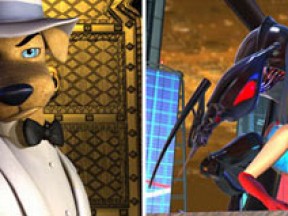
I was going to argue with his statement (made in this recent FAST COMPANY article) but then I saw these stills from Kasanoff’s first feature FOODFIGHT! that eloquently illustrate the surging upward quality in low-budget CG animation. Jobs and Katzenberg must surely be tossing and turning in their beds tonight.

foodfight.jpg

There is little doubt in my mind that Kasanoff is on the fast track to animation success. The same FAST COMPANY article reveals that Kasanoff even borrowed a classic Orson Welles technique to come up with the idea for FOODFIGHT!: he put one of his colleagues in his car and said, “We’re going to drive around Santa Monica until we come up with an idea for a movie.” Correct me if I’m wrong, but I’m pretty sure that’s how Welles conceived THE MAGNIFICENT AMBERSONS. And I’m predicting FOODFIGHT! will be another instant classic, if not on a par with the AMBERSONS, then at least with HOODWINKED.
(via Harry-Go-Round)

AFTERNOON OF REMEMBRANCE

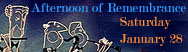
afternoon2006.jpgOn Saturday January 28th, Asifa-Hollywood, Women In Animation & The Animation Guild present their annual Afternoon of Remembrance, a “non-demominational celebration of departed friends from our animation community who touched our hearts and furthered the advance of the art of animation.”Honorees this year include: Don Adams, Ruben Apodaca, Henry Corden, Ed Friedman, Vance Gerry, Joe Grant, Wendy Jackson Hall, Gene Hazelton, Selby Kelly, Derek Lamb, Norm Prescott, Joe Ranft, Thurl Ravenscroft, Hal Seeger, Paul Winchell – and many others who passed away in 2005. Usually a friend or co-worker speaks about the person for five minutes… it’s a wonderful and touching tribute. No RSVP necessary. It’s free of charge and open to all. Light refreshments will be served. It starts at noon and runs all afternoon at the Hollywood Heritage Museum, 2100 N. Highland (across from the Hollywood Bowl) in Hollywood.

National Film Registry picks TOY STORY

The Library of Congress announced it’s annual list of 25 motion pictures to be added to the National Film Registry. Pixar’s TOY STORY was the sole animated film selected this year.Under the terms of the National Film Preservation Act, each year the Librarian of Congress names 25 “culturally, historically or aesthetically” significant motion pictures to the Registry. This group of titles brings the total number of films placed on the Registry to 425.

AURORA MIRANDA (1915-2005)

auroram.jpg

Aurora Miranda (sister of Carmen Miranda) passed away at the age of 90 on Thursday, December 22nd 2005. A major star in Brazil, Aurora was best known in the U.S. for her appearence in Walt Disney’s The Three Caballeros (1945) – where she danced with Donald Duck and Jose Carioca in the Bahia sequence, to the tune of Ary Barroso’s Os Quindins de Iaiá.(Thanks, Celbi Pegoraro)

UNDERDOG

underdognut.jpg

I actually met Suzanne Muldowny dressed as Underdog at New York comic cons back in the 1970s when she was no more eccentric than any other crazed comic book/cartoon fanatic. But in the intervening years her cult of celebrity has grown – in no small part by exposure on the Howard Stern show (Stern’s father happened to be a sound engineer on the original 1960s Total Television series). Now someone is making a movie about her. Just watching the trailer is enough for me – but it proves Andy Warhol’s famous statement, paraphrased: if you act crazy enough, for long enough, anyone can be “famous for 15 minutes”.

TOO ART FOR TV

There’s a New York animators art show titled “Too Art For TV!” opening at Brooklyn’s Stay Gold Gallery on the 13th of January, showcasing at least 24 of New Yorks best cartoonists & illustrators. The show is being currated by Liz Artinian (background painter “The Venture Brothers”) and contains work by Dave Levy, John Schnall, Jared Deal and many others. It runs through February 13th.

The Birth of the American Cartoon

I’ve previously noted that John Canemaker is making two don’t-miss Los Angeles appearances on Thursday January 12th and Saturday January 14th. But in case you need something to do on Friday the 13th, LACMA is presenting The Birth of the American Cartoon at 7:30pm that evening.

James Healey, Curator of Programs at George Eastman House in Rochester, will introduce and present a unique program comprising the most inventive, entertaining and influential American cartoons from the silent era, each of which has been preserved and made available on new 35mm prints. The animators represented include such cinema legends as Walt Disney, Walter Lantz, Paul Terry, and Max and Dave Fleischer. The program encompasses many of the “firsts” in animation techniques: the inaugural use of the rotoscope, the earliest color animation, and the original Felix the Cat cartoons. The prints are all unique to George Eastman House’s collection, and in many cases, have not been seen since their original screenings.

Films to screened that evening include: Domestic Difficulties (Bud Fisher,1916); Weary Willies (Isadore Freleng/Walter Lantz,1929); Trapped (Max Fleischer, 1921), a Koko short from the Out of the Inkwell series; Breath of a Nation (Gregory La Cava, 1919); Alice’s Spanish Guitar (Walt Disney, 1926); Col. Heezaliar-Shipwrecked (Bray Studios); Abie Kabibble Outwitted His Rival (La Cava); A Ramble on Skates with Inky Dink; and the following Pat Sullivan and Otto Messmer Felix the Cat films: Felix the Cat Trips Thru Toyland (1925); Felix the Cat Flirts with Fate (1926); Felix the Cat Gets Revenge (1922).

BOOK REVIEW: The Animated Movie Guide

Animated Movie Guide

Fellow Brewmaster Jerry Beck, modest individual that he is, sometimes doesn’t promote his own books enough, so I feel compelled to do a plug for his latest book, THE ANIMATED MOVIE GUIDE. It is, in my opinion, the single most important and valuable animation book released this year. Indispensable is the best word to describe it. In the month or so that I’ve owned the book, I’ve referred to it more times than I can count, and I think it’s safe to say that this book is destined to become one of animation’s standard reference books, right alongside Leonard Maltin’s OF MICE AND MAGIC and THE DISNEY FILMS, and the ever-handy Beck and Friedwald Warner Bros. guide.

The idea behind the book is simple — provide an alphabetical listing of every animated feature released theatrically in the United States. A concept that is seemingly so simple and so obvious that you wonder why nobody has done it before. Probably because the task is not as effortless as may initially seem. While it’s not too difficult to compile a list of all the mainstream studio features, Jerry wanted to create an exhaustive document of all the animated features that have been released stateside. So not only does Disney’s PINOCCHIO get a listing, but so does Filmation’s 1987 version PINOCCHIO AND THE EMPEROR OF THE NIGHT, as well as the mid-60s Belgian production PINOCCHIO IN OUTER SPACE.

This book truly lists it all: afternoon matinee releases of Japanese cartoons during the 1960s; obscure 70s films like DIRTY DUCK, HUGO THE HIPPO, SHAME OF THE JUNGLE and SHINBONE ALLEY; and awful 1980s films-based-on-TV-shows like HERE COME THE LITTLES, GOBOTS: BATTLE OF THE ROCK LORDS and MY LITTLE PONY: THE MOVIE. Each film entry lists basic details (release date, plot synopses, major credits, run time) and has extensive commentary with production details and well-informed (and often very strong) opinions about the films, written either by Beck or the book’s cadre of expert contributing writers: Martin Goodman, Andrew Leal, W.R. Miller and Fred Patten.

Viewing the entire history of American animated features in a book offers a unique perspective on the art form. The first thing that strikes me is that there have only been 308 features released in the US through 2004. Hollywood, by comparison, produces more live-action films in any one or two-year period than have been produced in the entire eighty years of animated film history. The other fact that sticks out is that over half of these animated films have been released since 1990. The animated feature, in other words, is still an extremely young art form, one that is largely unexplored and ripe for experimentation. With more animated films being produced than ever before, this book has arrived at the perfect time. It does a commendable job of showing us how far the art of the animated feature has progressed, but perhaps more importantly, it also shows us how far we still have to go.