Evolution of a Disney Character

siepermanntarzan.jpg

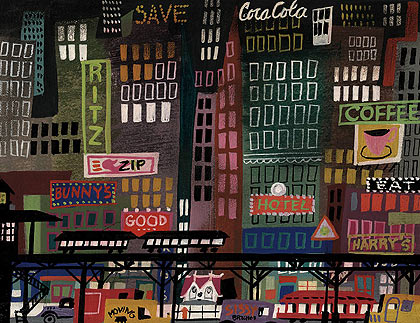
Master character designer Harald Siepermann has been doing some exceptional posts on his blog where he discusses how he arrived at the designs for various characters in recent Disney films. His latest post is about developing the character of Jane in TARZAN. Also worth checking out are Harald’s earlier posts about developing the villains Clayton in TARZAN and Yzma in THE EMPEROR’S NEW GROOVE.

RARE ANIME FEATURE RESTORED

japanprincess.jpgThe Japan Times is reporting that the first post-war Japanese animated feature has been restored to its original 48 minute length.

A complete version of “Princess of Baghdad” had not existed for years. A Fukuoka resident donated an almost complete version to the library in 2004. Since then, the library has worked with the National Film Center in Tokyo to restore the film to its original length. Before the resident came forward, the only copy confirmed to exist was a 37-minute version kept at the NFC.

“Remixing the Magic” in LA TIMES

Tony Mora painting

Alex Chun has been writing some excellent animation/pop culture-related pieces for the LA TIMES in recent months, and his most recent article in tomorrow’s paper is no exception. This time, Alex writes about the “Remixing the Magic” art show currently on display at Gallery 1988. One thing I wasn’t aware of until I went to the opening last week was that Disney was actually sponsoring the show, a commendable gesture on their part – even if they did put forth a few rules on what could and couldn’t be depicted. Chun sheds some more light on the nature of Disney’s sponsorship in the LA TIMES piece. To see more art from the show, check out this earlier post on the Brew. (And congrats to our super-talented pal Katie Rice for getting quoted in the article.)

Painting above: Tony Mora’s fine piece inspired by carniceria murals.

I WANT MY MAYPO!

hubley_maypo.jpg

Homestat Farm, the current manufactuers of MAYPO (the maple flavored oatmeal cereal) are relaunching the product with an updated version of their animated mascot, Marky Maypo.The company has also posted four classic John Hubley Marky Maypo commercials on their website. These are some of the best TV ads ever produced. Hubley had complete freedom and approched the spots as independent films, using a voice track improvised by his infant son and superb character animation by the likes of Emery Hawkins and Bobe Cannon.(Thanks, Jason Groh)

The (Mis)Marketing of Feature Animation

The FPS MAGAZINE blog has a thought-provoking piece by Marc Hairston about how Disney – not having learned anything from their clumsy release of Miyazaki’s SPIRITED AWAY in 2002 – again bungled the release of Miyazaki’s HOWL’S MOVING CASTLE last year. This points to a more serious problem with feature animation in the United States: no studio understands how to market intelligent animation. I’m not necessarily talking about rated-R adult animation; intelligent animation is simply any type of animated film that doesn’t fall into the conventional formulas of mainstream US studio animation.

Studios become confused if an animated film doesn’t have big-name voices like Will Smith, Halle Berry or Robin Williams. They begin scratching their heads if there aren’t dozens of fart and puke gags scattered throughout the film. After all, how can you create an advertising campaign for an animated film that doesn’t have fart and puke gags in it? What about an animated film that has a strong point of view yet doesn’t have instant generic appeal to both 5-year-olds and 50-year-olds? Preposterous! Studios have proven time and again that they are unable to design marketing campaigns specific to a film’s needs; they have one cookie-cutter marketing formula for animated features and they try to fit every animated film into that scheme. If a film doesn’t fit, they simply don’t release it.

The cruel irony being that there is more variety in animated features today than at anytime in the history of this art form. Unfortunately, the average moviegoer isn’t aware of this fact because most of the distinctive animated films aren’t released in the US, and the ones that do secure releases are rarely marketed beyond their wrongly perceived “niche audience.” With HOWL’S MOVING CASTLE, Hayao Miyazaki produced one of Japan’s all-time top grossing films. It’s shameful that CASTLE didn’t find its way into more than 200 theaters in the US, especially with Disney’s marketing and distribution muscle behind it? Puerile incompetent garbage like HOODWINKED can infest thousands of multiplexes, but Masaaki Yuasa’s MIND GAME (2004), one of the greatest animated films I (and many others) have ever seen, is unable to even secure a US distributor. What about the upcoming French anthology film PEUR[S] DU NOIR or the kooky Norwegian feature FREE JIMMY. Will they find their way to the US? If so, it’s doubtful they’ll receive more than the perfunctory art house release.

Bill Plympton’s strongest feature to date, HAIR HIGH, stilll hasn’t been released theatrically two years after completion. I’m not personally a fan of Satoshi Kon’s films – MILLENNIUM ACTRESS and TOKYO GODFATHERS – but they certainly were capable of making far more than their pathetic US grosses, $37,000 and $108,000, respectively. Incidentally, Satoshi Kon’s films were mismarketed by two completely different studios – Go Fish Pictures (DreamWorks) and Samuel Goldwyn Films. One interesting possibility is the upcoming French animated noir, RENAISSANCE, which Disney partially bankrolled and can distribute in the US. It will also be interesting to see how Warner Independent markets Richard Linklater’s A SCANNER DARKLY, slated for release this summer.

The development of the animated art is hampered not by a lack of vision from artists, but by shortsighted film studios that are unwilling to think outside of the box when it comes to animated film distribution and marketing. There’s the perception in the industry that only one type of animated film can succeed at the box office, and all other animated films are expendable “art” films that have no moneymaking potential and deserve to be seen by as few people as possible. With the glut of virtually indistinguishable animated films being released in 2006, this lack of variety will become even more noticeable and is guaranteed to have serious consequences on the ability of all animated features to succeed at the box office.

CHINA BANS SPACE JAM, ROGER RABBIT, COOL WORLD… etc.

spacejamchina.jpg

I love this story in today’s DAILY VARIETY:

Jessica Rabbit isn’t welcome in China — and Michael Jordan shouldn’t show up with any of his Looney Toons pals.In one of the more bizarre orders from China’s State Administration of Radio, Film and Television, TV shows and films featuring human thesps with animated companions will be banned.”These human live-action, so-called animation pieces will not receive distribution or distribution licenses,” read the order, issued Feb. 15. However, films and shows that have already received permits will continue to air.CGI and 2-D characters alongside human actors jeopardize “the broadcast order of homemade animation and mislead their development,” according to a report from the state-run Xinhua News Agency.Order comes as the Chinese government attempts to increase local production of Mandarin-language toons and cut the amount of foreign animated programming appearing on Chinese television. Chinese regulatory authorities are notoriously skittish regarding broadcast and film themes that include the supernatural or fantasy, including talking animals. “Babe” was banned on the basis that animals can’t talk and some viewers would be confused.

Happy Birthday, Nina Simone

aardmansimone.jpg

Today is Nina Simone’s birthday (Feb. 21, 1933-April 21, 2003), and to commemorate the date, here’s a soulful stop-motion music video for her performance of “My Baby Just Cares For Me”. The film was produced by Aardman Animations, and apparently quite a long time ago. There’s some nice subtle animation of the Simone feline throughout. If you want to hear more of her music, I highly recommend this collection of her work.
(via Screenhead), Tags:

Dear Mr. Iger,

Oswaldbutton2.jpgNow that you’ve returned a creative producer – an animator, no less – to head Disney Feature Animation and Imagineering, and you’ve righted a 77-year-old wrong by returning Oswald The Lucky Rabbit to the studio, why stop there? There are a couple of other loose ends in Disney history you might consider tying up.First off, there is a little film you own the rights to called THE THIEF AND THE COBBLER. Ask Roy Disney about it. This feature film was taken away from its creator Richard Williams (Who Framed Roger Rabbit) by the Completion Bond Company and reworked into a mess called ARABIAN KNIGHT (released by Miramax in 1995). Restoring this film to Williams’ intended vision would be a great way to get the traditional animators back up to speed while Pixar’s story team begins developing new films to revive this now-neglected art form.Secondly, there is a wealth of material in the Disney vaults and archives, developed and produced under Walt’s watch, which never made their way to completion. DESTINO was one of those projects. The two in particular I’m thinking of are Mickey Mouse shorts: THE TALKING DOG and PLIGHT OF THE BUMBLE BEE. Both were shelved late in their respective production schedules, in the early-1950s. Both have existing dialogue and music tracks, storyboards and were 98% animated (by the likes of Freddy Moore!). Two new classic shorts – just sitting there, simply waiting for ink-and-paint!You’ve already suceeded in returning some magic to the Disney name. These requests are rather simple compared to the two coups you’ve recently pulled off. Just consider them food for thought.(Oswald button, above, was distributed to employees on the Burbank lot last Thursday.)

HAPPY BIRTHDAY: ANIMATION 1906-2006

Humorous Phases of Funny Faces

The ASIFA-Hollywood Animation Archive has just noted that April 6th marks the 100th birthday of animation. James Stuart Blackton created “Humorous Phases of Funny Faces” in 1906, and the artform that it spawned is one of the greatest creative contributions of America, second only to Jazz. ASIFA’s Steve Worth has posted the story of Blackton and a link to a Quicktime movie of the film that started it all on the Archive blog.

Oswald South of the Border

Mexican reader Uriel Durán writes to let us know that Oswald is popular nowadays in Mexico, as well as Japan:

The situation is that in the 1950s and ’60s, many comic books based upon American cartoon characters were translated and published here for Mexican audiences. Then, when the American imprints stopped making comics, Mexican companies bought licenses and kept making new stories, written and drawn by Mexican artists. Some characters like Pink Panther, Droopy and Tom & Jerry still appear weekly in small comic books (5.5x8in) aimed at children. Some of the cartoons are still on air too on some local networks.

Now, Woody Woodpecker is also a character that still has a comic book series. About two or three years ago, as a request from Universal, the comic was cancelled and relaunched to fit the new character designs used in the most recent TV series – until then, the characters were still drawn in the softened style used in the first Woody cartoons. Oswald did not appear in the new cartoons but he kept appearing in short stories in the Woody comics, now using a retro look very much like the Japanese toys. Art could be better though, as the current artists are not very talented and not very familiar with the original black-&-white Oswald cartoons. Just wanted to let you know about the situation of the character as it seems he’s used almost everywhere except his native country.

Uriel also sent along a few examples of the Oswald comics. Click on images for larger versions. This is what the older comic looked like:

Oswald comic

And here are a couple pages from more recent Oswald comics, using the old-school redesign also seen in current Japanese merchandise.

Oswald comic

Oswald comic


Tags: , ,

Cartoon Brew Film of the Week: WELCOME TO GLARINGLY

Grant Orchard's Welcome to Glaringly

There’s a lot of animation nowadays that has a retro-pixel look with blocky graphics. None I’ve seen execute the look as elegantly as the British short WELCOME TO GLARINGLY (2003) by Grant Orchard. The film’s Orwellian theme is a perfect match for the style, and the animation is smartly done to take advantage of the pixelated look. With over a half million public surveillance cameras installed around London, the film’s idea is not far removed from current realities, and eloquently points out the pitfalls of relying on technology as judge, jury and executioner.

Grant Orchard has directed commercials for StudioAKA (like this terrific spot for MTV) and also is one of the founders of the studio The Hope & Anchor. Also, it should be pointed out that the graphics and sound on GLARINGLY are not too great on this online version I linked to, but it’s the only complete version I could find online. Here’s a CLIP that gives a more accurate sense of the film’s quality.