Cartoons And Janet Klein

Thursday night, August 3rd, in a small theatre in Hollywood I will be projecting several celluloid 16mm cartoons as the “opening act” of a live-action, in-person, performance by Janet Klein And Her Parlor Boys. Long time readers of this blog know by now that I do this the first Thursday of every month at the Steve Allen Theatre (4773 Hollywood Blvd. two blocks west of Vermont), in the lovely Los Feliz area. Cartoons to be screened this month include Love Krazy (a bouncy Krazy Kat cartoon), You Took The Words Right Out Of My Heart (a Max Fleischer Screen Song), and Voodoo In Harlem (a jazzy Walter Lantz musical cartune). The show starts at 8pm. Please check Janet’s website (under “Showtime”) for even more details and nifty vintage artwork. See you there!

ANIMANIACS DVD CONTEST!

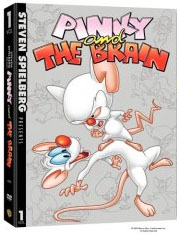
animaniacsdvd1.jpgpinkbraindvd1.jpg

Narf! Tomorrow morning (Tuesday) we will give away a few copies of the brand new ANIMANIACS and PINKY AND THE BRAIN dvds to several lucky Cartoon Brew readers.These two dvd collections were released last week and Warner Home Video is graciously supplying us with a few copies to give away as prizes. Are you a PINKY or a BRAIN? We will hold a quick cartoon trivia contest tomorrow (at 9am Pacific Time) and the first two BRAINS will get the PINKY AND THE BRAIN set. The next two BRAINS will get an ANIMANIACS collection. And the next six PINKY’S will get my home made WORST CARTOONS EVER collection (2006 edition). So get a good night’s sleep and see you here at 9am. “Those are the facts!”

A Letter to Mick LaSalle

Pixar story artist Jeff Pidgeon wrote a letter to SAN FRANCISCO CHRONICLE movie reviewer Mick LaSalle, in which he completely dismantled LaSalle’s inept review of MONSTER HOUSE and exposed his utter cluelessness about the animation art form. Jeff has posted the excellent letter on his blog HERE. He also posted LaSalle’s brush-off response, which was:

Thank you for a thoughtful message. I appreciate it. (Don’t agree with it, any of it, but I appreciate being accurately quoted and not being cursed at.)

Earlier posts about Mick LaSalle: 1, 2, 3, 4

Non-Surprise of the Week

So, ANT BULLY tanked. The Warner Bros.-distributed, Tom Hanks-produced film collected a meager $8.1 million (estimate) from 3,050 theaters, or as Box Office Mojo puts it, “the weakest start ever for a high profile computer-animated feature.” I’d predicted this film would flop back in June and I think most everybody else in the industry had similar feelings about ANT BULLY’s prospects for success. WB, however, had been expecting a stronger opening for the film. Warners distribution exec Jeff Goldstein commented yesterday about the film, “It’s much less than what we had wanted. The marketplace is crowded. The kids have been bombarded.”

COMIC CON RECAP #3: A COMIC BOOK REVIEW

heckjecklepanel4.jpg

I’m still going over the booty I obtained at the San Diego Comic Con last weekend. One thing I didn’t devote enough time to at the Comic Con was actually buying comics. I picked up a scant few. My favorite purchase was a well worn copy of BLUE RIBBON COMICS #1 (St. John, 1949). The cover logo actually reads TERRYTOONS PRESENTS HECKLE AND JECKLE, and I believe it’s the first solo comic book for the talking magpies.This particular book contains four stories – two drawn by background painter Art Bartsch and two by director Connie Rasinski. Rasinski’s Terrytoon comic book art is wonderful. His drawings have a handsome, controlled zaniness (as opposed to the raw unrestrained work of the great Jim Tyer) that point to what the screen Terrytoons could have been like if they had the money and time to make them better. The two stories by Bartsch are adaptations of animated cartoons. The first one, “Mind Over Matter” (panels pictured above), is an adaption of the 1949 meta-cartoon THE POWER OF THOUGHT, in which Heckle & Jeckle develop mental telepathy upon the realization that they are cartoon characters. The other Bartsch story, “Sour Grapes”, rips off Tashlin’s Columbia cartoon THE FOX AND THE GRAPES (1942) with H&J in the Crow role, versus Terrytoon bit-player Slyvester the Fox.The only comic books I’m actively collecting these days are ones with comic art by animation artists. This includes a wide array of titles ranging from DC’s FOX & CROW and FUNNY STUFF titles (with art by Otto Feuer, Jim Davis, Bob Wickersham, etc.), to Harvey’s Paramount comics (drawn by Dave Tendlar, Steve Muffatti, Bill Hudson, Marty Taras, etc.). As much as I like watching the animators art on a frame by frame basis, the strong poses in each comic panel of these 40s and 50s comic books are a pleasure to look at – and incredibly entertaining.

KING LEONARDO ON BLACK FAMILY CHANNEL

kingleonardobfn.jpg

Classic cartoons (and by that I mean the wide swath of animation history from 1906 to its dying days in the 1970s) are practically extinct on current broadcast and cable television program schedules. That’s why news of an animated character’s revival, or the spotting of a vintage cartoon short, is now considered a big deal to some of us (at least to me). Over on the Animation History Forum, a reader named “Troop” accidentally found a new outlet for an old favorite:

On Saturday morning, I was looking for something to watch and happened upon the Black Family Channel …part of my digital cable package. I was delighted to see KING LEONARDO AND FRIENDS playing there at 9:30 a.m. I came in on the middle of one of the segments featuring “The Hunter” and stayed thru the final King Leonardo and Odie cartoon. It was great seeing this again after “many years”. The print wasn’t the greatest, but watchable… and it was great hearing Jackson Beck again. I noticed Chuck McCann listed in the voice talents as well.Following this was something called BFC FUN FARM which featured short farm and animal segments with two youngsters introducing old PD WB cartoons. During the half-hour yesterday, typical PD prints aired of Porky’s Cafe, Farm Frolics and Yankee Doodle Daffy. Some of the channels’s promos aired clips of “Tennesee Tuxedo” and “Underdog” but I couldn’t find them listed in their web schedule…just “King Leonardo” everyday of the week at 9:30 am with “BFC Fun Farm” at 10 a.m. The BFC web schedule holds this schedule until this coming Saturday, August 5th when “Leonardo” and “Fun Farm” move forward to 9 and 9:30 a.m. and “Bullwinkle and Friends” is added to the schedule at 10 a.m.

Well that’s good news. As the saying goes, old cartoons never die – they just end up on the Fun Farm on the Black Family Channel.

The Friz Freleng Blog-A-Thon

Friz Freleng
Brian of the Hell on Frisco Bay blog notes that August 21, 2006 marks the 100th anniversary of Friz Freleng’s birth, and he’s officially calling on the blogging community to make that day a Friz Freleng Blog-A-Thon. Here’s Brian’s rules:

I invite anyone, whether animation experts, enthusiasts or newbies, fans of Freleng or not, to watch or rewatch at least one of his cartoons between now and August 21. On that day, post something about Freleng or one or more of his films on your website, and send me the link. You may name the cartoon(s), character(s), or aspect(s) of Freleng’s style you want to discuss in the comments section below, or leave it as a surprise for the rest of us.

Sounds like fun. We’re in at Cartoon Brew…who else is in?

The Parade of Ignorance Continues

From Paul Johnson’s invented history of the Disney strike to Mick LaSalle’s broad dismissal of a hundred years of animation accomplishments, it’s been a busy week for keeping track of misinformed animation commentary. Jaime Weinman has written a nice summary of what’s been said and explores the root cause of such statements.

There’s also a great thread going on at the CGTalk forums about Mick LaSalle’s comments. In that thread, Pixar lighting artist Jeremy Birn points out a link to A.O. Scott’s review of MONSTER HOUSE in the NY TIMES, where Scott pulls a “Mick LaSalle” and exhibits a similarly woeful lack of understanding about the animation medium. He writes:

Like Robert Zemeckis’s “Polar Express,” “Monster House” (for which Mr. Zemeckis served as an executive producer) uses the digitally captured movements of real actors rather than computer-generated algorithms as the basis for its animated images.

If Scott had any intention of writing with accuracy, he would have compared the digitally captured movements of real actors to the work of computer animators, not to “computer-generated algorithms” which implies that CG animation is an automated process created by a machine. To their credit, Mick LaSalle and A.O. Scott at least know they’re watching computer animation, which is more than can be said for USA TODAY’s Scott Bowles, who describes MONSTER HOUSE as “stop-motion animaton.” How are we supposed to take the opinions of critics like A.O. Scott and Scott Bowles seriously when they can’t even get their facts correct about how animated films are produced?

MEDICAL TOONS

snafu

Rarely screened historic medical cartoons will be featured in a film series this fall at the National Academies in Washington DC. The Cartoon Medicine Show: Animated Cartoons from the Collection of the National Library of Medicine, curated by Michael Sappol of the National Library of Medicine (NLM), will feature a good sampling of rarely screened animated medical cartoons from the 1920s to the 1960s. The films will be presented in a two-day series, Oct. 25 – 26, at the National Academy of Sciences Auditorium, each night at 6pm. Films scheduled include Disney’s silent-era Tommy Tucker’s Tooth (1922) and Clara Cleans Her Teeth (1926), Hugh Harman’s Winky The Watchman (1945), Cleaning Mess Gear (1945, U.S. Navy) and Use Your Head (1945, U.S. Navy) and UPA’s A Few Quick Facts: Fear (Private Snafu, 1945, Zack Schwartz), Swab Your Choppers (1946, U.S. Navy) and Man Alive (1952, American Cancer Society).Also on the program are two Bell Science films: Hemo the Magnificent (1956, Shamus Culhane) and Gateway to the Mind (1958, Chuck Jones) and well as several Private Snafu cartoons: Gripes (1943, Friz Freleng), Private Snafu Versus Malaria Mike (1944, Chuck Jones), and It’s Murder She Says (1945, Chuck Jones). Other wartime films include Strictly Personal (1945, Army Signal Corps), The Inside Story (1944, Paramount Pictures for the U.S. Coast Guard), Criminal at Large (1943, Office of Malaria Control, United States Public Health Service). Post war films include: The Appraisal of Competency (1956, Nebraska Psychiatric Institute), Fluoridation Story (1951, Public Health Service, Division of Dental Public Health) and a set of TV spots (1955-1959) for the American Dental Association.Animation historian Donald Crafton (Before Mickey) and medical historians Michael Sappol and David Cantor will provide commentary.National Academy of Sciences
2100 C St., N.W., Auditorium
Washington, D.C.
Admission: free. Seating is limited. RSVP to arts@nas.edu or 202-334-2436(Thanks, Karl Cohen)

Cartoon Brew Reader Survey

Federated MediaWe recently signed on with John Battelle’s Federated Media to represent us for online advertising. Federated is a boutique ad rep representing only a limited number of blogs with strong author-driven voices, including sites such as BoingBoing, MetaFilter and Digg. We’re proud to be associated with them. To help us gain a more accurate sense of who’s reading Cartoon Brew and so that Federated can get us ads geared to stuff that we like, please take a moment to fill out this SURVEY here. The survey is completely anonymous and takes only a few minutes to fill out. We’re going to run it for a couple weeks, and if there’s any interest afterwards, we’ll share the compiled statistics with everybody.

Real Animation Acting

MONSTER HOUSE vs. Bugs Acting

Thad Komorowski has posted three examples of animation acting – one each from Disney, WB and MGM – all created without the aid of rotoscoping or performance capture. The foolishness of commentaries by critics like Mick LaSalle and James Lipton becomes only more evident when they are presented with actual examples of the animation medium’s expressive potential. LaSalle believes that the animated film has never “had the ability to show the human face. There was never any point to a close-up in an animated film — there was never really anything to see.” Really, Mr. LaSalle? I think Rod Scribner and Bob McKimson proved you wrong about sixty years ago, as evidenced in the clip from TORTOISE WINS BY A HARE. James Lipton thinks that Robert Downey rotoscoped is a better performance than anything an animator could create. Perhaps he should look at Ken Muse’s anguished animation of Tom in HEAVENLY PUSS. We haven’t even begun to examine all the stellar animation in feature films, but even in these short films, the inanity of LaSalle and Lipton’s opinions are exposed.

Mick LaSalle on THE POLAR EXPRESS

I didn’t think of doing this but somebody found Mick LaSalle’s review of THE POLAR EXPRESS. An excerpt is below. If anything can be said to his credit, LaSalle is consistent…well, consistently blind.

It’s also an enchanting, beautiful and brilliantly imagined film that constitutes a technological breakthrough. The one profound limitation of animation — the rigid faces that don’t allow for emotional nuance — is overcome through a new process that allows actors to record their performances digitally onto a computer. These performances — the gestures, the subtleties of facial expression — are then used as the template for the computer-animation process.

It reminds me of Ward Jenkins’s classic blog post about POLAR EXPRESS and how it could have been improved.