Keep Moving Forward

meetrobinsonspic1.jpg

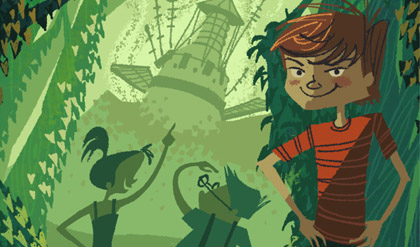
This isn’t a review or critique of Meet The Robinsons, but I saw the film today at a screening at the El Capitan, in 3-D.

In a nutshell, it’s a very likeable film with eye-popping visuals, gorgeous art direction and pleasing character designs. The 3-D is great. The Streamline Moderne future is pretty cool, though the architecture reminded me more of Music Land (the 1935 Silly Symphony) than Tomorrowland. The story is a bit disjointed—shifting from heartwarming reality one moment to off-the-wall zaniness the next. In Disney terms, think if Pollyanna were grafted into Babes In Toyland. But it does hang together pretty well.

The film ends with a great quote from Walt Disney himself:

“Around here, however, we don’t look backwards for very long. We keep moving forward, opening up new doors and doing new things… and curiosity keeps leading us down new paths.”
–Walt Disney

This quote perfectly caps the theme of the movie, but even moreso, it sends a subtle message about Lasseter’s commitment to Disney heritage—and possibly states a new direction for the beleaguered animation studio. Or at least I’d like to think so.

Am I reading too much into this? All I know is the quote was a nice touch, and I left the theater feeling pretty optimistic about the future—of Disney.

Ugly CG Peanuts

peanutscg.jpg

Good Grief! Some drawn characters just shouldn’t be rendered in 3-D.

A German telecommunications company, Combots, is selling animated icons based on popular animation and comics characters. These Peanuts ones are pretty hideous.

However, there are some characters that could (and do) work. I suppose it’s all based on design. Check out some of the others, particularly these Spongebob icons, which look pretty good. It’ll be interesting to see how they handle the Looney Tunes characters, which they’ve apparently licensed.

UPDATE: Little wonder the Spongebob icons look so good. They were done by the talented crew at Studio Soi. Soi also created the Zodies series and the “Tom and Lily” site tutorials (click on ‘trailer’ on the homepage to watch the six episodes).

Disney at PhillyFest

alicecomedies.jpg

A ‘heads up’ on some Disney Programs at the upcoming 16th Annual Philadelphia Film Festival, April 5th through 18th.

Friday, April 6 • 6:45 • Prince Music Theater • Tickets $10.00
Fantasia (1940) — A screening of the landmark film with an ensemble of Philadelphia Orchestra musicians, performing onstage preceding the screening.

Saturday, April 7 • 2:30 • Prince Music Theater • Tickets $8.00
The Disney Cartoon: Nine Decades of Magic — A screening of Disney shorts spanning nine decades of the company’s history. Shorts will include Pixar’s Red’s Dream, Roger Rabbit’s Roller Coaster Rabbit and the Salvador Dali-designed Destino.

Saturday, April 7 • 7:15 • Prince Music Theater • Tickets $10.00
A Salute To Roy Disney, an on-stage interview with Leonard Maltin. (Maltin will also be hosting a screening of rare Our Gang shorts on April 7th at 4:30pm)

Sunday, April 8 • 2:15 • Prince Music Theater •Tickets $8.00
Disney Cartoon Rarities – 35mm prints of Disney shorts including Hell’s Bells, Egyptian Melodies, Music Land, The Whoopee Party, Hawaiian Holiday, The Band Concert, as well as examples of Alice in Cartoonland and Oswald the Lucky Rabbit.

Non-Disney animation at the Philly Fest will include a screening of the forthcoming anime feature Paprika and a program of contemporary animated shorts.

An Open Letter

mrzip.jpg

Dear AOL/MSN/Yahoo/NBC-Universal and News Corp.,

Congratulations on the news of your new company to compete with YouTube.

The announcement of of this new partnership has me very excited. You say you are going to use your vault assets to create a new venue for programming—a “video-rich site… with thousands of hours of full-length programming, movies and clips, representing premium content from at least a dozen networks and two major film studios.”

One of my favorite quotes in your press release is the one from Yahoo’s CEO Terry Semel, who says, “We are excited to be a part of this landmark partnership that connects people to the content they care about…”, promising users “unprecedented access to their favorite shows”.

Allowing us access to the riches in your combined movie/TV libraries will be a great thing for our culture and will add to our collective knowledge of film history. It might even help thwart Internet piracy.

My only concern is that you might overlook the thousands of classic animation titles in your massive holdings. AOL’s parent company, Time Warner, holds the popular Looney Tunes and Merrie Melodies, the MGM Happy Harmonies, Tom & Jerry and Tex Avery masterpieces and the incredible Max Fleischer/Paramount Popeye cartoon; News Corp owns Crusader Rabbit, the historic first TV cartoon series; NBC-Universal has the wonderful Walter Lantz library of vintage Woody Woodpecker, Chilly Willy, and Oswald Rabbit. I’m not even mentioning all the TV cartoons and animated features contained therein, everything from Marine Boy to Wizards, all awaiting a chance to find—and entertain—a new audience.

And I’ll let you in on a secret. Your home video divisions have only released a fraction of the material you own.

Making them all available—the entire library, at minimal cost—will certainly connect your content to people who really care about it, namely our readers. There’s tons of money to be made from this proposition. This illegally posted 1940s Tom & Jerry short on YouTube has over 400,000 views. That’s more views than most of the modern animation posted there.

This is a watershed moment, the begining of a new age, with no rules, no ratings, no demographics to tell you people don’t want this or that. One thing we’ve learned from DVD is that people do want complete runs of great material. One thing we’ve learned from YouTube is that people are interested in esoteric material.

So release your old cartoons. Make them available for purchase. Believe it or not, people really want to see them. And I promise to be the first person in line to support the effort.

Best of luck,

Jerry Beck
CartoonBrew.com

Elbert Tuganov (1920-2007)

Elbert Tuganov (1920-2007)

Pioneering Estonian animator Elbert Tuganov has passed away at age 87. Chris Robinson, author of Estonian Animation: Between Genius and Utter Illiteracy, writes in with some details about Tuganov’s life and work:

Elbert Tuganov, the father of Estonian animation, died on Thursday, March 22, 2007. He was 87. Tuganov was actually born in Baku, Azerbaijan and began his animation career in Germany. When Hitler took power, Tuganov returned to Estonia. He joined Estonia’s state film studio, Tallinnfilm in 1946. For eleven years, Tuganov shot, drew, and painted titles and credit sequences. During this time Tuganov built an animation stand that would allow the studio to do frame by frame shooting. A visiting Moscow official was impressed by the new apparatus and suggested that Tuganov make animation films.

Tuganov immediately set out to find scripts and landed a Danish story called Palle Alone in the World. This became the basis for the first Nukufilm (the name of the puppet animation division of Tallinnfilm) production, Little Peter’s Dream (1957). For the next four years, Tuganov and his small crew of six people worked on films alongside artists from the Estonian puppet theatre. After his fourth film, Mina and Murri (1961), animation production received a budgetary blessing from Tallinnfilm. The division’s staff grew to twenty and it was decided that the puppets would then be fashioned in the studio.

Throughout the 1960s and 1970s, Tuganov made a number of innovative puppet and cutout films for both adults and children including the satires, Park (1966) and Bloody John (1974); the astonishing time-lapse film Inspiration (1975), a document of the famous Estonian song festival; and what may be the world’s first stereoscopic puppet animation films Souvenir (1977). In total, Tuganov made 38 animated films and received numerous international awards. He remained at Nukufilm until his retirement in 1982 and later wrote an autobiography, Walking Through the Century, that detailed his failed attempt to flee the Soviet Union in 1982.

Tuganov’s passing comes as Estonia celebrates Nukufilm’s 50th anniversary this year. In November, an international puppet animation symposium is being held in Tallinn to commemorate Nukufilm’s anniversary.

A complete list of his works can be found on the Nukufilm website.

LA SHOW: The Ancient Book of Myth and War

Ancient Book of Myth and War

“The Ancient Book of Myth and War” opens at Gallery Nucleus (30 West Main St., Alhambra, CA) this Saturday, March 24, from 7-11pm. The show of paintings, illustrations and prints based on classic myths and legends features work by four exceptionally talented animation development artists currently working at Pixar: Don Shank, Scott Morse, Lou Romano and Nate Wragg.

With their already crazed animation dayjobs, I have no idea how they find the time to create so much amazing art, but if the show isn’t enough, the work is also being collected into an 80-page hardcover book. A limited number of copies will premiere at the show this Saturday and the book can currently be pre-ordered on Amazon. This Sunday afternoon, there’s also an (almost sold-out) four-hour workshop/painting demo with the quartet. Details for that event are available here.

Stay tuned to the Brew for more details about the book and a contest you won’t want to miss.

El Tigre Beat Boards by Dave Thomas

Dave Thomas Beat Board

A quick follow-up to yesterday’s El Tigre review: the show’s supervising director Dave Thomas also has a blog where he’s posting many examples of his beatboards. Thomas would do between 30-60 pages of these beatboards before the episodes were handed out to the board artists, so he could visually describe how he wanted the action handled. It’s an immense amount of work that most TV directors don’t do, but it’s a good way for the director to take more control over the vagaries of the TV animation process. And the resulting quality speaks for itself. Dave also has an excellent post about his conversion from traditional pencil drawing to an all-digital paperless production using the Cintiq. Personally, I’m waiting for Dave to tell the story of his biggest accomplishment: how he came up with the 99 Cent Super Value Menu.

Naruto Movie: A new approach for U.S. release

narutomovie1.jpg

We don’t usually report on anime releases (we leave that to others more qualified like Anime News Network and the like), but this one is worth noting—not for the film itself, but the manner of its U.S. presentation.

Naruto, the Viz manga series-turned-anime hit series (on Cartoon Network in the U.S.), about the trials of a young ninja, is one of the most popular Japanese series now playing. Three theatrical films have been spun off and released in Japan. The first of these Daikatsugeki! Yukihime Ninpocho Dattebayo!! (English Translated Title: Snow Princess’ Book of Ninja Arts) is being theatrically released in the U.S. this year, on Wednesday June 6th at 7:00pm.

It is being shown on that day and time only, in selected theaters in cities including New York, Philadelphia, Atlanta, Boston, Los Angeles and San Francisco. NCM’s Fathom Events is handling this distribution plan. Fathom’s approach is somewhat unique. Taking advantage of digital distribution technology, they are creating a nationwide locked date event for this film. This forces all those interested in seeing the film to attend the one-time theatrical showing, practically assuring sold-out shows at each location.

This kind of “four-wall” event showing has been done before, but I don’t recall it being done on a national basis. As a former film distributor myself, and a student of trends in animated theatrical distribution, this strikes me as a great idea, a great way to get specialized film (particularly foreign animation) showcased.

The plain truth is that these films can’t make big money theatrically in the US. DVD, cable and Internet distribution have wiped out commercial theaters as a financially viable place to screen foreign animated films. The shame is that some of these films deserve the big screen experience.

National CineMedia (NCM), a partnership of AMC Theatres and Regal Theatres, was set up to explore alternative movie programming. They are experimenting with events centered around targeted audiences: Nascar films, faith-based movies, a Metropolitan Opera series… even a repertory screening of Dirty Dancing. Naruto the Movie (now subtitled Ninja Clash in the Land of Snow) is clearly test of the anime/animation fanbase.

I think this distribution scheme may work for them. It’ll certainly excite Naruto fans and build anticipation for the US DVD release (in September). I’ll certainly be keeping my eye on it and, if successful, NCM has the potential to become a new outlet for many international films unable to attain a US release. And that would be a good thing.

REVIEW: El Tigre (Nickelodeon)

El Tigre

My introduction to Jorge Gutierrez’s work was at the 1999 CalArts Producers’ Show. It was a screening of his CG short Carmelo. If I recall correctly (and I may not be) the film wasn’t even finished that year and was presented as a work-in-progress. No matter though, Jorge’s film instantly stood out. Here was that rarest of rare among student filmmakers: somebody who actually had something to say. The CG in his film might be considered crude by today’s standards, but what hasn’t dated is the passion and affinity for Mexican culture that he infused into that work.

I met him around town shortly after that screening and over the years have had the pleasure of getting to know both him and his lovely wife, Sandra Equihua, who is equally passionate about her art and heritage. Together, they are the animation world’s answer to Diego Rivera and Frida Kahlo…well, minus the physical abuse, marital infidelities and communist sympathies.

All this is to say that it’s hardly surprising somebody else has also recognized their talents. Jorge and Sandra now have a show on Nick called El Tigre: The Adventures of Manny Rivera. The show premiered earlier this month, and after watching the first four episodes, I’m delighted to report that it’s everything I could have hoped for and more.

When I first heard the series pitch a few years ago, I was immediately impressed by its concept and the dramatic possibilities it presented: the adventures of a young superhero (El Tigre/Manny Rivera) whose father is a superhero (White Pantera) and grandfather a supervillain (Puma Loco). As often as El Tigre fights villians in the show, he must also do battle with his own conscience and learn to distinguish between right and wrong. Does he cheat by his using his superheroic powers to win a soccer (sorry…futbol) match? Does he steal people’s pets and then return them to collect the reward money? Does he spend the family’s guacamole fund to buy a tattoo maker? These are the type of issues that young Manny struggles with in the series.

The series rarely broaches the deeper inner character turmoil inherent in such a setup, those fuzzy and exciting grey areas that fall somewhere between good and evil (I know, I know, it’s a kids show), but there are other levels of richness to be found in the series. Among them is a nicely fleshed out relationship between Manny and his best friend, Frida; a standout is the episode “Adios Amigos” where Manny makes the decision to stay away from Frida in order to protect her from harm, and the ensuing pain that it causes both of them. First and foremost though, the show is designed to entertain, and there’s no shortage of fun throughout. One of the show’s highlights is the stream of deliciously silly villains that El Tigre has to contend with: early episodes have included Dr. Chipotle Jr, General Chapuza and his grandson Che, Sartana and Titanium Titan. It’s a south of the border rogues gallery worthy of Dick Tracy.

El Tigre

Artistically, El Tigre clicks on all fronts. What is particularly impressive is how the visuals channel Mexican folk art without turning it into a caricature. It absorbs the bright rhythms, shapes and feeling of vernacular and folk art, and through digital means, transforms it into something new and exciting. Part of that new and exciting translation comes from how far the production pushes the use of Flash. El Tigre offers hands down the most dynamic implementation of Flash I’ve ever seen in an animated TV series, seamlessly combining the cinematic possibilities more commonly associated with 3D CGI alongside the organic appeal of drawn animation.

The show is intensely stylized but it is not the random styling one finds in most contemporary animation. The various pieces of the puzzle fit together well and form a compelling overall visual point of view. This includes tight energetic direction by Dave Thomas, lush color and background design by Roman Laney and Tod Polson, the eccentric and endearing character design sensibilities of creators Gutierrez and Equihua, and the artistic contributions of an almost too-good-to-be-true crew including Gabe Swarr, Fred Osmond, Chris Battle, Steve Lambe, Ray Morelli, Katie Rice, Sean Szeles, Joseph Holt, Luke Cormican, Ricky Garduno, Dave Knott, Gerald De Jesus, Eddie Trigueros, Fred Gonzales, Denise Chavez, Aaron Horvarth and Katrien Verbiest.

El Tigre

The show is not entirely free of weaknesses. Among them is its annoying tendency to stage too many scenes on slants and diagonals, voice acting performances that I couldn’t understand (good enunciation is apparently not in vogue among current voice actors), instances of out-of-character dialogue (though far less than other modern shows), and at least in the four episodes that I watched, not as much focus as I would have hoped for on the central relationship between El Tigre, his superhero father and his supervillain grandfather.

On the whole, the show’s strengths overwhelm its faults. Thanks to its creators, the series is colored with a generous Mexican spirit and personality, while remaining accessible to all audiences, whether you’re full-blooded Mexican or somebody whose knowledge of Mexican culture extends as far as the end of a churro stick. Refreshingly good-natured and lovely to look at, El Tigre is one of the finest animated offerings to appear on TV in recent memory.

New episodes of El Tigre: The Adventures of Manny Rivera air Saturdays at 10:30am/9:30c.

El Tigre

A sidenote: many of the El Tigre artists are also bloggers and they’re posting some illuminating production material on their blogs. Here’s a selection:

* Specialty poses by Gabe Swarr

* Rough Flash animation by Sean Szeles

* Various designs and paintings by Steve Lambe

* A piece of promo artwork by Chris Battle

* A great doodle of Frida by Katie Rice

El Tigre

Der Fuehrer’s Face

donaldnutziland.jpg

David Lesjack, on his Toons At War blog, has begun series of posts about Disney’s 1942 Academy Award winning short Der Fuehrer’s Face.

David’s blog is normally filled with odds and ends, interesting bits of obscure information and minutiae on Disney’s World War II animation. These latest posts on Der Fuehrer’s Face contain all sorts of new things I’ve never seen before – the original sketch (possibly by Kimball) for the sheet music, posts on Oliver Wallace and Spike Jones, comic strips and merchandising. Fascinating stuff.

Chris Ware Animates

Chris Ware animation

Superstar cartoonist/designer Chris Ware (Acme Novelty Library) apparently animates too. Here’s a four-minute segment he did for Showtime’s new series This American Life, based on the public radio program of the same name which interviews ordinary Americans about events in their lives. The story in this short strikes me as being more interesting than the animation, which doesn’t particularly enhance the audio track in many ways. All the same, it’s interesting to see Ware doing animation. It’d be even more interesting if he collaborated with an animator who understood his work and wanted to build on his graphic style in animation.

(Thanks, Adam Koford)

John Hubley’s Flat Hatting

John Hubley's Flat Hatting

We’ve debuted a new film on CartoonBrewFilms. It’s John Hubley’s Flat Hatting, a rare 1946 US Navy training film produced at UPA (at the time, still called United Film Productions). I’ve watched and studied this film countless times and I never get tired of it. There is so much graphic daring in the artwork of this film, and it is a terrific example of how beautiful animation can be created with a limited budget and small crew.

My introduction to the film came eight or nine years ago while I was working at Spumco. I was watching Tex Avery’s Symphony in Slang when John K happened to walk into the room. He said, “If you like that, then check out this film,” and pulled out a copy of Flat Hatting from his personal collection. Both of us assumed the films had the same designer since the guy in Symphony in Slang (designed by Tom Oreb) looks somewhat similar to the lead character in Flat Hatting. Of course, I later found out that Flat Hatting was the genius of John Hubley. And now, you can find out too just how much of a genius Hubley was by picking up a copy of Flat Hatting on BrewFilms.

Walter Tetley

tetleypix.jpg

Walter Tetley is a name you may not know, but you’ve definitely heard his voice.

He’s best known for his role as Sherman in Jay Ward’s Mr. Peabody (the Peabody’s Improbable History segments of Rocky & Bullwinkle), and he also did voice over for Walter Lantz (as Andy Panda and Reddy Kilowatt) and Warner Bros.

New York’s radio station WFMU posted a nice tribute to Tetley (1915-1975) on their blog yesterday. Check it out to learn more about the man behind the quintessential “kid voice”.