Woody Woodpecker DVD Contest!

woodycontest2.jpg

The very first correct answer to the question below will win the brand new Universal Home Entertainment 3 Disc DVD set Woody Woodpecker and Friends Classic Cartoon Collection Vol. 2.

All those who have won one of our contests in the past 12 months are disqualified from winning this contest. Also, if you’ve already bought a copy, do a fan a favor and do not enter the contest. Give someone else a chance.

QUESTION: Mel Blanc originated the voice of Woody Woodpecker in 1940, and Bugs Hardaway took over from him in 1941. During the 1950s, 60s and 70s who was the voice of Woody Woodpecker?

The contest is closed! We have a winner: Kelly Kilmer! Thank you all for participating.

Silent Cartoons on Matinee At The Bijou

muttjefftoon.jpg

The Matinee At The Bijou blog has just posted an informative three-part interview with animator, animation historian and film restoration specialist Ray Pointer. The site has posted five of Ray’s restored silent cartoons including a Disney Laugh-O-Gram, Puss In Boots (1922), an Alice Comedy, as well as cartoons starring Ko-Ko The Clown, Mutt & Jeff, and Felix The Cat. Most importantly, they’ve posted an excerpt from one of Ray’s documentaries pertaining to Max Fleischer during his Bray Studio years. Go there, check it out.

Popeye Supplements

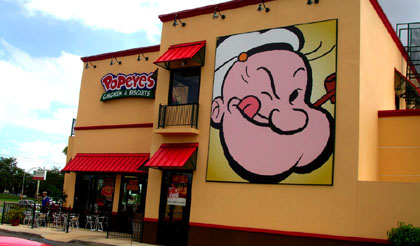
popeyescanada.jpg

I do a lot of posts regarding Popeye’s current licensed (and unlicensed) merchandising activities. Who can forget Popeye the Sewer Man, Popeye the Beer Salesman and of course, Popeye the-Pot-guy-Hip-hop-Hustler-Man? I’m always amused that the character could ever be used a pitchman for anything but Spinach.

Now Brew reader Art Binninger has just discovered that Popeye is fronting a new chain of vitamin supplement shops in Canada. If you live in Canada, here’s a complete list of shop locations. No steroids for this one eyed sailor.

Orgesticulanismus by Mathieu Labaye

Orgesticulanismus

This one’s a must-see! Orgesticulanismus by Mathieu Labaye of Camera Etc. starts out slow but quickly turns into one of the most impressive shorts I’ve seen in a while. It’s an animator’s film with lots of beautiful, wildly creative hand-drawn animation on display. I just find it incredibly inspiring to see skilled animators freestyling and having fun with the graphic possibilities of the medium. The film appears to have some deeper meaning as well; it’s a tribute to the late Benoît Labaye, and the French dialogue is the voice of Labaye. It’s on YouTube, but embedding is disabled, so head over here to watch it.

(Thanks to Louis-Étienne Vallée for pointing this out, and to Catsuka.com for the original post)

Masaaki Yuasa’s Kaiba

Below are the opening titles to the upcoming series Kaiba, created and directed by Masaaki Yuasa, the genius visionary behind Mind Game. A few more details on the series, which is described as a sci-fi romance, can be found on Wikipedia.

And here is a tantalizing clip from Kemonozume, Yuasa’s first TV series made in 2006. Considering how much I admired Mind Game, I’m ashamed to admit that I haven’t seen this series yet, though Ben Ettinger’s write-ups about the 13 episodes make it sound phenomenal. Even in this short clip, the graphic invention and cinematic quality of storytelling are astounding, and so far beyond anything I’ve ever seen in American TV animation. The only thing that surprises me is that Yuasa’s work isn’t more readily available in the United States. (Thanks, Brandon)

Titles for Run Papa Run

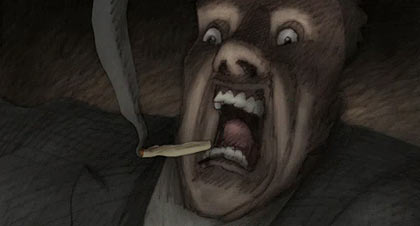
Run Papa Run

Henri Wong, an animator and motion graphics designer from Hong Kong, sent in a link to an eye-catching animated title sequence he recently created for the live-action feature Run Papa Run. Wong writes, “The animation is all about the nightmare of a gangster father running away from all kinds of fear and danger. More detail about the film can be found here.” Wong also did the animated sequences in this bizarre live-action short titled Solutions (warning: features animated arse stabbing).

The CFA

cfa2008.jpg

Channel Frederator has announced the nominations for its second annual Channel Frederator Awards (CFA). The competition includes 33 nominated films in a total of 11 viewer-voted categories, as well as 7 juried categories.

Anyone can vote – the process is simple and there are a lot of good films to view online. Winners will be honored at an awards party June 4th in New York City, which will be webcast on June 10th. The voting pages went live today on the CFA website.

Brad Bird on Ollie Johnston

Ollie Johnston in The Iron Giant
Ollie Johnston’s cameo in Brad Bird’s The Iron Giant

We asked Brad Bird, Oscar-winning director of Ratatouille and The Incredibles, if he could share a few thoughts about the passing of Ollie Johnston. Brad responded with this eloquent piece:

I was lucky enough to meet eight of Disney’s famed “Nine Old Men”. I never met John Lounsberry in person, though he did see the film that I made as a kid. The “Old Men” I knew the best were Milt Kahl and Eric Larson, who mentored me directly in early years, and Frank Thomas and Ollie Johnston, who I often visited and heckled, but didn’t really get to know well until I was working professionally.

Ollie Johnston drawing

In spite of the usual “one happy family” picture that public relations always wants to paint about production teams, Disney’s Nine Old Men were competitive with each other. They would help each other out, but like all artists, they had differences of opinion on how best to approach their work.

Milt’s complaint about Ollie’s work was “There are no extremes! His scenes are all inbetweens!”.

This is, of course, wrong.

But it does capture a truth about Ollie’s work; that it was intuitive, subtle and elusive. It was difficult to see all that Ollie was doing when you flipped his original drawings, because he didn’t push his key poses as far as Milt did graphically, or as far as Frank did performance-wise… but when you saw Ollie’s scenes the way they were intended to be seen– at 24 frames a second– all the beautiful nuances became crystal clear; and his characters were as sympathetic and as full of life as anything seen on screen.

Where both Milt and Frank exerted a huge amount of energy planning their scenes, grappling with problems, exploring every alternative, etc… Ollie just thought a bit, did a few thumbnails and sort of let the scenes happen. This is not to say that he was any less dedicated than any other top animator at Disney, but he didn’t sweat as much in the process. Drawings flowed out of him like water.

Toward the end of his career, when most animators are slowing down, this extraordinary ease enabled him to be a tremendously productive animator; on “The Rescuers” he was producing ten feet of top-quality animation a week, double (or more) the output of his fellow animators.

Ollie Johnston drawing

I came along at a “best of times/worst of times” moment at Disney animation. The worst of times because the studio was creatively moribund and young people were not yet empowered to do anything to change it. The best of times because a few of the old masters were still around, still working, and still able to impart their wisdom to us eager students.

When Frank and Ollie retired from production on the same Friday I was the next animator on Ollie’s desk the following Monday; the very desk he had used for decades to create so many indelible animated moments. I was properly awed as I sat down in Ollie’s chair, at his desk.

As I was checking it out and getting the feel of it I noticed the pencil sharpener was full of shavings. Instead of throwing them out I poured them into a glass jar, labeled it and set it atop the desk. Good luck shavings… a simple reminder of the hard work required to create magic. My own jar of real Disney dust. The last jar.

Ollie got a kick out of that story when I told him, and for years afterward he asked me how the jar was doing. I kept in touch with several of the “Old Men” after they retired, and was particularly happy to pay Ollie and Frank both a hand-drawn and computer generated (both animated by Mike Venturini) tip of the hat in IRON GIANT and INCREDIBLES, which they were surprised and delighted to be a part of so late in their lives.

Ollie was one of the best that ever was and will be. He lives on as an entertainer, a teacher and inspiration for all generations to come. Needless to say, I’ll miss him. But I plan on visiting him as I visit Milt, Eric, Frank and all the others who taught and/or inspired me–

–through their work.. which will be around forever.

Ollie Johnston in The Iron Giant
Ollie Johnston’s cameo in The Incredibles

The Disney Company on Ollie Johnston

miltmarkfrankolliewalt.jpg
(Above: Milt Kahl, Marc Davis, Frank Thomas and Walt Disney flank seated Ollie Johnston)

Howard Green just sent over the official studio press obituary, released to the media at 11am today:

Ollie Johnston, one of the greatest animators/directing animators in animation history and the last surviving member of Walt Disney’s elite group of animation pioneers known affectionately as the “Nine Old Men,” passed away from natural causes at a long term care facility in Sequim, Washington on Monday April 14th. He was 95 years old. During his stellar 43-year career at The Walt Disney Studios, he contributed inspired animation and direction to such classic films as “Snow White and the Seven Dwarfs,” “Pinocchio,” “Fantasia,” “Song of the South,” “Cinderella,” “Alice in Wonderland,” “Peter Pan,” “Lady and the Tramp,” “Sleeping Beauty,” “Sword in the Stone,” “Mary Poppins,” “The Jungle Book,” “Robin Hood,” “The Rescuers,” and “The Fox and the Hound.”

In addition to his achievements as an animator and directing animator, Johnston (in collaboration with his lifelong friend and colleague Frank Thomas) authored four landmark books: Disney Animation: The Illusion of Life, Too Funny for Words, Bambi: The Story and the Film, and The Disney Villain. Johnston and Thomas were also the title subjects of a heartfelt 1995 feature-length documentary entitled “Frank and Ollie,” written and directed by Frank’s son, Theodore (Ted) Thomas. In November 2005, Johnston became the first animator to be honored with the National Medal of Arts at a White House ceremony.

Behind every great animated character is a great animator and in the case of some of Disney’s best-loved creations, it was Johnston who served as the actor with the pencil. Some examples include Thumper’s riotous recitation (in “Bambi”) about “eating greens” or Pinocchio’s nose growing as he lies to the Blue Fairy, and the musical antics of Mowgli and Baloo as they sang “The Bear Necessities” in “The Jungle Book.” Johnston had his hand in all of these and worked on such other favorites as Brer Rabbit, Mr. Smee, the fairies in “Sleeping Beauty,” the centaurettes in “Fantasia,” Prince John and Sir Hiss (“Robin Hood”), Orville the albatross (“The “Rescuers”), and more than a few of the “101 Dalmatians.”

Roy E. Disney, director emeritus and consultant for The Walt Disney Company, said, “Ollie was part of an amazing generation of artists, one of the real pioneers of our art, one of the major participants in the blossoming of animation into the art form we know today. One of Ollie’s strongest beliefs was that his characters should think first, then act…and they all did. He brought warmth and wit and sly humor and a wonderful gentleness to every character he animated. He brought all those same qualities to his life, and to all of our lives who knew him. We will miss him greatly, but we were all enormously enriched by him.”

John Lasseter, chief creative officer for Walt Disney and Pixar Animation Studios and a longtime friend to Johnston, added, “Ollie had such a huge heart and it came through in all of his animation, which is why his work is some of the best ever done. Aside from being one of the greatest animators of all time, he and Frank (Thomas) were so incredibly giving and spent so much time creating the bible of animation — ‘Disney Animation: The Illusion of Life’ — which has had such a huge impact on so many animators over the years. Ollie was a great teacher and mentor to all of us. His door at the Studio was always open to young animators, and I can’t imagine what animation would be like today without him passing on all of the knowledge and principles that the ‘nine old men’ and Walt Disney developed. He taught me to always be aware of what a character is thinking, and we continue to make sure that every character we create at Pixar and Disney has a thought process and emotion that makes them come alive.”

Glen Keane, one of Disney’s top supervising animators and director of the upcoming feature “Rapunzel,” observed, “Ollie Johnston was the kind of teacher who made you believe in yourself through his genuine encouragement and patient guidance. He carried the torch of Disney animation and passed it on to another generation. May his torch continue to be passed on for generations to come.”

Andreas Deja, another of today’s most acclaimed and influential animators paid tribute to his friend and mentor in this way, “I always thought that Ollie Johnston so immersed himself into the characters he animated, that whenever you watched Bambi, Pinocchio, Smee or Rufus the cat, you saw Ollie on the screen. His kind and humorous personality came through in every scene he animated. I will never forget my many stimulating conversations with him over the years, his words of wisdom and encouragement. ‘Don’t animate drawings, animate feelings,’ he would say. What fantastic and important advice! He was one of the most influential artists of the 20th century, and it was an honor and joy to have known him.”

John Canemaker, Academy Award®-winning animator/director, and author of the book, Walt Disney’s Nine Old Men & The Art of Animation, noted, “”Ollie Johnston believed in the emotional power of having ‘two pencil drawings touch each other.’ His drawings had a big emotional impact on audiences, that’s for sure — when Mowgli and Baloo hug in ‘The Jungle Book;’ when Pongo gives his mate Perdita a comforting lick in ‘101 Dalmatians;’ when an elderly cat rubs against an orphan girl in ‘The Rescuers’ — Ollie Johnston, one of the greatest animators who ever lived, deeply touched our hearts.”

Born in Palo Alto, California on October 31, 1912, Johnston attended grammar school at the Stanford University campus where his father taught as a professor of the romance languages. His artistic abilities became increasingly evident while attending Palo Alto High School and later as an art major at Stanford University.

During his senior year in college, Johnston came to Los Angeles to study under Pruett Carter at the Chouinard Art Institute. It was during this time that he was approached by Disney and, after only one week of training, joined the fledgling studio in 1935. The young artist immediately became captivated by the Disney spirit and discovered that he could uniquely express himself through this new art form.

At Disney, Johnston’s first assignment was as an in-betweener on the cartoon short “Mickey’s Garden.” The following year, he was promoted to apprentice animator, where he worked under Fred Moore on such cartoon shorts as “Pluto’s Judgement Day” and “Mickey’s Rival.”

Johnston got his first crack at animating on a feature film with “Snow White and the Seven Dwarfs.” Following that, he worked on “Pinocchio” and virtually every one of Disney’s animated classics that followed. One of his proudest accomplishments was on the 1942 feature “Bambi,” which pushed the art form to new heights in portraying animal realism. Johnston was one of four supervising animators to work on that film.

For his next feature assignment, “Song of the South” (1946), Johnston became a directing animator and served in that capacity on nearly every film that followed. After completing some early animation and character development on “The Fox and the Hound,” the veteran animator officially retired in January 1978, to devote full time to writing, lecturing and consulting.

His first book, Disney Animation: The Illusion of Life, written with Frank Thomas, was published in 1981 and ranks as the definitive tome on the Disney approach to entertainment and animation. In 1987, his second book, Too Funny For Words, was published and offered additional insights into the studio’s unique style of visual humor. A detailed visual and anecdotal account of the making of “Bambi,” Walt Disney’s “Bambi”: The Story and the Film, the third collaboration for Thomas and Johnston, was published in 1990. The Disney Villains, a fascinating inside look at the characters audiences love to hate, was written by the duo in 1993.

In addition to being one of the foremost animators in Disney history, Johnston was also considered one of the world’s leading train enthusiasts. The backyard of his home in Flintridge, California, boasted one of the finest hand-built miniature railroads. Even more impressive was the full-size antique locomotive he ran for many years at his former vacation home in Julian, near San Diego. Johnston had a final opportunity to ride his train at a special ceremony held in his honor at Disneyland in May 2005.

The pioneering animator was honored by the Studio in 1989 with a Disney Legends Award. In 2003, the Academy of Motion Pictures Arts and Sciences held a special tribute to him (and Frank Thomas), “Frank and Ollie: Drawn Together,” in Beverly Hills.

Johnston and Thomas were lovingly caricatured, and even provided the voices, in two animated features directed by Brad Bird, “The Iron Giant,” and Disney/Pixar’s “The Incredibles.”

Johnston moved from his California residence to a care facility in Sequim, Washington in March 2006 to be near his family. He is survived by his two sons: Ken Johnston and his wife Carolyn, and Rick Johnston and his wife Teya Priest Johnston. His beloved wife of 63 years, Marie, passed away in May 2005. Funeral plans will be private. In lieu of flowers, the family suggests donations can be made to CalArts (calarts.com), the World Wildlife Fund (worldwildlife.org), or National Resources Defense Council (nrdc.org). The Studio is planning a life celebration with details to be announced shortly.

John Canemaker on Ollie Johnston

canemakerollierufus.jpg

Oscar winning animator, animation historian and author of Disney’s Nine Old Men, John Canemaker sent in this tribute to Ollie Johnston:

Like so many of the great pioneer hand-drawn animators, Ollie Johnston was athletic. As a boy he loved playing touch football in a wide field of haystacks at Stanford where his father was a professor of romance languages. He enjoyed hiking, fishing and swimming in the lakes of the nearby hills. The ironic thing is how his idyllic childhood and adolescence was riddled with poor health, everything from severe sinus infection to measles and chicken pox to palsy.

His dear friend and animation peer Frank Thomas once said that Ollie is “stuck together with spit and string but will outlast everyone.” That has proven to be true.

Ollie was a survivor, a wonderful combination of inner strength and outer gentleness. He could be practical, thoughtful and tough in making life decisions, such as buying property or cutting down a favorite old tree when it loomed dangerously. But he was also a passionate man, full of emotions that found the perfect outlet in his soft, blue pencil lines that, as Glen Keane said, “coaxed into being” the most sensitive of character relationships. “I seem to have a kind of reservoir of feelings about how people felt in certain situations,” Ollie once explained.

He was also a great believer in the magic that happens when two drawings of characters touch each other. “It’s surprising,” he said, “what an effect touching can have in an animated cartoon.” Mowgli literally bear-hugging Baloo; Pongo giving an encouraging lick to frightened Perdita; old Rufus (Ollie’s self-caricature) brushing against sad orphan Penny; Prince John poking sycophantic Sir Hiss; drunken Mr. Smee rough-housing with Capt. Hook are but a few of the vivid physical interactions that Johnston used to unlock personalities who became messengers of emotion that connected with audiences around the world.

It was my luck and pleasure to have known Ollie Johnston as a friend for many years. He was wonderful, warm and gentle man, a teacher and author (like his father), and one of the great artists of animation. I miss him, but find comfort in that I can always find him when I view his amazing and touching animated performances.

Ollie Johnston 1912-2008

olliesleeping.jpg

The end of an era.

The last of the Nine Old Men, Ollie Johnston, passed away today in Sequim, Washington at the age of 95. Jenny Lerew confirms it.

UPDATE (5:18pm): Brad Bird, the Oscar-winning director of Ratatouille and The Incredibles, remembers Ollie Johnston.

UPDATE (5:05pm): A fun Ollie-related image I found in my files. It’s a drawing by Ward Kimball of the 1-D animation unit at Disney. Left to right: Ward Kimball, Clarke Mallery, Ollie Johnston, Mary Schuster and Al Bertino.

Ollie Johnston by Ward Kimball

UPDATE (3:50pm): More good tributes to Ollie from:
Floyd Norman
Michael Barrier
Will Finn
Steve Hulett
Emru Townsend

UPDATE (12:20pm): The official statement from the Walt Disney Company about Johnston’s passing.

UPDATE (9:00am): Oscar-winning animator, animation historian and author of Disney’s Nine Old Men, John Canemaker, remembers Ollie Johnston.

UPDATE (5:42am): This morning, Hans Perk posted a brief video he took of Ollie Johnston on July 20, 2005. In it, Johnston eloquently explains the importance of creating believable animated characters that resonate with audiences. Hans also has some great Ollie-related posts on his blog here, here, here, and here.

UPDATE (4:54am): Tributes to Johnston, from people who knew him personally and others who simply admired his work, are appearing throughout the online community. Here are some of the better ones:
Pete Emslie
Rhett Wickham
Michael J. Ruocco
Floyd Bishop
Kate and Terry
Frank Dormer

UPDATE (10:17pm): A terrific video below in which Glen Keane examines the drawings and animation style of Ollie Johnston. Also be sure to see the three-part Disney “Family Album” documentary about Ollie.

UPDATE (9:35 pm): Howard Green sent us this quote from Roy Disney…

“Ollie was part of an amazing generation of artists, one of the real pioneers of our art, one of the major participants in the blossoming of animation into the art form we know today. One of Ollie’s strongest beliefs was that his characters should think first, then act…and they all did. He brought warmth and wit and sly humor and a wonderful gentleness to every character he animated. He brought all those same qualities to his life, and to all of our lives who knew him. We will miss him greatly, but we were all enormously enriched by him.”

UPDATE: Here are handy lists of all the characters that Ollie animated in the Disney features and shorts.

UPDATE: There are a couple of interviews with Ollie alone and a few of him and Frank, posted on the Disney Family Museum website, well worth reading.

UPDATE: Rebekah Mosely informs us that the Carolwood Pacific Historical Society has a previously planned event on Sunday May 18th at 2pm to dedicate Ollie Johnston’s Train Station at Griffith Park in LA. Their calendar and organization contact information can be found here.

Mouse Heaven

Here is a rarely seen film by Kenneth Anger (best known for the book Hollywood Babylon and his landmark avant-garde film, Scorpio Rising), using vintage Mickey collectibles set to an eclectic score of tunes from such artists as The Boswell Sisters, The Proclaimers and Ian Whitcomb. We first posted about this film in January 2005; Anne D. Bernstein reported here on its premiere screening at the Museum of Modern Art the same month .

(Thanks, Patrick McCart)

Annecy, Anima Mundi, Hiroshima & Ottawa

Annecy

Four major animation festivals on four different continents are coming up soon: France’s Annecy in June, Brazil’s Anima Mundi in July, Japan’s Hiroshima in August and Canada’s Ottawa in September. It’s well worth setting aside time to attend any one of these major festivals. Not only are festivals a great place to see animated films that are otherwise inaccessible and to meet people who are passionate about the possibilities of the art form, they’re also a lot of fun. Jerry and I will be attending at least a couple of these events. Let everybody know in the comments which one of these fests you’ll be attending.

Annecy ’08, from June 9-14, includes a focus on emerging animation from India, an Émile Cohl retrospective, a presentation on Winsor McCay by John Canemaker, and both an exhibiton and screening related to Tex Avery. Also the official film selections have been announced.

Anima Mundi takes place in Rio de Janeiro from July 11-20 and in São Paulo from July 23-27. There’s not much on their website yet, but they always manage to put together quality programs and guests.

Hiroshima ’08 takes place August 7-11 and among its programming highlights are retrospectives of Paul Driessen, Osamu Tezuka and Alexander Tatarsky.

Ottawa ’08 is happening September 17-21. They just launched a redesigned website including a preview of this year’s special programs. Highlights include: John Canemaker chatting in-person with the reclusive Richard Williams, a program about “new wave Japanese animation”, retrospectives of Michael Sporn and Jonas Odell, a four-part look at Canadian animation auteurs based on Chris Robinson’s new book Looking for A Place to Happen: On the Road with Canadian Animators, and an animation propaganda program curated by Karl Cohen.