Who Is Rocket Johnson? Charity Auction

Who is Rocket Johnson

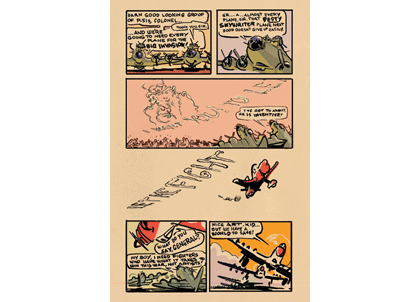
Who is Rocket Johnson? (previously mentioned on the Brew) is the new graphic novel anthology being self-published by Disney animation artists and debuting at Comic-Con in a few weeks. A special copy of the book is currently being auctioned on eBay, and all proceeds from the sale will be donated to the National Multiple Sclerosis Society to help fund research in finding a cure for the disease. The copy on eBay is signed by all of the Disney artists in the book and also comes with a set of pins made especially for Comic-Con. The auction ends on July 10. More details about the book are at WhoIsRocketJohnson.com.

Below are a few sample pages displaying some of the lovely artwork that can be found in the book. Click on each for a larger version.


“Pee Wee 51″ by Mike Gabriel

“The Last Stand of Lloyd Loomis” by Dean Wellins

“Number Nine Must Launch” by Sam Levine

Mind Over Manga

yamamotomononoke1.jpg

Anime website Digital Manga once again sponsors Pop Japan Travel’s Mind Over Manga Tour from Aug. 21st through August 27th. This year the tour will include a meeting with anime art director Nizo Yamamoto and a visit to Nippon Animation, the studio that helped give Hayao Miyazaki and Isao Takahata their start. Yamamoto will also introduce the group to the art staff he directed on this year’s acclaimed anime The Girl Who Leapt Through Time.

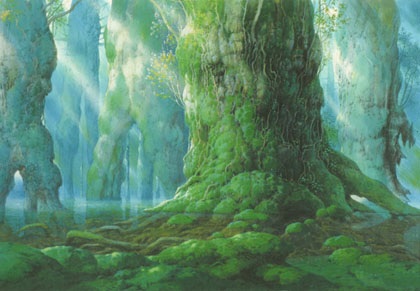
Yamamoto has served as art director on many acclaimed anime, including Princess Mononoke (above) and Grave of the Fireflies. His background art has also appeared in Spirited Away, Perfect Blue, Lupin III: The Castle of Cagliostro and more.

Mind Over Manga also includes a backstage visit to the Comitia indie manga event, plus Hayao Miyazaki’s Ghibli Museum, and a tour of Tokyo, plus a few excursions outside the city. Optional tours of Hiroshima, Kyoto and Osaka are also available.

The Mind Over Manga tour, including round-trip airfare from LAX to Tokyo, full hotel accommodations, transport in Japan, entry fees, bilingual guides and customized guidebook, is $2,198 plus a $235 fuel surcharge. The Kyoto and Osaka option is $898, while Hiroshima is $100. Considering the price of gas these days, this seems like a bargain. More information on the Pop Japan Travel website.

Marketing Wall•E and Kung Fu Panda

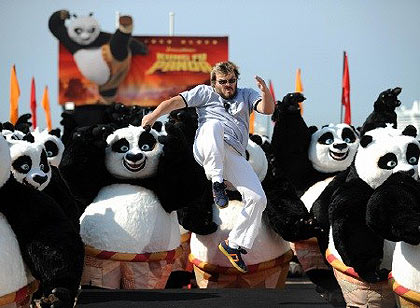
The Movie Marketing Madness blog offers interesting in-depth analyses of the marketing campaigns supporting the recent animated features Wall•E and Kung Fu Panda. The blog concludes that both movies had successful ad campaigns.

Then again, they had better be successful for the amount of coin they’re spending to market these pictures. This recent article in Variety discusses the exorbitant costs of promoting animated features nowadays, and says that these two animated features have the costliest marketing campaigns of any two Hollywood films this year, with Disney’s $54 million Wall•E campaign leading the way.

Grand Theft Auto IV: Almost Great Art

There is little doubt in my mind that videogames are one of the major emerging art forms of the late-20th century and beyond, but how do games stack up against other more established narrative forms like books and movies. Pulitzer Prize-winning author and videogame fan Junot Díaz wrote a piece in last weekend’s Wall Street Journal that examined the new Grand Theft Auto IV and the comparisons it has drawn to works like The Godfather and The Sopranos. Diaz argues that certain elements are inherent in all great pieces of narrative art and that those elements are missing from GTA IV:

GTA IV sucks you the hell in but its narrative doesn’t move me in any way or shake me up or even piss me off. I get madder when I crash my car in the game than when Niko makes a stupid decision in the cut-scenes (the movie-like interludes that players don’t control). GTA IV for all its awesomeness doesn’t have the sordid bipolar humanity of “The Sopranos,” and it certainly lacks the epic flawed protagonists that define “The Godfather” and its bloodier lesser brother “Scarface.” Successful art tears away the veil and allows you to see the world with lapidary clarity; successful art pulls you apart and puts you back together again, often against your will, and in the process reminds you in a visceral way of your limitations, your vulnerabilities, makes you in effect more human. Does GTA IV do that? Not for me it doesn’t, and heck, I love this damn game.

According to Diaz though, videogames do have the potential to be a powerful form of narrative expression:

What’s interesting though is that GTA could have been exactly what some folks are claiming it is. For all its over-the-top aberrance and brash transgressiveness, GTA IV doesn’t really wrestle with the radiant feverish nightmare labyrinth that post-9/11 America has become. Which is too bad. When you’re as lost as we are in this country, maps, no matter from where they come, are invaluable. It could have been that popular art blade that cuts through all pretensions and delusions; it could have been the map that we’ve been needing. But for that to have been possible GTA would have had to have put a small portion of the people playing the game at risk of waking up, even if only for a second, from the dream that is our current world.

Animated Sounds

duckamuck420.jpg

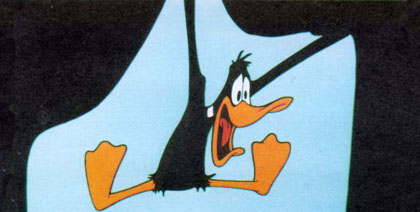
Heads up on yet another animation event at the Academy of Motion Pictures Arts and Sciences. The Sound Behind The Image II: Now Hear This! is an evening celebrating the art of sound in animated films. It will take place at the Samuel Goldwyn Theatre in Beverly Hills on Friday August 8th. Hosted by sound editor Mark Mangini (Looney Tunes: Back In Action, Runaway Brain, Raiders of the Lost Ark, etc.), the presentation begins at 7:30. You can order tickets ($5./students $3) here.

The Clockmaking Monkey (1938)

Here’s a rare treat: El Mono Relojero (The Clockmaking Monkey – Argentina, 1938) is only surviving film by the creator of the first animated feature (El Apostol, 1917), Quirino Cristiani (who also created the world’s first animated sound feature, Peludópolis in 1931). The rest of his films perished in a fire in 1962. Oscar Grillo says the voice is by Pepe Iglesias (aka “El Zorro”), the actor who later dubbed into Spanish the voice of the fox in Disney’s Pinocchio. A few months ago Jorge Finkielman posted a rare cel from this film on the Animation Show forum. For more about Cristiani, read Giannalberto Bendazzi’s 1983 article on AWN.

Looney Muses

looneymuses.jpg

Billy Collins, a former U.S. poet laureate, writes about his love for Warner Bros. Cartoons in today’s Wall Street Journal. This quote sums up the jist of the piece:

Bugs would do the impossible by jumping out of the frame and landing on the drawing board of the cartoonist who was at work creating him. This freedom to transcend the laws of basic physics, to hop around in time and space, and to skip from one dimension to another has long been a crucial aspect of imaginative poetry.

Collins life long enthusiasm for Looney Tunes is evident. The article has several nice illustrations, plugs for several essential reference books and a concise illustrated timeline of the golden age of Hollywood cartoons.

Cartoon Modern for the budget-conscious

Cartoon Modern cover

I know most people have my book Cartoon Modern by now, but if you’re in need of a copy, Amazon is currently selling new copies at a 42% discount, the cheapest I’ve seen to date on their website. I don’t believe it’s been remaindered because those discounts are generally much steeper, but $23.28 is still a good deal for a $40 book.

From my understanding, the first printing of the book is nearly out of stock and there aren’t plans for a second printing as of this writing, so it’s a doubly good time to pick up an extra copy or two. Also, if you’re in New York City, it’s worth noting that the great Strand Books always keeps a nice stock of Cartoon Modern and sells them at a 20% discount (or $31.95). Amazon link to Cartoon Modern

UPDATE Looks like the discount period is over. Amazon has returned the book to its usual 34% discount instead of the 42% discount.

The Tale of Despereaux Trailer

Despereaux

Here is the trailer for Universal’s CG adaptation of the children’s book The Tales of Despereaux. Sam Fell (Flushed Away) is directing, but the production has had a troubled history with earlier directors including Sylvain Chomet (Triplets of Belleville) and Mike Johnson (The Corpse Bride). Chomet told an interviewer about his decision to leave the film: “As the budget got bigger, the studio wanted a less dark, more commercial story and it wasn’t what I wanted to make.” Chomet’s wife and business partner, Sally, added, “We had barely finished a character sketch and its potential as a plastic toy was being assessed.”

(Thanks, Jakob for trailer link)

Wall•E and Presto talkback

walleopening.jpg
The professional critics have had their say (a huge 98% positive on Rotten Tomatoes). Now it’s your turn to weigh in with an opinion of Pixar’s latest feature film and short subject.

The purpose of this post is to solicit readers opinions of Wall•E and Presto. Please respond below only if you’ve actually seen the film (we will not post comments here by those who have not).

Ward Kimball on CinemaScope

Several years ago I curated a program of CinemaScope cartoon shorts from the 1950s, which I screened at the Ottawa Animation Festival, the Museum of Modern Art and several other venues. While researching the subject, I came upon a small article by Ward Kimball, from Films In Review (March 1954), in which he discusses the subject.

Kimball makes several interesting points referencing his work on Toot Whistle Plunk and Boom and shows the thought Disney’s animators put into using this unique, new screen shape. Kimball notes how wide shots and longer scenes play better in wide screen and how, in CinemaScope, “cartoon characters no longer perform in one spot against a moving background, but are moved through the scenes.” He also makes note of the use of directional Stereophonic sound used in these shorts. (Grand CanyonScope will be released letterboxed and in stereo on the forthcoming Disney Treasures: Donald Vol. 4 later this year).

Kimball’s piece is preceeded by an overview by writer Ed Lubin entitled “Disney Is Still Creative”(!) which touts the studio’s relevancy during the changing animation scene of the early 50s. Click on the thumbnails below to read both articles.

firmarch5311.jpg firmarch532.jpg firmarch533.jpg firmarch5304.jpg

Satoshi Kon: Beyond Imagination

beyondimagine.jpg

Big news for New York anime fans: acclaimed Japanese animation director Satoshi Kon (Paprika, Perfect Blue, etc.) is coming to New York City this week to personally host a retrospective of his films for the Film Society of Lincoln Center. Kon will be participating in an onstage interview opening night, Friday June 27th, to kick off the series, and will be introducing all the films for the duration of the screenings (June 27-July 1).

This is an incredible opportunity to meet one of the modern masters of anime. For more information on this series, Satoshi Kon: Beyond Imagination, and to purchase tickets go to the Walter Reade Theatre website.

CalArts Hiring New Character Animation Head

The CalArts Character Animation Department is looking for a new program director. Here’s the job listing. The CalArts grad who sent us this link added in his email:

“As an alum, I’ve grown somewhat disappointed with the level of ability graduating from the same department that raised me (don’t even get me started about last year’s Producers’ Show), so I have great hopes that whoever they get back in the school will do whatever it takes to restore its once sterling reputation.”

Kung Fu Panda Writer Can’t Stand Katzenberg

Dan Harmon, one of the writers of Kung Pu Panda, has written an entertaingly long rant about how much he disliked working on the film and particularly how much he disliked working with Jeffrey Katzenberg. Actually I’m not sure what’s more amusing: that Harmon hated working with Katzenberg so much or that he’s so damn clueless about the animation process. To begin the piece, Harmon expresses incredulity that some animated films are written with storyboards and not scripts: “First they storyboard the entire film. That is the first step. Not kidding. No writers, no script, just a story, and an entire film drawn on pieces of paper.”

Here’s another choice excerpt:

“I came in about four writers into the process. It’s kind of hard to write a “better” scene than the last writer when the rules are that you can only change 30 percent of each scene or completely change 30 percent of the scenes, per Katzenberg screening. So, for instance, in this scene, the panda comes up a flight of stairs carrying a bucket of water, slips on a banana peel, says something to two geese and does an air guitar. The good news? There can be anything in the bucket. Your mission: make the movie better.

“It’s harder than it sounds. Especially when the larger “bucket” that the movie is contained in cannot change: the fact that the story has to be about a panda who is informed he is the chosen one, destined to …beat up… a guy who has escaped from prison and who is spending the entire movie walking to town, in order to…try to beat him up, because that’s the prophecy. And I won’t spoil the movie, but the bad guy doesn’t win. Because he’s not destined to. But just to make sure he doesn’t win, and because there’s 70 minutes of time to kill before he gets there on foot, the panda is trained in the martial arts. it’s kind of like Karate Kid, but if Mister Miyogi had long ago banished the Kobras and was running the karate tournament.”

(via Seward Street)