The Bravest Warriors

Most people who view Pen Ward’s Adventure Time either passionately love it – or don’t get it at all. I’m in the camp that loves it, and I’m delighted Cartoon Network has gotten behind it. It’s practically the only animated series on the horizon I’m excited about (admittedly, I’m not that aware of most series currently in production). In fact, I think Invader Zim was the last show I felt had the potential to shake up the TV cartoon landscape as this does.

Adventure Time could be considered a perfectly skewed update/reimagining of Tom Terrific crossed with references to several early anime features… though Pen told me he hadn’t ever seen Tom Terrific nor any vintage anime for inspiration. Wherever he gets it from, Pen has the freshest vision in TV animation today — and it’ll be fascinatining to see how his cartoons fare with the general public.

His other short for the Random Cartoon series hasn’t gotten as much attention, but I think it’s equally good. The Bravest Warriors (co-directed with Randy Myers) proves (to me) that creator Ward isn’t a one-shot wonder. Warriors plays like his take on the Johnny Cypher-Captain Scarlet-Space Angel school of space cadet adventures (with a heart-felt dose of teen angst), but I bet he hasn’t seen those old cartoons either.

It’s all coming from somewhere inside his soul — and that’s where the best cartoons come from.

I, for one, would like to see more Bravest Warriors cartoons. Click here to read the brief production blog.

Watchmen: Black Freighter trailer

In conjunction with the March 6th release of Watchmen, Warner Bros. is releasing (on March 24th) a direct-to-video animation of Tales of The Black Freighter. In the original Watchman graphic novel, a Black Freighter comic book story is read and weaved within the main narrative. I’m particularly excited about this project because of the two talented directors helming this adaptation — animator Mike Smith (Tank Girl, 1001 Nights) and designer/filmmaker Daniel DelPurgatorio.

(via Frames Per Second)

No Girls Allowed?

Men Working

Danny Hayes, a guy who worked on Coraline, complains in Bitch magazine that the Coraline production was too much of a boys-only club. Says Danny:

Make no mistake — Coraline (the just-released stop-motion feature made by Laika Productions right here in Bitch’s hometown of Portland, OR) may be a girl’s story, but the animation industry is still very much a boys’ club. Stick around for the credits after the film and you’ll see that the screenwriter, director, editors, most of the animators, and the “Based on the Novel by” guy are all dudes. This tidbit may come as a surprise, but it shouldn’t. Men were at the helm of almost every major animated feature in recent and not-so-recent history, including those movies that have been embraced specifically by female audiences.

But what does keeping female voices out of the upper echelons of the movie machine do to the industry as a whole?

In my (admittedly limited) experience, it creates a stressful, and at times hostile, work environment. From Henry Selick (the movie’s sometimes maniacal leader) on down, there was definitely a machismo feeling on the set. Competition among co-workers and an assembly-line type of atmosphere was imposed on employees, most of whom were there because of their obsession with the art form but let down by the studio’s poor treatment of its workers.

Danny has a valid point that animation production in general is too male-dominated, but I’d argue that the situation has been changing very rapidly during the past decade. Though the mainstream industry’s creative figureheads remain almost entirely male, the independent animation industry has become much more diverse, with many of the coolest commercials, music videos and independent films being made by women like Gaelle Denis, Suzie Templeton and Laurie Thinot. Two recent indie animation features were also directed by women–Tatia Rosenthal’s $9.99 and Nina Paley’s Sita Sings the Blues–and women are principals of some of the coolest studios around like Shy the Sun, Panda Panther and Tiny Inventions. In other words, the animation world is currently experiencing an unprecedented diversification of its gender make-up, and as a result, the art form is becoming much richer and more interesting to watch.

Paint by Norman Gollin

Paint is a trippy live-action short from 1968 directed by West Coast advertising art director Norman Gollin. Why post it here on Cartoon Brew? Not only because it has the mesmerizing voice of Paul Frees, but because it was produced at the Haboush Company, which was the commercial production studio of animation legend Victor Haboush. I’ve known Vic for quite a few years and I’m always amazed by how many cool projects and people he’s been involved with throughout his career, from studying with Lorser Feitelson at Art Center, apprenticing under Tom Oreb for much of the 1950s on Disney films like Toot Whistle Plunk and Boom and Sleeping Beauty, art directing Gay Purr-ee, starting a commercial studio with the inimitable John Dunn, and later directing hundreds of live-action commercials and producing experimental animated shorts at his own company. Oh yeah, he also worked on The Iron Giant. Somehow it’s not surprising that he’d be involved with a film as wild as this.

The painter in Paint is Charlie White III, a veteran airbrush artist who is one of four people featured in the new book Overspray: Riding High with the Kings of California Airbrush Art. White notes that Gollin shot the entire film without any re-takes. No paint-overs or practice; it was all painterly improv.

(Warning: This film might be considered NSFW, though most people would consider it art.)

Dear Anna Olson

Dedicated independent animators will do – and should do – anything they can to complete their films. Case in point: East coast animator Dean Kalman Lennert has been working on a personal film for over ten years between professional jobs on Doug, Beavis & Butt-head, TV Funhouse, and Ice Age. Inspired by a note he found tied to a balloon, Dear Anna Olson is hand drawn, fully animated and entirely dependent on donations for completion. In an effort to raise the funds to finish the last 30% of the project, Lennert is doing everything he can think of, including making this recent appearance on local TV (“Better Connecticut”, WFSB, Channel 3 in Hartford) to make his case:

For more information on Lennert’s film, or to make a donation, go to DearAnnaOlson.com.

World Wildlife Fund PSA by Stephen Watkins

Stephen Watkins, repped by Melbourne’s XYZ Studios, created “Tick,” a stylish PSA for the World Wildlife Fund. The piece, set to Fleet Foxes’ “White Winter Hymnal” (which has its own animated music video too), makes effective use of digital animation and CGI to create a hand-crafted feel. The agency behind the piece, Leo Burnett Sydney, gave the following brief to the filmmaker:

Sometimes it’s hard to get people to support a cause because they think, ‘I’m just one person, what can I do?’ We wanted to show individuals how their support can have a direct and positive effect on Australia’s natural environment. So we took the universal symbol for pledged support, the ticked box, and we animated it. Then that ticked box joined forces with hundreds of other animated ticks and they built habitats around some of Australia’s precious native animals so they can survive.

(Thanks, Tony Sykes)

David O’Reilly Wins Top Prize the Berlinale

Please Say Something

Congrats to David O’Reilly who just won the Short Film Golden Bear at the 59th Berlin International Film Festival for his animated film Please Say Something. It’s a thrill to see animation take the top prize at one of the world’s most prestigious film festivals where distinctions aren’t drawn between live-action and animation and both mediums have to compete in the same category. (Don Hertzfeldt accomplished the same feat at Sundance in 2007.) O’Reilly’s ten-minute computer-animated short, a self-described Internet turbodrama that examines the “troubled relationship between a Cat and Mouse set in the distant Future,” uses a unique narrative structure comprising 23 episodes of exactly 25 seconds each. Below you can watch the first five of twenty-three episodes in the series. (On a sidenote, last December I also chose Please Say Something as my pick for the year’s best online animation.)

Jr’s Fun To Draw

Fun to Draw

I could have sworn someone would’ve posted the animation section from Alan Dale Bogorad’s 1943 book Jr’s Fun To Draw by now. When comics/animation historian Mark Arnold offered to scan his copy (in better shape than my own) I jumped at the chance to put it here for posterity. This chapter was compiled by Nat Falk and is a companion to his 1941 How To Make Animated Cartoons, combining model sheets, storyboards and animation sketches from Terrytoons, Fleischer and Warner Bros. Click on thumbnails below for full size images.


Cartoon Brew TV: To the Moon

To the Moon

We’ve arrived at the end of season one of Cartoon Brew TV and we’re going out with a bang. This week’s offering, To the Moon (2008), by Jacob Ospa is one of the finest examples of cartoon animation we’ve seen in a long time. That it was animated by a 21-year-old reaffirms our faith in the future of animation. The Flash-animated thesis film was created at the School of Visual Arts. Watch To the Moon only on Cartoon Brew TV.

The Ranft Bros. in Coraline

I mentioned in an earlier post that there is a nod to the late great Disney/Pixar storyman Joe Ranft (Lion King, Toy Story, Roger Rabbit, Cars, etc.) in Coraline. Thanks to the fine folks at Laika Entertainment, we can show you that acknowledgement.

The moving men who help the Jones family move into their new home are The Ranft Brothers, and the puppets are caricatures of real-life brothers and animation artists Joe and Jerome Ranft (Jerome, a sculptor at Pixar, provides the duo’s vocals). Joe Ranft worked with Henry Selick on both The Nightmare Before Christmas and James and The Giant Peach and was a valued member of the Pixar family. Selick’s tribute is a beautiful, fitting salute to a colleague and a friend.

Click on thumbnails below for large images.

Sculptor Damon Bard also posted photos of the Ranft model on his website:

Joe Ranft

UPDATE: Shane Prigmore writes in:

“It’s really cool you posted about the Joe and Jerome movers. Tonight I will post my original designs of the Ranft Brothers on my blog. You can use them in this post if you would like, so you can have the complete progression. I would be honored.

It was an honor to have Henry ask me to design Joe and Jerome. Joe’s family and freinds sent us tons of photos and told lots of stories to get me inspired. I would be lying if I said I didn’t get a little teary eyed surrounded by photos of and watching video of Joe and really trying to capture what made him Joe. I was so nervouse that his family and friends would not like what I had done (including Henry). But they were all so gracious and happy about what I had done. It was a wonderful memory that I am very glad you posted about. It brought it all back. Thanks for your continued support for Coraline, Jerry. We all apreciate it.”

(Design above by Shane Prigmore. Ranft Bros. photos from Coraline, at the top of this post, courtesy of Fumi Kitahara, Jade Alex and Laika)

Harvey Comic Art at MoCCA

The Harvey Comics art exhibit, From Richie Rich to Wendy which began it’s tour last summer in San Francisco, is now in New York City at the Museum of Comic and Cartoon Art. The exhibit will run through April 18th and is well worth a visit. The Villager just published a story (which quotes yours truly) about Harvey and the art show in this week’s edition. MoCCA is located at 594 Broadway at Houston St., in suite #401. It’s open Tuesday through Saturday, 12 noon through 5pm. Here is a video report on the exhibit from local New York News channel NY1.

The State of DreamWorks Animation

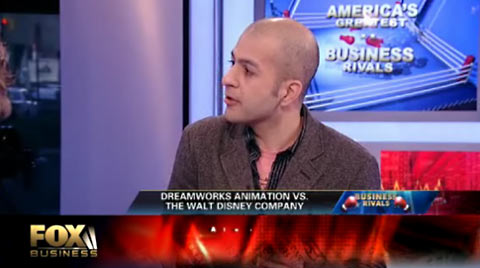
Jeffrey KatzenbergThe NY Times published a lengthy piece last week about how DreamWorks Animation is performing financially. None too shabby is the Times’ verdict. “This company is a flower that is just beginning to blossom,” Katzenberg tells the paper. The studio’s features are obviously popular–their last four have outgrossed Pixar’s efforts–and they’re aggressively expanding with two TV series on Nick, theme parks in Dubai and Singapore, and the Shrek Broadway musical (which has flopped, according to the article). My opinion of the company’s output hasn’t changed, but their success can’t be denied. Katzenberg has clearly found a way to generate short-term profits by tapping into the audience’s desire for celebrities, crude humor, and pop culture-fueled entertainment. At what cost though? In my opinion, Katzenberg has sacrificed long-term cultural relevance (and profits) by ignoring the need for honest storytelling, meaningful artistry, and offering a unique point of view in his films.

(Thanks, Celia Bullwinkel, for the link)