The WB Cartoon Billboard returns!

Remember the Warner Bros. cartoon mural that adorned the Burbank studio lot at Olive and Pass Avenues? I noted back in December that the studio took down the 15 year-old cartoon wall and I wondered what would take its place.

Well the good news is that Looney Tunes, Hanna-Barbera and the animated DC Comics characters will return. In fact, you’re all invited to the public unveiling of the new billboard. Warner Bros. is holding a free, open to the public, Animation Celebration on Tuesday, April 7, 2009. At 7:00 p.m. a public entertainment program will precede the billboard reveal at 7:20pm. A live, special performance by the Beat Freaks, “the phenomenal all-girl dance crew from the 2009 edition of America’s Best Dance Crew.” The studio is encouraging people come dressed as your favorite DC Comic super hero (Batman, Superman, Wonder Woman, Green Lantern, etc.) or other Looney Tunes or Hanna-Barbera character and there will be prize giveaways, including tickets to the Warner Bros. Studios VIP Tour, as well as DVDs, toys and more. Free refreshments will be provided. Get there early… this is guaranteed to snarl traffic.

Early Terrytoons: Fried Chicken and Chop Suey

During the golden age of animation Disney was the top – and Terrytoons were the bottom. Cartoonist Paul Terry started making cartoons at the birth of the medium in the mid-teens, and established his long running Terrytoons studio in 1930.

My fascination with this studio never ends. Michael Sporn reprinted several interesting Terrytoons newspaper clippings dating from the 1940s and 50s on his blog yesterday. Today animation historian David Gerstein adds to our collected knowledge by unearthing several press sheets from Terrytoons studio first year of sound production. Fried Chicken is one of several lost cartoons from this era – cartoons whose only record of existence are these printed plot synopsis (click on thumbnail below left to read). These synopsis from 1930, in particular, are actually rather shocking – as they describe ethnic characters in the crudest possible terms; using words no longer acceptable to society. Chop Suey is one of the initial sound Terrytoons, and comparing the publicity synopsis (below) to available film copies shows how these early cartoons rely of prevalent stereotypes of the day.

(Thanks, David Gerstein, and readers Kliph and Debbie)

Academy tribute to Milt Kahl

The Academy of Motion Picture Arts and Sciences is celebrating the centential of Disney master animator Milt Kahl, “The Animation Michelangelo”.

On Monday April 27th at 7:30pm, the annual Marc Davis Lecture (recently renamed the “Marc Davis Celebration of Animation”) will be in tribute to Kahl (1909-1987) with a spectacular slide and clip show hosted by Andreas Deja – and a panel featuring Kathryn Beaumont (voice of Alice and Wendy), Brad Bird, Ron Clements, John Musker, Floyd Norman. Animation critic Charles Solomon will moderate. Tickets are $5. each – and this event will sell out, so buy them now. For more information check the Academy’s website.

(Thanks, Alberto Natel)

The Art of Pixar Short Films: Contest, Interview & Reviews

The Art of Pixar Short Films

UPDATE: Thanks to everybody who entered! Here are the winners:
Maya Shavzin (who commented on this post)
Brad Blackman (who follows us on Cartoon Brew Twitter)
Fabian Molina (who is a member of our Cartoon Brew Facebook page)
Stay tuned…we’ve got a lot more contests coming up!

It’s give-away time on Cartoon Brew! We’ve got three sets of my new book The Art of Pixar Short Films and its companion DVD, the Pixar Short Films Collection, Volume 1. Here’s how to win a set:

* We will choose one winner from the comments section of this post. Anybody who posts a comment below, before 12am tonight, is automatically entered.

* A second set will be given away to a random subscriber to the Cartoon Brew Twitter account. If you’re already a subscriber, then you’re already entered. If not, just subscribe to our Twitter feed. Winner will be chosen tonight at 12am.

* A third winner will be randomly chosen tonight at 12am from subscribers to our new Cartoon Brew Facebook Page. To enter, just join the page. (Note: This is different from our Facebook group.)

Want to hear more about the book. Check out this interview I did with Mike Bastoli at The Pixar Blog.

Reviews of the book are starting to come in. A selection:

“[W]ith the Pixar Shorts book, Amid has written what I consider to be his best book. His writing style is fluid and easy to read, but he doesn’t dumb down the material. His focus is more on the people who made the films than the films themselves, although he smartly lays out what is so remarkable about each film.” (Ricky Grove/Renderosity)

“Author Amid Amidi gives wonderful insight into the Pixar process with stories and anecdotes you won’t find anywhere else…It’s kind of hard to do this book justice via a write-up, you really need to take a gander at all the beautiful art that is contained within. I’ve had it in my living room for a couple of weeks now and every time I have friends over they end up getting caught up in it for a good amount of time. The book is definitely an easy way to show off your passion for all that is Pixar.” (Monki/Ain’t It Cool News)

“[N]one of the art-of Pixar books to date have taken us behind the creative process, and deeper into the history of the company, the men and women who made the company the juggernaut it is today. That has changed with Mr. Amidi’s terrific The Art of Pixar Short Films. A lovingly packaged and in-depth look at not only the films themselves, but also a de-facto history of Pixar, and their critical importance in the development of digital animation in general. (Brett Warnock/Hey Bartender!)

“An always astute Amid Amidi has partnered with Chronicle Books to write a concise but fairly thorough and very smart monograph hidden in an “art of” that, frankly, looks like every other ‘art of’ book Chronicle has ever produced…Amidi provides some excellent historical information and carefully measured editorial observations in a smart, easy to read take on the development of Pixar via the amuse-bouche of animation.” (Rhett Wickham/Laughing Place)

“The writeup is great. There’s a short history of Pixar before it was even known as Pixar (founded in 1986). Following on, it details the making of each short film. There are interesting things like how depth map shadowing and tweening were used in Luxo Jr. or how John Lasseter would animate into the morning and sleep under his table.” (Parka/Parka Blogs)

“Going through the book, it’s obvious that Amidi wanted to give the spotlight to a wider variety of artists than what one often sees on DVD special features, where the main directors and producers generally get the spotlight. In this book, you get to see work from a large number of artists who contributed to the films. There is no conceit here in terms of making us think that any film is the product of one man; rather, the exuberance of Pixar collaboration is quite evident.” (Randall Cyrenne/Animated Views)

“I can really appreciate the difficulty of writing the establishing section, distilling highly technical systems and challenges in understandable terms while avoiding the obvious out of respect for the readers. As each short appears in the book, historic narrative is woven in order sustain the context of the films and their impact.” (Greg Ehrbar/MouseTracks)

“What’s particularly nice about The Art of Pixar Short Films isn’t its use of seldom-seen photographs…but — rather — that Amidi isn’t afraid to dig into the more controversial aspects of the Pixar story…Amid Amidi strikes just the right balance with this handsome new hardcover. There are just enough new stories to interest history buffs like myself. While — at the same time — there are enough great illustrations to be found in The Art of Pixar Short Films that animation professionals & students of the medium will probably want to pick up a copy of this new Chronicle Book just for inspiration and/or reference purposes.” (Jim Hill/Jim Hill Media)

“I’d like to start off by saying that The Art of Pixar Short Films by Cartoon Brew’s Amid Amidi is, in one word, beautiful!…The Art of Pixar Short Films will look great next to your other “Art of…” books, but on the inside it is more like To Infinity and Beyond!: The Story of Pixar Animation Studios (also from Chronicle) although it focuses on the shorts in more detail than ever before!” (Martin/Pixar Planet)

The Lost Tribes of New York City

Filmmakers Andy and Carolyn London (A Letter to Colleen) interviewed people around New York City and transposed their voices onto inanimate objects. The result could be likened to a grittier (and more disturbing) version of Creature Comforts. Andy told me that to covertly record the two drunks who appear in the short, he had to slouch down on the ground next to them in Penn Station and act drunk while pretending to listen to music. I think it was well worth the effort.

Cartoon Network promises more Live Action!

CN

Yeah, I know… what else is new?

Cartoon Network’s upcoming slate of programming was announced at the 2009 Upfront presentation yesterday at Time Warner Center in New York. Here’s some excerpts from the press release:

Cartoon Network Continues Its Evolution With Largest, Most Diverse Development Slate in Network History

• 19 New Programming Ventures: Seven New Animated Series and Four Original Movies (Live-Action/CG-Animated)

• Network Introduces For the First Time Six Live-Action “Alternative” Series and Two Scripted Live-Action Pilots

• Sports Partnership with NBA, Recruits Boston Celtics Superstar Eddie House for My Dad’s a Pro Short-Form Series

Highlights of Cartoon Network’s new content strategy to launch across the 2009-2010 season include the following:

COMEDY AND ACTION-ADVENTURE ANIMATED SERIES
Adventure Time with Finn and Jake The 30-minute series is from Cartoon Network Studios, created by Pendleton Ward and executive produced by Fred Siebert and Derek Drymon.
Stoked Six teenaged groms (young surfers) come together for 12 weeks over summer to work and surf . From Cake Distribution and Fresh Animation, Stoked is created by Jennifer Pertsch and Tom McGillis (Total Drama Island).
Total Drama Action Showcasing all the elements of favorite reality TV shows, fourteen contestants face thrilling challenges on an abandoned film studio back-lot, all inspired by the movies. From Cake Distribution and Fresh Animation.
Ben 10: Evolutions An all-new animated series .
Sym-Bionic Titan From creator Genndy Tartakovsky (Dexter’s Laboratory, Samurai Jack) comes an exciting hybrid of high school drama and giant robot battles.
Generator Rex Infected by microscopic molecular-altering nanites, 15-year-old Rex has the ability to grow incredible machines out of his body. From Man of Action, creators of Ben 10.
Scooby-Doo — Mystery, Inc. More Fred, Daphne, Velma, Shaggy and Scooby-Doo.

ALTERNATIVE LIVE-ACTION SERIES
The Othersiders This thrilling reality adventure series follows five friends on real missions to explore mysterious, potentially haunted locations in search of evidence that will confirm or deny the existence of paranormal activity.
Survive This An exciting reality series challenges teenagers ages 14 to 17 to push their limits, overcome fears and develop lifelong survival skills. Hosted by Les Stroud (Survivorman), each episode aims to test endurance, wit and self-determination.
Destroy Build Destroy In a huge construction zone, two teams become demolition experts with the guidance and assistance of experts in the field, using wrecking balls, human destroyers and real explosions. Each week brings a new challenge to build from the debris, with strategy, wits and teamwork deciding which team’s creation out-performs the other–and whose hard work goes up in smoke.
Head Rush Kids participate as game show contestants playing for cash while riding thrill-inducing amusement park rides.
Dude, What Would Happen? This series stars three adventurous teens who ask and answer imaginative questions such as, “Dude, what would happen if you attached 350 helium balloons to a sumo wrestler?”
Bobb’e Says Starring Bobb’e J. Thompson (30 Rock, Human Giant), Bobb’e Says is a fast-paced, viral video clip show where other people’s painful mistakes become tools for Bobb’e as he dispenses sage wisdom to an unsuspecting public.

LIVE-ACTION AND ANIMATED ORIGINAL MOVIES
Ben 10: Alien Swarm An all-new, live-action movie based on the hit animated series
Scooby Doo! The Mystery Begins The never-before-told story of how a mismatched quartet of teenagers first came together before becoming known as the Mystery Inc. gang. Directed by Brian Levant (Snow Dogs, The Flintstones).
Firebreather Cartoon Network’s first original all-CG animation adventure, Peter Chung (Aeon Flux) is attached to direct.
Tiger’s Apprentice The best-selling young adult book by Lawrence Yep will be brought to life in a live-action movie. Wayne Wang (The Joy Luck Club) is attached to serve as executive producer/director

SCRIPTED LIVE-ACTION PILOTS
Unnatural History An action-packed series centered around Henry Griffin, a teenager with exceptional skills acquired through years of globe-trotting with his anthropologist parents. Henry faces his biggest challenge of all when he moves back to America to attend a high school stranger than any place he’s ever lived before. Created and written by Mike Werb (Face/Off, The Mask)

Prepped A rebellious teen wakes up one morning to find himself trapped at a mysterious prep school that offers no escape. He forms a secret group to discover what they’re being trained for and how to escape. The pilot is executive-produced and written by Paul Dini (Batman Beyond).

Ray Aragon, 1926-2009

Ray Aragon

Animation artist Ray Aragon passed away on Sunday, March 15, at the age of 83. He had been in poor health in recent months. Aragon was born in Boyle Heights, California on January 12, 1926, the second oldest of five children. After high school, he enlisted in the military for WWII, and served overseas in France and Germany for eighteen months beginning in March 1945. Following the war, he studied illustration on the GI Bill at Chouinard Art Institute.

Aragon was frustrated working in advertising illustration, and in the mid-1950s, he returned to Chouinard to take night classes. There he met instructor Marc Davis, who also happened to be one of Disney’s top animators. “I told him what I was doing,” Aragon said, “and he realized I wasn’t happy so he gave me a number and said, ‘Call Ken Peterson.’ I said, ‘Marc, I can’t draw Mickey Mouse. I can’t draw Donald Duck.’ But Marc said ‘Never mind.’ So I called Ken Peterson and they hired me in the layout department on Sleeping Beauty.

Mary Poppins layoutLayout sketch by Ray Aragon from Mary Poppins.

After Sleeping Beauty, Aragon continued in the layout department on 101 Dalmatians (1961) before moving on to a diverse career that included working at a wide range of LA studios (UPA, Fred Calvert Productions, Hanna-Barbera, TMS, Sanrio, Tom Carter Productions, Filmation and Warner Bros). Besides the two Disney features, his film credits include Gay Purr-ee, Mary Poppins, Yellow Submarine, Metamorphoses, Little Nemo: Adventures in Slumberland, The Iron Giant and In the Heat of the Night. On the latter film, he worked closely with director Norman Jewison as a storyboard artist. In a recent interview, Aragon reflected on the nature of his collaboration with Jewison and how he contributed to the shot set-ups in the film:

“We were looking for locations and…we get off the main highway [onto] a small road just to explore and we come to a roundhouse for the engines. So we drove up and it’s a dead end! The place is abandoned, hadn’t been used in years. We walked in and I looked back at the sunshine, and it’s rather dark inside where we are. Then I said, ‘Mr. Jewison, what if instead of the sequence being shot by the river, Tibbs comes in here to get help [and] finds he’s trapped? He’s trapped and those guys pull up in their cars and we see them in the bright sunlight with their pipes as they come in.’ I’m not even part of the crew! This script was written by one of the top writers of the day and I’m just this guy, you know? How dare I change his script. And Jewison looked at me, just gave me this cold look, and I said to myself, ‘Oh God! He’s gonna fire my ass right here.’ And he said, ‘Alright, smartass. Board it that way.’ I did it [and] the picture was shot that way.”

In the 1970s, Aragon developed an ambitious and visually striking feature adapatation of Don Quixote while working at Fred Calvert Productions. The film was never realized. Aragon’s animation career included numerous detours into other fields, such as live-action films and theme park design. One of his favorite projects was designing the ride “El Rio del Tiempo” (The River of Time) in Epcot’s Mexico Pavilion. He was involved in every aspect of its creation from the costumes to backdrops.

Sketches by Ray AragonPersonal drawings by Ray Aragon

Director Brad Bird remembered Aragon’s work in the early pre-production efforts on The Iron Giant:

“He was a great guy, very vigorous. Though he had the draftsmanship chops to do really precise, nailed down work (see his layouts from 101 Dalmatians), his joy was from really vigorous, rough exploration, and I would classify his involvement with Iron Giant in that way. By that time in his life he had no enthusiasm for nailing it down with any tight drawings.

“At the beginning of the film, we took a small group of artists on a trip to Maine for inspiration (though it was a little too early in the year to get the foliage the way we needed it for the film) and Ray was part of that group. I just remember a bunch of us bundled up in warm clothing against the biting cold wind and here’s this old guy hiking up the cliffs wearing cargo shorts. He was funny, energetic, and passionate about drawing. Like his friend Vic Haboush, he loved being around younger people and seemed to match their vigor about life. I feel very happy that I had a chance to work with him.”

Ray also taught during the 1980s at CalArts. Art director and production designer Ralph Eggleston (Toy Story, Wall-E, Finding Nemo), who had Aragon as a life drawing teacher for three years, recalled:

“The most important thing Ray Aragon said to me when I took his first few life drawing classes at CalArts was ‘You can’t draw. And that’s a compliment.’ It wasn’t as if I didn’t know this (and I still struggle with it!), but I didn’t realize until later what he really meant: that I didn’t have any bad habits to unlearn. Ray Aragon began teaching Life Drawing classes at CalArts my first year, 1983. He didn’t rely on formulas of construction, but instead encouraged LOOKING and DRAWING WHAT YOU SEE in LINE. He really didn’t get into shading forms, but wanted us to learn how to describe form with line alone–a very difficult thing to do! I can’t say I was always the most consistent student of his classes, but what he taught me stuck, and has aided me in every project I’ve approached since, and can be summed up in one word: LOOK. The only thing I regret is that Ray didn’t begin teaching layout classes until shortly after I left CalArts–something I would have truly valued. Friends and I would run into Ray at the Sherman Oaks Galleria for years after we left school, sitting in the food court, filling sketchbook after sketchbook with sketches of people passing by…the guy loved to observe and draw, and it showed in everything he did.

Personally, I got to know Ray better than many of the veteran artists I’ve interviewed, and it was such a privilege to have known him for the time that I did. When an artist of his caliber dies, the biggest regret you have is simply not spending more time with them. Every time I visited with Ray, I learned something new, not just about his life and career, but about what it means to be an artist. I have fond memories of talking art in his studio, surrounded by his sketchbooks and artwork, as well as shelves lined wall-to-wall with books.

I remember once we were talking about crowd scenes, and he pulled out a book of Reginald Marsh drawings, and began to analyze the work by showing how every individual figure in a Marsh scene had distinctive personality and posture while still fitting within the overall composition. I also remember arriving at his house on multiple occasions during the scorching heat of the Valley summer only to find him outside working on hands and feet in the garden. Ray was a hands-on kind of guy; if he wasn’t in the garden, he might be in the garage working on his vintage car, a Triumph TR3.

His daughter Victoria remembers that, “He had an open eye for everything,” and that he taught them to “Look at all the opportunities there are out there. He came out of East LA during the Depression. This is one thing he always said, ‘If there’s a brass ring, take it, take the ride.’ Victoria goes on to describe him as an upbeat person who loved life and always remained down-to-earth. “He loved to talk to everybody,” she says. “It didn’t matter if you were the gardener or the girl at the checkout counter. He really liked to talk to people And whenever we had parties at our house, everybody would want to talk with him. He touched everybody in one way or another.”

Last month, Aragon summed up his career to an interviewer in this way: “My career in the movie business–in animation and live action–was nothing but sheer joy. I loved it! I always did! We all did, you know. It was a bunch of wonderful people.” He is survived by his wife, Lena, two daughters, Victoria and Lorena, and two grandchildren.

For more vintage images of Ray, see this set of photos he took at Disney in 1958 during production on Sleeping Beauty and 101 Dalmatians.

We Swear, It’s Not A Gimmick

Monsters vs Aliens

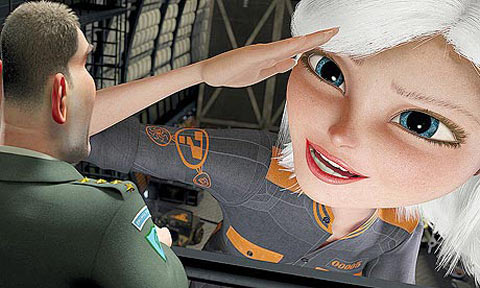
To paraphrase a well-worn saying, With employees like these, who needs enemies? The DreamWorks employees interviewed in last weekend’s NY Times don’t exactly exhibit the type of enthusiasm for 3-D filmmaking that their boss Jeffrey Katzenberg appears to have for the technology. Nowhere in the article do they even attempt to describe how 3-D is integral to the film’s narrative or creative structure. That’s probably because, according to the article, 3-D was added midway through production.

In the piece, Monsters vs. Aliens director Conrad Vernon recalled how he felt when Katzenberg told him that they would be switching to 3D: “We were totally taken aback. I didn’t sign up to do something garish.” Producer Lisa Stewart had a different reaction when she heard the news: “I just remember thinking, ‘Oh, great, I’m going to have a headache for the next two and a half years.’”

The Times also explains how Katzenberg told the artists that 3-D shouldn’t be used as a gimmick, but that when the film was nearly finished, he asked the filmmakers to go back and add more 3-D “pow.” Stewart, who prepared herself for 3-D by studying Beowulf, says that they put in a paddleball sequence at the beginning of the film, because “that was basically us telling the audience, ‘Look what we could do to you, but we’re going to control ourselves.’”

Re-Animating Live-Action Films

Night of the Living Dead

Artist Christopher Panzner is promoting a new animation technique that he has dubbed Re:Naissance, which is essentially rotoscoped key frame drawings with traditional in-betweens. He plans to use this technique to create “homages” to older live-action films. This interview with the website Eye For Film offers more details about his process. Panzner says:

“Re:Naissance can be succinctly defined as ‘the re-creation of live-action films in animation’. It’s a new spin on adaptation and the remake. For the first time ever in the 100-year history of animation, Re:Naissance is going to invert the adaptation process by taking existing live-action films and faithfully reproducing them in animation, in a totally original graphic style unique to each film. We use a process known as ‘rotomation,’ which is a combination of rotoscopy and traditional animation. Our goal is not merely to rotoscope the original film – we are creating an entirely new film while remaining faithful to the original; an homage to the source film. The end result is an original animated feature film, meaning the stars in the live-action film will be caricaturized in some form but the movements and expressions (and original dialogue) will remain true to the original actors, although the animated characters will be completely new original graphic representation.”

The first live-action feature that Panzner is adapting via his Re:Naissance method is George Romero’s cult classic Night of the Living Dead. Below is a line-test based on the French film La Traversée de Paris that gives some sense of what the finished product will look like. The animation was created by Hong Ying studio in Shanghai. Panzner has a blog LicenseToIllustrate.blogspot.com that offers progress updates on the production of his first feature.

Disney Limited!

I don’t keep up with the world of limited edition animation art – in fact, I’m not sure how large that market is anymore. Chris Jackson of Acme Archives just sent me some information on their latest offerings and I like what I see. My favorite pieces are these two black and white silent era limiteds – the first (above) from Plane Crazy (150 of those) and an Oswald Rabbit from Rival Romeos (pictured below, only 95 of those). I can’t afford them, but they are cool.

Tomorrow, Acme is launching DisneyStudioArt.com, but the site is up and running now. There they are offering original production art from The Jungle Book, Robin Hood, The Little Mermaid and several others. Acme is also producing two extremely limited (only 23 pieces each) hand-painted cels, offered through the new D23 site. One from the 1933 Mickey Mouse short, The Mad Doctor and the vaulted Song of the South. It’s just nice knowing the company is aware of these titles.

A Herb Alpert and the Tijuana Brass Double Feature

In response to Amid’s earlier post on Oscar Winning shorts, Tom Knott located the extremely rare Oscar winning John Hubley cartoon, A Herb Alpert and the Tijuana Brass Double Feature (released by Paramount in 1966). Written and Produced by John and Faith Hubley and animated by Gerard Baldwin, Phil Duncan, Emery Hawkins, Barrie Nelson, Rod Scribner and Ed Smith. Enjoy!

(Thanks, Tom Knott)

The Warner Archive Collection

Starting today, Warner Bros. begins opening their film vaults by making hundreds of previously unavavilable movies available on DVD. For $19.95, Warner’s will ship a made-to-order DVD, in a shrink-wrapped case with cover art, to customers within five days of purchase. These films will only be available through Warner’s website, WarnerArchive.com – not on amazon, not at Wal-Mart, nowhere else. The first 150 feature films in this initiative are now listed. You can also order each film as a computer download for $14.95. More details on this “movies-on-demand” project are discussed in today’s LA Times.

What does this have to do with classic animation? Warner Home Video Sr. VP George Feltenstein is behind this project. I’ve been told Warner’s will eventually make available its shorts (Joe McDoakes, anyone?), TV series (Marine Boy, perhaps?), and cartoons (Happy Harmonies??) in this program. Plans for animation collections are being brainstormed now… Any suggestions?