What Animation Can Learn from a Restaurant Owner

This business case study of Ferran Adrià’s restaurant elBulli restaurant has nothing to do on the surface with cartoons, yet the conclusions of the study can be applied equally well to the animation industry.

In particular, this comment by Michael Norton of the Harvard Business School stands out:

“Adrià’s idea is that if you listen to customers, what they tell you they want will be based on something they already know. If I like a good steak, you can serve that to me, and I’ll enjoy it. But it will never be a once-in-a-lifetime experience. To create those experiences, you almost can’t listen to the customer.”

One of the key points in Norton’s study is making a distinction between understanding and listening to customers; the former is what Adrià does. Apply this to the idea of focus grouping in animation, and you might see where I’m headed. Norton is saying that if Adrià focus-grouped his food to satisfy the preconceived notions of his customers, his restaurant would be no different from all the others. The reason his restaurant is sold out year-round is because he surprises the tastes and sensibilities of his customers with an unpredictable personal vision.

In an increasingly homogenized culture, audiences (whether in a restaurant or in front of TV) crave experiences that are different and new. The entire purpose of focus groups in animation, however, is to ensure that audiences are given more of the same previously-successful ideas. But, look at many of the most successful animated series of recent years–The Simpsons, Ren and Stimpy, Beavis & Butt-head, South Park, Family Guy–and what they have in common is that they broke the mold of everything that preceded them. Focus groups (which I should point out are different from test screenings that can actually aid filmmakers) are a hindrance to the development of successful animation; an unspoken reason for their existence is largely to relieve execs of accountability for their decisions: “Well, I don’t know why the show failed,” they can say. “The focus groups loved it.”

Not So Mighty

Mighty B

A Brew reader reports that Erik Wiese, the co-creator of Mighty B, hinted on his Facebook today that Nick has cancelled the show. Wiese wrote:

“Goodbye Bessie. Goodbye Happy. It was good knowing you.”

In case you’re curious, here are Nick’s top-rated programs from a few weeks ago. It’s a more revealing comment about the stagnant creative state of Nick than anything I could write:

#1 — SpongeBob’s Truth or Square
#2 — SpongeBob’s Truth or Square
#3 — Fanboy & Chum Chum
#4 — SpongeBob
#5 — Fanboy & Chum Chum
#6 — SpongeBob
#7 — SpongeBob’s Truth or Square
#8 — SpongeBob
#9 — SpongeBob
#10 — Penguins of Madagascar
#11 — SpongeBob
#12 — SpongeBob’s Truth or Square
#13 – iCarly Movie

Quote of the Week: Tom Rothman

From the November 2 issue of The New Yorker:

“The trick is, from the business side, to try to be fiscally responsible so you can be creatively reckless.”

– Tom Rothman, president of Fox Filmed Entertainment, on why the $40 million budget of Fantastic Mr. Fox allowed them to be more creative.

Rothman’s comment couldn’t be more common sense, yet I’ve never heard an exec say this about an animated feature. The mega-budget Pixar/DreamWorks features are not a sustainable business model for other studios. When smaller studios without an established creative infrastructure attempt to emulate the model, like Planet 51 ($60 million budget) and Astro Boy ($65 million), they typically end up with a half-assed product that falls flat on its face at the box office. Audiences are increasingly demanding variety in their animated features, and the studios that figure out how to offer original and unconventional animated films that are modestly budgeted will find themselves amply rewarded. One of the major keys to keeping costs down and maintaining originality will be to implement a top-down creative strategy by hiring directors with a strong personal vision, like Anderson, instead of the usual approach that consists of building bloated creative teams. Mark my words, the $15-40 million animated feature will be the big thing of the next decade.

How to Make $55,000 by Giving Away A Film

Sita Sings the Blues

Filmmaker Nina Paley explains in the Wall Street Journal how she’s earned $55,000 from her animated feature Sita Sings the Blues by giving it away for free. The idea of offering content for free is still counterintuitive to a lot of artists, but I’m a firm believer that this concept will eventually become an important part in the arsenal of indie filmmakers. Nina is among the first within the animation community to prove that it works. A good starting point for understanding the concept is Chris Anderson’s recent book Free: The Future of a Radical Price.

A Page From TV Animation’s Past

Broadcast Notes
(click to enlarge image)

Understanding the extent to which artists have lost control of the animation process in the past is vital to ensuring a robust and healthy future for the art form. With that in mind, here’s a page of Broadcast Standards notes from a 1978 episode of the Filmation series Fabulous Funnies. The notes are comical and absurd, but it’s utterly horrifying to think that any artist could endure working under such conditions. Would TV artists today be willing to put up with such maddening bull crap or is the community more enlightened?

(The names in the cc are telling: Margaret Loesch and Jean MacCurdy, who would soon thereafter gain great power as kidvid execs, and NBC up-and-comer Brandon Tartikoff.)

CTN wrap up

One last post and a few more snaps from CTN yesterday:

Peter De Seve signs copies of his new book A Sketchy Past for a huge crowd. NOTE: Stuart Ng has Peter’s new book in stock and available NOW. Amazon won’t have it until March (and Ng’s copies have an exclusive signed illustrated bookplate).


Two kings of modern day good-girl art: Dean Yeagle and Bill Pressing


Jerry Beck and Lou Romano

The final day of the CTN event was as exciting as the first two. Everyone I spoke to agreed that this was a successful first effort and all praised Tina Price for creating such an artist friendly evironment. The whole thing felt less like a Comic Con and more like a party for cartoonists and animators – a great way to spend the weekend with old friends or making new contacts. I picked up a lot of sketchbooks, prints and art that I will write about in a separate post later this week.

Mish-Mish in National Defense

We’ve posted about Mish Mish cartoons before – but here’s a new one you gotta see. The character was the star of a popular Egyptian cartoon series of the 1930s by the Frenkel Bros. – who apparently were so taken with American cartoons they literally traced animation, character designs and ideas directly from them. This one, National Defense, is a World War II epic presented in two parts. In the musical first half, the animators borrow from Bosko and Buddy, mix belly dancers and dancing hooka’s, and possibly the worst caricatures of Laurel and Hardy, Eddie Cantor and Charlie Chaplin you’ll ever see. The second half takes place on the battlefield and it’s probably the funkiest animated propaganda ever made. The crude animation only adds to the charm. No matter what you think of Mish Mish, they don’t make ‘em like this anymore!

(Thanks, Milton Knight)

Going West by Andersen M Studio

This is an impressively elaborate papercraft animation created by London-based Andersen M Studio for the New Zealand Book Council. I wonder if CG was used in the planning of this film. According to the filmmakers, no computers were used in the actual production: “The animation took 8 months to complete and is 100% handmade with a good old 10A scalpel blade.”

(via Boing Boing)

The Sunday Funnies 11/22/09

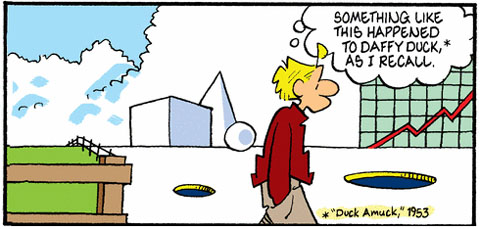
This week’s comic strips with references to classic cartoon stars. Above Mark Parisi’s Off The Mark from Thursday (removed by request from the cartoonist), and below Mike Peter’s Mother Goose and Grimm on Friday. If you spot any like these during the week let me know and I’ll save them up for a semi-regular Sunday showcase.

(Thanks, Jed Martinez and Kurtis Findlay)

Day Two: CTN Expo with Don & Gary

And on the Second Day, the CTN Expo became Comic Con for animators.

Day 2 at CTN-X was wall-to-wall with attendees, standing room only panels, exhibits, demonstrations, screenings and parties. Andreas Deja drawing in the lobby surrounded by hundreds of students and pro’s; talks by Roger Allers, Bill Kroyer, Peter De Seve, Rob Minkoff and Simon Wells; a screening of The Secret of Kells and a preview of Don Hahn’s Waking Sleeping Beauty; a party hosted by Disney Animation… and that’s not the half of it.

I moderated an interview with Don Bluth and Gary Goldman (photo above: Goldman at left, Don in center and yours truly pointing to screen at right). We only had 45 minutes, but we covered an awful lot of their history and gained new insight as to why and how they left Disney thirty years ago (in 1979). Don and Gary inspired the SRO crowd with their love of, and enthusiasm for, the future of hand drawn character animation.

In an instant, a new major animation event has emerged. The CTN Expo has turned out to be a huge success. If you are reading this in Los Angeles and have a few hours to spare today, I highly recommend dropping by the Burbank Marriott on Hollywood Way between 10am and 7pm. A few of today’s highlights include Charles Solomon interviewing the creators of The Secret of Kells, Yvette Kaplan moderating a panel on comedy writing in animated cartoons, Harald Siepermann discussing character design and Ed Gombert on The World of Appeal. See you there.