Donald Duck @ Threadless

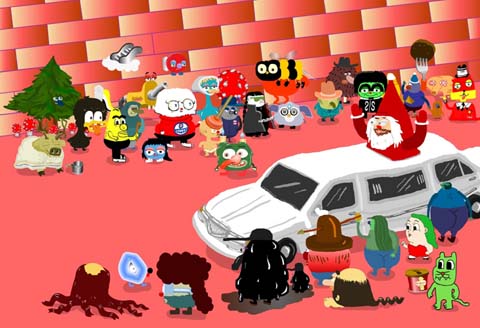
Threadless has teamed with Disney to create a contest to design a Donald Duck T-shirt. Normally I wouldn’t plug such a commercial venture, but I have to admit some of the entries are incredibly cool. One day left to score the designs – the winner will have his design printed on a limited edition shirt. A few of my favorites are posted above (Top: Zinkete; Center: TVSKyle; Botton: Rodgepodge). Check out the complete list of design submissions here.

(Thanks, Trevour Meyer)

The Latest Developments in Motion Capture

The Future of Motion Capture

Michael Bay, Jon Favreau, Ray Liotta, Paul Scheer and Rob Huebel all participate in this Funny or Die video about the latest developments in motion capture. I don’t want to ruin it so just click on the link and watch the two-minute short.

(Thanks, Daniel Savage, via Invisible Creature’s Twitter)

“Satori” by Abhilasha Dewan

Satori

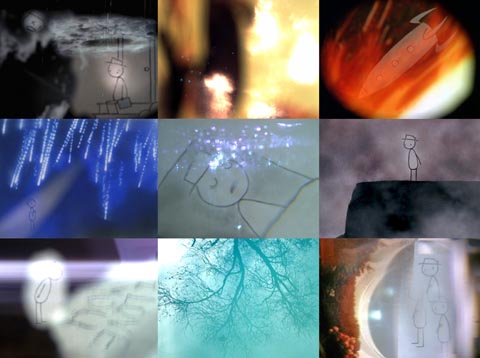
Satori is another recent Sheridan thesis film that has popped up online. Along with yesterday’s A Good Wife, the film offers a glimpse of the new crop of animators emerging out of the Canadian school. The filmmaker Abhilasha Dewan was “inspired by the misty mountains of Nainital, India. She’s posted artwork from the film on her website.

Learn 2D FX Animation for 85 Cents a Day

Adam Phillips

2D special effects animators are a breed apart. Their work is extremely detail-oriented and demands an incredibly high level of craftsmanship, yet the animation they create is rarely the center of attention like the work of character animators. Last month when I was in LA, I visited with retired Disney FX animator John Emerson who showed me how he animated the wings on the hummingbird Flit in Pocahontas and the way he did it nearly made my brain explode. Let’s just say he’s really good at handling an airbrush and cutting friskets. If 2D FX sounds like your dream job, then you may want to look into a new weekly FX animation course run by Australian animator Adam Phillips.

Phillips used to be the special effects supervisor at Walt Disney Animation Australia, and has since achieved Internet fame as the creator of Bitey Castle and the successful Brackenwood shorts on Newgrounds. His online course covers all the principles: lightning, flames, ripples, wave motion, smoke, dust, steam, and surface tension, among others. He tells me that, “It’s aimed at complete FX beginners and is taught from a traditional perspective so there’s no particular medium or software angle.” The real attraction is that the program is just $24/month and includes weekly articles, demonstrations, examples, illustrations and videos. The program length is approximately three months and can be started anytime. Find out more at Bitey.com.

Flea & Fly in “City Troubles” by Fernando Miller

Longtime readers of this blog know I have a “thing” for retro-style cartoons – i.e. new animated shorts that faithfully mimic a past era of animation. Today I’m proud to present the Internet premiere of one of the best I’ve ever seen: Fernando Miller’s Flea and Fly in City Troubles.

The film follows the antics of two homeless urchins in Rio, recreating the look and feel of late 1920s cartoons by mashing the styles of Otto Messmer with Hugh Harman and Rudolph Ising, with a pinch of Tex Avery and a nod to Tezuka (Broken Down Film, in particular). However Miller’s film is not simply a clever homage to old cartoons. It addresses real life problems of poverty and street children in modern day Brazil. Flea and Fly’s antics echo innocent behavior of 80 years ago, updated to reflect today’s realities: They sniff glue instead of drink booze; they also smoke, steal, bathe in public and urinate in the street.

I asked Miller, who works as a freelance animator in Rio, to explain the origin of his film:

“I had the idea for the film about 12 years ago. I was on a bus in Rio, my hometown, and there was this bunch of street kids on it, laughing out loud, slaping each other, screaming out of the window calling people names, and all this sort of things kids like to do to have fun. But the other people on the bus seemed terrified, as if those 10, 11 years old boys were about to shoot them or something. Everybody was so scared with the violence in the city, and the problem of abandoned kids living in the streets of Rio, that no one noticed, above all at that moment, that those were just kids acting as normal kids. On the other hand, those same people would smile at those exact same things while watching old fashioned cartoons – like Katzenjammer Kids – thinking about how inocent kids were at that time! So I wanted to show that things were not that different from the past, and try to create the same sympathy for nowadays kids, despite of the terrible situation they live in.

“That big church in the beginning and the end of the film is Candelaria Church, were in 1993 six street children got killed by police officers. It was a famous and terrible massacre every Brazilian knows well.

“All the places in the film do exist. Here’s a curious fact for animators: those two building behind the man selling food are where Animamundi Festival takes place. It’s across the street to Candelaria Church.”

With the current critical and artistic success of the live action “silent” film The Artist, perhaps Miller’s cartoon is coming out at just the right time. It would certainly make an appropriate short to accompany that feature. It sheds light on an important social issue with unusual finesse. Here, fresh from the festival circuit, is Flea and Fly in City Troubles:

How Cartoon Brew Spawned Bronies

One of Cartoon Brew’s most popular archived posts is my October 19, 2010 commentary about the end of creator-driven animation. The post, which discussed a common topic within industry circles, took on an unexpected life of its own among younger readers and spawned the well-known “Brony” fandom, which is the celebration of the TV series My Little Pony: Friendship is Magic by male viewers. If you’ve ever wondered how my post led to Bronies, here’s Scott Spaziani explaining its history. My role in the movement pops up around the 6-minute mark. You’re welcome, guys.

“A Good Wife” by W. Scott Forbes

The story of A Good Wife is fairly well summarized by its ironic title. What remains is a tribute to mid-century modern aesthetics and an eerie amount of stillness. W. Scott Forbes made the film while attending Sheridan College. The film doesn’t necessarily succeed in wringing out the emotions suggested by its sad story and musical cues, but Forbes’ approach is refreshing for a student film and a worthy experiment.

Rising Artist: Paul Cabon

It’s rare to browse through someone’s on-line animation videos and enjoy everything they’ve produced. That’s the happy feeling I experienced watching the work of French animator Paul Cabon. In fact, it was too difficult to choose a single piece of his to share so I’ve included three more of his films after the jump. His work is packed with fresh visual concepts coupled with strong control of color and shape and a keen sense of humor. His animation of human figures moves in an almost experimental fashion, which is to say it doesn’t follow the rules of conventional character animation but fits perfectly with the rest of his style. Cabon graduated from the French animation school La Poudrière a couple years back.

See more of his work after the jump:
Continue reading

“The Adventures of Tintin” Wins Golden Globe

Paramount Pictures/Nickelodeon Movies’ The Adventures of Tintin won the Best Animated Feature prize at tonight’s Golden Globe ceremony in Beverly Hills. Director Steven Spielberg accepted the award (video below) and seemed genuinely surprised.

How about you? Did you expect Rango, Puss In Boots, Arthur Christmas, or perhaps Cars 2 to win this award? Do you think a Golden Globe award will help Tintin’s chances with Oscar or Annie voters?

Animated Fragments #15

Welcome to the first 2012 installment of Cartoon Brew’s “Animated Fragments.” Covering the animation world used to be a lot easier five or ten years ago. Today there is a greater amount of animation being produced than ever before and more of that animation is being posted on-line. Likewise, our thinking is constantly evolving about how to cover this ever-expanding world of animation. We introduced Animated Fragments last year after realizing that a lot of the animation being posted on-line didn’t fit into the traditional categories that everybody uses (TV, feature, music video, short, etc.). On-line culture is built on openness and sharing, and emerging artists (as well as an increasing number of established animators) share just about everything they produce on-line: animation tests, experiments, small-scale commercial gigs, pilot projects, you name it. The Animated Fragments is our attempt to catalog and share these pieces with a wider audience, and to hopefully introduce you to more talented artists who choose animation as their medium of visual expression.

Opening credits: Motel Monstre animated by Nick Cross and designed by Dave Cooper (Canada)

“Wolf-cub” by Loup Druelle (Norway)

“ThingSync Test–Seashells” by Javan Ivey (US): Toying with the idea of lipsyncing with objects and actions that are related to the dialogue.

“Random Animation about Anything” by Sophie de Jong (The Netherlands)

Morphology by Peter Sluszka (US)

“The Prophet”

Yesterday, Deadline Hollywood posted about Salma Hayek’s Ventanarosa Productions signing animation director Roger Allers (Lion King) to supervise an ambitious independent feature based on Khalil Gibran’s 1923 classic The Prophet. Allers will oversee the entire film – and will direct the opening, closing and bridging sequences – which will combine the work of a who’s-who of renown international animators.

The Prophet is a book of 26 poetic essays on life and the human condition. It’s divided into chapters dealing with love, marriage, children, giving, eating and drinking, work, joy and sorrow, houses, clothes, buying and selling, crime and punishment, laws, freedom, reason and passion, pain, self-knowledge, teaching, friendship, talking, time, good and evil, prayer, pleasure, beauty, religion, and death.

Already signed on (or in discussions) to participate: Tomm Moore (The Secret Of Kells), Sylvain Chomet (The Illusionist), John Stevenson (Kung Fu Panda), Marjane Satrapi (Persepolis), Chris Landreth (Oscar-winning short Ryan), Nina Paley (Sita Sings The Blues), Bill Plympton (Guard Dog) and Kunio Kato (Oscar-winning short Tsumiki No Ie). This “Super Bowl of animation” begins pre-production later this month – and is certainly one we will keep tabs on.

“A Year of Sun with Mr. Persol”

I do believe there is such a thing as over-art directing a piece of animation to the point where the message becomes buried within the polish of the artwork. Whether that’s the case with “A Year of Sun with Mr. Persol,” a glossy piece of advertising for Persol Eyewear directed by Kevin Dart and Stéphane Coëdel, is open to debate. What’s inarguable is that it’s an extremely competent piece brimming with sophisticated design and visual concepts throughout.

Credits after the jump
Continue reading

TV Cartoon Explains Politics to Kids

This 1961 episode of Tales of the Wizard of Oz harkens back to a time when animation writers didn’t speak down to kids. It’s a perfect example of children’s TV animation that works on multiple levels, encouraging kids to question their surroundings and understand the realities of the world while entertaining them at the same time.