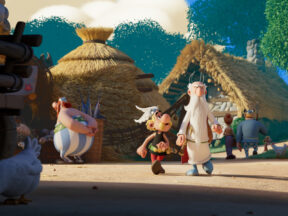
David Stodolny (we previously posted his spoof Harrey Podder) is an animator for Dreamworks who makes funny stuff like this in his spare time:
Monthly Archives: June 2012
Pixar’s “Brave” Dominates At Box Office

Animated films ruled the US box office last weekend, capturing the top two places. Brave, directed by Mark Andrews and Brenda Chapman, grossed $66.3 million in its debut. That figure is virtually identical to last summer’s Cars 2, slightly better than WALL•E and slightly lower than Up. The real test will be in the weeks ahead, as we’ll watch to see whether it has box office legs like Toy Story 3 and Up or plummets quickly like Cars 2.
DreamWorks’ Madagascar 3: Europe’s Most Wanted, which debuted with $60.3 million three weekends ago, beat out newcomers like Abraham Lincoln: Vampire Hunter and captured $19.7 million for a strong second place showing. With $157 million in the bank already, the film is on a pace to beat the domestic grosses of the first two entries in the Madagascar series.
Blue Sky’s “Epic” Teaser
20th Century-Fox and Blue Sky have released a teaser trailer for their next film, Epic. Based on a William Joyce book… it’s looking pretty good:
More MGM Model Sheets
More from that cache of vintage MGM model sheets obtained by Mike Van Eaton. I don’t think these have been reprinted, or are on any other websites (though I’m happy to informed otherwise). Above, the warden and the prisoner in Avery’s final MGM short, Cellbound (1955); below from the animation sequence of Gene Kelly’s dance film Invitation To The Dance (1956). Click on images below, and thumbnails below that, to enlarge.
The zany bird from “an Avery epic”, Jerky Turkey (1945)
The Truant Officer from another “Avery epic”, The Screwy Truant (1945)
The tormented cat from The Cuckoo Clock (1950)
Here’s a potpourri of goodies: Butch from the Hanna Barbera Tom & Jerry series; Spike from the Tex Avery cartoons; Barney and the seal from the Mike Lah-Preston Blair film, Goggle Fishing Bear (1949); 1941 vintage Jerry model sheet; and two sheets from the Hugh Harman cartoon, Abdul The Bulbul Ameer (1941).


Genndy Tartakovsky To Direct 3D CG “Popeye”

Apparently, Genndy Tartakovsky (Dexter’s Laboratory, Samurai Jack, Star Wars: Clone Wars, Sym-bionic Titan) impressed Sony Pictures Animation with his directing on Hotel Transylvania. Variety reported on Monday afternoon that Sony has enlisted him again to direct a 3D CG Popeye feature. Avi and Ari Arad will produce under their Arad Productions banner with Sony. Brew readers remind us in the comments that Popeye was adapted into CG once before for Mainframe Entertainment’s Popeye’s Voyage: The Quest for Pappy. Anything Tartakovsky does is guaranteed to be an improvement over that cartoon.
(Photo of Popeye and Olive Oyl at the Mermaid parade on Coney Island via Lev Radin/Shutterstock)
Ryan Woodward Aims To Hit A Home Run In The “Bottom Of The Ninth”

Animation professionals are pushing the limits of the field every day on the big and the small screen, but veteran animator and storyboard artist Ryan Woodward is breaking new ground right in your hands: on phones and tablet devices. Debuting last Friday, Woodward’s Bottom of the Ninth is an iOS app that is both a graphic novel and animated short film, with each comic panel acting as a frame for a short piece of the animated work. Using the skills accumulated from his seventeen years in animation, he’s broken out on his own with a small team of animators, programmers, musicians and voice-over talent to push the boundaries of what people think of as animation. Woodward has created what he calls “the first animated graphic novel,” and not just simple sliding graphics as in many animated comics, but a graphic novel featuring full character animation.
The story of Bottom of the Ninth is set 200 years in the future and revolves around a young girl named Candy gifted with phenomenal talent on the baseball field. Her father, a retired pro baller named Gordy, is training her to harness her raw talent into the skills needed to become a pro in their futuristic version of baseball, dubbed “New Baseball,” that comes complete with artificial gravity and vertical infields. With Candy’s talent she might be a shoe-in, but as anyone who’s parented a teenager or been one themself knows (don’t deny it), work is the last thing on her mind.
Ryan Woodward jumped into the animation field in 1995 fresh out of Brigham Young University, cutting his teeth in the trenches on Space Jam and the film’s polar opposite, The Iron Giant . As a young artist, Woodward apprenticed under a number of notable animators including Michel Gagné. In recent years, Woodward has transferred his talent to the CG realm and worked on this year’s The Avengers and Snow White and the Huntsman. After hours, he has continued to work on personal projects like the award-winning short film Thought of You ,and now, Bottom of the Ninth.
The first chapter of Bottom of the Ninth is available now for $3.99 from the iTunes App Store, with plans to release future chapters as in-app purchases.
Chris Arrant: Ryan, you’ve had an extensive career working in theatrical animation and live-action films, but I was surprised to learn that you’d trained under animator Michel Gagné at Warner Bros., an industry veteran who has similarly pursued his own creative path. How do you balance a busy career working on major feature films while creating ambitious independent projects like Bottom of the Ninth?
Ryan Woodward: Not easy. But guys like Michel and also Acturas Actas taught me to have passion for this art form and they taught me the value of pursuing my own dreams along with supporting great feature productions. In the end it comes down to wanting to feel human. I want to feel like I’m arriving to my potential. The studio system is great and I learned a ton there, but the need for specialists in that industry limit you to how much you want to grow in other areas, and I’ve always wanted to grow and be a much more well-rounded production artist. And when you do your own production, you have to animate, write, design, storyboard, do compositing, learn 3D software, etc. etc. and it’s awesome!
Chris: Both sports themes and female protagonists are rarities in animation. Can you tell us the genesis of the story of Bottom of the Ninth, and did you ever think of producing it as a traditional animated film?
Ryan: The full ten-app script is actually written as a full length feature. Just because that’s how I know how to write best. Then I broke it up into comic books to fit in this new world of apps. The character is a female, primarily because I have three daughters. They are my life and my true source of happiness. (and my wife of course). So it’s much more natural for me to connect with a character that’s a female. I’m not your macho Dad at all. I’ll take a snuggle on the couch any day rather than a football toss. But the sports theme is where I introduce the principle of rewards for hard work. I love great sports legends and their stories. The physical, emotional, and celebrity status problems they have to overcome is incredible and it’s important for a main character to have to learn to do hard things and overcome them. I love baseball, not because I played Little League when I was a kid, but because of that nostalgia, that American dream that it naturally has embedded in it. Also, I really love the early time period of the Twenties and Thirties and the struggles that baseball went through with racism and female rights. Those issues make for great complexities in the story. The story has a little bit of Jackie Robinson’s struggle in it, and a lot of Jackie Mitchell’s (Google her).

Chris: Back in the origins of animation, Winsor McCay’s films were compared to moving comics, but animation quickly evolved into its own medium. The idea of an animated graphic novel–that is mixing the motion of animation with the static panel-to-panel storytelling of comics–is still somewhat of an amorphous medium. As an artist, how do you see it–are we going back or moving forward?
Ryan: Man, I hope we’re moving forward. This was so difficult to achieve, and I hope I did it justice. There are comic purists out there who may feel that what I am doing is blasphemous. That’s okay. I respect their loyalties to the art form and I sincerely strived to hold onto that comic feel though out the creation of this app. There were countless times that really cool gimmicks and tricks were introduced to me, and each time I had to ask myself if it helped to keep us in comic book land or does it take us out. So many tricks weren’t employed for that reason. All the way to the last week of production, I didn’t even have a table of contents, because I wanted the reader to flip through each page. But in the end I was convinced that due to the device’s limited memory, page flipping was really clunky if you wanted to go through fast to show someone a page and that would hurt the word-of-mouth marketing. So I added the table of contents. Also, at one point I had the first five or so animated scenes all together in one clip. But I realized that watching it, the viewer was taken out of the comic book world and put into short film world, so I diced up the animation and spread it out between five new pages. That then allowed me to add in a lot more new character elements and story. The only thing that I’m still trying to figure out is how to keep the nice flow of a film, yet give the viewer the self pacing like a comic. I think I did it the best way I could for now, but I’m sure new ideas will hit me by the second issue.
Chris: You’ve done a great job of capturing the fluid grace of a baseball player’s movement–a pitcher winding up to throw the ball, a batter’s swing. I couldn’t help but think of your breakout animated short Thought of You which explored the rhythms and gestures of contemporary dance. As an animator, did you find any connection between the movement in baseball and dance?
Ryan: Absolutely. I had so much fun studying the energy the flows through a pitcher and a batter. All the way from the foot, through the hips, torso, shoulders and then the arm. Man, it is so beautiful how the human body does that and it’s just like dance. Dance is all about these beautiful lines and rhythms that flow through the body. Baseball does the exact same thing. I had a fun time stretching out the overlapping action of the batter and the pitcher as well. The body is terribly distorted in some frames but it really helps sell the transfer of energy. I really studied the body movements of Tim Lincecum [starting pitcher for the San Francisco Giants] when he pitches. His torso is like rubber and it’s absolutely beautiful. With batting, there’s so much personality in there. A great comedian called The Batting Stance Guy characterizes a lot of the players’ different personalities and he was a huge inspiration as to how much personality comes in. In the next few apps coming, I’m gonna go crazy animating more batting personalities.
Chris: What kind of unexpected challenges–artistic or technical–did you face when creating an animated project for the iPad?
Ryan: Everything. When I started this, I didn’t have the slightest idea how an app was made. I just started hoping to figure it out along the way because that seems to be the way I do everything. So I got my developers license from Apple, opened Xcode and spent two full days learning coding before I realized this is not something I can just pick up. Coding is like learning Japanese. So I found a couple great coders that know Objective-C and left the magic up to them. The other big challenge was learning how to limit my ideas. In January, I had a simple idea that was only going to take three weeks. Then one idea after another, and another and another, I couldn’t help myself but do everything that I thought was cool and fun to create. Well, that totally got out of control and the app got so robust for a small team that I almost cracked and went into looney bin land. I would sleep less than 2 hours a night, I even went 3 days with no sleep at one point. Because the ideas were so fun to create, and I couldn’t put a stop to them. Finally, after my wife saw me degenerating slowly, I put a clamp on it and wrapped it up. The next issue will have a lot of these new ideas that are brewing in me.
Chris: Many artists are using Kickstarter nowadays to find funding for unconventional projects, but you self-funded this entire venture, correct? Why did you choose to self-fund instead of reaching out to the public?
Ryan: A ton of people told me to go to Kickstarter for this. And I think if I would have, it could have been really great. But I wanted to present myself to the public as a solid, professional studio structure that plans, finances, and produces totally independently on its own. Something about how I was raised in being totally independent held me to that idea. As a kid, I paid for my own scout camps, I had a paper route that funded my comic collection and quarter video game addictions (Russian Attack!). I put myself through college, and basically learned how to feel good about earning a dollar and spending a dollar. Over the past four years, I’ve done several outside projects and I’ve socked away every dime to fund “some future project” one day. That became Bottom of the Ninth and I dropped every last dime into it–with no regrets (even though it ended up costing 4x more than I anticipated and taking 4x as long). The thought of working hard, saving, and investing in my own beliefs is worth more to me than the Kickstarter cash flow. No disrespect to the Kickstarter guys though. I’ve contributed to some of their projects. I just had the fortune of previous jobs that allowed me to save up and invest in my own dream.
Share Your Cartoon Sightseeing Tips For Paris And Brussels

A brief note: I’ll be visiting Paris and Brussels soon. It’s not a work-related trip, but I’m always interested in animation and cartoon-related sidetrips. I’ll definitely be seeing the R. Crumb retrospective while in Paris. What other cartoon goodies are worth checking out in these two cities right now? Comment below or get in touch privately.
(Photo of French patriot holding poultry via Shutterstock)
Web Roundup: Brave Hair, T. Hee, And Animation’s “Onion”

FX Guide offers an in-depth look at how Pixar created the curly red hair of Brave‘s Merida including a 30-minute audio podcast with Pixar simulation supervisor Claudia Chung.
The new official website of animation legend Thornton (T.) Hee is frustatingly difficult to navigate, but those who make the effort will be rewarded with never-before-seen caricatures of Hee’s Disney colleagues and examples of his Cartoon Modern-styled Christmas cards.
2Day in Animation is an Onion-esque take on the animation industry, and it’s often quite funny. Article highlights include “3,800 Really Cool Animation Jobs Posted in April, Though Only 17 Are For Pay,” “Big Studios Promise to Start Making Films with Cage-Free Animators,” “Digital Domain Creates Holograms of Nine Old Men to Helm New Animated Feature,” and “Teletoon Gives Series to Mediocre Animator Just To Shut Him Up.”
WEDNESDAY: Jerry on Stu’s Show

Several years ago I was invited onto Stuart Shostack’s internet radio program, Stu’s Show, to discuss the history of Terrytoons animation studio. Somehow we never got around to it. It’s been a running joke of my visits there ever since. So this week we’ve decided to cut the listener phone calls, dispense with the news and just concentrate on discussing the story behind the company that brought us Mighty Mouse, Heckle and Jeckle, Hashimoto Mouse, Tom Terrific, Mighty Heroes, Deputy Dawg, Gandy Goose and Farmer Alfalfa. At least, we’re gonna try.
To be clear, we will NOT be accepting any questions regarding DVD news of any kind; if you want to send in a specific question regarding Terrytoons you may do so at comments-at-stusshow.com today only. Oh, and as a side note, don’t miss the first half hour – June Foray will appear in-studio to discuss her reactions to winning her first Emmy Award. Should be a great show. Tune-in live on Wednesday at 7pm Eastern/4pm Pacific right here!
“The Frogs’ Bollocks” by Stephen Ong (NSFW)
A short sequence of animated cycles – with a rude twist – from UK based graphic designer Stephen Ong. Not-safe-for-work but funny as hell, The Frogs’ Bollocks and Other Assorted Bollocks.
“Fable” by Daniel Sousa
Daniel Sousa’s beautifully crafted Fable, a subtle tale of two shape shifters, has been on the festival circuit for a few years and is now online. Sousa tells us of his technique:
“Most of the rough animation was prepared in Flash along with the corresponding color fill layers. The drawings were then printed, traced, and cleaned up on paper to achieve a more organic quality. They were then re-scanned and composited in After Effects. Some of the drawings were etched on acetate and rubbed with ink. The backgrounds were a combination of paintings, collages, and photos. The animation was rendered in HD and transfered to 35mm film.”
Sousa works out of Providence, RI, where he’s also an animation teacher at RISD. You can read about his current animated project, Feral, on his production blog.
“Brave” / “La Luna” talkback

A lot of divided opinion about this film. Manohla Dargis in her review in The New York Times focused on feminist stance of Merida, the heroine of Brave, calling her “a marvel of computer imagineering”. Kenneth Turan of The Los Angeles Times took a little closer look at the film’s story and says it “doesn’t hit the bullseye.”
There’s no doubt Brave is Pixar at its best – visually. The film begins as the kind of forward-thinking original story we’ve come to expect from the studio – something bold, new and different; a tale that hasn’t been told this way before. But alas, the story veers into territory already explored in Brother Bear, The Princess and The Frog — even The Emperors New Groove. Is it entertaining: yes. Is it gorgeous to look at: absolutely. Is it Pixar’s best? Or is this the year the frontrunner joins the rest of the pack? That’s what I want to know from you.
Comments accepted below only by those who have seen Brave in a theatre. Oh, and let us know how you liked Enrico Casarosa’s La Luna, the marvelous short playing along with the film.
Cartoon Dump!

Has it really been five years since Cartoon Dump started its unholy life as a live show in Los Angeles? Our 5th Anniversary is either this month or next month, or maybe August (we’re too depressed to remember for sure), so we’re kicking off our summer-long celebration with a sensational lineup of hilarious talent and a craptational lineup of awful cartoons.
Join us next Monday with our Special Guest Stars: Maria Bamford, Emo Philips, Melissa Villasenor, Ron Lynch, April Hava Shenkman, Hannah Gansen and maybe a few surprises – along with our usual cast of neurotics: Frank Conniff as Moodsy, the Clinically Depressed Owl, Erica Doering as Compost Brite, J. Elvis Weinstein as Dumpster Diver Dan, Kristin Arrigo as Cue Card Goddess and yours truly as “Jerry Beck”.
Showtime is 8pm on Monday June 25th at the Steve Allen Theatre in Hollywood (4773 Hollywood Blvd; two blocks west of Vermont), and tickets can be purchased at the door or online here. Join our FaceBook Event page for more information and updates.
(Drawing above by Thom Foolery)
“Hamar” by Sara Gunnarsdottir
It’s Experimental Animation time on Cartoon Brew!
Sara Gunnarsdottir just graduated from CalArts with a masters degree in experimental animation. This spring Gunnarsdottir has been working with Icelandic musician Kira Kira on her new album, Feathermagnetic, making concert visuals and music videos based on her sound. This stunning video, taken from her work, was edited to the song Hamar. Turn the volume up.
I asked Gunnarsdottir to explain how this film came to be – and how she created it. She said:
“Originally I created the loops as visuals for Kira Kira’s concerts, and she has already performed using them in Moscow and Tokyo; next up, her concert in Berlin July 8th. For that concert the visual piece lasts for 47 minutes – the total length of the album. I decided to use the bulk of the visuals for a shorter piece, a more music video-type version, Hamar. The loops are hand drawn on paper and then colored in photoshop. I used the same loops more then once, in most cases, to make different cycles or various movements within After Effects. It was both fun and surprising experimenting with the effects and blending modes in AE.”
Trailer: Genndy Tartakovsky’s “Hotel Transylvania”
One week after the Adam Sandler/Andy Samberg-starring That’s My Boy bombed, we get the trailer for Hotel Transylvania starring Adam Sandler and Andy Samberg. But the real star of the film is director Genndy Tartakovsky (Dexter’s Laboratory, Samurai Jack, Star Wars: Clone Wars, Sym-bionic Titan) who is making his feature directing debut. Hotel Transylvania will rise or sink on the merits of his direction, and it looks like we could have a fun and campy popcorn-movie on our hands. The Sony Pictures Animation film will be released on September 28.