Digital Domain artists–past and present–can now vent their frustrations via the Pirate Textor meme.

Digital Domain artists–past and present–can now vent their frustrations via the Pirate Textor meme.
Today, as part of Cartoon Brew’s Student Animation Festival, we’re delighted to present Ballpit by Kyle Mowat of Canada’s Sheridan College. What begins in pure abstraction slowly reveals itself to be an evolutionary tale–albeit an unconventional evolution that blends organic materials with the mechanical. The film could be dissected, but the total effect is what makes it memorable. Ballpit delights the eyes and yields visual suprises at every turn. The riot of color, the patterns of shapes, the rhythms of movement–it is the joyous possibilities of animation distilled into 90 seconds.
Click HERE to read an interview with the filmmaker Kyle Mowat.


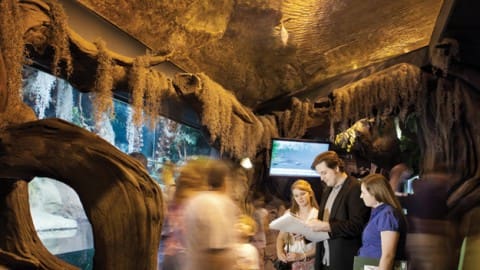
Remember the CGI 2Pac “hologram” that Digital Domain created for Coachella earlier this year. The gimmick was well received, but Digital Domain CEO John Textor (above, right), who we’ve already established isn’t the sharpest tool in the shed, somehow convinced himself that animating CG versions of dead celebrities was an actual business model.
A couple weeks ago, Textor boasted to investors that he was trying to “tie up the real estate” of virtual humans. How could anyone miss with such an obviously sure-fire business, Textor claimed, “as long as we’re the only people in the world that can do this work.” It was just a matter of “getting the contracts, securing the rights, negotiating with the families, making sure that the likeness rights line up with the music rights and the venue rights and that’s what we should be doing.”
What Textor didn’t tell investors is that there are literally hundreds of other high-end VFX/CG companies that can create computer-animated human characters nowadays. Textor’s scam unfolded when rumors began floating around of a Ronald Reagan hologram that would appear at the Republican National Convention. Textor quickly told the Wall Street Journal “that rumor isn’t true.” Except it is true. Today, businessman Tony Reynolds, confirmed to Yahoo! News that he is indeed working on a Ronald Reagan hologram, and he’s not using Digital Domain to make it.
Holograms of dead people are the least of Textor’s worries though. Since DD’s stock peaked on May 1st, the company has been in freefall. Today, Digital Domain’s stock plunged 21% to a 52-week low of $2.31. In the past four months, the company has lost $300 million in value.
It gets worse. Textor owns 24 percent of Digital Domain. He took out a $12.5 milion loan to buy the shares in the company, and now he can’t pay back the loan. But here’s where it gets Lehman Brothers-style sketchy–and downright insane, if you ask me: Textor got the loan from Digital Domain’s largest shareholder, Palm Beach Capital. The Palm Beach Post has the sordid story:
Corporate governance experts said it’s rare for a shareholder to lend money to a CEO to buy shares. “It’s just not a smart idea,” said Charles Elson, a finance professor at the University of Delaware. “If you can’t pay it back, what happens?” If Textor were to default on the loan from Palm Beach Capital, his annual interest rate would go from 12 percent to 19 percent, Digital Domain said this week. Collateral for the loan includes 8.5 million shares of Digital Domain stock owned by Textor and mansions in Stuart and Mountain Village, Colo.
Executive compensation expert Paul Hodgson of GMI Research said such arrangements are “not very usual. It’s kind of generally been frowned upon because it tends to complicate relationships and undermine situations from a governance point of view. That would raise a red flag with us.”
There are already many victims in this situation. I feel awful for the artists who are working on Digital Domain’s first (and potentially last) feature The Legend of Tembo, as well as for all the other Digital Domain employees. I feel bad for Florida citizens who handed $132 million of their taxpayer dollars to a reckless and clueless businessman. I feel outraged for the incoming students of Digital Domain Institute who may have to perform slave labor because Digital Domain doesn’t believe in federal labor laws.
But you know who I don’t feel sorry for?
John Textor.

Fred Mogubgub was among the New York animation scene’s innovative figures of the Sixties and Seventies. One of his most famous artistic statements wasn’t on film, but on the side of a building in Manhattan. It was part of an extended series of stunts that he staged during the 1960s. Richard O’Connor of Ace & Son animation studio wrote on his blog about Mogubgub’s work at the time:
What may be his best-known work was made at this time–a three-story mural painted on the outside of his Sixth Avenue studio. The left side was a beautiful woman, design by Irene Trivas, the right hand side was a word bubble saying “Who Will Give Mogubgub Ltd. Two Million Dollars To Make A Feature?”
Without the two million Mogubgub still made a feature. The Day I Met Zet runs 71 minutes and has 72,000 scenes. Zet consumed Mogubgub for three years. In 1967 a distributor offered him three points of advice after screening a work print- the next day the film was in the trash and he started over. When the New York Film Festival refused Zet, the filmmaker mounted a protest. He marched through Lincoln Center with a sign reading “Fuck the New York Film Festival”. When the police came he threw the film into the trash and ignited it. The newspapers had shown up questioning him -”How many hours of work was he destroying?” “Why this protest against the Festival?” Mogubgub stood by silently as he watched an old 16mm print go up in flames. Meanwhile the whole proceeding was being filmed. He planned to make it into a short called The Day I Burned Zet.
To learn more about Fred Mogubgub’s life and work, read Richard O’Connor’s essential series of blog posts about Mogubgub: Part 1, Part 2, Part 3, Part 4
Also, don’t miss this terrific collection of Mogubgub drawings on Michael Sporn’s blog.

At least it’s not animation. Billboards and posters for this mysterious children’s film have been appearing all over town for weeks. The film opened yesterday to disastrous reviews. This project has the stench of Delgo all over it.
Unfortunately, as animation is still perceived as children’s fare, a film like this could harm the good will animated features have built up in recent years. The Oogieloves in The Big Balloon Adventure (it hurts just to type that) opens this weekend on 2000 screens. The $55 million dollar production (that figure includes production and marketing) is being bankrolled and self-distributed by a would-be Walt Disney (or perhaps Jim Henson) named Kenn Viselman.
Viselman was previously a “marketing visionary” and producer on Thomas the Tank Engine and Teletubbies. He is so sure that he can “sell” parents and kids on this film, he has a sequel ready to shoot in October. This guy is either a genius–or a madman. My mind is made up regardless–based on the trailer, this guy is crazy. I look forward to reading the grosses next week.

Today, family animation distributor GKIDS announced that they will qualify four animated features for consideration in the Oscars Best Animated Feature Film category. The films are Goro Miyazaki’s From Up On Poppy Hill (Japan), Jean-Francois Laguionie’s Le Tableau (France), Joann Sfar and Antoine Delesvaux’s The Rabbi’s Cat (France), and Rémi Bezançon & Jean-Christophe Lie’s Zarafa (France/Belgium).
GKIDS has had an outsized influence in the animated feature category over the past three years, earning three Oscar nominations–Secret of Kells in 2010, and A Cat in Paris and Chico & Rita in 2012. Their strategy has been simple and it doesn’t involve producing a single frame of animation; rather they pick up U. S. distribution rights to foreign animated features that otherwise will never appear in America. It’s a win-win for both GKIDS and the filmmakers.
Even the major film studios benefit from the situation. That’s because the four films that GKIDS will enter this year push the current number of animated feature contenders to 15. A minimum of 16 features is required to have five nominees in the category, and it is very likely that will happen now.
The 15 films currently in contention are as follows:
The Lorax (Illumination Entertainment/Universal)
The Pirates: Band of Misfits (Aardman/Sony)
Madagascar 3 (DreamWorks Animation)
Brave (Disney/Pixar)
Ice Age: Continental Drift (Blue Sky/20th Century Fox)
ParaNorman (Laika/Focus)
Hotel Transylvania (Sony)
Frankenweenie (Disney)
Rise of the Guardians (Dreamworks Animation)
Wreck-It Ralph (Disney)
A Liar’s Autobiography: The Untrue Story of Monty Python’s Graham Chapman
Zarafa (Pathe/GKids)
The Rabbi’s Cat (TF1/GKids)
Le Tableau (Rezo/GKids)
From Up on Poppy Hill (Studio Ghibli/GKids)

Barneys New York has partnered with Disney for their Electric Holiday campaign, set to debut at Barney’s Madison Avenue flagship store on November 14th. Part of this promotion includes a film “about Minnie Mouse’s fantasy to attend Paris fashion week”. In it, Mickey Mouse will be dressed in Balenciaga, Minnie Mouse in Lanvin, Goofy in Balmain, Daisy Duck in Dolce & Gabbana and Snow White in Nina Ricci. Nice – for characters created during the Depression, this is quite a step up. But must they follow the emaciated super-model look (above) in a pathetic effort to be trendy? Maybe these are gag promotional pictures? I hope so.
UPDATE 10/24/12: Women’s groups and parents have become outraged and more vocal since we first reported this story back in August. There is now a petition on Change.org asking that Barney’s and Disney to “leave Minnie Mouse alone”. The new “skinny Minnie” sends the wrong message to women and especially little girls about their body image. Over 135,000 people have already signed the petition.
Meanwhile, Popeye the Sailor has been hawking healthy Spinach products for decades. Now Taylor Farms is starting a new line of Popeye branded “Superfoods” with a license from King Features/Hearst. Notice anything different? Popeye no longer has his pipe! Not on the packaging, not in any of their promotional materials. I get it, it’s unhealthy to smoke – but this is getting ridiculous! His pipe is part of his character! Toot! Toot!
(Thanks, David Alvarez and Fred Grandinetti)
Here’s a cool piece of retro/experimental madness by UK animator Stephen Irwin. It was one of several animated pieces curated by Chris Shepherd for Lupus Films, recently telecast on a series called Random Acts on Channel 4. Other filmmakers commissioned included Max Hattler, David Shrigley and Phil Mulloy.

Family Guy creator Seth MacFarlane is like the Neil Armstrong of the animation community, venturing into places that other animators have never dared to go. In another first for an animator, it was announced today that MacFarlane will host the season premiere of Saturday Night Live on September 15.
(Photo of Seth MacFarlane via s_bukley/Shutterstock)

How might Mars look like a hundred years in the future, after we’ve sent dozens of rovers to explore the planet? That’s the idea that Canadian digital media artist Kelly Richardson wanted to explore in her new animated video installation Mariner 9. The piece debuted earlier this month at the Spanish City in Whitley Bay, UK, and will have its North American premiere at next month’s Toronto International Film Fesitval as part of their Future Projections exhibit.
The 20-minute piece is projected on a panoramic 39-foot screen. In the words of the artist, “Mariner 9″
presents a panoramic view of a Martian landscape set hundreds of years into the future, littered with the rusting remains from various missions to the planet. Despite its suggested abandoned state, several of the spacecraft continue to partially function, to do their intended jobs, to ultimately find signs of life, possibly transmitting the data back to no one.
In interviews, Richardson said that she referenced data and imagery from NASA missions to help recreate the topography of her speculative future, but the goal of this research wasn’t so much strict accuracy as authencity. She modeled and animated the landscape with Terragen software, and used Lightwave to create the vehicles.
I can only imagine that the subtle movements across a large screen would look striking, but the sheer scale of Mariner 9 demands that it be viewed in person before passing any judgement on its effectiveness. As a general comment though, I can point out that it’s similar to another artwork profiled on Cartoon Brew earlier this year called “Transforming Still Life Painting”, in which animation was used by a fine artist to create subtle movements within a fixed shot.
The question becomes then whether these animated canvases constitute a unique development in animation art? They certainly extend the medium beyond a linear cinematic experience. But in the case of Richardson’s Mariner 9, couldn’t the same detailed still landscape with subtle animated variations (and accompanying soundscape) be achieved simply by remaining motionless in any number of CGI computer games? If those games were projected onto a panoramic screen, would it achieve a similar effect?
If a piece like “Mariner 9″ isn’t exactly revolutionary, it at least uses animation in a new context and directs it toward a different end, which is not a bad thing. It also forces us to acknowledge that the visual language of animated film, interactive gaming, and digital fine art is converging more quickly than ever before.


Eminent animation historian John Canemaker wrote a lovely tribute to animator Tissa David for the Wall Street Journal. It’s packed with great insights, including this quote from David: “Animation is such a long, hard work. You have to keep doing, doing, doing to learn. You can only have one love if you want to be an animator: animation. You can’t devote yourself to it part-time.” Tissa David passed away last week at the age of 91.
(Photo of Tissa David via Michael Sporn’s Splog; drawing from the collection of John Canemaker)
This thesis film by Alyse Miller and Phillip Simon, from Florida’s Ringling College of Art and Design, is a heartwarming tale of a girl, her demon from Hell — and revenge.
(Thanks, Steve Gattuso)

Film critic Patrick Goldstein recently wrote his last piece for the LA Times. The article, “Wanted: A Few Good Mavericks“, is about the lack of originality in Hollywood and it’s worth reading in full. In particular though, Goldstein’s bit about what sets Spike Lee apart from other directors in Hollywood stood out:
In 1988, not long after his first success, I heard Lee give a speech to a group of black college students in which he preached the value of capitalism. If you didn’t own your own business or brand, he said, you’d always be working for the man. As a filmmaker, Lee has practiced what he preached. He runs a Brooklyn-based production company that has made enough money, largely through Lee-directed ads, to allow him to fund internships and college prep programs as well as make such message-oriented documentaries as “When the Levees Broke,” the Emmy Award-winning TV miniseries about the devastating impact of Hurricane Katrina on New Orleans. It’s what makes Lee different from indie peers Paul Thomas Anderson or Wes Anderson. They are gifted filmmakers, but they seem to disappear down a rabbit hole between films, while Lee is always on call, weighing in on issues that matter.
How do Spike Lee’s thoughts fit into today’s animation world, where selling one’s creation to a TV network is often considered the pinnacle of success? Is giving up control of one’s creation a prerequisite for success in our industry, or can artists who own their brands carve out successful careers? Can an artist sell a creation to a corportion, but still maintain the integrity of their personal brand ? There may be no easy answers, but I think these are questions worth asking.
New York-based Titmouse animator Jim Sugrue’s latest personal film could use a musical score, but is otherwise a pretty wild ride:

Random House, which is a sponsor of Cartoon Brew this month, has provided us with FIVE copies to give away of their new book A Mary Blair Treasury of Golden Books. The official description:
Fans of illustrator Mary Blair will cherish this never-before-published treasury of her Golden Books, which includes material that hasn’t been in print in decades. I Can Fly is here in its unabridged glory, as are Baby’s House, The Up and Down Book, and The Golden Book of Little Verses. Many of the finest pages from The New Golden Song Book are included, to round out this gorgeous collection. All of the original artwork has been digitally reproduced, and has never looked more breathtaking! Academy Award-winning animator John Canemaker–author of The Art and Flair of Mary Blair–wrote the foreword for this highly anticipated book honoring one of the most beloved illustrators of our time.
CONTEST IS NOW CLOSED! The winners are:
Matthew Gerber
Eben Zboch
MyFriendLovesMaryBlair
Sasha
AJ
Giveaway is open to anyone living in the United States. To enter into a random drawing, simply comment on this post. Giveaway ends at 12 pm Pacific Time on August 29. Do not comment multiple times or you will be disqualified. Make sure to leave a real contact in the e-mail field (it is hidden from view and will not be used for any purpose other than to contact if you win).