Looney Tunes on PBS History Detectives

Below I’ve embed the entire one-hour episode of History Detectives which aired last night on PBS. The first 18 minutes is devoted to tracking down the story behind a cache of rare cartoon cels, which turn out to be from the long-forgotten first Buddy cartoon, a Looney Tunes cartoon from 1933. During the course of the investigation, host Tukufu Zuberi interviews animation art expert Mike Van Eaton, Woodbury University’s Dori Littell Herrick, ink & paint veteran Martha Sigall and yours truly, Jerry Beck. For your further viewing pleasure, the PBS website has also post the first Looney Tunes cartoon, starring Bosko, Sinkin’ In The Bathtub (1930).

Watch the full episode. See more History Detectives.

Flapjack ends tonight

Flapjack

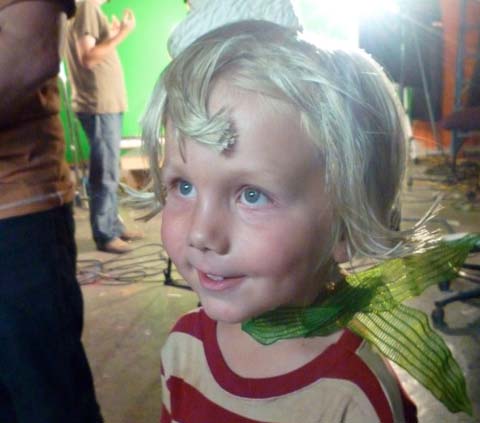
The Marvelous Misadventures of Flapjack ends its series run tonight on Cartoon Network after forty-six episodes. Chowder, which also ended its run earlier this year, lasted forty-nine episodes. The last eleven-minute episode of Flapjack titled “Fish Out of Water” will have live-action portions, and features an appearance by creator Thurop van Orman, and his son, Leif (pictured above), who portrays Flapjack.

(Thanks, Compn)

Is Aniboom Virtual Studio a legit studio?

Aniboom

Animation video sharing website Aniboom has announced they’re launching a “virtual animation studio.” They’re unclear about how their business model works, but as I understand it, Aniboom intends to create productions for corporate clients by cherry-picking crew members from the large pool of animators who have uploaded videos to their site. On one of their pages, they advertise to potential clients that the 9,500 artists who have uploaded videos are ready to create animation of high-quality in a fast and cost efficient manner.

How can they do high-quality, fast AND cheap? A clue can be found in this section where they describe how animators who participate in their virtual productions will be compensated with “a variety of potential monetary benefits that include revenue share, employment offers and payment for series development with Aniboom.” Note that their ideas of compensation do not include any of those pesky line items that other studios have to contend with like salaries, health insurance, vacation time, retirement benefits, maternity leave, and learning and development opportunities.

Aniboom has been indoctrinating young artists for years through a savvy and systematic use of contests that encourages users to create work for corporations on spec and without any expectation of pay. We’ve warned readers about these contests on mutiple occasions. Now they appear to be pushing the exploitation of young artists to an entirely new (and more profitable) level, and for a company with millions of dollars in venture capital backing, that’s exactly what we’ve always expected them to do.

UPDATE: Aniboom’s rep has told us that everybody who works for them will be paid and they have updated their website, which now says, “We offer creators around the world the attractive opportunity to work from home, on their own schedule and get paid directly via PayPal or Payoneer.”

How much do they pay? Not much according to a couple readers in our comments. The most detailed comment is from Mike who quoted this response from Aniboom:

“Thank you for your response to our call for illustrators. We are gearing up to start production of the second season of a popular animated series for television. It’s a comedy-action show for children based on five heroes who travel to strange fantasy worlds, and fight innumerable foes to try and save their kingdom. We’re looking for character illustrators and background illustrators.

The major production will begin in September, but we’re starting in about 2 weeks to produce the assets and several sequences. Are you interested, and would you be available to work with us starting in around 2 weeks time?

We’re paying:

· $90 an average per sequence.

· $250 for a full character package with all positions and facial lipsync

· $100 for a character with only basic positions.

· $100 for background art

(Thanks, Chris Sokalofsky)

The Solo Adventures

If you like Star Wars, you’ll get a kick out of this. The Solo Adventures was shown a few weeks ago at the Star Wars Celebration V in Orlando, Florida (I was there!), where it was an audience favorite and won a Best Animation prize. This 3D student film, written and directed by Daniel L. Smith and Jeffery Sheetz, was a class project by students at the DAVE School of Digital Arts and Visual Effects in Orlando.

(Thanks, Mike Stanfill)

Scantily Clad CGI Horuses in a Conga Line

Enjoy:

As best as I can make out, the animation combines a popular Japanese meme surrounding gay porn star Billy Herrington with a newer animation-loop meme called Fukkireta in which “anime characters dance with their hands on their hips and shaking side to side with cute background music,” like this:

A lot of the Fukkireta appear to be cycles edited from existing anime productions, but it’s all inspired by this piece of animation that first appeared online last May:

Disney’s Annie Awards Withdrawal

Last Wednesday we posted a link from Variety in our Industry Headlines column (at right), Disney Withdraws from Annie Awards, which clearly deserves further discussion on Cartoon Brew. The Variety piece, as far as I know, is essentially fair and accurate. But some of the secondary reporting on this, on such blogs as the Animation Guild and Michael Sporn to name two, are unintentionally spreading misinformation. So I thought we owed it to our readers to set a few things straight.

First, Disney’s withdrawal does not mean Disney films will not be considered or nominated, and does not mean the studio has no chance to win future Annie Awards. They certainly will.

Disney’s decision only affects the Annie Awards in two ways: Disney will not provide their traditional portion of co-sponsorship money (a role that dates back at least twenty years), funds that help mount the annual event at UCLA’s Royce Hall. And secondly, the company currently says they will not submit nominees from their feature animation studios.

Disney and Pixar artists (and all animators, anywhere) should be aware that they can submit their own work for Annie nomination without studio assistance. Also, Annie nominating committees have the power to nominate work which was not submitted. Nominations are decided by peer-group committees, not studio execs, and winners are voted on by Asifa’s professional membership. So again, I predict Disney and Pixar to be well represented come award time.

ASIFA was established by animation artists such as Norman McLaren, John Hubley, and John Halas in 1957. ASIFA’s Hollywood chapter, a non-profit organization, was started a few years later by Bill Scott, Stephen Bosustow, Ward Kimball, William T. Hurtz, Carl Bell, Les Goldman, June Foray, and Bill Littlejohn. The Annie Awards have always been presented by artists, for artists.

Long before the Oscars and Golden Globes thought animated features worthy of their awards, the Annies recognized features, TV shows, direct-to-video movies and commercials, as well the animators, story artists, background painters, voice actors and other behind the scenes talent.

It’s a wonderful thing when those who run the corporations that profit most from the artform support and celebrate the people who actually create the work. From what I know, the Annies will go on this year with strong support from Nickelodeon, Sony, Dreamworks, Warner Bros., Cartoon Network, Fox, Universal and Starz.

Disney management, in an email sent to Disney/Pixar employees last week, encouraged its employees “to maintain their memberships and support for the Annies as they deem appropriate”. Somehow, someday, I suspect Disney will return to supporting the Annies – at a time they deem appropriate.

Saturday Book Review

Here’s a roundup of few new books that several publishers and authors were kind enough to send my way:

ANIMATED PERFORMANCE (Ava Publishing) by Nancy Beiman is an instant classic. There have been many many “how-to” books written by current and past animation masters in recent years, many of them quite good (Richard Williams and Eric Goldberg’s books come to mind first). Beiman’s new book concentrates solely on character animation and she knocks it out of the park. It is a thorough, step by step examination of the art, aimed at the advanced student or professional animator who already knows the basics. The principles she discusses can apply to any technique (CG, Flash, stop motion, etc.) and she has packed the book with ample examples of her own animation, as well as classic comic strips, commercial art and movie stills to illustrate her points. She’s also peppered the book with inspiring quotes (such as this neat one from Kaj Pindal: “Animation begins where live action gives up.”). What’s most important is the book is a joy to read – even a non-animator such as myself can get a lot out of it. It’s 232 oversized pages, loaded with solid information based on a lifetime of professional experience. I highly recommend this book to anyone doing, or attempting to do, character animation on any level.


THE ADVANCED ART OF ANIMATION (Course Technology) by Ken A. Priebe is a sequel to Preibe’s 2006 book, The Art of Stop Motion Animation. This time Preibe takes a closer look at some the techniques touched upon in his earlier volume, as well as covering advances in the techniques during the last five years. The book contains a more thorough history of the stop-mo technique, extensive interviews with visual effects supervisor Pete Kozachik, clay animator Marc Spess, Screen Novelties’ Mark Caballero & Seamus Walsh, as well as expanded chapters on building puppets, character animation and visual effects. There are several books out there on stop motion, off hand I’d say Priebe’s new book is possibly the best.


SID THE SQUID (Immedium) by David Derrick is part of the trend of animators writing and illustrating children’s books. Derrick is a story artist at Dreamworks, and this charming book reads like a classic animated feature that never was. Sid leaves the ocean, and with the help of a little girl, he searches the city in hopes of finding the right job for his particular talents. Fun, and with an inspiring message. Perfect for kids of all ages.


Last but not least, CHRISTMAS WISHES (Stackpole Books) by Tim Hollis (co-author of Mouse Tracks, The Story of Walt Disney Records) is one to pick up for purely inspirational purposes. It’s Tim’s nostalgic recollections of Christmas past, lavishly illustrated with images of vintage toys, comic books, records, TV specials, sheet music, toy catalogs and advertisements from the 1950s, 60s and 70s. Cool stuff, nicely compiled, and fun to browse.

Shelter Stories

Speaking of animator Paul Fierlinger (as we did yesterday), The Animal Shelter Project and the Humane Society have brought Fierlinger together with cartoonist Patrick McDonnell (Mutts) to create six public service spots based on the book Mutts Shelter Stories.

According to producer Peter Barg, “McDonnell felt Paul’s ability to capture true-to-nature body language was the perfect complement to his famous Mutts characters”. Fierlinger’s feature My Dog Tulip, opens in NYC at Film Forum on September 1st and in LA at the Nuart on October 22nd. You can watch all six spots online at Z Animation.

Kihachiro Kawamoto, RIP

It’s not a good week to be a Japanese animation legend. Stop motion animator and puppeteer Kihachiro Kawamoto, passed away last Monday at age 85. The cause of death was pneumonia.

From Wikipedia:

Born in 1925, from an early age Kihachiro Kawamoto was captivated by the art of doll and puppet making. After seeing the works of maestro Czech animator Jiri Trnka, he first became interested in stop motion puppet animation and during the 50s began working alongside Japan’s first stop motion animator, the legendary Tadahito Mochinaga.

In 1958, he co-founded Shiba Productions to make commercial animation for television, but it was not until 1963, when he traveled to Prague to study puppet animation under Jiri Trnka for a year, that his puppets truly began to take on a life of their own. Trnka encouraged Kawamoto to draw on his own country’s rich cultural heritage in his work, and so Kawamoto returned from Czechoslovakia to make a series of highly individual, independently-produced artistic short works, beginning with Breaking of Branches is Forbidden (Hana-Ori) in 1968.

Heavily influenced by the traditional aesthetics of Noh, Bunraku doll theatre and Kabuki, since the 70s his haunting puppet animations such as The Demon (Oni, 1972), Dojoji Temple (Dojoji, 1976) and House of Flame (Kataku, 1979) have won numerous prizes internationally. He has also produced cut out (kirigami) animations such as The Trip (Tabi, 1973) and A Poet’s Life (Shijin no Shogai, 1974). In 1990 he returned to Trnka’s studios in Prague to make Briar Rose, or The Sleeping Beauty.

In Japan, he is best known for designing the puppets used in the long-running TV series based on the Chinese literary classic Romance of the Three Kingdoms (Sangokushi, 1982-84), and later for The Story of Heike (Heike Monogatari, 1993-94). In 2003, he was responsible for overseeing the Winter Days (Fuyu no Hi) project, in which 35 of the world’s top animators each worked on a two-minute segment inspired by the renka couplets of celebrated haiku poet Matsuo Basho.

This is a link to a news story in Japanese about his death. Here’s an interview with Kawamoto that offers more details about his career. Also, be sure to check out the fantastic imagery in his short film The Trip.

(Thanks, Chris Robinson)

Disney Remixes Old Cartoons into Blam!

Brew reader Topher writes, “I saw these on the Disney channel. They are called BLAM! and they are horrendous. Disney cartoons with America’s Funniest Home Videos style commentary and horrible music running over every second of footage. Why they don’t just show the cartoons I have no idea.”

Personally, I have no problem with remixing footage that might be too slow-paced for today’s media-saturated kiddies. The idea for Blam! is nothing new. Ward Kimball did the same thing in the 1970s with his TV series The Mouse Factory (watch an episode of the series with Don Knotts). The difference was that Ward edited and packaged the cartoons in a witty and fun way that enhanced an audience’s appreciation for the source material and made the viewer want to seek out the original shorts. These Blam! episodes, which are probably named so because the viewer wants to blam their head off after watching them, destroy the spirit of the Disney cartoons and over-explain every joke to the point where it becomes unfunny. I’ve included three in this post so you can judge for yourself.

UPDATE: Pixar’s Up has been “blammed”!

“My Dog Tulip” opening in New York

My Dog Tulip

Paul Fierlinger’s animated feature My Dog Tulip opens an exclusive two-week run on September 1st at the Film Forum in New York. It opens later elsewhere in the US (complete list of cities here). Fierlinger is an exceptional and exceptionally devoted animation filmmaker (he made the artwork for his film with only one other person–his wife, Sandra), and I can’t wait to finally see the results. As this article from the Boston Globe makes clear, the film isn’t conventional animated fare; the book on which its based, by J.R. Ackerley, has been called the “[most] preeminently disgusting of all great dog books” and derided as “meaningless filth about dogs.”

This is a revealing quote from Fierlinger from an interview in The Bark magazine, which says a lot about where he’s coming from:

From a very young age, I disliked Disney and loved The Little Prince because the fox explains to the boy [in The Little Prince] what he must do to tame him, the fox. If the fox would know this, wasn’t he already tame? But instinctively–I was seven or eight at the time–I undersatnd that it shows Antoine de Saint-Exupéry’s understanding of nature. He wasn’t violating any rules, whereas Disney violated all the rules of nature. That’s what I want our film to be: the opposite of 101 Dalmatians. So that people would not want to buy a dog after they saw Tulip, like too many people do who watch Disney movies.