CARTOONS AT UCLA

krazyrare2.jpg

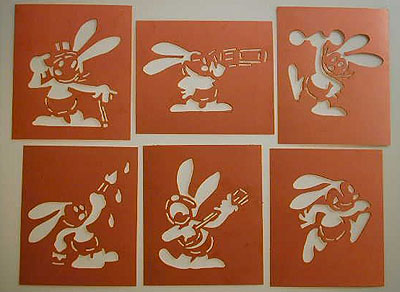
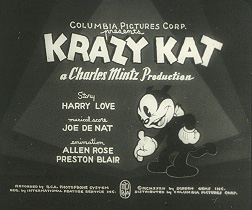
Heads up for those in Los Angeles area. On Friday (3/3, 7:30pm) the UCLA Film & Television Archive is running a tribute to Comic Art Onscreen. The Friday night program presents a selection of animated cartoons from the silent to early sound era (drawn from the Archive’s own collection, the Museum of Modern Art, Library of Congress, George Eastman House and Columbia Pictures).

Titles include: LITTLE NEMO (1911), DREAMS OF A RAREBIT FIEND: BUG VAUDEVILLE (1921), Fragment from THE CENTAURS (1921), GERTIE THE DINOSAUR (1914), BOBBY BUMPS STARTS A LODGE (1916), BOBBY BUMPS AT THE DENTIST (1917), INDOOR SPORTS (1921), BREATH OF A NATION (1919), THE BEER PARADE (with Scrappy, 1933), KRAZY KAT GOES A-WOOING (1916), KRAZY KAT AND IGNATZ MOUSE AT THE CIRCUS (1916), THE APACHE KID 1930 (Krazy Kat), FELIX THE CAT IN BLUNDERLAND (1926), FELIX THE CAT WEATHERS THE WEATHER (1926).

A second program (Saturday March 11th, 2006, 7:30PM ) features another rarity, the only non-live-action feature film by Japanese New Wave master Oshima Nagisa (MERRY CHRISTMAS, MR. LAWRENCE [1983], IN THE REALM OF THE SENSES [1976]). BAND OF NINJAS (1967) is not animated, but rather a filmed manga (comic book). Using sound and montage techniques, Oshima made an action epic by filming the pages of Shirato Sampei’s 16-volume manga classic about bloody revenge and revolt in feudal Japan.(Thanks, Sharon Burian)

Cartoons for Victory!

Bury the Axis

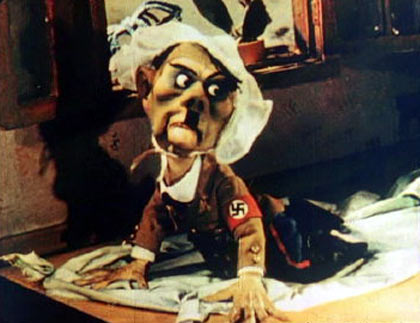
I rarely buy dvds, but one of the few that I’m planning to get is the forthcoming GOLDEN AGE OF CARTOONS: CARTOONS FOR VICTORY!. I saw a ‘rough cut’ of the dvd a few months back and it’s a spectacular collection of super-rare World War II-era cartoons from the US and Europe. The group of filmmakers represented on this dvd is stellar: Lou Bunin, Jiri Trnka, Hans Fischerkoesen, John Hubley, Chuck Jones, Bob Clampett and Frank Tashlin, among others. DVD producer Steve Stanchfield is passionate about animated films and puts a lot of care into finding the best prints around and presenting these cartoons properly. The dvd also has commentaries by Cartoon Brew’s very own Jerry Beck, as well as Eric Goldberg and John Kricfalusi. For a mere $10 on Amazon, it’s hard to go wrong with this collection. For more details about what’s on it, check out this review.

John Canemaker in the NY TIMES

Yesterday’s NY TIMES (use BugMeNot to bypass registration) had a piece by Charles Solomon about John Canemaker’s Oscar-nominated short THE MOON AND THE SON: AN IMAGINED CONVERSATION. At the end of the piece is this eloquent thought by Canemaker:

The potential for animation to be emotionally expressive and personal has barely been touched. In the future, we’re going to see more personal films, including memoirs and diaries… Animation has been ghettoized as a kids’ medium, which is a waste of its potential for artists who could express larger visions.

(Thanks, Joel)

Tachiguishi Retsuden

Tachiguishi Retsuden

TACHIGUISHI RETSUDEN is an upcoming Japanese animated film by Mamoru Oshii (GHOST IN THE SHELL) and Production IG. It is yet another example of the type of innovative animated features that are being produced in seemingly every corner of the world nowadays except the United States. I was really impressed with the film trailer. The film’s visuals are comprised largely of digitally manipulated photo cut-outs mixed with some straight-up CG. It’s worth noting that the filmmakers don’t hide the fact that these are flat photos, and the animation style emphasizes the flatness when characters are turned and moved around. The last film I saw that innovated this much with photo cut-outs was Virgil Widrich’s mind-bending FAST FILM.

A synopsis of the film at Twitchfilm.net is both confusing and intriguing for its nuttiness: it is apparently some type of historical comedy/fantasy about “fast-food grifters.” At least that explains why people continuously yell ‘Hamburger’ in the trailer. Catsuka.com offers some other interesting details about the production. The film uses 30,000 photos, taken in only five days, and a lot of the digital animation was created by students. Most of the cast was made up of folks who work in animation: the actors include the CEO of Production IG, Mitsuhisa Ishikawa, Ghibli producer Toshio Suzuki, ESCAFLOWNE director Shoji Kawamori, and storyboard artist Shinji Higuchi. One can sense that the filmmakers and crew were truly having fun on this project. This anything-goes spirit of experimentation and playfulness is one of the primary factors that makes cartoons from the Golden Age of Hollywood animation so appealing, and it’s something that’s largely absent from contemporary animation. It’s nice to see the spirit is alive and well in Japan.

TACHIGUISHI RETSUDEN opens in Japan on April 8. The official website (in Japanese) is HERE.

Doogal Tanks

doogalstill.jpg

Well, that didn’t take long. Congrats to our friends at the Weinstein Company for releasing the first CGI bomb of 2006, DOOGAL. The film opened relatively wide in over 2,300 theaters, but managed only $3.6 million for an 8th place finish. The film had a per-theater average of $1,556, the second-lowest per-theater average in the top ten. With over a dozen CG cartoons still on the slate for ’06, and most of them poorly conceived, DOOGAL promises to be only the first of many flops.

Classic Cartoon Video Podcasts

Michael Barrier posted an article excerpt on his site from yesterday’s WALL STREET JOURNAL that said the Vintage ToonCast, which is an independent site that broadcasts classic public domain cartoons, is beating out mainstream corporate podcasts like the one for ABC’s LOST. What the article didn’t say is that the Vintage ToonCast will soon be getting some competition from ReFrederator, a new podcast being prepped for launch by Frederator, which promises to deliver one classic public domain cartoon everyday.

Unfortunately, the WALL STREET JOURNAL article is behind a subscription barrier, but here’s part of the excerpt that Barrier posted on his site:

One of the most popular podcasts currently online was made 63 years ago and stars Bugs Bunny.

On iTunes this past week, beating out ABC’s podcast for “Lost,” in which the show’s stars are interviewed, was a video podcast called Vintage ToonCast. It’s a free weekly posting of cartoon shorts from the 1930s and ’40s, with adventures of Bugs Bunny, Elmer Fudd and Woody Woodpecker. The first, in December, of the 1943 short “Falling Hare,” has been downloaded close to 50,000 times.

While big entertainment companies are focused on charging viewers to download TV shows and music videos, this podcast and others like it are a reminder that there’s plenty of competition online from free media. The early animation clips shown by Vintage ToonCast are no longer protected by copyright and can be freely distributed by anyone. Any money made by podcasts usually comes from ads on the podcasts’ Web sites, or occasionally, product mentions in the podcasts themselves.

“Anyone could be doing what I’m doing,” says Vintage ToonCast creator Josh Cuppett, a 25-year-old chemical engineer at an environmental services contracting company, who is also a budding filmmaker. Mr. Cuppett gets the clips from Internet Archive (archive.org) a nonprofit “Internet library” offering free access to historical digital materials. The classic cartoon collection was provided to the archive by Film Chest, a company that collects old film clips and stock footage.

A CAR-TUNE PORTRAIT

portrait13.jpg

One of the hot things emerging on several cartoon blogs lately is the detailed deconstruction of classic animated features and shorts. By “deconstruction” I mean the study of individual animator’s styles within a cartoon by determining who animated what scene. Records of this work, known as “animator drafts,” were created in-house during production and usually discarded once a film was completed. Disney, of course, saved theirs. The existence of these records from other studios is usually harder to come by – but miraculously several survive from the likes of Warner Bros., UPA, MGM, Terrytoons and Fleischer simply because the animators themselves occasionally hung onto them.Jaime Weinman has been examining classic Warner Bros. cartoons (such as RABBIT OF SEVILLE) scene by scene on his blog; Jenny Lerew has posted drafts from Disney shorts like THE NIFTY NINETIES; and Michael Sporn just posted several pages of animator drafts from Disney’s PINOCCHIO. Adding to the fray, I’ve just posted a draft of a 1937 Max Fleischer Color Classic, A CART-TUNE PORTRAIT, up on my Cartoon Research website. Animators identified in this cartoon include Dave Tendlar, Joe Oriolo, Bill Sturm, Nick Tafuri and several other Fleischer regulars. Once you get a handle on an artist’s particular traits, following their work becomes easier – and studying their accomplishments significantly adds to our collective knowledge of the history of animation.

The New Yorker Cover That Wasn’t

This story is more about illustration than cartoons, but Bill Joyce is a familiar face in animation nowadays. He was the production designer of Fox’s ROBOTS (I worked with him on the film’s ‘art of’ book) and his children’s book A DAY WITH WILBUR ROBINSON is being turned into Disney’s upcoming CG feature MEET THE ROBINSONS. Joyce, who is a native Louisianan and still lives there, had drawn a cover and written a story for the NEW YORKER magazine about the Katrina hurricane tragedy. Both the story and cover got bumped from this week’s issue because of vice-president Dick Cheney’s recent hunting escapades. Here is Bill’s story about the NEW YORKER cover that wasn’t:

DICK CHENEY SHOT HIS FRIEND BUT HE KILLED OUR COVER.
I was asked some months back to do a New Yorker Cover depicting some aspect of how New Orleans was dealing with Mardi Gras in the post Katrina world.

I’ve done occasional covers for the New Yorker since 1994 and since I am a native Louisianan and still live here they hoped I’d have an informed perspective on the tragedy and its aftermath.

My schedule has been crazed. The movie business demands all you’ve got and more. But this was a labor of love and something I felt I had to do.

Coming up with a concept that tempered my rage with some hope was not easy, but I got inspiration from an old photograph of Mardi Gras in the ’30′s by J. Guttman, called the” The Game”. It’s a wonderful, eerie image of New Orleans and its curious magic.

The editors were very pleased with the results. The proof looked great. Some friends cried when I showed it to them.

The image did what I’d hoped. It made people from here sad and proud at the same time.

I was hoping it would, I don’t know, somehow help. Help call attention to our plight. Help people understand us.

Then Dick Cheney shot his friend instead of a bird.

A more topical cover was cobbled together. A clever twist on Cheney’s folly.

I’ve had covers at the New Yorker bumped before. That’s just part of the game. But this one really mattered. The hurricanes have turned the people of Louisiana into activists. We no longer have the luxury of emotional distance with this story.

Louisiana had received its share of coverage lately I was told. They tried to find a place for it inside the magazine. Everyone said they were sympathetic. But nothing happened.

So we’ve been shunted aside again.

Our collective sorrow and tragedy mattered less than a single hunting accident.

I really had hoped that compassion would win out over clever.

Mr. Cheney’s friend is thankfully alive. Meanwhile we’re still finding bodies in New Orleans.

Here’s the cover. I hope you can use it to keep the story of our troubles alive.

New Yorker cover by Bill Joyce
(click on cover for larger version)