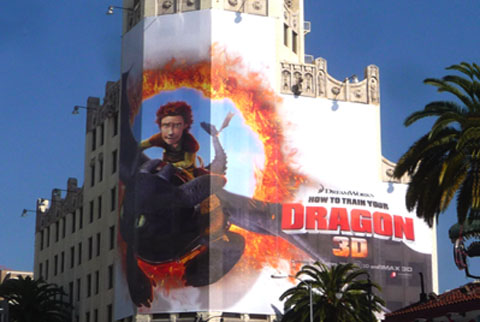
Man arrested for posting Dreamworks billboard in Hollywood

Dreamworks’ How To Train Your Dragon got a little unintended publicity this weekend in Hollywood. A man alleged to have put up a large, “supergraphic” billboard in violation of Los Angeles city law was arrested and held on $1 million bail over the weekend.

The massive movie ad was draped over a 1927 building on the corner of Hollywood Boulevard and Highland Avenue, property co-owned by Kayvan Setereh, the man arrested. The ad was strategically positioned to be seen by the throngs attending next week’s Academy Awards ceremony, both in person and on television. According to the L.A. Times, “the city outlawed such signs in August, arguing they are unsafe for pedestrians below and that they could prevent firefighters from entering buildings in an emergency. Critics also decry them as visual blight.”

Spongebob Little Golden Book

Regular Brew readers are aware that I collect old Little Golden Books relating to animation and have frequently mentioned my admiration of the recent “retro-stylized” Golden Books for current Disney and Pixar films. Add Nickelodeon to the watch-list. I just discovered Mr. Fancypants, a Spongebob Squarepants tie-in, at my local Barnes and Noble last night. The book was published as a commemorative to celebrate the sponge’s tenth anniversary and features great artwork by animation artist Caleb Meurer. Take a look — Random House has posted the first few pages online:


A Free Animation Book Idea For You

Finians Rainbow
Concept art from John Hubley’s Finian’s Rainbow

This repost of John Canemaker’s article about John Hubley’s unproduced feature Finian’s Rainbow reminded me of a book idea I’ve had for years. With my full plate of writing, editing, and creative directing various book projects, I know I’m never going to get around to doing this book, but I believe in the idea so I’m going to put it out there and hope somebody runs with it.

Here’s what I’d like to see: a richly illustrated coffeetable book that explores unproduced animated features. Kind of like Charles Solomon’s The Disney That Never Was minus all the dull-as-dishwater Disney projects. There’s a good reason why most of those Disney films were never produced! (An exception might be made for Marc Davis and Ken Anderson’s Chanticleer.) Looking past Disney, there is an extensive catalog of daring and colorful feature animation projects that were unrealized. It’s an eye-opening alternative animation history that spans some of the art form’s biggest names. Anybody who tackles the book should be sure to include:

* Orson Welles’ The Little Prince (developed with Hugh Harman and Mel Shaw)
* UPA’s The White Deer (developed by Leo Salkin and Aurelius Battaglia)
* John Hubley’s Finian’s Rainbow
* John Dunn and Vic Haboush’s Wolgalooly
* Richard Williams’ Thief and the Cobbler
* George Dunning’s The Tempest
* Fred Calvert’s Don Quixote (developed by Ray Aragon)
* Yuri Norstein’s The Overcoat
* Tom Carter Productions’ Huck’s Landing
* TMS’ Little Nemo: Adventures In Slumberland (with various crews that included Hayao Miyazaki, Chuck Jones, George Lucas, Isao Takahata, Ray Bradbury, Frank Thomas and Brad Bird)
* Ralph Bakshi’s Last Days of Coney Island
* Bill and Sue Kroyer’s Arrow
* Brad Bird’s Ray Gunn

The “what could have been” factor of these films is a persistent source of fascination for me. Any number of these projects had the potential to change the course of the art form. Imagine if Orson Welles had released an animated feature at the height of his influence, or if John Hubley’s vision of mature feature animation had come to fruition in the 1950s. Some of these films were indeed produced in bastardized forms (Little Nemo and Arabian Knight are examples), but most perished for a variety of reasons like financing, a director’s inability to finish, a director’s death, the Hollywood blacklist, or in the case of Huck’s Landing, the head of the studio being sent to prison.

Putting together this book won’t be easy. Whoever does it will have to do tons of research and detective work; it would even be wise perhaps to divide it amongst a cadre of historians and writers to ensure that the book is finished in a reasonable period of time. But if executed properly, I have no doubt it would be an entertaining, educational, and thoroughly unique contribution to animation literature.

Cartoons in Cinemascope

Next Tuesday, at my usual monthly screening at The Silent Movie Theater, I’ll be running a great selection of 1950s cartoons in widescreen CinemaScope. I will be showing rare 35mm and 16mm prints – many in Technicolor. Among the titles being screened will be Ward Kimball’s Toot Whistle Plunk and Boom and the Donald Duck Grand CanyonScope from Disney, Tom & Jerry and Droopy cartoons from MGM, Mr. Magoo and Gerald McBoing Boing from UPA, and a slew of rare Terrytoons, including Flebus, Dinky Duck in It’s A Living, and many others including R.O. Blechman’s Juggler Of Our Lady (narrated by Boris Karloff).

Join us at 8pm, 611 N. Faifax Avenue (one block south of Melrose) in Hollywood. For more information or to reserve tickets check the CineFamily website – or join our Facebook page.

Animated Review of Avatar

Nobody’s come forward to claim responsibility for this elaborate animated review of Avatar. I particularly like how they (I’m assuming more than one person made it) used the same performance capture animation technique as the film itself. Stats on YouTube show that the video is popular in New Zealand, but word on the street is that it’s not WETA. Hmmm . . .

(Thanks, Kim Hazel)

Rudy Larriva (1916-2010)

Variety is reporting that veteran Warner Bros. director Rudy Larriva passed away last Friday Feb. 19 in Irvine, Calif. He was 94.

Larriva, an animator for nearly six decades, worked primarily at Warner Bros. in the 1930s and 40s, recieving animation credit on several cartoons including the seminal Chuck Jones cartoon, Elmer’s Pet Rabbit (1941). He later joined Disney (Song of the South, Melody Time) and spent the 1950s at UPA (Mr. Magoo). He is credited as the animation director for the opening credits of The Twilight Zone in 1959-60. He spent much of his later years toiling on TV series for Ruby Spears and other studios. His greatest claim to fame, unfortunately, was his direction of several low budget Road Runner cartoons for DePatie Freleng in the mid-1960s. Funeral services will be held at 10:30 a.m. March 1 at Eternal Hills Cemetery, Oceanside, Calif.

(Thanks, Joe Apel)

Beyond Yellow

The Animation Guild is hosting its second-ever art opening at its new Gallery 839, on Friday, March 5th, from 6 pm to 9 pm. The gallery is located in the new Guild building at 1105 N. Hollywood Way (between Magnolia and Chandler) in Burbank. The show is called Beyond Yellow and showcases the work of Simpsons animators doing what they do outside the realm of Springfield.

(The images above are not part of the show, but are the work of David Barton at limpfish.com.)

Clips and Reviews of Sylvain Chomet’s The Illusionist

Illusionist

Sylvain Chomet’s The Illusionist easily tops my list for most anticipated animated feature of 2010 (sorry Tangled). The film premiered to raves last week at the Berlin International Film Festival, and the Pathé Distribution website lists a May 5, 2010 release date, which I believe is for France. Pathé is also handling UK distribution, though I haven’t run across a release date yet. ScreenDaily reported yesterday that the film has also secured distribution deals for Japan (Klockworx), Italy (Cinema 11), Greece (Nutopia), Benelux (Paradiso) and the Middle East (Phars Film) while “a US deal is expected to be announced shortly.”

The first clips from the film to appear online can be seen in this video interview with Sylvain Chomet. Here are three different reviews of the film from people who saw it in Berlin:

Screen Daily: “The imagery excels at depicting less-harried times: as a train chugs over a trestle bridge in the country, its reflection in the water below is as stunning as the changing light over Edinburgh. And somehow the animated rain seems more real than the wet stuff in live-action films. The deceptively simple story (which bears some scattered similarities to Chaplin’s Limelight) is anchored in nostalgia for bygone traditions. And yet the theme of dedicated craftsmen (a clown, a ventriloquist, a magician) made obsolete by changing tastes (not to mention age making way for youth) remains relevant.”

In Contention: “It took six days and an awful lot of films, but the Berlinale has finally turned up a masterpiece. Moreover, it’s a rare case of one of the fest’s most eagerly awaited titles managing to meet, and even subvert, expectations. The Illusionist . . . confirms a truly singular auteur sensibility, while revealing a more disciplined artist and storyteller within. A streamlined character study, less deliriously eccentric in tone and structure than his debut feature, The Illusionist nonetheless boasts an emotional heft that handsomely repays its creator’s restraint.

Variety: “The pic is a thrilling exercise in retro aesthetics, from the pencil-and-watercolor look to the 2D animation that harks back to mid-1960s Disney (especially “101 Dalmatians”) and the delicate lines and detailed backgrounds of Gallic animator Paul Grimault, to the details that perfectly evoke Scotland in the 1950s. All the same, the backgrounds here brim with little jokes that the long takes offer a chance to catch, such as the sight of lobster thermidor (with a fried egg on top and haggis) on offer at a fish-and-chips shop . . . Pace may seem a little slow for those reared on contempo animation, but for those immersed in the film, the rhythms are delicious.”

(Thanks to Martin Gornall, who worked on the film, for these links)

ASIFA-East Animation Festival Entry Deadline

The deadline to enter ASIFA-East’s 41st Annual Animation Festival is Monday, March 1. Entry forms are available on the ASIFA-East website.

Jury screenings take place in March at the SVA 3rd Floor Amphitheater (209 E. 23rd Street). They are free and open to all, though only ASIFA-East members can cast votes. Screening schedule is below (all of them start at 7pm):

TUESDAY, MARCH 9 – Student Films
THURSDAY, MARCH 11 – Commercials/Promos under 2mins
TUESDAY, MARCH 16 – Independent Films
WEDNESDAY, MARCH 17 – Sponsored Films over 2 mins (5th fl, rm. 502)

George Lopez to voice Speedy Gonzales in live action/CG movie

From the story in today’s Hollywood Reporter:

“We wanted to make sure that it was not the Speedy of the 1950s — the racist Speedy,” said the comedian’s wife Ann Lopez, who will serve alongside him as a producer. “Speedy’s going to be a misunderstood boy who comes from a family that works in a very meticulous setting, and he’s a little too fast for what they do. He makes a mess of that. So he has to go out in the world to find what he’s good at.” That path becomes clearer once Speedy befriends a gun-shy race-car driver.

“The racist Speedy”? Pardon me, but the Speedy I know from the 1950s cartoons was a hero, a champion. I would suggest the writers watch a few of the cartoons before inventing a scenario from whole cloth.

James Cameron: “I’m not interested in being an animator”

Avatar

In last week’s LA Times, James Cameron continued to assert his position that Avatar isn’t animation, though at least he’s acknowledging now that “a whole team of animators” is used in the process:

“I’m not interested in being an animator. . . . That’s what Pixar does. What I do is talk to actors. ‘Here’s a scene. Let’s see what you can come up with,’ and when I walk away at the end of the day, it’s done in my mind. In the actor’s mind, it’s done. There may be a whole team of animators to make sure what we’ve done is preserved, but that’s their problem. Their job is to use the actor’s performance as an absolute template without variance for what comes out the other end.”

In the LA Times, animation director Henry Selick also weighed in publicly for the first time on the issue:

“The academy has to come to terms with where [performance capture] goes. Is it animation? Is it a new category? I’m like the academy. I don’t know where it fits. I will tell you this, animators have to work very, very hard with the motion-capture data. After the performance is captured, it’s not just plugged into the computer which spits out big blue people. It’s a hybrid.”

In response to the recent article, Kristin Thompson at Observations on Film Art has written a thoughtful article about the hybrid nature of the performance and the disingenousness of Camerons’ claim that the creative work ends with his actors.

(Earlier Brew coverage about the amount of animation in Avatar can be found here, here, here, and here.)