The Man Behind “Blinky Bill”: A Documentary on Yoram Gross

For those of you wondering who Yoram Gross was, your questions are about to be answered. The man behind the Australian series Blinky Bill and Dot and The Kangaroo is the subject of a brand new feature length documentary, Blinky and Me. According to press materials:

The untold story of Australian animator Yoram Gross comes to life in this new film that follows the artist and his family through his childhood in Nazi-occupied Poland, to Israel, where he began creating animated art films, all the way to Australia, where he found his fortune and happiness through animated features for children and the popular film series Blinky Bill, for which he received the highest honor in Australia. Gross continues to create even today, with his 85-year-old youthful enthusiasm.

After a few months on the festival circuit, the documentary opens to the public on Friday September 7th, at the Laemmle’s Playhouse 7 in Pasadena. See the trailer here.

Brenda Chapman Talks About “Brave” In “New York Times”

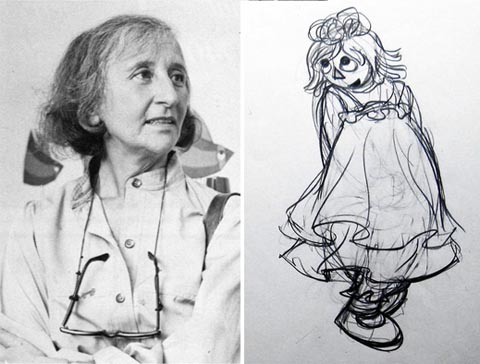
Brenda Chapman

Now that Brenda Chapman is no longer an employee of Pixar, she is speaking out for the first time about being removed as the director of Brave. This hardly comes as a surprise, but she wasn’t happy with what happened during the production, though she admits to being proud of the results. In a New York Times op-ed, she spoke about the experience:

It has been a heartbreakingly hard road for me over the last year and a half. When Pixar took me off of “Brave” — a story that came from my heart, inspired by my relationship with my daughter — it was devastating. Animation directors are not protected like live-action directors, who have the Directors Guild to go to battle for them. We are replaced on a regular basis — and that was a real issue for me. This was a story that I created, which came from a very personal place, as a woman and a mother. To have it taken away and given to someone else, and a man at that, was truly distressing on so many levels. But in the end, my vision came through in the film. It simply wouldn’t have worked without it (and didn’t at one point), and I knew this at my core. So I kept my head held high, stayed committed to my principles, and was supported by some strong women (and men!). In the end, it worked out, and I’m very proud of the movie, and that I ultimately stood up for myself, just like Merida, the protagonist in “Brave.”

“Gum” by Noam Sussman

Move over, Bazooka Joe! Welcome to the latest–and possibly most outrageous–selection in this year’s Cartoon Brew Student Animation Festival: Gum by Noam Sussman of Canada’s Sheridan College. A mere sixty seconds, Gum begins with a bizarre premise and keeps building. Filmmaker Sussman topps (pun intended) every scene with an even funnier one using zany drawings, assured staging, and a “what-did-I-just-see” attitude, making this a whole bunch of politically incorrect fun.

Click HERE to read an interview with the filmmaker Noam Sussman.


The Cartoon Brew Student Animation Festival is made possible by the generosity of our presenting sponsor JibJab.

Mickey Mouse Stop Signs Protest Copyright Extension

A street artist named Denmark has added a set of attachments to several local stop signs in Los Angeles and Burbank in protest of Disney’s ongoing lobbying efforts to change copyright law and extend copyrights on its short films of the 1920s and ’30s. Denmark told street art blog Wooster Collective:

“I recently did an installation in and around Los Angeles protesting Copyright Extension, which is Disney’s very effective lobbying to keep Mickey Mouse, and works created thereafter, out of the public domain.”

Thanks to congressional lobbying by Disney, traditional copyright terms have gone from 28 years to at least 95 years – or even longer (the law since 1998). Some have argued that films falling into public domain has actually saved them from extinction. Though Disney does a good job of making its library available to the public (with the obvious exception of Song of The South) other studios, unaware of any value these assets may yield, vault and abuse their older animated shorts still under copyright protection. This debate has been raging for years–it’s nice to see it take such a creative turn.

(via Art Info)

Disney Has Halted Production On Henry Selick’s Stop Motion Feature

Entertainment industry website Deadline.com published a report this afternoon that Disney has halted production on the new feature directed by Henry Selick (The Nightmare Before Christmas, Coraline). Selick was producing the film at his new San Francisco-based studio Cinderbiter (aka Shademaker Productions):

The crew on Henry Selick’s untitled stop motion animated film were told this afternoon that Disney is not proceeding with this project. Though the film had no title, it had a October 4, 2013 release date, and about 150 San Francisco-based artists ready to go, so it’s a blow to the animation troops out there. Started shooting last summer, but I’d heard it just wasn’t coming together in a manner that pleased the studio. Selick has been given the chance to take the project to other studios…[I]t’s unclear what this does to his plans to helm Neil Gaiman’s “The Graveyard Book,” a project Disney acquired in April.

Is Deadline’s report accurate? If you have details, share them anonymously in the comments or contact me directly.

UPDATE: Local 839 IATSE business rep Steve Hulett confirmed on the animation union blog that Disney contacted the union on Tuesday morning to inform them of the impending shutdown. Hulett wrote, “I have no idea why Henry [Selick]‘s project was shut down so deep into production…whatever the actual reason, we’re saddened to see so many animation professionals lose their jobs off a feature that appeared to be in full flight. Here’s hoping that Mr. Selick sets the feature up someplace else and folks can continue working.”

Meanwhile, Variety reported that, “Sources close to the production said from a creative and scheduling standpoint, the pic wasn’t where it needed to be to meet its planned release date and [Disney] decided not to continue production as a result. While the pic had been in production since last summer, Disney had yet to hire thesps to voice characters. Studio also had yet to reveal any artwork from the project during its production or as promotional materials, making it easier for another distributor to pick up the film. ”

“Sick Leave” By Jake Fried

Watching Boston-based Jake Fried‘s Sick Leave feels like discovering the animation of an indigenous tribe in some faraway land. The exciting stream-of-conscious flow is a constant surprise, mixing Fried’s personal symbolism with recognizable imagery, like a burning house and a can of soda. The visceral quality of the artwork is enhanced by the use of raw materials like ink and white-out.

A French Skin Flick That Gets Up Close (NSFW)

It’s almost a guarantee that when you see a student film from the French animation school Supinfocom, it’s going to look beautiful. But few of the school’s films push narrative boundaries or challenge the viewer like J’aurai ta peau (I’ll Have Your Hide). The provocative CG short is based on interviews with people talking about skin and their relationship with their bodies.

Nothing could be more familiar to the average person than one’s own skin, but the extreme close-ups in J’aurai ta peau transform human skin into an exotic, foreign landscape. The atypical marriage of photoreal rendering and abstraction is startling, beautiful and discomforting all at once. Suddenly, we see the commonplace in a new light, and perhaps feel an urge to examine our own skin more closely.

The daring quartet responsible for the short is comprised of Victoria Jardine, Vivien Ebran, Alexis Koch and Nicolas Trotignon. Credit also belongs to Benoit Duvette for sound design that adds a lot. Toolset was Maya, Photoshop, Nuke and Avid.

“Stitches” by Reut Bortz

Reut Bortz recently graduated from Bezalel Academy of Art and Design in Jerusalem, Israel. Her graduation film Stitches took a year and a half to complete, and it deals “with the question of whether it is possible to adapt every child to one specific mold”.

“I define the movie as semi–autobiographical,’ says Bortz. “In some parts it is based on my life, but mainly on the lives of hundreds of others who feel like they can’t be themselves among their own families and communities.” I think the message is universal – and the film is beautiful:

Ed Hooks Explains Why His Popular Acting Book Is No Longer Available To Art Institutes Students

Last weekend we broke the story about Mike Tracy, a veteran teacher at the Art Institute of California–Orange County who is being threatened with termination by the school’s management because he refused to force his students to buy E-textbooks that he felt were unnecessary. Since we published the story, we’ve learned that the E-textbook controversy extends far beyond Mike Tracy’s plight and affects teachers and students at many of The Art Institutes schools.

There are over fifty Art Institutes colleges in the United States, all owned by Education Management Corporation (EDMC). The art school chain has begun the process of switching all its schools to an E-book system called Digital Bookshelf. The switch to E-textbooks has met resistance at multiple schools, including Art Institute of Philadelphia. That school’s Faculty Federation complained about EDMC’s E-textbook policy a few months ago:

“EDMC continues to insist on e-books only and wants sole discretion over what e-books are used, compromising faculty independence and expertise in choosing best resources for class.”

To understand how EDMC’s “Digital Bookshelf” works, here’s a downloadable PDF explaining the system for their online courses. In this case, the Art Institute online program charges a “digital resource fee” of between $50-$75 for each class. In return, students receive a temporary copy of an e-textbook. In many cases, printed versions of the books can be purchased for a lower price, but according to the school, “If you choose to purchase a printed copy of a textbook that is available through Digital Bookshelf, you will be responsible for both the Digital Resource Fee and the cost of the textbook.”

That means every student enrolled at the Art Institutes is required to use EDMC’s Digital Bookshelf system. Not only that, but the Digital Bookshelf system isn’t open to every publisher, but only to those publishers who have signed a deal with EDMC’s E-book technology vendor, Vital Source. That means Art Institute students have to buy all their E-books from a single book distributor.

In the case of teacher Mike Tracy, he was being forced to choose a random E-textbook that he felt was unnecessary for his students. But there’s a flipside to the story. Sometimes a teacher at one of the Art Institute schools may want to use a particular E-textbook, but they can’t because it hasn’t been acquired by EDMC’s vendor, VitalSource.

Ed Hooks, author of the popular animation textbook Acting for Animators, explained to Cartoon Brew how his book is no longer available to Art Institutes students, even though his book is widely available in both print AND as an E-textbook, and is highly demanded by Art Institutes teachers:

My book Acting for Animators was published late last year in a revised third edition by Routledge/London.  Not too long after it came out, I received an e-mail from an Art Institute animation teacher in Texas.  He told me that the headquarter of the AI schools, located in Pittsburgh, had established a new textbook policy.  From then going forward, all text books must be e-books.  No more hard or soft cover. He was worried that my book might not be available in e-book format, explaining that it was one he recommended to all of his AI students.  

As it happened, Routledge was at that moment in between E-Book distributors.  They were in the process of vetting a new one and expected to announce E-Book available for all of their titles shortly.  I passed this positive message along to the teacher in Texas.

A few weeks later, I received an e-mail from an Art Institute Project Manager in Pittsburgh. He wanted my publisher Routledge to hurry up with that E-book availability because the time was near when textbook titles would have to be set in concrete for AI’s schools.  If E-Books were not available, AI would no longer be able to recommend or use “Acting for Animators”, I forwarded his e-mail to my editor, which instigated a trans-atlantic back-and-forth e-mail conversation, with the Art Institute representative specifying the particular KIND of e-book format he wanted.  He wanted Routledge to contract with VitalSource and even gave my editor a personal contact at VitalSource.  

Mind you, every single e-mail from the man in Pittsburgh mentioned the large number of potential sales we would be forfeiting if we did not do the E-Book thing according to AI’s blueprint.  

In the end, Routledge went with some other e-book distributor, and the man in Pittsburgh said he was sorry but that was that. It was out of his hands.  No more Acting for Animators book at any of the Art Institutes.  

My editor in London is a decent man and he felt personally terrible that he and Routledge had just cost one of its authors many thousands of book sales.  I told him not to worry about it because serious students would sooner or later find “Acting for Animators” on their own.

As an author myself, I would never allow any publisher to sell a book I wrote to EDMC’s “Digital Bookshelf.” The set-up sounds like it benefits neither myself nor my publishers. But the biggest losers in this scenario appear to be the students who attend Art Institutes schools. According to Mike Tracy, they are being forced to purchase books deemed unnecessary by their teachers, and now, as Ed Hooks points out, they are being denied books that the school’s teachers feel are needed.

“The Lost Art Of Heinrich Kley” Collects Over 450 Rare Drawings And Paintings

Small press publisher Picture This Press will release two-volumes of The Lost Art of Heinrich Kley next month at the Small Press Expo in Bethesda, Maryland. The book will be available to order on-line afterward. The German cartoonist Kley has been an especially important influence on Disney artists from the 1930s through today. In the words of animator Andreas Deja, “Kley was doing with illustration what Walt was doing with animation. Making impossible characters and situations look completely plausible and believable.”

The publisher’s description of The Lost Art of Heinrich Kley is printed below:

The Lost Art of Heinrich Kley Volumes One & Two collect over 450 drawings and paintings from a wide array of sources. Neither volume overlaps with past books on Kley, as nearly none of these drawings have been collected and reprinted since their original publication a century or more ago. Both volumes also provide groundbreaking scholarship on Kley’s life and work by German art historian Alexander Kunkel–whose recent research is presented in these volumes for the first time in English–along with incisive appreciations by contemporary artists Michael Wm. Kaluta and Jesse Hamm.

Volume One focuses on Kley’s ink drawings, and reprints for the first time a substantial selection of his illustration work for children’s books and adult genre fiction, a side of Kley’s career previously unexplored in other collections. This volume also includes a wide sampling of Kley’s cartoons and magazine work, with newly collected examples taken directly from a variety of rare sources such as Jugend, Simplicissimus, and the historic Der Orchideengarten (the world’s first fantasy fiction magazine). In all, over 300 Kley illustrations and cartoons fill this first volume.

Volume Two also breaks new ground by being the first book to present a large number of Kley’s paintings and preparatory drawings, some reproduced directly from the original art. These color works reveal a heretofore rarely glimpsed pool of talent, and expand on the subject matter traditionally associated with the artist by including examples of his landscapes and industrial paintings. This volume’s preparatory drawings are culled from the Library of Congress’ untapped Kley archive, and show the artist working out concepts for book illustrations, reworking ink drawings into color paintings, and doodling for his own amusement. Approximately 150 drawings, many in color, appear in this volume.

“PigGoat BananaMantis!” By Dave Cooper, Johnny Ryan and Nick Cross

PigGoatBananaMantis! is a wacky teaser trailer created recently by comic artists Dave Cooper and Johnny Ryan, and animated by Nick Cross. The network that commissioned the pilot prefers to remain anonymous, but feel free to guess in the comments. This is not the first collaboration between Cross and Cooper–they worked together a few years back on this music video.

CREDITS
Created by Dave Cooper and Johnny Ryan
Written by Johnny Ryan
Directed by Dave Cooper and Nick Cross
Animation by Nick Cross
Art Direction by Dave Cooper
Music by David Burns
Sound design by Ray Gould and Wayne Bartlett
Voices by Matt Jones, Candi Milo, Tom Wilson and James Urbaniak

“Far Out Isn’t Far Enough” NSFW trailer

Here’s one documentary I look forward to seeing: Rick Cikowski and Brad Bernstein’s Far Out Isn’t Far Enough: The Tomi Ungerer Story. Illustrator Ungerer is the famed children’s book author/artist (The Three Robbers) and occasional pornographer, revered by Maurice Sendak, Jules Feiffer (both of whom appear in the doc) and Gene Deitch (who has adapted several of Ungerer’s books to animation). Filmmakers Cikowski and Bernstein funded the production last year through Kickstarter. It will premiere next month at the Toronto Inernational Film Festival. It looks good:

(Thanks, Martin Quaden)

“ParaNorman” Smears

Here’s something I’ve never seen before: sculpted smear models. Over the past decade, 3-D printers have transformed the art of stop motion animation, allowing for unprecedented subtlety and nuance in character animation. Laika has been at the forefront of exploring these new possibilities. This article in Variety discusses Laika’s use of rapid prototyping, and reveals that the new printers they used on ParaNorman had the capability to print out models in full-color. Wow!

(via Smears, Multiples and Other Animation Gimmicks)