brewmasters
JERRY BECK
bio & contact
view posts by jerry
AMID AMIDI
bio & contact
view posts by amid
TAG FOR
“Stop Motion”
by amid
March 11, 2009 7:35 am


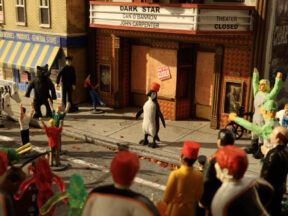
After Chuck Menville and Len Janson earned an Oscar-nomination for their automobile-themed pixilation short Stop, Look and Listen (1967), they were commissioned by Gulf Oil to recreate the idea for a series of commercials. Last night I ran across one of the spots on YouTube:

by amid
March 10, 2009 1:34 pm


United States of Tara

Stop-motion director Jamie Caliri (titles for Madagascar: Escape 2 Africa) created pop-up book-style opening titles for the Showtime series United States of Tara. The opening can be seen on the website Forget the Film, Watch the Titles and an interview with Caliri is included on the same page. The illustrations in the piece were done by Alex Juhasz, set building was led by Morgan Hay, and animation lead was Anthony Scott.

by amid
February 16, 2009 8:16 am


Scintillation by Paris-based music video director Xavier Chassaing is an experimental work comprised of over 35,000 photographs and using a mix of stop-motion and live-action projection mapping techniques. While nobody seems to be exactly sure of how the look was achieved, it’s an undeniably gorgeous visual experience.

(via Laughing Squid)

by amid
February 14, 2009 3:56 pm


Coraline Panel

Did you miss the Coraline production artists panel at Gallery Nucleus last week? Sean Szeles recorded the discussion and has posted it onto YouTube. The artists on the panel were Shannon Tindle, Shane Prigmore, Dan Krall, Chris Appelhans, Jon Klassen and Andy Schuler. All of Chris Appelhans’ and half of Jon Klassen’s presentation weren’t recorded due to the camera battery dying. Nevertheless this is a rare opportunity to hear from the talents who helped design this extraordinary film, especially seeing as how the film’s accompanying ‘art of’ book is a farce that excludes the work of these artists. I’ll be writing more about Coraline soon. Until then, I’ve created a playlist so you can watch the entire panel with just one click below:

by jerry
February 10, 2009 11:31 am


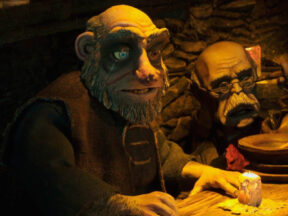
I mentioned in an earlier post that there is a nod to the late great Disney/Pixar storyman Joe Ranft (Lion King, Toy Story, Roger Rabbit, Cars, etc.) in Coraline. Thanks to the fine folks at Laika Entertainment, we can show you that acknowledgement.

The moving men who help the Jones family move into their new home are The Ranft Brothers, and the puppets are caricatures of real-life brothers and animation artists Joe and Jerome Ranft (Jerome, a sculptor at Pixar, provides the duo’s vocals). Joe Ranft worked with Henry Selick on both The Nightmare Before Christmas and James and The Giant Peach and was a valued member of the Pixar family. Selick’s tribute is a beautiful, fitting salute to a colleague and a friend.

Click on thumbnails below for large images.

Sculptor Damon Bard also posted photos of the Ranft model on his website:

Joe Ranft

UPDATE: Shane Prigmore writes in:

“It’s really cool you posted about the Joe and Jerome movers. Tonight I will post my original designs of the Ranft Brothers on my blog. You can use them in this post if you would like, so you can have the complete progression. I would be honored.

It was an honor to have Henry ask me to design Joe and Jerome. Joe’s family and freinds sent us tons of photos and told lots of stories to get me inspired. I would be lying if I said I didn’t get a little teary eyed surrounded by photos of and watching video of Joe and really trying to capture what made him Joe. I was so nervouse that his family and friends would not like what I had done (including Henry). But they were all so gracious and happy about what I had done. It was a wonderful memory that I am very glad you posted about. It brought it all back. Thanks for your continued support for Coraline, Jerry. We all apreciate it.”

(Design above by Shane Prigmore. Ranft Bros. photos from Coraline, at the top of this post, courtesy of Fumi Kitahara, Jade Alex and Laika)

by amid
February 6, 2009 5:13 am


Coraline

The first animated feature out of Laika, Henry Selick’s Coraline, opens in theaters today. Jerry loved the film, I haven’t seen it yet. The overwhelming critical consensus on Rotten Tomatoes is that it’s a solid film with a nearly 90% positive review rate. Personally, I can’t wait to see it. It’s so rare for any animation studio to start out of the gate with a film that looks and feels this different from everything else out there. Selick and company have created a gutsy film that appears to take risks and doesn’t repeat the tired formulas and conventions that make most animated features such a chore to watch. For that alone, the film deserves the support of the animation community, and you can be sure that I’m going to be planting my butt into a theater seat this weekend.

There are plenty of interviews with director Henry Selick appearing online. One of the smartest series of questions, especially as it relates to the techniques used in the film, can be found in this chat with the A.V. Club. Selick has this to say about the continuing relevance of stop-motion in a CG-dominated world:

“You know, I love stop-motion. I’ve done almost all the styles of animation: I was a 2D animator. I’ve done cutout animation. I did a CG short a few years ago, “Moongirl,” for young kids. Stop-motion is what I keep coming back to, because it has a primal nature. It can never be perfect. There’s always something like—[Points to the Coraline puppet on the table.] Coraline’s sweater, you can notice here that it’s sort of boiling. And that’s because people are touching it and moving it for every frame. There’s an undeniable reality that I don’t think any of the other mediums give you. You know these things are real even if you don’t know exactly how they move, how big they are. It’s something I got when I was 4 or 5, and I saw my first Ray Harryhausen film. I saw some monsters he created. So why still follow that in this day and age? Well, it has certainly been the age of CG, and the hits keep coming. You know, Jeffrey Katzenberg’s company [DreamWorks], they seem to have a formula. Pixar as well. And they make very, very well-made films with maybe the best story department in the world. But I do think there’s a part of everyone that likes to see handmade stuff. That’s what we offer. It’s never going to be the dominant filmmaking style. It’s always going to be the cousin off to the side. You know, the more eccentric relative of yours that some of the kids like.”

Another fun interview peppered with insider details about the production is this one which appeared on Ain’t It Cool News a few days ago. There’s also a profile of Selick in the LA Times in which he points out Laika’s questionable plans to build a new studio campus from the ground up. Those plans have temporarily been put on hold, and that’s fine with Selick, who’d like to see the company spend its money elsewhere:

“I’m in favor of no campus — let’s use our resources to put the movies on the screen. You build a campus after you’ve had five hit movies. And without a doubt, ‘Coraline’ will have an impact on the number of films put into production. If we do a little business, it will be a good first film — because then it will have proven its worth.”

As Selick alludes to in that last sentence, expectations are modest for the film’s opening weekend with forecasts in the $9-12 million range. One of the reasons that could prevent Coraline from becoming a smash hit is also the reason that it’s such a promising film: the fact that the original vision hasn’t been watered down so that it attempts to appeal to each and every member of the audience. Any animated film that takes chances also carries with it the risk of failure, especially with a general public that still assumes every animated feature is designed for four-year-olds. Films like Coraline will eventually broaden the audience’s palette for different approaches to animated storytelling, but they don’t guarantee instant piles of money like your average Kung Fu Panda does. Coraline’s creator Neil Gaiman had the best retort about whether Coraline is appropriate for every child in America; in an interview with Canada’s National Post he said:

“Someone asked me last week if Coraline would be an appropriate film for their six-year-old son. I don’t know. That’s like asking me if their six-year-old would like mushroom soup. I don’t know the kid and so I have no idea what is appropriate for him.”

This article from The Oregonian offers the most detailed look at the business side of Laika and what Coraline means to the fledgling studio’s prospects. Nike co-founder Phil Knight, who started Laika, is upbeat and tells the paper, “Even if nobody goes to see it, we’re going to make another couple of movies at least.” But the reality is that no follow-up film is currently in production at the studio and, according to the article, their next feature might not premiere until 2014. To be fair, this lag is not uncommon in a start-up studio; there was a three-year lag between Pixar’s first feature, Toy Story, and their follow-up A Bug’s Life. According to the article, the film’s $60-70 million production cost went over-budget by more than 12 percent and the film was completed a year late. “We really got surprised a little bit on the production, on how complicated that was,” says Knight. “We were going along fat, dumb and happy.”

Fans of stop-motion (and intelligent animated filmmaking in general) have a lot to look forward to in 2009 with another major stop-mo film scheduled for November—Wes Anderson’s The Fantastic Mr. Fox—and hopefully the wider releases of two indie films, Tatia Rosenthal’s $9.99 and Adam Elliot’s Mary and Max.

by amid
January 30, 2009 2:44 pm


Every year, US households and businesses throw out 251 million tons of trash and our second biggest export to China is trash! Good Magazine packages these disturbing facts into a cute animated short called Mister Trash Can that’s guaranteed to make you feel bad about yourself. It’s directed by Garrett Morin, animated by Chad Colby and written by MacKenzie Fegan. The video is below but if you want a higher-res version, head to Good’s website.

by jerry
January 26, 2009 10:00 am


As mentioned previously on the Brew, Adam Elliot’s Mary and Max opened the Sundance Festival this month. Collider.com has just posted four brief film clips from the film - and here’s the trailer: