.png)
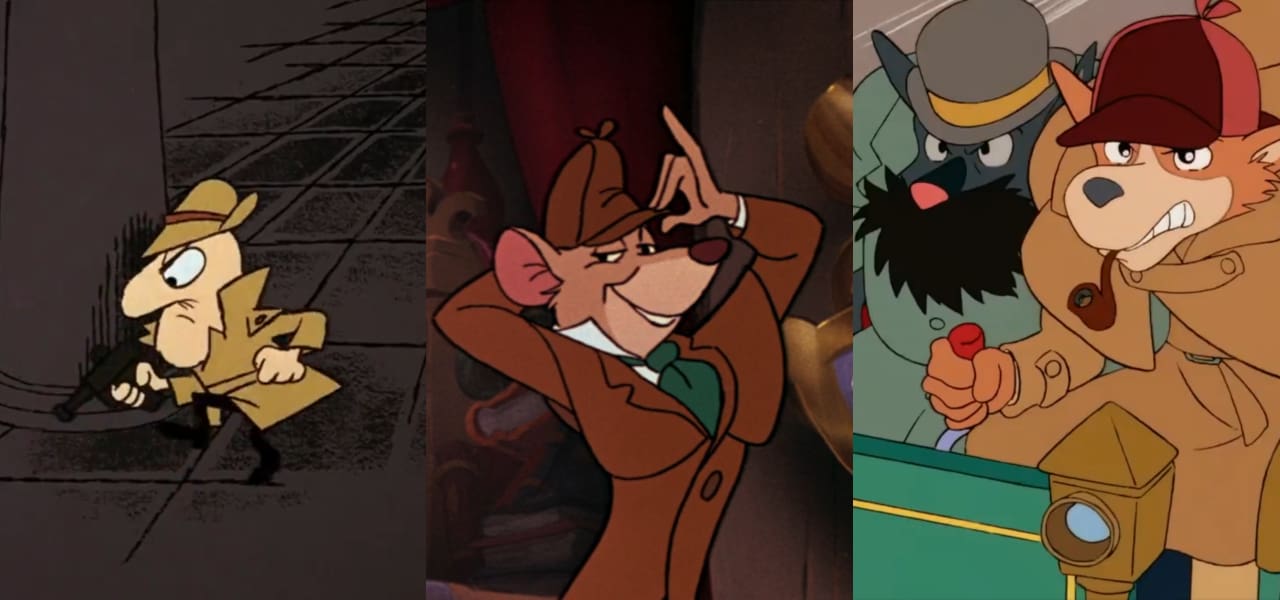
‘The Great Mouse Detective’ Turns 40: A History Of Animation’s Best Investigators
Stay informed with free updates
Sign up to get our news digest — delivered directly to your inbox twice a week.
Disney’s The Great Mouse Detective turned 40 this month, so we’re celebrating the film’s anniversary by sleuthing out the best cartoon detectives throughout animation history.
The Great Mouse Detective is a film that deserves more attention. Coming in just before Disney’s critical and commercial dominance was restored thanks to 1989’s The Little Mermaid, the film tends to be overlooked, but it shares many of the strengths seen in the better-known movies of the Disney Renaissance. The film boasts a smart script, snappy animation, a spectacular villain, groundbreaking CGI effects, and an intelligent, interesting hero. Supervising animator Mark Henn does a great job capturing Basil’s quick wit and sharp mood swings.
— Cartoon Study (@CartoonStudy) July 27, 2026
Sherlock Holmes was not the first fictional detective – Edgar Allan Poe’s C. Auguste Dupin preceded him, among others – but he has certainly become the archetype since his first appearance in Sir Arthur Conan Doyle’s 1887 story A Study in Scarlet. It is because of Holmes that cartoon detectives frequently sport deerstalker caps and peer through magnifying glasses. Doyle actually threatened legal action against one of the earliest Sherlock spoofs, Gus Mager’s 1910 comic strip creation Sherlocko the Monk, which was retitled Hawkshaw the Detective to avoid copyright infringement. Still, he couldn’t stop the onslaught of cartoon parodies to come. Sherlock-esque hats and magnifying glasses appear in several silent-era mystery cartoons, including the excellent Max Fleischer short Ko-Ko Baffles the Bulls (1926), starring Ko-Ko the Clown.
— Cartoon Study (@CartoonStudy) July 27, 2026
Shorts where the characters solve a mystery tend to be among my favorites in any classic cartoon series, not because of the mysteries themselves (I can’t think of any that actually include a coherent narrative), but because having a detective stalk through some spooky old mansion in search of a criminal often inspires high-caliber, darkly surreal gags from the animators. 1930s characters like Flip the Frog, Cubby Bear, and even the much-hated Buddy starred in above-average mystery cartoons. The Max Fleischer studio, no stranger to macabre comic surrealism, made one of the best in this subgenre with The Herring Murder Case (1931), starring Bimbo as the investigator trying to solve who caused the “wah-wah-wah-wah-wah.” James “Shamus” Culhane served as the de facto director on this one.
— Cartoon Study (@CartoonStudy) July 27, 2026
Speaking of surreal, we also have the Columbia short The Vitamin G Man (1943), which offers a unique twist on the detective genre: an aspiring sleuth at Flatfoot College must solve a mystery set up by the faculty as part of his final exam. The Columbia/Screen Gems shorts are among the oddest studio films of the 1940s; most of them miss the mark in trying to be funny, but they usually spiral in weird directions that make them fascinating to watch anyway. This one was co-directed by John Hubley, future founder of the modernist UPA studio, and you can see his influence in the stylized layout of the house of horrors. Note that the professor’s voice here is Kent Rogers doing an impersonation of English actor Richard Haydn. Haydn himself would later voice the caterpillar in Disney’s Alice in Wonderland.
— Cartoon Study (@CartoonStudy) July 27, 2026
The great Tex Avery made one of the finest of all murder mystery cartoons: Who Killed Who? (1943), in which every whodunit cliché in the book gets mercilessly skewered at a mile a minute. The short-fused police detective, voiced by Billy Bletcher, makes a terrific foil for all the absurdist nonsense that Avery dreams up. The organ score by Bernard Katz, reminiscent of old-time radio shows like Inner Sanctum Mystery, is also a nice touch.
— Cartoon Study (@CartoonStudy) July 27, 2026
One of the most bizarre cartoons ever produced by the Disney studio is Jack Kinney’s Duck Pimples (1945), a parody of noir films and radio serials in which Donald Duck is accused of being a thief/kidnapper by police detective H.U. Hennesy (named after studio layout artist Hugh Hennesy). The ever-shifting backgrounds, constant non-sequiturs, and oddball characters who wander in and out of the story add up to a confection that is about as stream-of-consciousness as Disney ever got.
— Cartoon Study (@CartoonStudy) July 27, 2026
Speaking of Disney, Goofy makes an unlikely private eye in How to Be a Detective (1952), adopting the nom de plume Johnny Eyeball. Director Jack Kinney went a little nuts in his “How To…” Goofy cartoons of the ‘40s, filling entire stadiums full of Goofys, until Walt Disney had Kinney dial it back a bit in the ‘50s, restricting him to one Goofy and refashioning the character into a slightly more relatable persona. This short is less manic than earlier Kinney films, but it still has a nice streak of black humor.
— Cartoon Study (@CartoonStudy) July 27, 2026
One of the best cartoons ever made – and I don’t mean just detective cartoons, but one of the best cartoons, period – turned 80 years old this month: Bob Clampett’s The Great Piggy Bank Robbery (1946). This Looney Tunes masterpiece casts Daffy as master detective Duck Twacy, sending up Chester Gould’s comic strip creation Dick Tracy while taking us on a gleefully demented tour through Daffy’s fevered brain.
— Cartoon Study (@CartoonStudy) July 27, 2026
The Great Piggy Bank Robbery is not the only time Daffy Duck attempted to solve a mystery: Chuck Jones cast Daffy as Dorlock Holmes in a totally different but also brilliant mystery short, Deduce, You Say! (1956). Out of all of the Sherlock Holmes spoofs that have been made, this one is my favorite. I love the stylishly skewed Victorian atmosphere in Maurice Noble’s gorgeous layouts, and Daffy’s blustering attempts to cover for his own inadequacies as a detective are an endless well of comedy.
— Cartoon Study (@CartoonStudy) July 27, 2026
Mr. Magoo also caught the private eye bug in the UPA short Barefaced Flatfoot (1951), directed by John Hubley. The warped perspective in that shot where Magoo swings on the rope is insane.
— Cartoon Study (@CartoonStudy) July 27, 2026
UPA also created the little-seen but delightful The Sleuth’s Apprentice, as part of the short-lived TV series The Boing-Boing Show. The segment was animated by Rod Scribner, known for his wild animation in Bob Clampett’s Warner Bros. cartoons, and it’s fascinating to see his distorted, wrinkly drawing style applied to flat UPA designs. Look at those crazy teeth!
— Cartoon Study (@CartoonStudy) July 27, 2026
The Zagreb Film studio from Yugoslavia took what UPA was doing with modernist stylization and went even further with it. You can see the fruits of their labors in the incredible The Inspector Comes Home (1959), directed by Vatroslav Mimica, where a cartoon detective chases around a gigantic disembodied fingerprint. Even the simple act of having the inspector walk from one side of the room to the other becomes a bizarre exercise in seeing how many ways the animators can break his design apart.
— Cartoon Study (@CartoonStudy) July 27, 2026
There were a few attempts to create private eye characters in the waning days of the theatrical cartoon, like Walter Lantz’s Inspector Willoughby and Famous Studios’ Perry Popgun. The DePatie-Freleng studio had already scored a hit with their Pink Panther cartoons, so it made sense to follow it up with a series starring a cartoon version of Inspector Clouseau, the standout character from the live-action Pink Panther movies the cartoons were based on. The Inspector cartoons aren’t as funny as the Pink Panther cartoons – or Peter Sellers’ slapstick antics in the live-action films, for that matter – but they do have a fun rogues’ gallery of villains. My favorite is the Blotch, the shapeshifting art thief from Gerry Chiniquy’s Cirrhosis of the Louvre (1966).
— Cartoon Study (@CartoonStudy) July 27, 2026
William Hanna & Joseph Barbera’s gumshoe duo Snooper & Blabber had their own segment on The Quick Draw McGraw Show. Most of the voices of H-B characters were inspired by popular actors and comedians, but voice actor Daws Butler went a bit obscure in choosing his inspiration for Snooper’s voice: character actor Tom D’Andrea, who played supporting roles in noir films like Dark Passage. Here’s a side-by-side comparison.
— Cartoon Study (@CartoonStudy) July 27, 2026
The Mystery Gang from Scooby-Doo, Where Are You might be the most famous of all cartoon detectives. The mystery format allowed Hanna-Barbera to get around increasingly stringent standards pushed by the advocacy group Action for Children’s Television , since the villains could be foiled by being unmasked rather than through violence. The show’s success spawned about a million Scooby-Doo rip-offs, with the cowardly canine swapped out for a shark, car, unfrozen Neanderthal… or sometimes just another dog. Here’s an unusually self-aware gag from The New Scooby and Scrappy-Doo Show from 1983.
— Cartoon Study (@CartoonStudy) July 27, 2026
Another popular cartoon detective among Gen Xers is Inspector Gadget, a semi-spoof of Get Smart starring a detective with bionic doodads installed in his body. Shuki Levy’s intro music is one of the great TV themes.
— Cartoon Study (@CartoonStudy) July 27, 2026
There are plenty of popular anime series built around detectives, such as Detective Conan (released in English as Case Closed). One of my favorites is Sherlock Hound from 1984, which remains underappreciated despite boasting none other than Hayao Miyazaki as director of the early episodes. Miyazaki’s talent for action choreography and visual storytelling – as well as his penchant for flying machines – are on full display in this beautifully animated clip.
— Cartoon Study (@CartoonStudy) July 27, 2026
I thought I knew my stop-motion, but I’ve somehow never heard of Dick Spanner, P.I., a British series from the ‘80s about a robot detective. The show was the brainchild of Gerry Anderson, creator of the puppet series Thunderbirds, and most of the humor is built around puns.
— Cartoon Study (@CartoonStudy) July 27, 2026
In the decades since The Great Mouse Detective was released, a number of animated detectives have shown up in features (Sherlock Gnomes, Detective Pikachu) and TV series (Chip ‘n Dale: Rescue Rangers, Duckman). We’ve certainly had our share of Sherlock Holmes parodies, but in my opinion, we could use more animated noir films starring hard-boiled gumshoes in the vein of old classics like The Maltese Falcon and The Big Sleep. Perhaps Brad Bird’s upcoming sci-fi neo-noir Ray Gunn will fill that void. For now, here’s a beautifully animated noir spoof from 2010, created by Andrew Chesworth as the opening to the Palm Springs International ShortFest.
— Cartoon Study (@CartoonStudy) July 27, 2026
Who are your favorite cartoon detectives? Let us know in the comments below.
— Cartoon Study (@CartoonStudy) July 27, 2026
Thanks to FleischerCartoons for the “Ko-Ko Baffles the Bulls” and “Herring Murder Case” clips. You can see beautifully restored Fleischer shorts on the “Fleischer Cartoons Greatest Hits Vol. 1” Blu-ray, which you can purchase at rockinpins.com.