.png)
Malaysia’s Highest-Grossing Animated Film Ever, ‘Papa Zola The Movie,’ Sets Its Biggest International Expansion Yet (EXCLUSIVE CLIP)
Stay informed with free updates
Sign up to get our news digest — delivered directly to your inbox twice a week.
Malaysia’s highest-grossing local animated feature is heading into its widest international rollout yet.
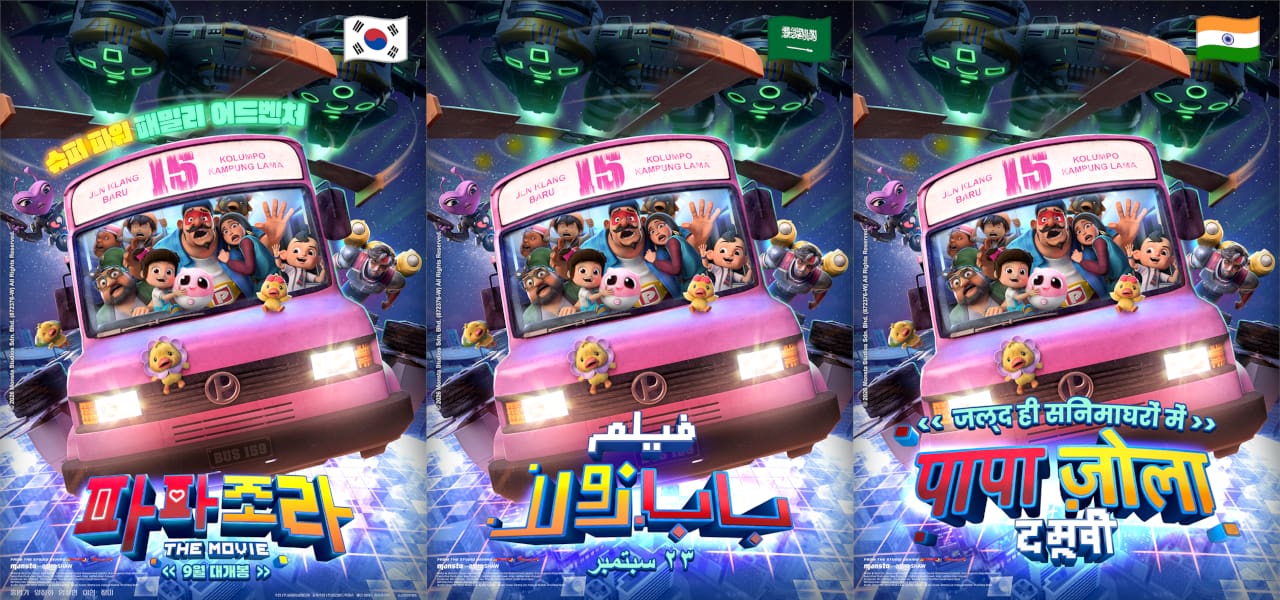
Monsta Studio’s Papa Zola The Movie will open in South Korea, the world’s ninth-largest theatrical market, on September 2, followed by Saudi Arabia, the United Arab Emirates, and Kuwait on September 23. Releases are also planned for Australia, New Zealand, and India, extending a theatrical run that has already attracted more than 4.5 million moviegoers across Southeast Asia and generated over RM69 million ($16.9 million), a staggering total for a film of this kind.
Here’s the film’s South Korean trailer:
The expansion represents a significant test for a film whose success has been closely tied to its distinctly Malaysian setting. Written and directed by Monsta founder and CEO Nizam Razak, Papa Zola The Movie follows a working-class father juggling several jobs while trying to provide for his family. When aliens abduct his daughter and begin transforming Earth into a game-like simulation, the ordinary dad is pushed into the role of action hero.
For Razak, the character’s everyday struggles were central to the film’s appeal.
“In Southeast Asia, it’s kind of normal to work two or three jobs,” he told Cartoon Brew. “We have a saying over here that men don’t really tell anyone about their struggles. I thought it was very important to capture this emotion and this journey, and let Papa Zola speak on behalf of them.”
Papa Zola originated as a comedic supporting character in the studio’s BoBoiBoy franchise, first appearing in the series in 2011. Monsta had previously built much of its reputation on youth-oriented action properties such as BoBoiBoy and Mechamato, but Razak saw an opportunity to tell a different kind of superhero story centered on an adult protagonist that might prove more appealing to a four-quadrant audience.
“I think fathers are underrepresented all over the world,” he said. “Previously, we always did shonen superheroes, like BoBoiBoy and Mechamato. We wanted to try something different.”
The studio did not initially expect that shift to produce a record-breaking hit. At the Malaysian box office, the film ended up making more than not only local competitors, but imported animated blockbusters as well. Its RM69 million-plus gross makes it the country’s top-grossing animated film and one of Malaysia’s most commercially successful local releases of any kind.
Razak believes audiences were drawn to a character whose life looked more like their own than those typically seen in imported family films.
“People have become more supportive of local animated features because they feel that they want to be represented,” he said. “Of course, we’ve been watching films from Hollywood, from Disney and Pixar, but nowadays people want to connect with their characters.”
That local identity extends throughout the film’s environments, food, homes, and public spaces. Papa Zola drives a school bus, delivers food, and creates a children’s book with his daughter. The family’s surroundings are unmistakably Southeast Asian, even as the larger science-fiction plot aims for the scale and spectacle typical of international titles.
“It has a very strong Southeast Asian and Malaysian background, whether it’s the house, the school bus, or the food,” Razak explained. “But the story is about a father trying to save his daughter. That is something kids should be able to enjoy anywhere, even though the setting is Kuala Lumpur.”
Monsta produced the film with a core crew of around 80 people, drawn from a studio workforce of approximately 170 when part-timers and freelancers are accounted for. Maya was the tool of choice for the film’s CG animation, with Premiere and After Effects employed in post-production. Razak directed alongside Raja Nukman Raja Mohd Noordin, who focused on screenplay and layout, and Dzubir Mohamed Zakaria, who oversaw the final animation.
The film’s technical ambition reflects nearly two decades of accumulated production experience at Monsta, which Razak co-founded in 2009. Although Malaysia has long supplied artists to overseas animation productions and done service work, Monsta has concentrated on developing and producing its own intellectual property alongside its more commercial endeavors.
Razak said the team understood that local audiences would judge its work against films made with far larger resources.
“If the audience in Malaysia is paying the same amount of money to watch our film and a Hollywood film, what will make them choose us?” he said. “It’s all about quality. And the quality isn’t only visual; it’s also the way we cut and the way we edit. We want to raise our bar to make sure we can compete at a certain level.”
To emphasize his point, Razak shared an exclusive clip that shows off the high level of technical execution that can be found in the film:
The company has also had to build much of the commercial infrastructure around its properties itself. Unable to rely on major manufacturers to support homegrown Malaysian characters, Monsta began producing its own toys, trading cards, and publishing projects. The picture book Papa Zola creates in the movie was released as a real product and temporarily sold out.
“We didn’t just do animation,” Razak said. “We did our own toys, our own trading cards. It wasn’t because we were good at it; it was because we didn’t have any other choice.”
A sequel is now in development after the film crossed a RM60 million benchmark set by the studio. Monsta is also preparing Papa Pipi, a new family series featuring Papa Zola, Mama Zila, and Pipi Zola, scheduled to debut on Netflix and Monsta’s YouTube network by the end of 2026.
For Razak, however, the immediate goal is to see whether a hero created to reflect Malaysian families can connect just as strongly elsewhere.
“I would love to see Papa Zola travel the world,” he said, “because we want people to know our story as well.”
