.png)
New Zealand’s First Stop-Motion Feature ‘Kiri And Lou Go Raaa!’ Gets Trailer Ahead of Annecy Premiere (EXCLUSIVE)
Stay informed with free updates
Sign up to get our news digest — delivered directly to your inbox twice a week.
Many years ago, on an island far away, there were three happy-go-lucky New Zealanders crafting a pilot episode in their garage. They didn’t know it yet, but they were about to embark on a stop-motion journey that would lead them where no fellow countrymen (or women) had ever been before.
A decade later, Fiona Copland (producer), Harry Sinclair (writer, co-director), and Ant Elworthy (animation director, co-director) have brought Kiri and Lou from New Zealand to the world and are about to make a splash at the lakeside Annecy Film Festival.
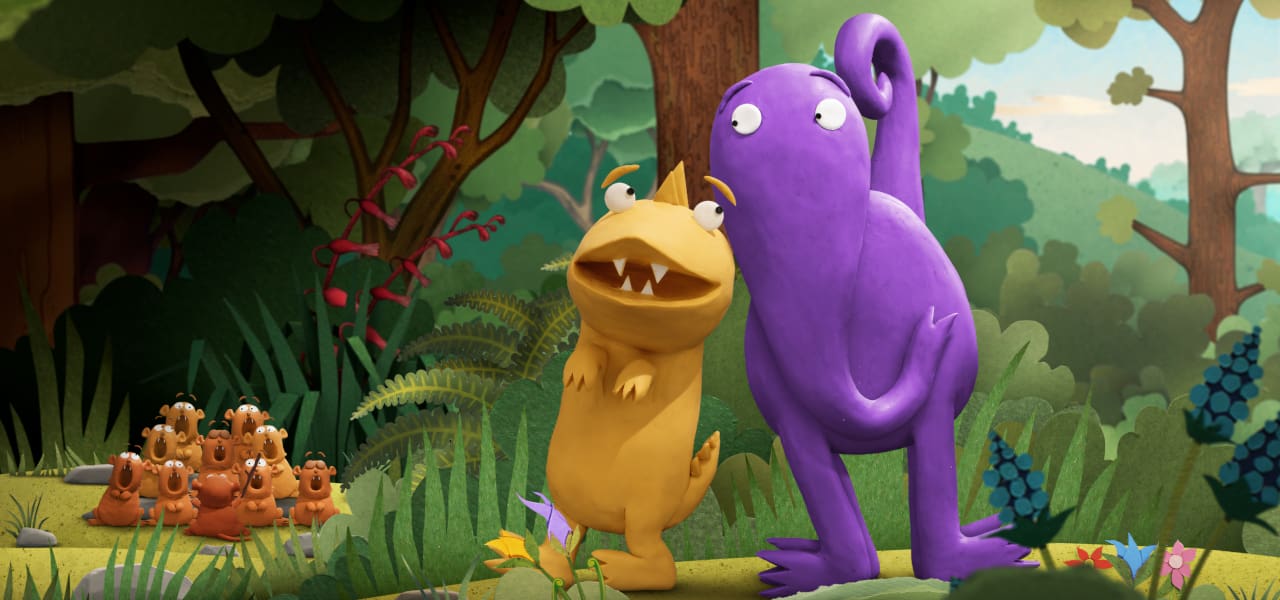
First aired in 2019, Kiri and Lou follows the friendship between Kiri (Olivia Tennet) and Lou (Jemaine Clement), a lovable and adventurous duo, as they explore the world of feelings through laughter, song, and play.
The handcrafted stop-motion animated series, co-produced between New Zealand and Canada, soon became a global hit, dubbed in multiple languages and collecting several international awards and a BAFTA nomination along the way.
Today, as the growing Kiri and Lou universe enters a new chapter with the feature film prequel Kiri and Lou Go Raaa!, Cartoon Brew spoke with co-directors Sinclair and Elworthy ahead of their Annecy world premiere. The duo also shared the film’s first trailer with us, which we’re happy to debut below.
Cartoon Brew: Can you tell us how Kiri and Lou was born?
Harry Sinclair: Many years ago, my producer Fiona Copland and I were talking about making something for young audiences. Having a kid inspired me a lot, yet neither Fiona nor I had ever done any animation. So we started asking people in New Zealand who we should work with, and Ant Elworthy’s name came up more than a few times.
After reaching out, we managed to get some money to make a pilot, and Ant made it in his garage. So, in a way, Kiri and Lou had a long development process, but once it started, it became an incredible journey. Here we are, a decade later, and we’re still working together.
Ant Elworthy: When I first got a call from Fiona, and she explained Harry’s idea, I was pretty excited as I really liked the vision, which was to make a show for kids that was gentle and thoughtful, going against the trend of fast, loud, overly saturated children’s TV. Making a pilot on a small budget is like sowing a magic bean, and you can’t be certain that you will grow a beanstalk. But we just sort of pushed ahead tentatively, and it just kept growing.
What attracted you to stop-motion as a way to depict these characters?
Elworthy: I was keen to find a technique that gave us a good range of emotional expression while still being efficient. Stop-motion is not particularly efficient, unfortunately, but it’s unrivaled in its ability to convey emotion, and that’s really at the heart of the stories we wanted to tell. So we sacrificed efficiency for that.
Sinclair: I remember those tests, and I was already sure you’d put them side by side to make me say, “It’s got to be stop-motion.” In truth, I’m glad we did it in stop-motion because I love it now. It’s an extraordinary way of making animation.
I still find animation a mysterious, magical, and wonderful thing. I’m not an animator myself, and having watched our animators and all the incredible people gathered to make Kiri and Lou over many years, it still amazes me that they can create a grumpy expression, then a smile, then a laugh. The timing of these moments, and the extraordinary detail involved in moving the clay frame by frame, is exhilarating.
With claymation, when you’re using your hands and creating these characters, the animators really are the performers in a way that I’d never fully understood. It’s made exactly for those expressions, for that bit of dialogue, for that moment. It doesn’t exist anywhere else in the film. And so it gives an incredible delicacy and nuanced way of expressing emotions.
Can you elaborate on your artistic process, from character design to backgrounds and the actual production workflow?
Elworthy: One of the advantages of our particular technique of stop-motion animation, shooting 2.5D clay models on glass, is that we can bypass the intricate process of puppet-making that you normally have in stop-motion production. In short, you don’t need armatures, rigging, or miniature clothes. So Harry can introduce far more characters into the series. In most of our scripts, a new character is introduced, and I think we have about 80 in our lineup now.
All the background elements are drawn and painted on paper, cut out by hand, and then photographed. So we have a vast library of trees and bushes, rocks and hills, and so on. If it’s a new location, I do a sketch of the layout, then the compositors get to work and construct the set.
Before we start animating, Harry goes through the process of recording our voice actors, including Jemaine Clement and Liv Tennet, and editing the dialogue. Together with the storyboard artist, we edit the animatic. Then the animators get to work, animating each clay character as a separate element, sometimes as multiple elements. Animating different passes means that we can sometimes reuse difficult-to-animate footage, such as turns from one side to the other, which all have to be sculpted. We can also create loops, such as a run cycle, and then animate a head pass onto it.
As the animation passes are completed, I start assembling a rough cut, layering them onto the timeline and adding camera moves and so on. Once a sequence is complete, I hand it over to our amazing team of compositors, led by Sandesh Codhadu, who composite the animation into the backgrounds, adding shadows and light effects, grading the colors, and tidying up all the messy bits.
After that, we have a bit of back-and-forth with Harry, and then it’s handed back to him, along with Don McGlashan and Amy Barber, to work on the music and sound, which is what really brings it to life.
How does one turn a 104×5-minute series into a 60-minute feature?
Sinclair: The incredible thing about making a whole lot of episodes is that the stories begin to write themselves. When you put these characters in a situation now, they are so fully formed in everybody’s minds that they react the way they will always react. It now feels obvious what Kiri would do in any situation because she’s Kiri.
Then, when you create a bigger story like Kiri and Lou Go Raaa!, you think of all the adventures they could have and put them in those situations.
The big question, in a sense, across the whole four-series arc has been: How did these two become friends? They’re so different from each other. They’re different species, they have different habits, different interests. I’d been thinking for a long time that it would be great to explore how they first met.
How did it influence your pipeline, and what were the main challenges in adapting it?
Elworthy: For the film, we wanted to really lift the production value to make something that looked spectacular on the big screen and could sustain visual interest for a full hour.
We already had a very effective pipeline, and we didn’t want a complete overhaul, but we dialed everything in more tightly, starting with investing in better lights and controlling the colors more accurately, as well as sculpting the characters more consistently and carefully, and animating more slowly with even more attention to detail.
In our studio in Christchurch, we had a maximum of eight animators simultaneously, one camera person, myself, and five compositors, so roughly 15 people.
An unusually small team for a stop-motion feature, so everybody’s input matters proportionally more. It really came down to the relationships within our team, and it’s been really great in that respect. We work on a much smaller scale, and yet we’ve shown that we can still make something as impactful as many things produced in a much bigger studio.
Sinclair: Amazingly, that intimate way of working really fits with our collective. We’re working on a very small scale, and I find it amazing that we’re still able to make something considered world-class.
I really value that we work with a caring approach. And that fits with the philosophy of our characters because Kiri and Lou are all about caring. That might sound a bit pretentious, but it really is what I believe.
Going back to your production workflow, can you elaborate on the sound design and music?
Harry Sinclair: For the film, Don McGlashan has created an incredible score. It’s been such a joy because we’ve done these five-minute episodes for years, and being able to spread out into some big musical shapes and some really operatic moments with large pieces of music has been an absolute blast.
Amy Barber, our sound designer, brings this incredible vitality to the sound of our work.
I think one of the things that Ant, Fiona, and I all feel very strongly about is that if we are enjoying the work, then that will show on the screen. If you get the right group of people and bring them together, you can really make something wonderful.
What did it represent for New Zealand’s animation industry back then, and how has the series’s success influenced the New Zealand animation industry so far?
Elworthy: The animation industry in any country is always going to be niche, especially the stop-motion industry, and especially in a small country like New Zealand. We started out in a very, very niche industry and now, I won’t lie, it’s still a very, very niche industry!
Now that the film is about to premiere in Annecy, I’m truly grateful because this has really just been a huge labor of love. And it’s so exciting to be able to share it and gather again with some of the amazing animators from around the world who came to Ōtautahi Christchurch to make this film with us.
Sinclair: I’m very proud of what we’ve created and to have been at the heart of a celebrated piece of animation that really shows what we can do in New Zealand.
What can we expect from Kiri and Lou going forward?
Sinclair: After 104 episodes and an hour-long movie, Ant and I were just talking and thinking maybe we should, you know, do some more Kiri and Lou!
I would love it to keep going if that could happen. We also have a new project, Tralala, a 52×7’ animated preschool series that has been commissioned by CBC and Sky NZ, and that’s very exciting. Ant, Fiona, Don, and I are making it together with many of the same cast.