
Take A Trip Inside Laika’s Studio, Where Hundreds Of Artists Brought ‘Wildwood’ To Life
Stay informed with free updates
Sign up to get our news digest — delivered directly to your inbox twice a week.
PORTLAND, Oregon – The craftspeople at Laika have been defying what’s possible in stop-motion animation since their first feature, Coraline, advanced the painstaking technique. Wildwood, their newest film, feels like the culmination of more than two decades of innovation. Visiting their studio in Portland, Oregon, is a mind-boggling experience. The more one learns about how their movies are made, the more astonishing they become to those of us mostly familiar with the final product that takes years to finish.
Wildwood takes place in Portland and was directed by Oregon native Travis Knight, Laika’s president and CEO, who previously directed Kubo and the Two Strings. Based on Colin Meloy’s 2001 book illustrated by Carson Ellis, the screenplay is by Chris Butler (ParaNorman, Missing Link), and it follows Prue (Peyton Elizabeth Lee), a teenage girl forced to enter the Impassable Wilderness, a magical realm in the forest, to rescue her baby brother. Along the way, she encounters talking animals, bandits, and even dark magic.
By far the most ambitious film Laika has ever produced, Wildwood features epic battles, over 200 puppets, numerous sets, and the most delicately emotional performances the studio has ever elicited from its intricately conceived puppets. During a recent visit to Laika, Cartoon Brew heard from the craftspeople in charge of turning the fantastical into objects that can be manipulated to tell a story and convince us that they are truly alive.
Here are highlights from the exchanges with the artists.
Characters Made of Eclectic Materials
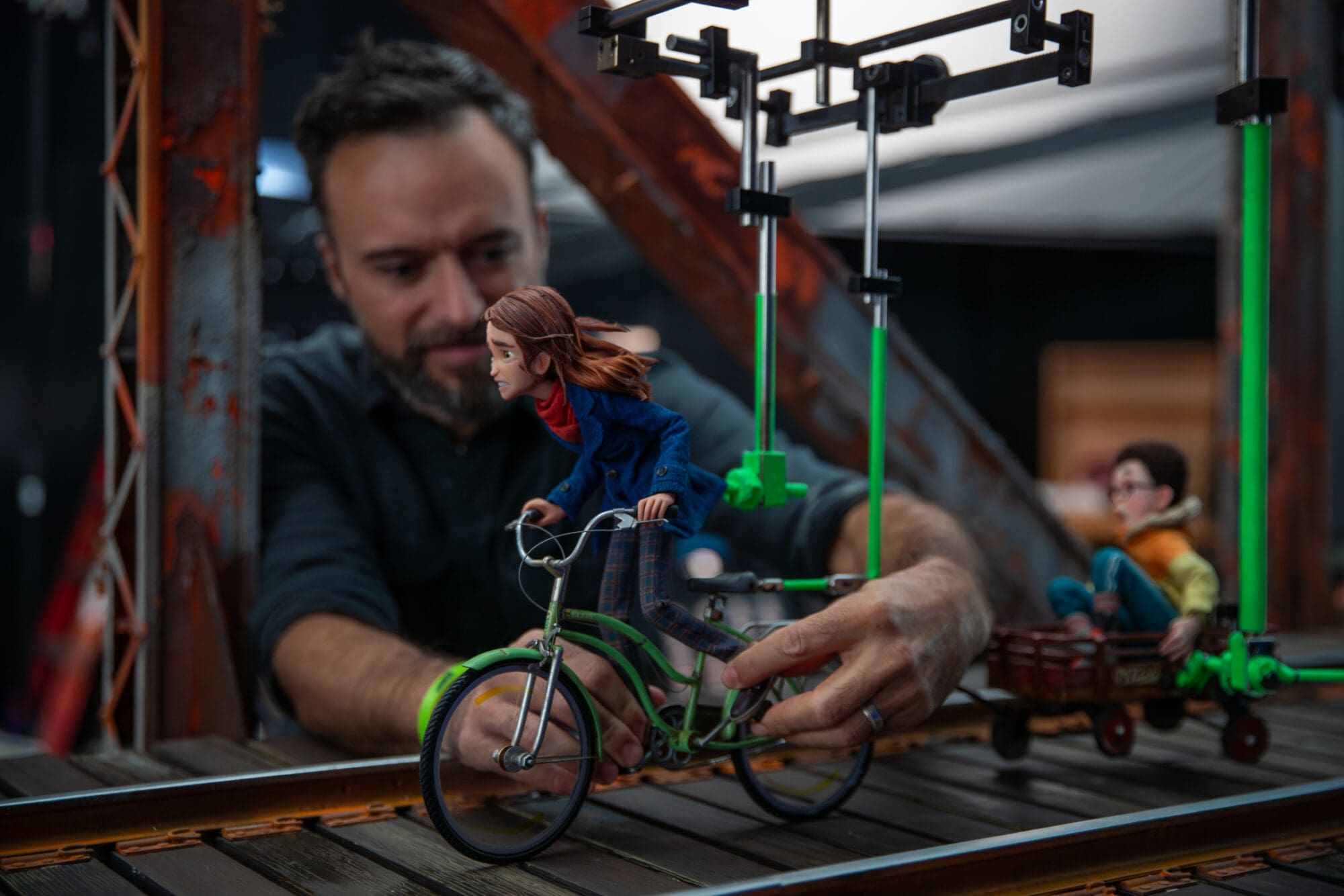
Each character at Laika starts as a 3D render that allows the artists to see each character’s volume and silhouette. That’s when Oliver Jones, head of character and practical effects, and his team start having conversations with the director, animation team, and costume designers about what it’s going to take to build the character.
Then the fabrication team builds the puppet sculpt, which will eventually house an armature. “The armature is the main tool for the animators to use. It’s made out of CNC steel. We have our own CNC shop here at Laika, and what we’re trying to do is give the animators the best possible tool to get a lifelike performance,” Jones explained.
On every film, the craftspeople at Laika evolve their toolkit. On Kubo, for example, they started using “jetpacks,” which are two turnbuckles that are sitting side by side that the animator can move inside the puppet. “What that’s enabling them to do is create very fine increments,” Jones said, which makes for a more precise performance.
On Wildwood, Knight wanted to have puppets with animatable muscles, particularly for the battle sequences. The Alexandra puppet, for example, can flex her bicep. This is the first time Laika has done this, and only two other characters have bicep movers: the bandits Niamh and Seamus. “Alexandra’s bicep is made out of a material called horse boning [poly boning], which is used in hat making. It’s basically a mesh that when you push it in and out, it expands in the opposite direction. We used it to make flowers on Coraline,” Jones said.
On previous projects, Jones recalled, Laika would use foam latex for its puppets. However, when casting the material, it would shrink and lose volume, an issue particularly for larger characters. The team has now developed a sponge made out of silicone. This material better complements the movement of the armature underneath. The imposing Bandit King, Brendan, illustrates how the material was used, along with another innovation.
“There’s a stiff silicone here on his chest. And then there’s this really spongy material in the parts that need to flex. That’s created by taking confectionery sugar and d we wash that into the silicone. It cures and makes this kind of bread material. And then we crush that between a vise, we wash out the fragments, and then that gives us those different silicones,” Jones explained. Another unexpected material serves a sophisticated purpose.
Countless Faces for Better Acting
The emotionally rich story of Wildwood demanded subtle facial expressions. That meant every face produced for the film was bespoke, with none used twice.
“The performances are more nuanced and subtle and naturalistic than anything we’ve done in the past,” explained animation supervisor Brad Schiff. “That was a huge challenge, trying to get those fine increments, so minute.”
Brian McLean, the director of rapid prototyping, runs the department that produces all the facial animation for Laika’s films. The rapid prototyping department started on Coraline with the intention of using 3D printers to produce replacement animation, which, according to McLean, had not been done before.
“The idea was pretty novel, you would animate faces in the computer, and then you’d use one of these fancy, brand new machines to turn that digital object into a physical object,” McLean explained. “Back then, we were really proud of what we were able to do with performance, but the limitations were always around color because back then everything had to be hand painted.”
The rapid prototyping team consists of about 70 people, McLean explained. Half of those artists sit at computers modeling faces. “They are texture painting faces. They are rigging faces, and they are animating faces,” he said. Meanwhile, the other half, about 35 people, design the internal components of the faces. “They’re figuring out how we can take a puppet and turn it into a replacement face character.”
“[Curtis’s] face has a code on the back that’ll tell you exactly what frame this face needs to go on, and for how long. How many frames you need to hold this face,” McLean said. “In certain shots, we are producing one face for every frame in the movie, which means 24 faces for one second of footage. The subtlety that we’re getting into these performances is really unheard of.”
There are also facial librarians, Schiff explained, who are in charge of delivering kits of faces to the animators. Sometimes it’s one tray of faces; sometimes it’s ten. The facial librarian places the faces in order, so the animator doesn’t have to think about it.
Wildwood required around 142,000 printed faces. “Every face we produce is touched by the hands of artists,” McLean added. “We are testing it to make sure it’s consistent. We are painting on tear gloss, sometimes painting on lip gloss. There was a whole bunch of infrastructure to make this whole process possible.”
As for the color on the faces, these days Laika relies on voxel printing (a voxel is a three-dimensional pixel). “These tiny little droplets of color are dropped down, but each voxel cannot overlap. Each voxel has to occupy its own unique 3D volume. The voxels are tiny. There are 330 million voxels in this cubic inch,” McLean said, nerding out on the topic.
“If you were to look at Prue’s face under an electron microscope, you’re not going to see smooth mixed peach color skin. You’re going to see distinct droplets of cyan, yellow, magenta, black, white, clear in these different dithering patterns. It’s a lot like a pointillist painting,” he added. This process allows Laika to control the translucency and opacity of the faces, helping achieve the right skin tone for the naturalistic design of the puppets.
Costume Makes the Puppet
Costume designer Deborah Cook has worked on every Laika film since ParaNorman. She describes her costume designs as providing “an infrastructure to anchor our characters identities, their personalities, and visualize their emotional arc with costume changes that propel on story pivots.” For this purpose, she undertakes historical and environmental research to determine how the location where the characters live, their socioeconomic status, and their ages influence what they would plausibly wear.
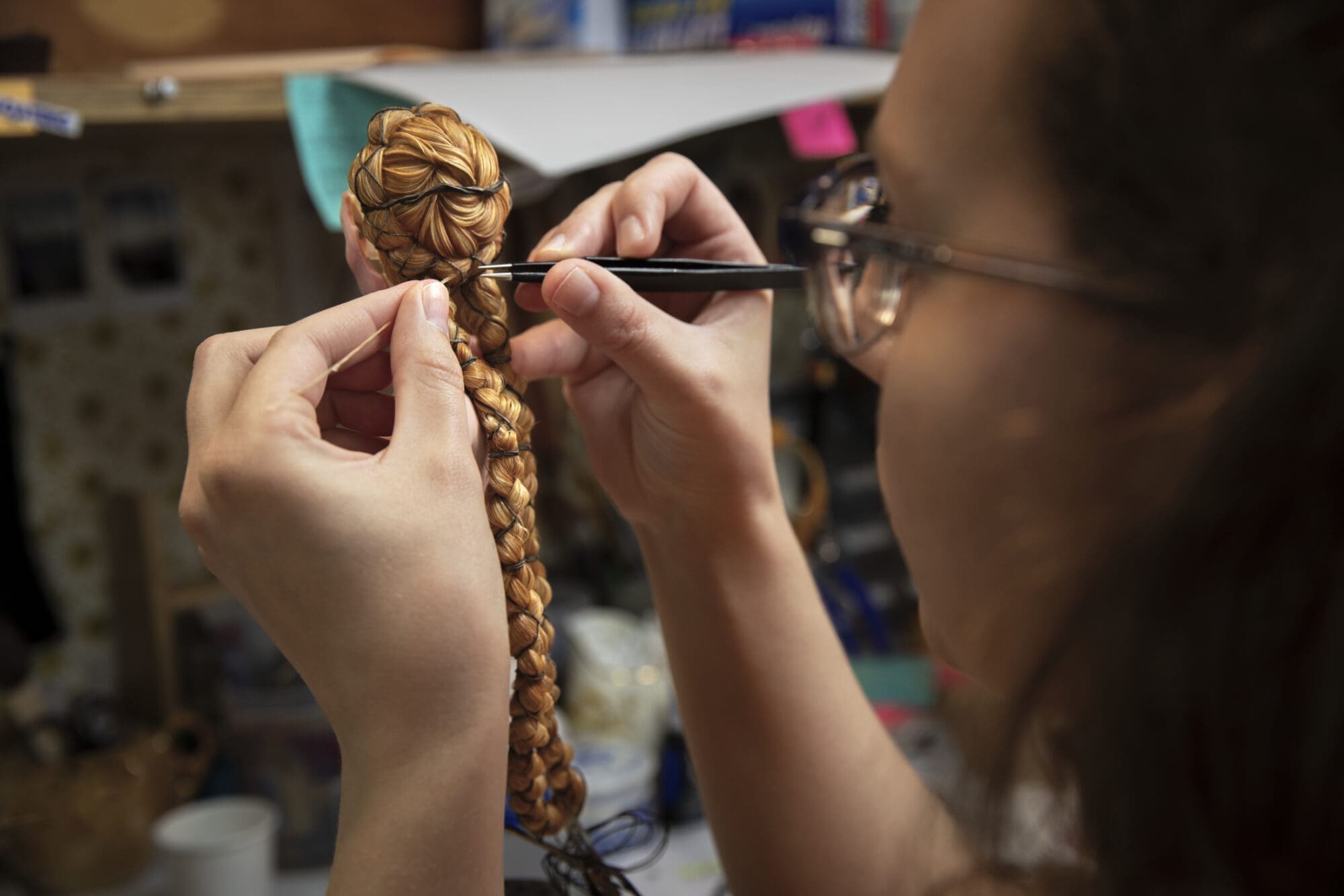
“I look for specific items, fabric textures, pattern cutting information, and costume treatments that enable these costumes to be built in this scale and in a three-dimensional build from a 2D design,” said Cook. She shares reference images with the director, in this case Knight, until they decipher what the characters are going to be wearing and why they might have chosen that item for that particular point in the story. “You’re trying to build real characters and look at how these characters might have picked something from themselves,” she added.
For example, Curtis, Prue’s friend who goes on the journey with her, has several costume changes, from his casual outfit early in the film to the uniform he wears when he is under the influence of the antagonist Alexandra to the outfit he puts on when he joins the bandits.
In addition to Carson Ellis’s illustrations for the original Wildwood book, which Cook says is based on “history, folklore, and some mysticism,” the people of Portland also served as a key reference. That’s evident, for example, in the coat Prue’s mother wears. “Quilting is very much a historical storytelling technique in Portland,” Cook said. “It’s been handed down through generations of families. Her mom’s coat. It’s made up of those fragments.”
Cook says that “Portland has the most fantastic vintage stores” she’s ever visited, and she spent plenty of time going through the clothing there for inspiration. “They tell you so much about what is available to a local community, the heritage of that community and where the people have come from that actually live here,” Cook explained. “Looking at what young families might be wearing while walking around Portland was also an information gathering point.”
Cook also has to think about the physics of fabrics when designing costumes for the puppets. “Fabric is built to cover us and our bodies and move with us. And that physics does not change when it has to fit a smaller character,” she said. This means that even something like a crease has to be engineered to work for the animation process. Thankfully, Cook and her team have more control over the materials they can utilize.
“On previous movies, we were very much in service to fabrics available to us just locally in stores. But now we make them with animation in mind so we can build fabrics that work for us, that have a little bit of flexibility, and it might have wiring built into it or be woven in a certain way that help us,” she said.
Familiar Places and a Digital Helping Hand
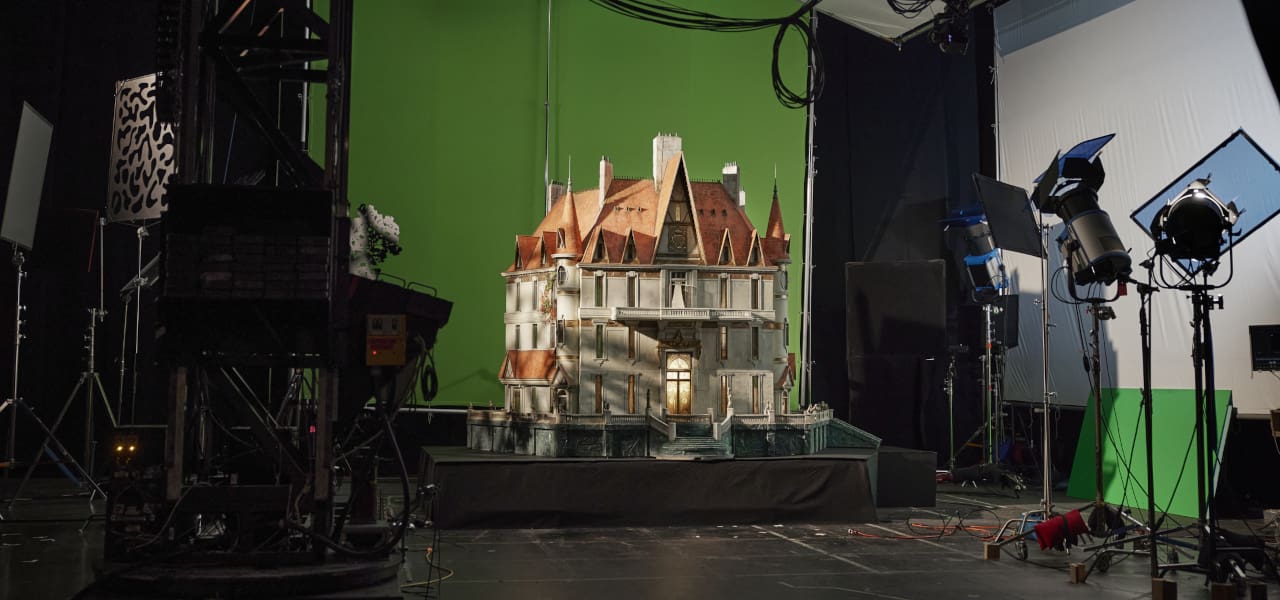
The magical realm in Wildwood is known as the Impassable Wilderness, which, according to production designer Nelson Lowry, was designed to replicate Forest Park in Portland. Like the rest of the elements of the film, the sets are physically crafted.
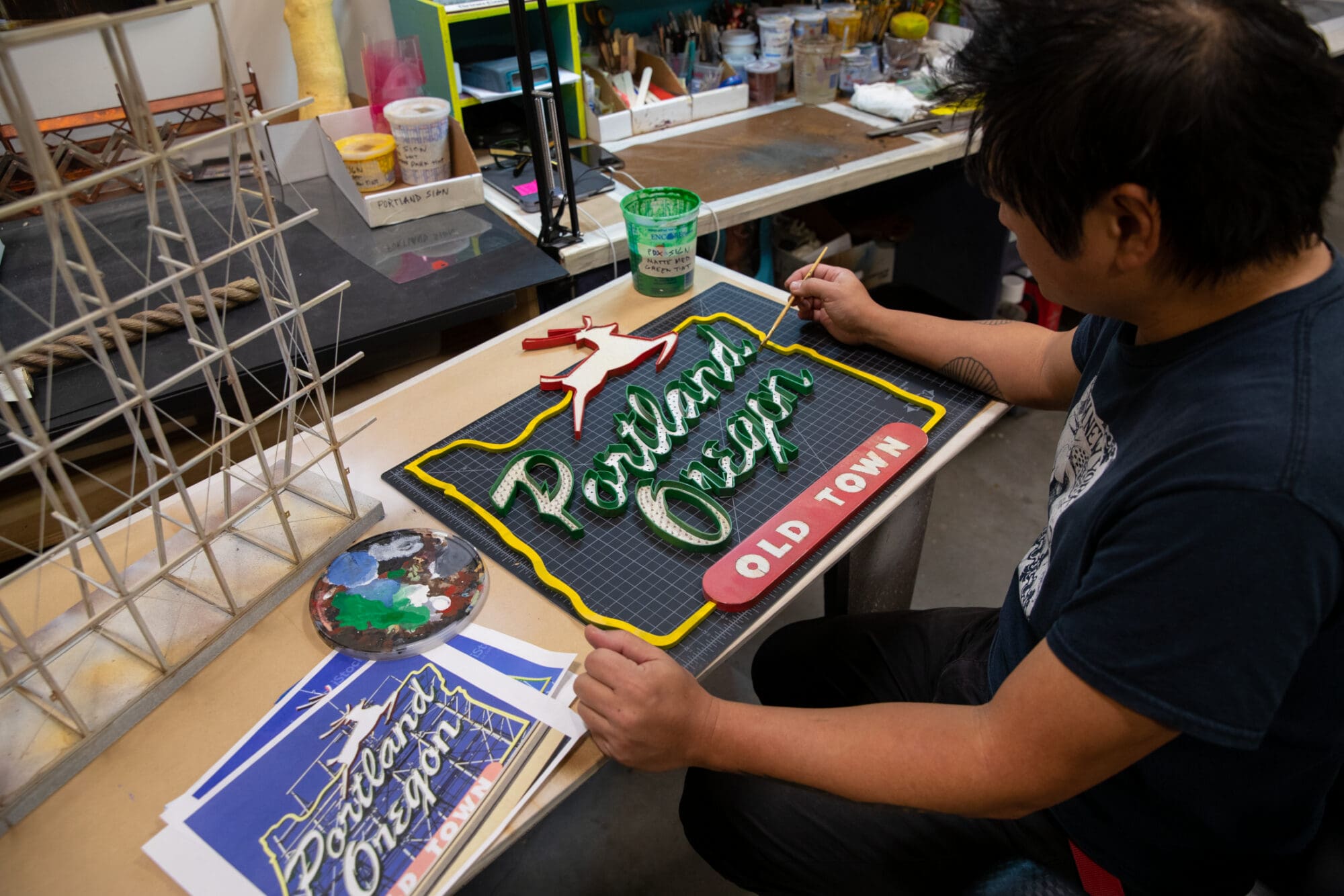
The trees in the forest are cast, and the leaves are tissue paper and fabric supported by chicken wire spray-painted black. “You hear a lot of numbers. I don’t know this for a fact, but I’m going to guess there were over a million ivy leaves just because we made them nonstop for four years,” Lowry said. “They’re laser cut, but they are hand applied.”
For all the high technology involved in Laika films, many components are still crafted with simple ingenuity. “For the dirt we use ground-up walnut shell that comes in all different grades for other industries,” Lowry said. “It’s cheap as chips, so we buy large volumes of it.”
To figure out the film’s lighting, cinematographer Caleb Deschanel, who had never worked in stop-motion animation, took some of the physical assets Laika created to Forest Park and put them in a variety of lighting conditions to photograph them for reference. He wanted to see how the materials reacted to the real sun rather than only artificial lights.
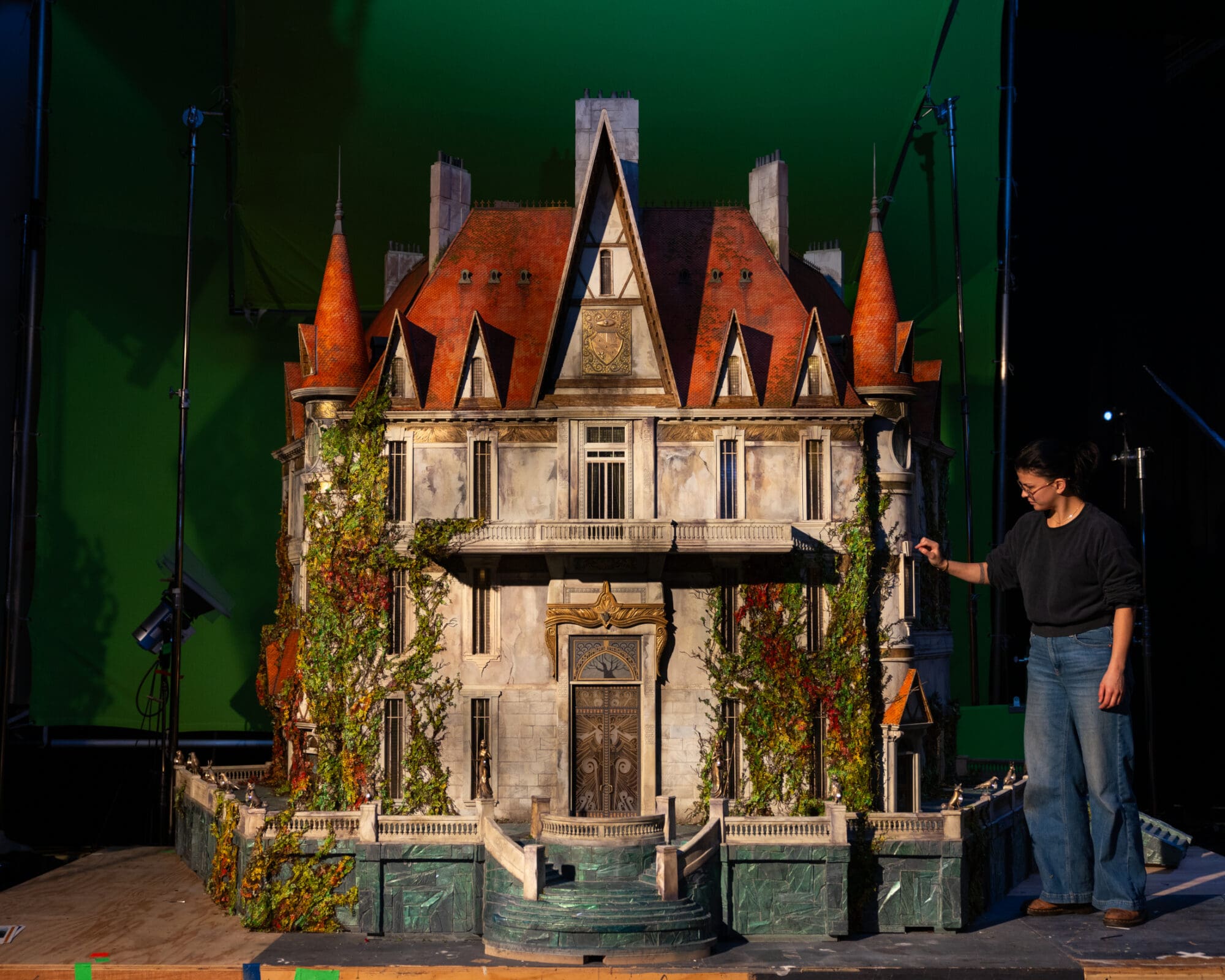
And while Wildwood is a feat of tactile craftsmanship with 136 locations and hundreds of puppets, Laika has become more sophisticated at incorporating digital elements into its films. But even those digital assets are based on their physical creations.
“Scanning technology has come a long way in a very short amount of time. [The VFX team] is able to scan all of our assets. And the scans are very high resolution and pick up color and texture,” Lowry said. “It still requires some cleanup, but we’re dressing a digital set with our scanned physical assets.” This creates a seamless transition between physical sets and characters and their digital extensions or doubles, particularly in the battle scene.
“Travis really wanted as much physical built and lit so that when we did do the extensions, there was a lot of reference, and that paid off in a big way because we were starting to do the extensions and they didn’t feel quite right,” Lowry explained. “Then you just bring in our physical elements into the scene, and you’re just like, ‘Oh, we just need to do that.’ It worked.”
Certain locations required duplicates. That was the case for Alexandra’s hideout. Because scenes with substantial dialogue take place there, they needed two units working on them at the same time, so two identical sets were built. Only about 7% of the sets had duplicates.
Making The General Fly
With over 3,000 feathers hand-applied to a silicone skin, the General was the most complex puppet in Wildwood. The production had three puppets of the General: two that could fly and one that could fold its wings. “That was one of the biggest challenges because birds are shape shifters, and you have to get them from tucked in and squat to spread out and flying,” explained Schiff.
The feathers on the back of the General’s wings and on its tail, as well as strategic ones around the neck and body, are posable.
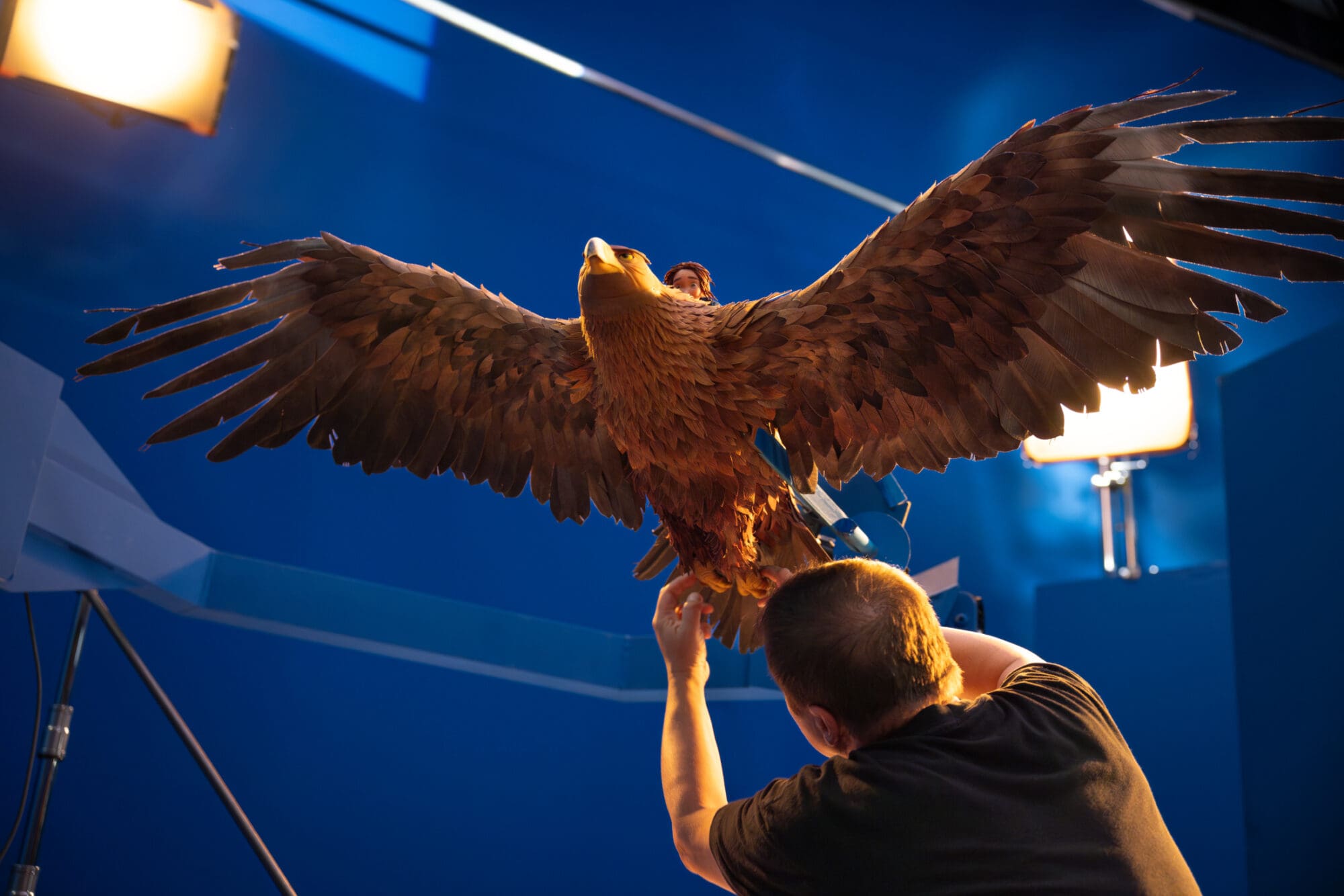
One of the flying General puppets was placed on a hexapod, similar to what Laika did with the giant skeleton or the boat on Kubo and the Two Strings. The other flying puppet was on a gimbal used for more acrobatic moves. The General’s wingspan is about five feet, so her shoulders are motorized to help animators achieve a nuanced performance.
“The only reason the shoulders are motorized is because they’re too heavy to be able to get the subtle animation that we need to get out of them,” said Schiff. “The animators move the dials to get them to the place they want, and then everything else is all done by hand.”
The anatomy of the General also includes an extender on her neck, so it can elongate and contract. She has a breather, which is a mechanism that Laika first implemented on Missing Link to simulate how a chest expands and contracts when breathing.
Animator Dobrin Yanev was in charge of the flying sequence, and while it was undeniably challenging, Schiff believes one technological advantage makes a major difference in the process. “Unlike [Ray] Harryhausen, Rankin and Bass, or Phil Tippett when he was doing Empire [Strikes Back], we have digital cameras, so we have frame grabbers where we can see where we’ve been and where we are,” said Schiff. “That’s why you see less and less chatter in animation today, because you can track every last frame.”
Still, the flying sequence took over four years to complete because, on average, animators complete only 20 frames a day. That’s less than a second of footage because Laika animates its films on ones, using a new pose for each of the 24 frames per second.