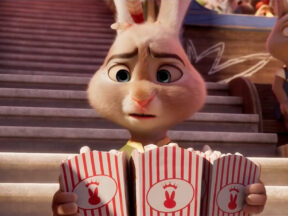
MTV caught up with the band Field Report to find out “what the f**k they’re looking at online.” I’m happy to report that they like cartoons!
Author Archives: Amid Amidi
Genndy Tartakovsky Talks “Hotel Transylvania”

Genndy Tartakovsky on making Hotel Transylvania:
“I took all the aesthetics I like from 2-D and applied them here. I don’t want to do animation to mimic reality. I want to push reality. You want to have your own identity. You don’t want to have an expression that Pixar has. That was super important to me. In 2-D, the way you draw defines you, but in CG the computer takes away your identity. I wanted to make sure the movie had my point of view.”
There’s more surprisingly frank commentary from Genndy in this LA Times piece.
D’oh! U. S. Postal Service Printed 682 Million Extra “Simpsons” Stamps

Apparently, people who watch The Simpsons don’t like to mail letters. According to the Washington Post, the U. S. Postal Service had anticipated it would sell 1 billion commemorative stamps featuring characters from The Simpsons. They sold less than a third of that and ending up destroying 682 million unsold stamps, which had cost them $1.2 million to print.
Patrick Boivin Teams With Aardman For Nike Spot
Even if you don’t care about football shoes, this Nike commercial provides good entertainment value. Montreal-based filmmaker Patrick Boivin (of Iron Man vs. Bruce Lee fame) directed the stop motion spot starring a marionette version of footballer Andrés Iniesta. Aardman produced the animation, South Korea’s Coolrain created the figures, and Wieden+Kennedy (London) was the agency.
(Thanks, @eee)
Calling Los Angeles Artists: Support Kevyn Wallace On Monday

Last August, animation veteran Kevyn Wallace was driving down the 134 Freeway in Los Angeles, just a half mile from the Walt Disney Feature Animation where he had worked in the layout department on films like Tarzan and Mulan. As he was driving, an L. A. driver’s worst fear was realized–he was hit by a drunk driver. Eyewitness accounts from that evening said that the other driver’s car slid around the freeway and clipped another car. Then, the driver’s car spun around and faced Kevyn’s car straight on.
The high-impact crash punctured Kevyn’s gas tank and his car exploded into flames. A couple of good samaritans stopped on the freeway and attempted to rescue him from his burning vehicle. Unable to free him, they ran back to their own cars to find something to cut the seatbelt with. The witnesses reported that Kevyn, strapped into his seat, screamed for help as he struggled to free himself. Meanwhile, Kevyn’s windshield exploded. He miraculously managed to pull himself out of the car–but not before he had suffered burns over 90% of his body. Kevyn was placed into an induced coma and died a little over a month later at the LAC+USC Burn Center.
It was a life tragically cut short at age 47. Kevyn had worked on dozens of animation projects including The Simpsons Movie, The Land Before Time series, and Bébé’s Kids, but at the time of his death, he had embarked on a new career path. He had returned to his alma mater, Art Center College of Design, to earn a Master’s degree in filmmaking. Animation remained always close to his heart. The class project he was working on was a documentary about African-American animators.
I spoke to one of Kevyn’s sisters, Niva, earlier this week. She told me about her family’s efforts to find justice for Kevyn and bring some closure to the painful event. To their disappointment, the driver who caused the crash hasn’t served any time behind bars and has been freed on bond for the past year. His punishment to date has been to wear an alcohol monitoring bracelet and to turn over his passport. The family is understandably frustrated by the drawn-out legal process, but recognizes that the judicial system will ultimately determine whether the other driver bears any responsibility for the death of Kevyn Wallace.
There’s not much Kevyn’s family can do at this point, but they are making a public plea for support from the animation community. They tell me that one of the most important hearings in the case against the other driver will take place this Monday, August 27th. The defendant may either enter an open plea or choose to continue to a jury trial, which would begin next month. Kevyn’s family is asking his friends, colleagues and fans to show up to the hearing on Monday morning. In the words of his sister, they want to “put a face on Kevyn” and show that he’s more than just a statistic.
Kevyn’s sisters have spent the last year attending all the hearings related to his case. But the court has no sense that Kevyn was part of the much larger animation family, an important contributor to the art form, and a guy who was liked and appreciated by many. Kevyn’s family feels that a courtroom filled with industry professionals could make a positive impact. It would be amazing if the 400 people who showed up at Kevyn’s memorial would show up again, but even a fraction of those people would be a powerful statement of strength and support from our community. If the defendant chooses to enter an open plea, Kevyn’s colleagues will even have a chance on Monday to make statements to the court before the sentencing.
The hearing is scheduled for this Monday, August 27th, at 8:30 AM. The hearings generally take an hour or two, but Kevyn’s family would appreciate anybody who can come, even if they can’t stay for the entire hearing. Here’s where to go:
Los Angeles Criminal Courts Building
210 West Temple Street
11th Floor, Room 114
Meet The Artists Who Make The Google Doodles
Every few days, the Google homepage offers up a new Google Doodle either in the form of an illustration, short animation, or interactive element, like the playable Les Paul guitar. The Doodles are not only an ingenious promotional vehicle for Google and its corporate ethos, they also illustrate the goodwill that a company can generate by appealing to the audience’s creativity and imagination. The in-house Google artists and engineers who create the Doodles don’t get a lot of publicity, so if you’ve ever been curious about who’s responsible for the Doodles and how they do it, I highly recommend watching this panel discussion from a couple weeks ago. The speakers are Google Doodle lead Ryan Germick and three of the Google Doodle staff–Kris Hom, Marcin Wichary and Jennifer Hom.
Box Office Report: “ParaNorman” Debuts Weak; “Ice Age” Huge Overseas

Laika’s stop motion film ParaNorman opened last weekend in third place at the U. S. box office with $14.1 million. Despite opening in one thousand theaters more than Laika’s previous film Coraline, the film still didn’t match the $16.8 million opening of the earlier film. ParaNorman did, however, top last April’s $11.1 million opening of Aardman’s The Pirates! Band of Misfits.
ParaNorman‘s disappointing opening is a reminder that stop motion doesn’t generate the huge box office returns we’ve come to expect from major computer animated features. It’s debatable whether the lower grosses are attributable to the technique of stop motion, the type of stories that artists tell with stop motion animation, or the simple fact that no stop motion film has ever enjoyed the type of massive marketing push that accompanies the typical CG feature.
Ice Age: Continental Drift fell out of the domestic top ten, grossing $3 million in its sixth weekend. Its U. S. total is currently at $150.2 million, which will end up being the lowest grossing entry in the Ice Age franchise. But don’t take that as a sign of failure. The film has been an overseas phenomenon, grossing $646.3 million from foreign markets. Combined with domestic grosses, its global total will surpass $800 million this week, making it the sixth highest grossing animated feature of all time.
The overseas popularity of the Ice Age series is an outlier in the animation world. To put it into perspective, the latest Ice Age will gross more from foreign markets alone than Disney/Pixar’s Brave will gross domestically and foreign combined. Each new Ice Age film has increased its percentage of overseas share, as shown below:
| Film | % of Domestic Gross | % of International Gross |
| Ice Age (2002) | 46% | 54% |
| Ice Age 2 (2006) | 29.8% | 70.2% |
| Ice Age 3 (2009) | 22.2% | 77.8% |
| Ice Age 4 (2012) | 18.9% | 81.1% |
“Thunderpaw”, An Animated Comic By Jen Lee

Jen Lee is doing something very special with her newly launched on-line comic Thunderpaw: In the Ashes of Fire Mountain. The comic, which is updated weekly, makes extensive use of animated GIFs, which in itself is not a new idea. However, the way that Lee incorporates animation into her narrative is as original as I’ve seen. She’s just getting started and I can’t wait to see where she takes the idea.
THIS THURSDAY IN NYC: Scribble Junkies Festival of Drawn Animation

New York animation filmmakers Bill Plympton and Pat Smith will present a screening of recent hand-drawn animation this Thursday, August 23, in Manhattan. The line-up includes the American premiere of Hisko Hulsing‘s masterful 18-minute short Junkyard, which alone makes the screening worth attending. There will also be preview footage from Bill Plympton’s upcoming feature Cheatin’. The screening is FREE and open to the public. It begins at 7pm at the SVA Theatre (333 W. 23rd Street, between 8th and 9th Avenue).
A Site Devoted To Rubber Hose Animation

It seems the more CG becomes the prevalent form of contemporary animation, the greater the desire that young artists have to rediscover hand-drawn animation techniques and styles. Animation smears already have a Tumblr. It’s only fitting that there’s now a Tumblr devoted to one of the earliest major styles of animated movement–rubber hose animation.
(Thanks, Charles Kenny)
Brenda Chapman Talks About “Brave” In “New York Times”

Now that Brenda Chapman is no longer an employee of Pixar, she is speaking out for the first time about being removed as the director of Brave. This hardly comes as a surprise, but she wasn’t happy with what happened during the production, though she admits to being proud of the results. In a New York Times op-ed, she spoke about the experience:
It has been a heartbreakingly hard road for me over the last year and a half. When Pixar took me off of “Brave” — a story that came from my heart, inspired by my relationship with my daughter — it was devastating. Animation directors are not protected like live-action directors, who have the Directors Guild to go to battle for them. We are replaced on a regular basis — and that was a real issue for me. This was a story that I created, which came from a very personal place, as a woman and a mother. To have it taken away and given to someone else, and a man at that, was truly distressing on so many levels. But in the end, my vision came through in the film. It simply wouldn’t have worked without it (and didn’t at one point), and I knew this at my core. So I kept my head held high, stayed committed to my principles, and was supported by some strong women (and men!). In the end, it worked out, and I’m very proud of the movie, and that I ultimately stood up for myself, just like Merida, the protagonist in “Brave.”
Disney Has Halted Production On Henry Selick’s Stop Motion Feature

Entertainment industry website Deadline.com published a report this afternoon that Disney has halted production on the new feature directed by Henry Selick (The Nightmare Before Christmas, Coraline). Selick was producing the film at his new San Francisco-based studio Cinderbiter (aka Shademaker Productions):
The crew on Henry Selick’s untitled stop motion animated film were told this afternoon that Disney is not proceeding with this project. Though the film had no title, it had a October 4, 2013 release date, and about 150 San Francisco-based artists ready to go, so it’s a blow to the animation troops out there. Started shooting last summer, but I’d heard it just wasn’t coming together in a manner that pleased the studio. Selick has been given the chance to take the project to other studios…[I]t’s unclear what this does to his plans to helm Neil Gaiman’s “The Graveyard Book,” a project Disney acquired in April.
Is Deadline’s report accurate? If you have details, share them anonymously in the comments or contact me directly.
UPDATE: Local 839 IATSE business rep Steve Hulett confirmed on the animation union blog that Disney contacted the union on Tuesday morning to inform them of the impending shutdown. Hulett wrote, “I have no idea why Henry [Selick]‘s project was shut down so deep into production…whatever the actual reason, we’re saddened to see so many animation professionals lose their jobs off a feature that appeared to be in full flight. Here’s hoping that Mr. Selick sets the feature up someplace else and folks can continue working.”
Meanwhile, Variety reported that, “Sources close to the production said from a creative and scheduling standpoint, the pic wasn’t where it needed to be to meet its planned release date and [Disney] decided not to continue production as a result. While the pic had been in production since last summer, Disney had yet to hire thesps to voice characters. Studio also had yet to reveal any artwork from the project during its production or as promotional materials, making it easier for another distributor to pick up the film. ”
“Sick Leave” By Jake Fried
Watching Boston-based Jake Fried‘s Sick Leave feels like discovering the animation of an indigenous tribe in some faraway land. The exciting stream-of-conscious flow is a constant surprise, mixing Fried’s personal symbolism with recognizable imagery, like a burning house and a can of soda. The visceral quality of the artwork is enhanced by the use of raw materials like ink and white-out.
A French Skin Flick That Gets Up Close (NSFW)
It’s almost a guarantee that when you see a student film from the French animation school Supinfocom, it’s going to look beautiful. But few of the school’s films push narrative boundaries or challenge the viewer like J’aurai ta peau (I’ll Have Your Hide). The provocative CG short is based on interviews with people talking about skin and their relationship with their bodies.
Nothing could be more familiar to the average person than one’s own skin, but the extreme close-ups in J’aurai ta peau transform human skin into an exotic, foreign landscape. The atypical marriage of photoreal rendering and abstraction is startling, beautiful and discomforting all at once. Suddenly, we see the commonplace in a new light, and perhaps feel an urge to examine our own skin more closely.
The daring quartet responsible for the short is comprised of Victoria Jardine, Vivien Ebran, Alexis Koch and Nicolas Trotignon. Credit also belongs to Benoit Duvette for sound design that adds a lot. Toolset was Maya, Photoshop, Nuke and Avid.
Ed Hooks Explains Why His Popular Acting Book Is No Longer Available To Art Institutes Students

Last weekend we broke the story about Mike Tracy, a veteran teacher at the Art Institute of California–Orange County who is being threatened with termination by the school’s management because he refused to force his students to buy E-textbooks that he felt were unnecessary. Since we published the story, we’ve learned that the E-textbook controversy extends far beyond Mike Tracy’s plight and affects teachers and students at many of The Art Institutes schools.
There are over fifty Art Institutes colleges in the United States, all owned by Education Management Corporation (EDMC). The art school chain has begun the process of switching all its schools to an E-book system called Digital Bookshelf. The switch to E-textbooks has met resistance at multiple schools, including Art Institute of Philadelphia. That school’s Faculty Federation complained about EDMC’s E-textbook policy a few months ago:
“EDMC continues to insist on e-books only and wants sole discretion over what e-books are used, compromising faculty independence and expertise in choosing best resources for class.”
To understand how EDMC’s “Digital Bookshelf” works, here’s a downloadable PDF explaining the system for their online courses. In this case, the Art Institute online program charges a “digital resource fee” of between $50-$75 for each class. In return, students receive a temporary copy of an e-textbook. In many cases, printed versions of the books can be purchased for a lower price, but according to the school, “If you choose to purchase a printed copy of a textbook that is available through Digital Bookshelf, you will be responsible for both the Digital Resource Fee and the cost of the textbook.”
That means every student enrolled at the Art Institutes is required to use EDMC’s Digital Bookshelf system. Not only that, but the Digital Bookshelf system isn’t open to every publisher, but only to those publishers who have signed a deal with EDMC’s E-book technology vendor, Vital Source. That means Art Institute students have to buy all their E-books from a single book distributor.
In the case of teacher Mike Tracy, he was being forced to choose a random E-textbook that he felt was unnecessary for his students. But there’s a flipside to the story. Sometimes a teacher at one of the Art Institute schools may want to use a particular E-textbook, but they can’t because it hasn’t been acquired by EDMC’s vendor, VitalSource.
Ed Hooks, author of the popular animation textbook Acting for Animators, explained to Cartoon Brew how his book is no longer available to Art Institutes students, even though his book is widely available in both print AND as an E-textbook, and is highly demanded by Art Institutes teachers:
My book Acting for Animators was published late last year in a revised third edition by Routledge/London. Â Not too long after it came out, I received an e-mail from an Art Institute animation teacher in Texas. Â He told me that the headquarter of the AI schools, located in Pittsburgh, had established a new textbook policy. Â From then going forward, all text books must be e-books. Â No more hard or soft cover. He was worried that my book might not be available in e-book format, explaining that it was one he recommended to all of his AI students. Â
As it happened, Routledge was at that moment in between E-Book distributors. Â They were in the process of vetting a new one and expected to announce E-Book available for all of their titles shortly. Â I passed this positive message along to the teacher in Texas.
A few weeks later, I received an e-mail from an Art Institute Project Manager in Pittsburgh. He wanted my publisher Routledge to hurry up with that E-book availability because the time was near when textbook titles would have to be set in concrete for AI’s schools. Â If E-Books were not available, AI would no longer be able to recommend or use “Acting for Animators”, I forwarded his e-mail to my editor, which instigated a trans-atlantic back-and-forth e-mail conversation, with the Art Institute representative specifying the particular KIND of e-book format he wanted. Â He wanted Routledge to contract with VitalSource and even gave my editor a personal contact at VitalSource. Â
Mind you, every single e-mail from the man in Pittsburgh mentioned the large number of potential sales we would be forfeiting if we did not do the E-Book thing according to AI’s blueprint. Â
In the end, Routledge went with some other e-book distributor, and the man in Pittsburgh said he was sorry but that was that. It was out of his hands. Â No more Acting for Animators book at any of the Art Institutes. Â
My editor in London is a decent man and he felt personally terrible that he and Routledge had just cost one of its authors many thousands of book sales. Â I told him not to worry about it because serious students would sooner or later find “Acting for Animators” on their own.
As an author myself, I would never allow any publisher to sell a book I wrote to EDMC’s “Digital Bookshelf.” The set-up sounds like it benefits neither myself nor my publishers. But the biggest losers in this scenario appear to be the students who attend Art Institutes schools. According to Mike Tracy, they are being forced to purchase books deemed unnecessary by their teachers, and now, as Ed Hooks points out, they are being denied books that the school’s teachers feel are needed.