About Amid Amidi

test

John Textor Is (Kind Of) Sorry

This past Monday, John Textor sent a letter to Digital Domain employees, saying that he chose his words poorly, but didn’t make any indication that he was backing away from his plan to charge students to intern at his studio.

Textor’s rationale for making students pay to work at Digital Domain is that he felt strongly about keeping jobs in North America. That’s why yesterday he announced a co-production deal with Chinese company Beijing Galloping Horse Film Co., Ltd. which will serve as co-producer and distributor of Digital Domain’s first feature The Legend of Tembo.

It’s easy to understand why Textor is so enthused about China. The Chinese government is giving him free land and Chinese investors are handing over $50 million for Digital Domain to build a motion capture facility. With a deal like that, students will have to pay Textor a lot more money to work for free if they want those jobs to stay in North America.

Keep reading for the full text of Textor’s email sent to Digital Domain employees.
Continue reading

EXCLUSIVE: Interview With The Artists Who Demand Better Working Conditions At Sony Pictures Imageworks

Hotel Transylvania

At first glance, the incendiary comments about free labor by Digital Domain CEO John Textor may appear to be an isolated issue, but many artists working in the visual effects industry see it as emblematic of the type of abuses they’ve been suffering for years. These labor violations have simply become more public thanks to a vocal online community and watchdog sites like VFX Soldier. The growing awareness is also part of the maturing of the vfx industry, which is still a relatively young art form compared to feature animation. In the past decade, most of the highest-grossing films at the global box office have been visual effects-driven, yet there has been no trickle-down benefit to the artists who have helped these media conglomerates make hundreds of millions of dollars.

A group of artists at Sony Pictures Imageworks is leading a push for change at their studio that could have big ramifications for the rest of the vfx industry in Los Angeles. Their goal is to unionize Imageworks, and they are promoting their cause publicly through the SpiUnion blog, as well as Twitter and Facebook accounts.

What makes the plight of Sony’s artists particularly urgent is that there are different standards of treatment for LA-based artists working on the same films: Sony Pictures Animation artists enjoy union benefits, whereas Sony Pictures Imageworks artists don’t. In other words, if you’re storyboarding and designing films like Cloudy With a Chance of Meatballs and Hotel Transylvania, you get treated better than if you animate on those same films in Los Angeles. This divide-and-conquer tactic that Sony uses is distinct from other Los Angeles feature animation studios like DreamWorks and Disney Feature Animation that extend union benefits to all their artists, including the animators.

To learn more about the situation, Cartoon Brew conducted an interview with the Imageworks artists who are leading the effort to unionize the studio. For obvious reasons (i.e. not being fired), they have chosen to remain anonymous.

CARTOON BREW: As an outsider, I struggle to understand the mindset of the vfx industry and why it’s so difficult to organize those within it. Can you shed some light into why the vfx field has been so reluctant to organize in LA, especially considering the working conditions, which involve ridiculously long hours. It seems that union representation like your counterparts in CG feature animation would be a benefit.

Artists of SpiUnion: Yes, you would think so right? It’s just as difficult for us to understand as well. We can’t speak to the economics of other companies, but we feel Sony is in a unique situation as opposed to other purely vfx facilties. We produce our own content (Cloudy With a Chance of Meatballs, Smurfs), we produce the 3D content our parent company depends on to sell 3D Blu-ray players and televisions, we’re partially unionized (SPA) already, we produce vfx for other studios, we have offices in multiple countries, and we’re owned by one of the major studios.

The LA vfx industry seems to based on FUD (Fear , Uncertainty, and Doubt). There is the prevailing opinion that if any artist dares to stand up and make any noise, the entire company/industry will closeup shop and leave town. Companies are not in LA out of the kindness of their hearts, they are here because there is a large talent base here. (See VFX Soldier’s post on the Animation Guild’s membership and agglomeration.)

People need to ask why are the directors, producers, actors, cameramen, grips, best boys, are all union, but not us? We certainly don’t dare stand up and say anything for fear of angering the mothership right? In the last year we have made multiple projects that either our parent company is making (Men in Black 3,  The Amazing Spider-man) or projects where we are outright the content owners of (Hotel Transylvania, Smurfs 2). How are we not a feature animation company these days?

CARTOON BREW: Sony Pictures Imageworks (SPI) isn’t union while Sony Pictures Animation (SPA) is. There may be some people confused as to the distinctions between these two arms of Sony so can you explain what films you work on versus what the unionized SPA works on.

The 38 union employees of SPA do all the “pre-production” work for Sony animated features. Storyboards, concept art, character design, etc. Once the movie is ready to start going into the actual shot production process, the “client” (SPA) will then give the project to the “vendor” (SPI) who will then make the finished project. It’s similar to our relationship with the late ImageMovers. It’s an odd distinction, since we are right next to each other, and in some cases work in the same building. So we work on the same films. Five percent of the residual revenue from the movies we make goes to the unionized part of the company to pay their pension benefits. The rest of us get nothing. This is seen as not only fair, but essential to the business of the company. This is not an attack on SPA in any way; they were the smart ones, and voted to unionize when they had the chance.

CARTOON BREW: By going union, what benefits do artists at Sony Pictures Imageworks stand to gain which aren’t currently provided by the company itself?

The biggest gains are portable benefits that travel with you. Many artists will work a short term (five months or less) on a show, and then be unemployed. Many longer term artists will also be let go with no warning at all by the whim of company management.

(Our apologies to your foreign readers, but some of the following is very US specific.) If the project you are on ends on a Friday, if you want health insurance, you need to pay the $1000+ for COBRA benefits in the following 30 days, and then every month thereafter. Dropping COBRA is not advised, since then you will have to try to find individual coverage as opposed to being under the group COBRA coverage. This excludes anyone with a pre-existing health condition.  Under the TAG plan, when you lose your job,  you now have six months of health insurance (and up to 18 months depending on your hours worked in the previous year) for yourself, your partner, and your dependents. You can go work on a non-union commercial for 4 weeks, while you wait for Sony to call you back.

There are also several retirement and pension plans offered. This is in addition to guaranteed paid overtime (the amounts of “free”, “voluntary”, and off-the-books OT worked is unbelievable), vacation days, sick days, guaranteed wage minimums, and a voice in the contract that we all work under. Many staff hires receive zero benefits beyond an HMO that ends as soon as you are layed off. No retirement plan, no sick days, no vacation days.

It’s absolutely puzzling why an artist wouldn’t want these benefits, and will vocally campaign that they don’t want them. The public sees movies for the hard work the vfx artists put into the films, but we receive less benefits than nearly everyone else on the film. This is seen as not only equitable but essential to the business of the film industry. At what point do people wake up? Our work provides billions of dollars in profit to Hollywood.

How sad a statement is it about ourselves that portable health insurance and a retirement pension is seen as some kind of major extravagance that we don’t deserve?

CARTOON BREW: SPI tried to organize a union drive in 2003 and the employees at the time voted overwhelmingly against that proposal. What has changed at SPI in the past ten years, and why do you feel the employees today will be more receptive to the union proposal.

Staff employees at the time received a nice benefits package, it had profit sharing amongst other things. No one seemed to want to admit that those benefits could all be taken away at a moments notice, and they all eventually were. A matching 401k, and poor health insurance are about the only major benefits they have left, and this could be removed at any time as well. Since that time there has been a steady erosion of benefits for all employees.

Imageworks employees have lost 10 years of pension and benefit contributions that they could have been earning. We should all ask ourselves: Have we seen our workplace conditions improve or degrade in the last ten years? How many of those conditions did we have any say in at all?

People that were here for 15 years were summarily dismissed, everyone feels like their jobs could be gone at any moment, and many are afraid to “rock the boat” and feel lucky “to just have a job at all”. The makeup of the company is now mostly people that are hired for one show, and then immediately let go when its over. This is exactly the group of people that needs portable benefits most. We have many ex-Disney, Dreamworks, and ImageMovers artists working here still enjoying their medical benefits they earned while working at those union companies.

Ten years ago we didn’t have a central resource for information and people felt TAG was not involved enough at the time. We have a resource now at spiunion.wordpress.com. Steve Kaplan, the Animation Guild organizer, has been great helping us answer people’s questions. Follow us on Twitter and Facebook, where we post people’s questions anonymously if they don’t want to be identified.

CARTOON BREW: My understanding is that in the past, Imageworks’ treatment of permanent staff was much more generous than production hires who received little health/retirement benefits. Is this still the case? Also, approximately how many of SPI staff are “permanent” and how many are short-term production hires?

Yes, it is still the case that “staff” artists receive more benefits than production artists. But, to the best of our knowledge, no one is “staff” anymore, just who is more or less likely to be laid off the instant your last shot is done on a show. The failed union vote of ten years ago actually caused show/production hires to get more benefits. There has been a serious erosion in benefits from the meager benefits the company once provided to people. Many show hires receive zero benefits beyond an HMO that ends as soon as you are laid off. No retirement plan, no sick days, no vacation days. This is occurring as the company rakes in Smurf money that we helped make.

The exact employee numbers are always in a state of flux. According to the Animation Guild, there are 38 SPA employees. There are somewhere between 400-500 Imageworks artists in LA, and another 100+ in Vancouver, soon to be 250+. There are 30-40 artists in Albuquerque, with an unknown number of those to be relocated between LA and Vancouver.

CARTOON BREW: Besides its LA studio, SPI also has facilities in New Mexico and Vancouver. It was recently announced that the New Mexico studio would close (after less than five years of operation) and the Vancouver studio would expand. What is there that prevents Sony from moving its entire operation to Vancouver? Do you fear that unionization in LA would make Sony push more of its production up north?

This is the argument that is most repeated and makes no sense to us. If the company were capable of moving all the work to Vancouver (or anywhere else in the world), they absolutely 100% would. The agglomeration of people in LA is the why the company is still here. If you look at it from a different point of view, if the company gets a 30% rebate on its work, why in the world would they have ANY artists at all in another location? The answer is that there are key people and departments who won’t move. This is leverage in action. By all accounts, Albuquerque was a profitable division.

Someplace else offered more incentives, so the company is chasing the free government handouts. Don’t be surprised in the future to see Vancouver divisions shutting down and opening up in other locations as every company chases incentives to the next hot location. Our opinion has always been that as an individual artist you have no control over what another country decides to do economically. You have no control over any other business decision that happens way over your head. What you can control is that you will accrue pension and health benefits while you are working. These will continue after you are unemployed for yourself and your family.

We are not trailblazing a new idea and fighting to set up a new organization. TAG has existed for every seventy years, and has served the employees of Disney, Dreamworks, Nickelodeon, SPA and many others.  Why would anyone not want to have the same benefits? All anyone at any studio in the US or Canada need to do is sign and mail a rep card to get the process started.

J. B. Kaufman’s “Snow White” Books and a Disney Sketchbook

This is turning out to be quite the year for historical Disney animation books. We’ve already announced Pete Docter’s Nine Old Men flipbook series and my own biography Full Steam Ahead: The Life and Art of Ward Kimball. Now, available for pre-order are two different Snow White books, in honor of the film’s 75th anniversary, which is this December.

The first is The Fairest One of All: The Making of Walt Disney’s Snow White and the Seven Dwarfs, which is written by the incomparable J. B. Kaufman, author of Walt in Wonderland: The Silent Films of Walt Disney and South of the Border with Disney: Walt Disney and the Good Neighbor Program, 1941-1948. At a hefty 320 pages, this promises to be the final word on the production of that seminal Disney film.

The second volume, also by Kaufman, is Snow White and the Seven Dwarfs: The Art and Creation of Walt Disney’s Classic Animated Film. More of an art book, this serves as the catalog to a major Snow White art exhibit that will open this fall at the Walt Disney Family Museum in San Francisco. Both Kaufman books will be published in October.

Also, arriving in October: A Disney Sketchbook. I’m not quite clear about the contents of the book, but judging from the description, it sounds like there will be lots of Disney development artwork in it (hopefully, mostly unpublished):

Imagine if one sketchbook had been passed down through the decades from one Disney animator to the next, with each one making a contribution before leaving it in the talented hands of another artist. That idea was the inspiration for A Disney Sketchbook. The drawings contained within it represent the entire range of animation development, from the origins of ideas to fully conceived characters. Pencil studies of a much-younger Wendy and a serpentlike sea witch reveal the many imaginative iterations that animators create before they ultimately perfect every hero and villain. And comprehensive studies of Mickey and Baloo showcase the dedication that goes into defining the facial expressions and body language of each beloved character. Films and shorts from throughout the history of the company are featured–beginning with Steamboat Willie and ending with Tangled–demonstrating the ingenuity and skill that have remained a constant at Walt Disney Animation Studios since 1928.

A Documentary About Voice Actors

This is the trailer for I Know That Voice, an upcoming documentary about voice actors. The trailer unfortunately makes the film look unfocused and lacking a point of view. The primary appeal of the documentary (if the trailer is any indication) appears to be filmed interviews with lots of popular voice actors talking about themselves and being goofy onscreen. Four minutes of that goes a long way. Let’s hope the final product offers some greater insight into the art of voice acting besides revealing that Mel Blanc was a legend and actors do video game voice-over nowadays.

A Storyboard Chandelier and Dining Amidst Background Art

I haven’t pinpointed what it is exactly about Disney World’s Art of Animation resort that simultaneously fascinates and annoys me. Somehow it manages to romanticize the art form–a chandelier made of storyboard drawings–while decontextualizing the artwork to the point where it becomes wallpaper for a hotel lobby. The restaurant area of the resort promises guests can enjoy their food “while dining among background art from the featured films.”

Perhaps what’s missing from the Art of Animation resort is recognition of the creative process. This resort could have been a wonderful opportunity to enhance the public’s appreciation for the hard work that goes into making an animated film. Instead, it appears that animation art serves only as the gimmicky backdrop to a generic hotel experience.

This Is What Computer Animation Looked Like In 1971

The documentary above offers a fascinating look at the Key Frame animation system designed by Marceli Wein and Nestor Burtnyk at the National Research Council of Canada. Besides the impressively futuristic vibe of their hardware setup, it’s also amazing to see the sophistication of their software. It may come as a surprise to many that shape tweens had been figured out as early as 1971.

The Key Frame software was used in Peter Foldes’ pioneering vector-animated shorts Metadata (1971) and Hunger (1974). Here’s my question for the CG historians: what happened to vector animation between 1974 and the early-90s? After the films by Foldes, were there any other vector animation films in the Seventies and Eighties because I’m having trouble finding many examples. It seems to me that not many artists explored the possibilities of vector animation until Web animation in the mid-Nineties brought it back into vogue.

(Thanks, Celia Bullwinkel)

GIVEAWAY: UPA Jolly Frolics DVD sets

CONTEST IS CLOSED! WINNERS WILL BE ANNOUNCED ON SUNDAY.

I’ve got two copies to give away of TCM’s 3-dvd UPA Jolly Frolics set. It’s loaded with visual delights guaranteed to inspire any fan of the “cartoon modern” aesthetic. Simpy leave a comment–say anything you wish–and make sure to include a real email address so I can contact you if you win. (Your email remains hidden and will not be used for any purpose other than to contact the winners.)

RULES: Contest will be closed at Saturday midnight (Eastern time). If you’ve won anything recently from us, you can’t win again. One entry per person. Multiple entries will automatically disqualify you.

Eye Candy From The UPA “Jolly Frolics” DVDs

I watched all the UPA theatrical shorts back when I was writing Cartoon Modern, but seeing them restored on TCM’s new 3-DVD “Jolly Frolics” set has been an eye-opening experience. If there was ever any doubt about how progressive the studio was graphically, this set will dispel such notions. Immediately after UPA, the floodgates of animation design opened–by the mid-1950s, all varieties of graphic styles were being explored in TV advertising and industrial films, and soon after, European animation studios like Zagreb Film were out-UPAing UPA. The studio’s dominance lasted but only a short period, but UPA’s influence was lasting. It played a key role in pushing animation out of its cocoon, thus allowing it to evolve into the rich and diverse art form that it is today.

The director whose reputation will benefit most from this collection is Robert ‘Bobe’ Cannon. While his stories tend to be formulaic and thematically repetitive, often times it seemed like he was the only director at UPA who knew how to put together a coherent film. (A good deal of that credit also belongs to his close collaborator T. Hee, who wrote most of Cannon’s films.)

More than the stories though, it’s the way that Cannon animated characters, which looks even more refreshing today in light of all the generic Flash and After Effects animation. In Cannon’s work, the way a character moves is never separate from its design. Discovering a visually inventive way to animate a character from point A to point B is Cannon’s greatest strength. The two most famous films in the Cannon canon are Gerald McBoing Boing and Madeline, but his later efforts, especially Fudget’s Budget, Christopher Crumpet’s Playmate and The Jaywalker–all looking better than ever on this set–display remarkable confidence as a director.

Below is some random visual eye candy from the “Jolly Frolics” shorts. We’ll be giving away a couple copies of the set this weekend so check back.


Continue reading

Comment of the Day: Everything is Better Free

Today we learned that some animation executives believe, “Free labor is much better than cheap labor.” Cartoon Brew commenter Jody Morgan pointed out though that it’s not just megamillionaire businessmen who like free stuff:

“And seeing a movie for free is better than paying the matinee price.”

See, now you can enjoy Digital Domain’s first animated feature The Legend of Tembo, while still respecting John Textor’s business philosophies.

Welcome to the Gold Rush of Internet Animation Channels

In last week’s post about Butch Hartman’s animation channel, I wrote that, “The word of the year for Internet content is CHANNELS.” The LA Times is tracking the trend as well, and published two pieces this week –here and here–highlighting some of the forthcoming animation “channels.” Most of these channels appear to be producing content with an Adult Swim/Comedy Central vibe, targeted at young adult males. Their goal, no doubt, will be to steal advertising dollars away from their cable channel competitors.

Here’s a handy guide to who’s doing what:

Mondo Media
The creator of Happy Tree Friends and distributor of Six Point Harness’s Dick Figures, Mondo Media already operates a successful YouTube channel with over 1 billion views. Now they will receive additional funding from Google (YouTube’s parent company) which announced its ambitious plan last fall to build dozens of online channels. According to the LA Times, Mondo Media will apply its funding toward the production of 65 original pilots over the next year. They are accepting pitches on their website, and are looking for shows that cater to teens and young adults. Mondo has already signed production deals with actor Carlos Alazraqui, and Kent Nichols and Douglas Sarine, who created the YouTube series Ask a Ninja.

Cartoon Hangover
Cartoon Hangover is the second major animation channel blessed with YouTube funding. It’s run by veteran animation producer Fred Seibert (Adventure Time, Fanboy and Chum Chum, What A Cartoon!). Seibert’s earlier foray into online channels–Channel Frederator–led to the formation of Next New Networks, which was purchased by YouTube for tens of millions of dollars last year. That channel was criticized on Cartoon Brew for Seibert’s unwillingness to pay filmmakers for films that were building his personal brand. With Cartoon Hangover, Seibert is reverting to a traditional production model and will fund the creation of animated series from creators with established track records. Ten original series are planned including Bravest Warriors by Adventure Time creator Pen Ward, and Superf*ckers by comic artist James Kochalka.

Shut Up! Cartoons
The third animation channel being funded by YouTube, Shut Up! Cartoons was created by Anthony Padilla and Ian Hecox, who run the well known YouTube channel Smosh. They’re planning 18 original series including Krogzilla Gets a Job being developed by Hoodwinked co-director Cory Edwards and Pubertina based on a student short created by CalArts Experimental grad Emily Brundige. Shut Up!’s president and executive producer has a history in TV animation: Barry Blumberg was the president of Disney TV Animation between 1994 and 2006.

Yahoo
Yahoo doesn’t appear to be building a network (at least not yet), but they’re investing in animation in a big way. Their tentpole project is Electric City, an animated series conceived by and starring Tom Hanks. The production company for the show is India’s Reliance Entertainment, which ironically has a partnership with Digital Domain. Electric City, which will premiere this summer, has a budget of $2.5 million for 20 episodes between four to five minutes each. The per-minute cost exceeds the average production cost of animated shows on cable, so if they use that money wisely, the show should have high production values.

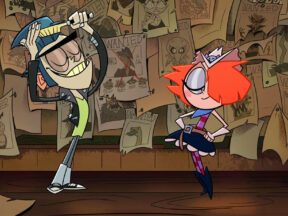
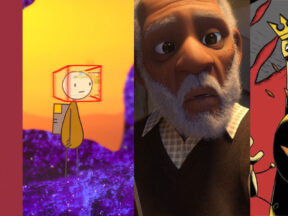
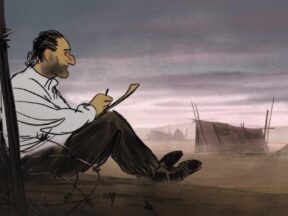
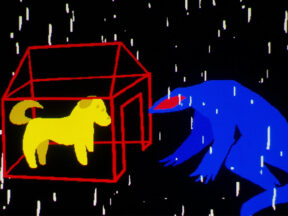
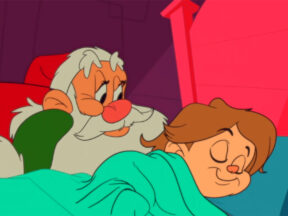
(Images at top from Emily Brundige’s “Pubertina” series)

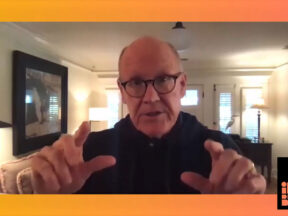
Douchey Digital Domain CEO John Textor: “Free Labor is Much Better Than Cheap Labor”

VFX Soldier has dug up its pièce de résistance: a video of Digital Domain CEO John Textor gloating about how not paying people at all is better than having to pay them even a little bit of money. It’s like an animation studio executive’s wet dream come true: