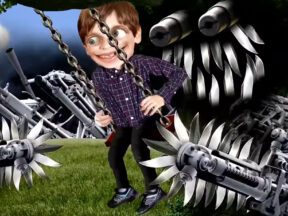
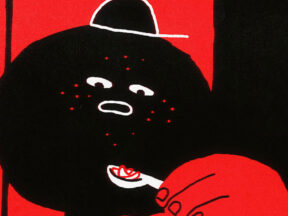
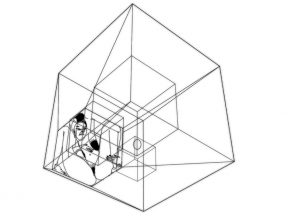
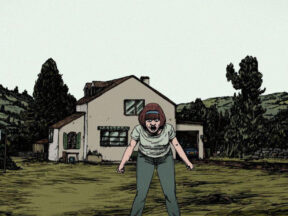
Faces by Alexander Gellner (Germany): “This is an abandoned project and study, pretty much in preparation for my One Minute Puberty piece…I want to develop this approach further at some point. For now, it’s a nice study and tribute to a certain michael jackson video. The “John Jay Marathon” tune was made by beatbox legend Mando.”
I was digging around for some UPA photos the other day when I stumbled onto this photo that I’d labeled “Tee Hee and visitors.” Tee Hee is, of course, the gentleman on the right–a sequence director on Pinocchio and the “Dance of the Hours” segment in Fantasia, before moving over to UPA where he worked with director Bobe Cannon on shorts like Gerald McBoing Boing, Fudget’s Budget and The Jaywalker. When I looked at this photo again though, I thought, “Wait a second…these aren’t any ordinary visitors…they’re the legendary husband-and-wife design team of Charles and Ray Eames!” At least I’m fairly certain they are. If anybody can confirm this, please do.
The cross-pollination between creative disciplines was an essential ingredient of the “cartoon modern” era. I wrote a little bit about Charles and Ray Eames and their relationship to animation on the Cartoon Modern blog. The story goes that Charles Eames was so impressed after he visited the UPA studio that he bought stock in the company. The Eames later created some animated projects and hired animation artists like John Whitney, Dolores Cannata, Ed Levitt and Chris Jenkyns. Here’s a film they produced in 1958 called The Expanding Airport:
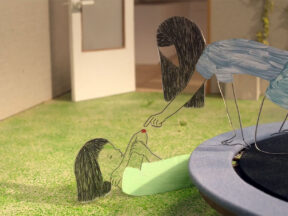
BREWMASTERS NOTE: This week Cartoon Brew takes a closer look at the five Academy Award nominated animated shorts. Each day at 10am EST/7am PST we will post an exclusive interview with the director(s) of one of the films. Today, we discuss Studio AKA’s A Morning Stroll with its writer/director Grant Orchard:
Amid Amidi: At Pixar, when artists pitch their short film ideas to John Lasseter, if Lasseter really likes the idea, he hugs you at the end of the presentation. Did you get any hugs at Studio AKA when you pitched A Morning Stroll, and if so, who hugged you?
Grant Orchard: Not really, some curious questions and then an — ‘OK, we trust you, give it a go’. I bet you think we’re all very Downtown Abbey over here. All arch and stiff, but no, it’s all free hugs and love man. In fact it sounds like Mr. Lasseter is holding back a little, he should share it around a bit more.
The commercial directing team of Dan & Jason has been developing Office Buddies over the past few years at the New York commercial house Hornet. The earlier episodes, including the funny “Stapler Face Off”, have screened at festivals like SXSW and Platform.
BREWMASTERS NOTE: This week Cartoon Brew takes a closer look at the five Academy Award nominated animated shorts. Each day at 10am EST/7am PST we will post an exclusive interview with the director(s) of one of the films. Today, we discuss the NFB’s Sunday with its writer/director Patrick Doyon:
An Oscar nomination is the ultimate hard-won honor for a short filmmaker. Thirty-two-old Canadian filmmaker Patrick Doyon achieved the Oscar nod with his first professional film. His short Sunday is as quiet and reflective as the day of the week its named after. Told through a young boy’s point of view, the film celebrates the triumph of imagination over the mundane routine of childhood.
The events that take places in this quaintly drawn world are accompanied by a feeling of foreboding. “Death is very present throughout the film,” Doyon says. “The three crows are never very far.” The apprehension about the future–signified by a large factory with a “for sale” sign on it–is in part rooted in Doyon’s childhood memories growing up in the Quebec town of Desbiens. “As young as I can remember, the factory was always closed. Maybe just a few times, it was functioning, but only for a short period of time,” Doyon says.
Watch a making-of documentary about Sunday.
Doyon acknowledges that a lot of the film is autobiographical–going to church with his parents, visiting his grandparents–but he took liberties with the animation. For example, though he lived near a railroad and his house vibrated with each passing train, his home didn’t jump and bounce off its foundation as the houses do in Sunday. “This is the pleasure of animation: not trying to recreate reality,” he says. Continue reading →
Ghostshrimp (aka Dan James), an artist on Adventure Time and The Marvelous Misadventures of Flapjack, is currently developing his own seven-minute pilot for Cartoon Network called Mars Safari. This is a peek at some of the pitch materials:
The gang would need to be wearing seatbelts in this car.
This pooping bit would need Rob [Sorcher]’s okay before we elevate for Stu [Snyder]’s approval.
We’d need to see color models for the Alien guys here. There may be some issues with them stealing the car radio as it could play like an offensive stereotype
The references to the Afterlife would need Rob’s okay before we elevate for Stu’s approval.
Mister Nuggets suggesting that Bull Goose has mental problems would need Rob’s okay before we elevate for Stu’s approval.
It raises the question, If Cartoon Network is worried about such trivial matters, why would they greenlight a pilot for someone who openly jokes about incest and rape on his Facebook fan page? Ghostshrimp’s latest Facebook update asks, “But what would you do if you woke up and your mom was giving you a hand job?”
An earlier Facebook posting, which appears to have since been deleted, asked, “If you could rape anybody, ever, anywhere, who would it be?” This is a screengrab of the post (click for a larger version):
It’s the height of hypocrisy for Cartoon Network to be so finicky over innocuous gags expressed in an animator’s cartoon, and yet turn a blind eye to a show creator’s public persona, which would be considered genuinely offensive by many people. The art we create is a reflection of our values and principles (whether we intend it to be or not), and when someone treats serious subject matter in a flippant manner, that attitude will inevitably seep into their work, too.
This is fine, of course, if Cartoon Network embraced the crude ideas of the artists they hired and if they’d given Ghostshrimp a long leash to explore his unconventional sense of humor. But the standards & practices notes tell a different story: Cartoon Network goes to great lengths to preserve a veneer of decency, while ignoring the fact that some of their show creators are anything but decent.
SVA grad Ross Bollinger has been steadily building his Pencilmation cartoon brand over the past few years, and his YouTube channel now counts over 4,000 subscribers and 2.6 million views. He recently started a new series of Pencilmation shorts that offer a tongue-in-cheek history of the world. It begins with cavemen:
I’ve never been a huge fan of the Animated Feature category in the Oscars, but I play along because that’s what all the cool kids do. This piece by Mark Harris on Grantland is a compelling argument though for why the animated feature category is, statistically speaking, silly and unnecessary. It’s such a thoughtful piece that I’m even willing to overlook Harris’s identification of animation as a genre, which we all know is incorrect..
At the very least, the Academy should consider Harris’s suggestion to cap the number of animated feature nominees at three. To date, there has not been a single year where more than three films have been worthy of the award. And it makes little sense to select five nominees out of a field of eighteen, when the Foreign Language category selects five from over sixty films. And those 60 films are already whittled down from a long list of contenders in each country. The dozen-and-a-half contenders in the feature animation category aren’t even preselected from a larger pool; films that nobody would ever think of rewarding like Mars Needs Moms and Hoodwinked Too! Hood Vs. Evil are what make the category possible. Are animated films really that much better than live-action that every third film made is Oscar-worthy? As much as I like animation, even I’m not that deluded.
Be sure and visit Google’s front page today for an animated Valentine’s Day short with music by Tony Bennett. For a Google Doodle, it’s an impressively long piece. I hope they’ll be doing more of these long-form animated pieces in the future. The designer and writer of the piece was Willie Real and the animator was Michael Lipman (aka Lippy). Also, kudos to Google for not being afraid to slip in a nod to gay marriage.
Video hosting website Vimeo will be presenting their second-annual Vimeo Awards this June in New York City. The deadline to submit films is next Monday, February 20. The awards have an animation category, as well as other categories that may apply to readers of the Brew, like music video, experimental, advertising, remix and motion graphics. The winner in each category receives $5,000 and there’s also a $25,000 grand prize. Entry fees are $20 per film, or $5 for Vimeo Plus/Pro subscribers. Submission details and official rules are available on their website.
I’m a big fan of the service that Vimeo provides to the filmmaking community. They get everything right from their high-quality video player to elegant site design and respectful community standards. That’s why I’m delighted that they invited me to be one of the judges in their Animation category, along with DreamWorks’s Marcy Page and Eran Hilleli, whose short Between Bears won the animation prize at the first Vimeo Awards. Make our jobs hard and submit lots of great animated films!
Yesterday, the BAFTAs–the British equivalent of the Academy Awards–were handed out, and the winners of the Animated Feature and Shorts categories were Gore Verbinski’s Rango and Grant Orchard’s A Morning Stroll. The production design nod went to Dante Ferretti and Francesca Lo Schiavo for their work on Hugo, and “special visual effects” was awarded to Harry Potter and the Deathly Hallows – Part 2 (Tim Burke, John Richardson, Greg Butler and David Vickery).
Both Rango and A Morning Stroll are Oscar nominees as well, but it’s difficult to judge what a BAFTA win means for their Oscar chances. That’s because besides these two films, the BAFTA nominees in both categories were completely different from the Oscar nominees. Interestingly, the other nominees in the BAFTA animated feature category were The Adventures of Tintin and Arthur Christmas, two films that many said should have also received Oscar nods.
Think Brilliance by Diego De la Rocha (Canada): “This is my animation final project from Vancouver Film School. Shot #1 (Head Title Sequence–Stop Motion / Cloth, strings, cardboards & maple leaves); Shot #2 (CG Lightbulb–Maya 2011/ Zbrush/ Photoshop/ Nuke/ Premiere Pro)”
Futile Devices–Kickers by Nicolas Ménard (Canada): “A series of 6 five seconds kickers made in Denis Dulude’s class at UQAM (Université du Québec à Montréal)”
God and Money by Philip Vose (US): “Finished in just under five days for my church as an intro to a short series topic of God and money.”
(NSFW) Twenty Four Hour Woman by Scott Lenhardt (US): “Celebrating the women who make the world go around.”
PHONO – a Sound Creature by Lucas Zanotto (Italy/Germany): “Sound creatures are imaginary beings, a collection started and maintained by composer & sound designer David Kamp in the name of science.”
“I don’t know and I would like to correct that,” was John Lasseter’s response when asked by the Wall Street Journal why Studio Ghibli films don’t perform well in the United States. “I ask that same question all the time…They’re beautiful on the big screen.” Next week, Lasseter and Disney will make their most ambitious attempt to popularize Ghibli’s films stateside when they open the English-language version of The Secret World of Arrietty on 1,200 screens.
The WSJ Journal article about the film, which can be read here (but might be behind a paywall), describes Disney’s challenge of building buzz for the film without any merchandising rights. They are hoping that Arrietty finds a broader audience than the typical Ghibli film since it’s based on Mary Norton’s children’s classic The Borrowers. It’ll be interesting to watch how the film performs in the US. This is a relatively wide release for an indie/foreign animated film, and when Disney feels that they can make money from a more diverse palate of animated films, other film distributors will likely follow suit.
Tonight at 6:30, the Society of Illustrators (128 East 63rd Street, between Park and Lexington Ave.) presents a special screening of Bill Plymptons’s colorized and voice-enhanced version of Winsor McCay’s The Flying House. Bill will be on hand afterward for a cocktail reception, as will the film’s voice actors Matthew Modine and Patricia Clarkson. Tickets are $10 (students), $15 (Society of Illustration members) and $20 (general public). Purchase them at the Society of Illustrators website.
How much is a personal painting by Disney animation legend Ward Kimball worth? Watch the segment above. The painting, owned by animation artist Jim Clark, was featured tonight on an episode of Antiques Roadshow. The appraiser, Leila Dunbar, really knows her Disney history. It’s not mentioned in the program, but Ward originally gave the painting to his unit animator Julius Svendsen as a gift.