|
|
|
|
TAG FOR “Cartoon Modern”Cartoon Brew's home for up-to-the-minute, unedited announcements and press releases direct from industry sources.
May 23, 2012 4:32 pm
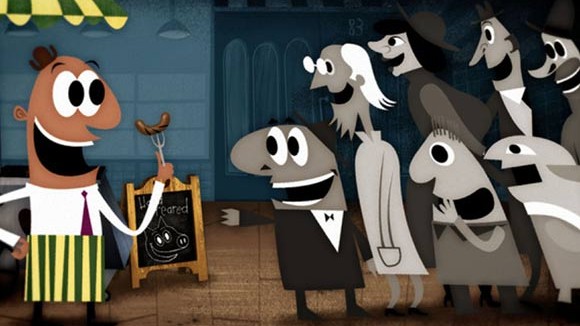
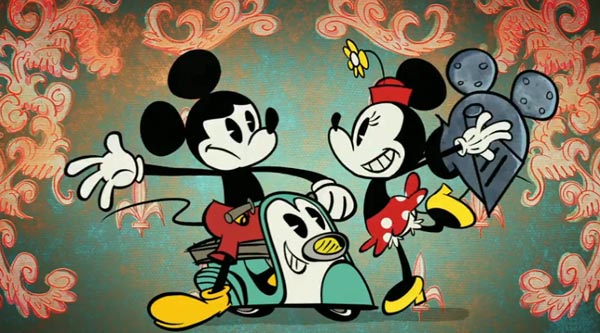
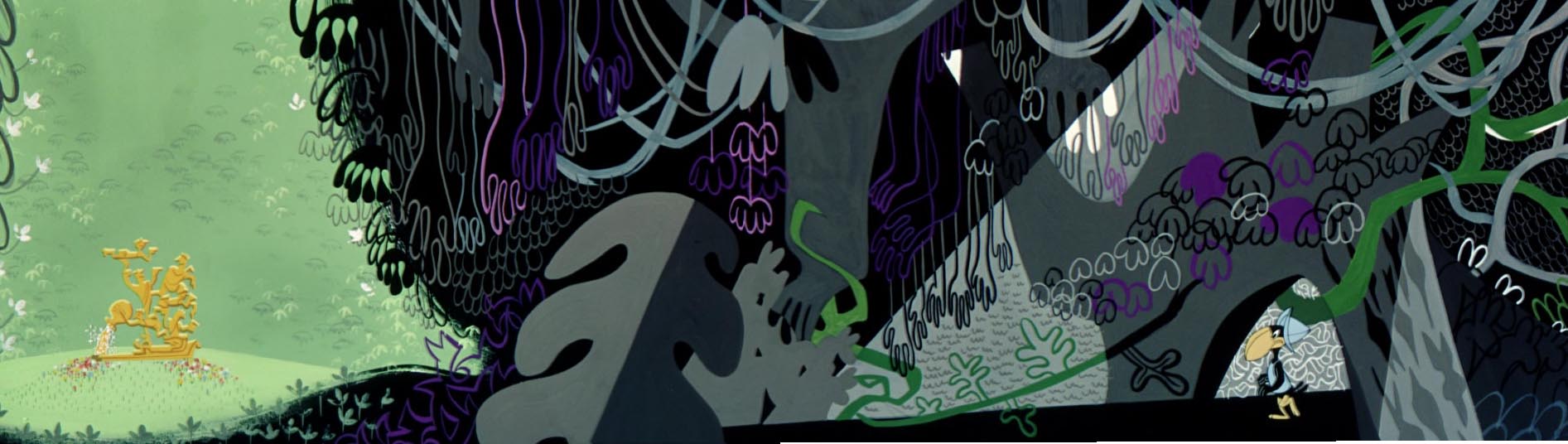
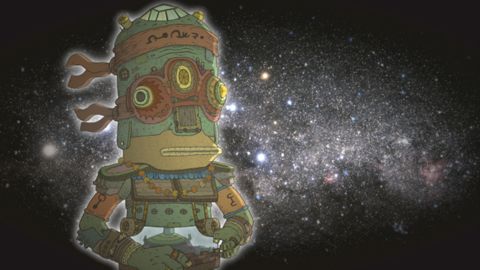
Self-taught Australian animator Lluis Fuzzhound’s Marooned On Watango Island is a loving tribute to the Cartoon Modern style April 6, 2012 4:23 am
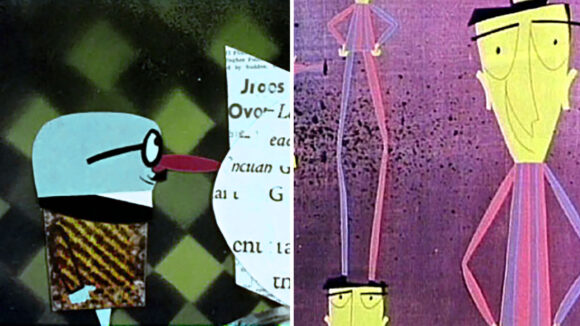
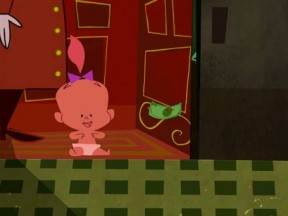
I watched all the UPA theatrical shorts back when I was writing Cartoon Modern The director whose reputation will benefit most from this collection is Robert ‘Bobe’ Cannon. While his stories tend to be formulaic and thematically repetitive, often times it seemed like he was the only director at UPA who knew how to put together a coherent film. (A good deal of that credit also belongs to his close collaborator T. Hee, who wrote most of Cannon’s films.) More than the stories though, it’s the way that Cannon animated characters, which looks even more refreshing today in light of all the generic Flash and After Effects animation. In Cannon’s work, the way a character moves is never separate from its design. Discovering a visually inventive way to animate a character from point A to point B is Cannon’s greatest strength. The two most famous films in the Cannon canon are Gerald McBoing Boing and Madeline, but his later efforts, especially Fudget’s Budget, Christopher Crumpet’s Playmate and The Jaywalker—all looking better than ever on this set—display remarkable confidence as a director. Below is some random visual eye candy from the “Jolly Frolics” shorts. We’ll be giving away a couple copies of the set this weekend so check back.
February 24, 2012 2:17 am
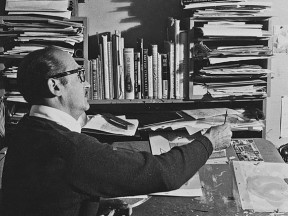
What kind of books might an animation artist have kept on their bookshelf sixty years ago? They certainly wouldn’t have owned many animation books. In the 1950s, there was no Illusion of Life or Animator’s Survival Kit, and the entire number of books published about animation could be counted on one hand. Inspiration for the classic animation artist lay beyond the world of cartoons and animated film. I was reminded of this when I found a photo of Jules Engel, a background painter who started at Disney prior to joining the Modernist studio United Productions of America (UPA). The shot below was taken at UPA circa 1954-’55. Engel later made his own independent shorts and created the CalArts Experimental Animation program, which he ran until his death in 2003. After examining the image (and a similar photo taken from a slightly different angle), I was able to identify many of the books on Engel’s shelf. (Click HERE for a larger view of the image.) Engel’s books span the spectrum of visual arts from photography to painting to dance and theater. His collection confirms much of what we already know about the artists who worked at UPA, and their commitment to exploring the possibilities of the animation medium. Far from working in a vacuum, they were fully aware of the latest trends and ideas in the contemporary art world. Below is an inventory of the books that are identifiable in the photo of Engel’s bookshelf. I’ve tried to include the covers of the specific editions that Engel owned: British Circus Life by Lady Eleanor Smith and John Hinde New Theatres for Old by Mordecai Gorelik February 18, 2012 2:26 pm
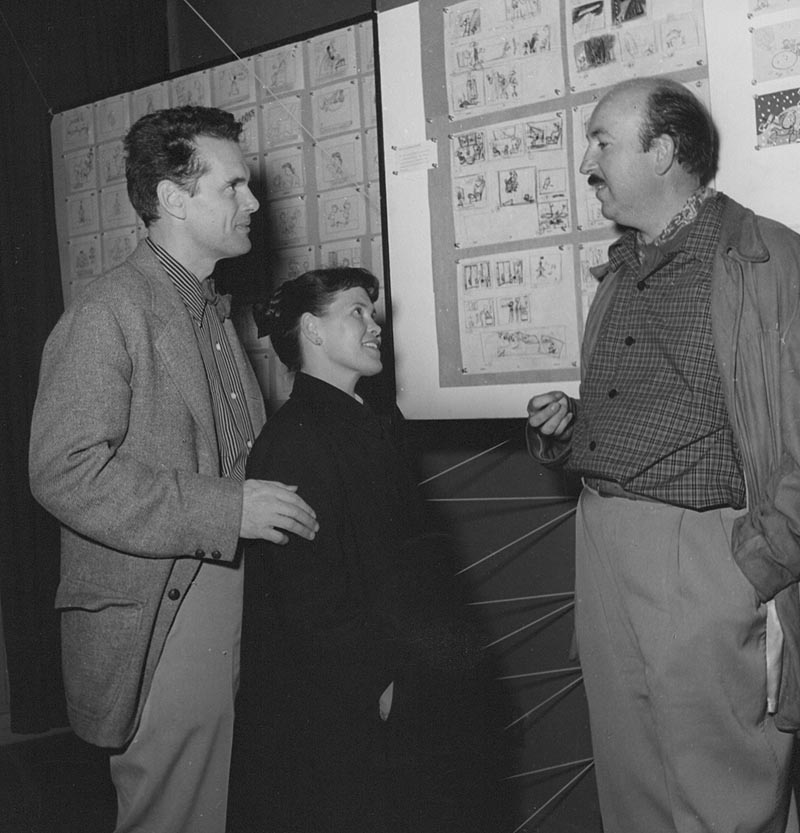
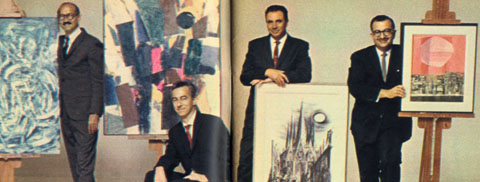
I was digging around for some UPA photos the other day when I stumbled onto this photo that I’d labeled “Tee Hee and visitors.” Tee Hee is, of course, the gentleman on the right—a sequence director on Pinocchio and the “Dance of the Hours” segment in Fantasia, before moving over to UPA where he worked with director Bobe Cannon on shorts like Gerald McBoing Boing, Fudget’s Budget and The Jaywalker. When I looked at this photo again though, I thought, “Wait a second…these aren’t any ordinary visitors…they’re the legendary husband-and-wife design team of Charles and Ray Eames!” At least I’m fairly certain they are. If anybody can confirm this, please do. The cross-pollination between creative disciplines was an essential ingredient of the “cartoon modern” era. I wrote a little bit about Charles and Ray Eames and their relationship to animation on the Cartoon Modern blog. The story goes that Charles Eames was so impressed after he visited the UPA studio that he bought stock in the company. The Eames later created some animated projects and hired animation artists like John Whitney, Dolores Cannata, Ed Levitt and Chris Jenkyns. Here’s a film they produced in 1958 called The Expanding Airport: January 13, 2012 12:56 pm
This 1961 episode of Tales of the Wizard of Oz harkens back to a time when animation writers didn’t speak down to kids. It’s a perfect example of children’s TV animation that works on multiple levels, encouraging kids to question their surroundings and understand the realities of the world while entertaining them at the same time. December 30, 2011 6:45 pm
The future of animation books, like the rest of the publishing industry, isn’t rosy. Page counts and print runs are shrinking, and publishers seem more reluctant than ever to take risks with unconventional subject matter. Despite the uncertainty, there is still a fairly promising line-up of animation-related titles being released in 2012, including a much-needed biography of the McKimson brothers (most notably Bob, but also Chuck and Tom), the definitive history of UPA, and an intriguing flipbook project by Up and Monsters, Inc. director Pete Docter. My list below is by no means complete. Publishers still haven’t released their winter ‘12 titles, and others books will certainly pop up throughout the course of the year. If you know of other animation-related titles coming out in 2012, please comment below. FEBRUARY 2012 Book description: You’ve researched your character extensively, tailored her to your audience, sketched hundreds of versions, and now you lean back content as you gaze at your final character model sheet. But now what? Whether you want to use her in an animated film, television show, video game, web comic, or children’s book, you’re going to have to make her perform. How a character looks and is costumed starts to tell her story, but her body language reveals even more. Character Mentor shows you how to pose your character, create emotion through facial expressions, and stage your character to create drama. Author Tom Bancroft addresses each topic with clear, concise prose, and then shows you what he really means through commenting on and redrawing artwork from a variety of student “apprentices.” His assignments allow you to join in and bring your drawing to the next level with concrete techniques, as well as more theoretical analysis.Character Mentor is an apprenticeship in a book. Professional artists from a variety of media offer their experience through additional commentary. These include Marcus Hamilton (Dennis the Menace), Terry Dodson (X-Men), Bobby Rubio (Pixar), Sean “Cheeks” Galloway (Spiderman animated), and more.
Book description: Swiss animated film is currently in one of its most productive, ambitious and successful historical periods. Never before have so many films been made and never before have these films enjoyed such international success. At the centre of animation.ch are conversations with 20 film makers who represent the variety and uniqueness of Swiss animated film – from short author films to children’s productions, from television series to feature film projects, not to mention art and commercial productions. animation.ch explores the development of Swiss animated film over the last 20 years, examines current trends and looks at what’s to come in the future. With Georges Schwizgebel, Jonas Raeber, Samuel and Frédéric Guillaume, Ted Sieger, Yves Netzhammer, Claudius Gentinetta, Claude Barras, Isabelle Favez, Jadwiga Kowalska, Rafael Sommerhalder, Adrian Flückiger, Marina Rosset, Basil Vogt, Dustin Rees, Zoltán Horváth,Izabela Rieben, Maja Gehrig, Anne Baillod, François Chalet and Claude Luyet. MARCH 2012
Book description: One of the most beloved stories of all time—The Hockey Sweater—is celebrated in this heartfelt recollection. Reflecting on the original short story and mortifying real-life moment that started it all, the account relates how the resulting film is as much about childhood emotions and the desire to fit in as it is about hockey, the clash of cultures, and a harkening to bygone times. Canada’s tireless devotion to the film is illustrated, emphasizing how it is also loved by many more around the world. Delving into the artist’s notebooks, photographs, and memories, this record recreates the movie’s entire development, journeying back to the people and places that inspired its original imagery. The director’s additional films and illustrations are also explored, chronicling a 40-year career and providing rich insights into the creative process. MAY 2012 Book description: The first survey dedicated to the work of the McKimson brothers, this book offers a rare behind-the-scenes look at the upper echelon of 20th-century animation and examines the creative process behind the making of numerous popular characters and classic programs. Featuring original artwork from the golden age of animation, this book includes a wealth of material from many professional archives—screen captures, original drawings, reproductions of animation cels, illustrations from comic books, lobby cards, and other ephemera from the author’s collection—while surveying the careers of three groundbreaking animators whose credits include Looney Tunes, the Pink Panther, and Mr. Magoo. Beginning in the 1920s and then tracing the brothers’ work together at Warner Brothers Cartoons in the following decades, this history details Robert McKimson’s creation of such beloved characters as Foghorn Leghorn, the Tasmanian Devil, and Speedy Gonzales; Tom McKimson’s work at Warner Brothers, Dell Comics, and Golden Books; and Chuck McKimson’s long career working in comic books and then later at Pacific Title, creating animated film titles and commercials, including his award-winning work on Music Man, Cleopatra, and The Sound of Music.
Book description: Designed in the form of a scrapbook, this visual feast for Harryhausen fans reveals models from unrealized projects, such as dinosaurs from the unfinished film Evolution; prints of outtakes from various films; early concept drawings and storyboards; color transparencies of Ray at work; written artifacts such as letters, production budgets, and a diary that details Ray’s first meeting with his mentor Willis O’Brien; early film treatments and script extracts; publicity posters and brochures; and more. Some items show Ray’s earliest artistic endeavors such as watercolors painted when he was 15 years old and marionettes of creatures from King Kong that he made when he saw the film in 1933. The result is a treasure trove of rare artifacts and material which not only offer new insights into how Ray created particular effects, but bring the worlds of his films to life in a new way and paint a fascinating visual portrait of the man himself and his creative imagination.
Book description: Among their many idiosyncrasies, Adolf Hitler and Joseph Goebbels, the Nazi minister of propaganda, remained serious cartoon aficionados throughout their lives. They adored animation and their influence on German animation after World War II continues to this day. This study explores Hitler and Goebbels’ efforts to establish a German cartoon industry to rival Walt Disney’s and their love-hate relationship with American producers, whose films they studied behind locked doors. Despite their ambitious dream, all that remains of their efforts are a few cartoon shorts–advertising and puppet films starring dogs, cats, birds, hedgehogs, insects, Teutonic dwarves, and other fairy-tale ensemble. While these pieces do not hold much propaganda value, they perfectly illustrate Hannah Arendt’s controversial description of those who perpetrated the Holocaust: the banality of evil. JUNE 2012
AUGUST 2012 SEPTEMBER 2012 FALL 2012 Part of a Complete Breakfast: Cereal Advertising Characters of the Baby Boom Era by Tim Hollis (University Press of Florida). The Fairest One of All: The Making of Walt Disney’s “Snow White and the Seven Dwarfs” by J. B. Kaufman (Walt Disney Family Foundation Press).
February 12, 2010 1:30 pm
Over at Bob Shea and Lane Smith’s wonderful Curious Pages blog, they’ve posted the classic Jim Flora children’s book, The Fabulous Firework Family (1955). Flora is best known for his distinctive designs for RCA and Columbia Record jackets, magazines and various commercial art projects of the 40s and 50s. The Fabulous Firework Family launched Flora’s second career as a children’s book author and illustrator. The book was acquired by Terrytoons during the Gene Deitch era (1956-1958) and the resulting film turned out to be the last cartoon Deitch personally produced at the studio. Al Kouzel directed and, though Flora was involved with adapting the story to the screen, the final result wasn’t entirely successful in translating the charm of the original book. It’s illuminating to compare the book to the cartoon. Below is a pan-and-scan TV version of the Terrytoon, sans credits. (The original CinemaScope version of the film, with full credits, will be screened March 2nd at my Wide Screen Cartoons program at the CineFamily/Silent Movie Theatre). August 9, 2009 12:05 am
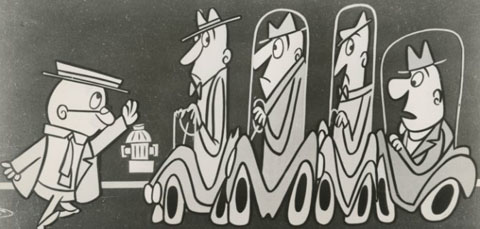
Sam Henderson has uploaded a rare, heavily illustrated article about UPA on his Magic Whistle blog. The article, by Catherine Sullivan, appeared in the November 1955 issue of American Artist. The text is rather slim, but the images are from a variety of UPA works including commercials and industrials, as well as theatricals like The Jaywalker (pictured above). Worth a look.
|