brewmasters
JERRY BECK
bio & contact
view posts by jerry
AMID AMIDI
bio & contact
view posts by amid
TAG FOR
“Ward Kimball”
by amid
June 25, 2009 3:38 pm


I didn’t expect to be using this picture in such a sad context, but here is a photo of Michael Jackson visiting with Ward and Betty Kimball.

Michael and Ward

The opening to Rankin/Bass’s Jackson 5ive series. (Thanks, OM)

Will Vinton’s “Speed Demon” sequence from Moonwalker.

“Do the Bartman” co-written and produced by Michael Jackson. (Thanks, Carlos)

by amid
February 5, 2009 1:10 am


Drawing by David Swift

During World War II, dozens of Disney artists were drafted into the US military. Today I’m sharing letters written by three of those artists who served in uniform–Berk Anthony, Carl Fallberg and David Swift. The letters were all addressed to Ward Kimball, who continued working at Disney’s Burbank studio during the war. Not only are the contents of the letters fascinating but also the artists’ writing styles which exhibit a surprising level of literary sophistication. I’ve annotated the letters with some information about the artists as well as references they make in their writing. Please add your own notes if you know any more about what is described in these letters. Click on each image to see the full page.

Berk AnthonyThis first letter dated August 18 (presumably 1941) is written by Berkeley “Berk” Anthony. He is a mysterious figure in animation history and I haven’t been able to turn up much about his life and career. He began working at Disney in the mid-1930s. He was Ward Kimball’s assistant for a period of time before David Swift and Tom Oreb took over the assistant spots. I have no records on what he assisted on, but I’m guessing he helped Kimball with Jiminy Cricket in Pinocchio and Bacchus in Fantasia. Anthony also worked in story on The Reluctant Dragon. He was drafted while still working at Disney. I know only two random facts about his post-military career: he designed the Arizona State mascot Sparky the Sun Devil in 1946, and according to a late-’90s interview with Ward Kimball, he committed suicide.

Page 1:
Berk Anthony Letter

Page 2:
Berk Anthony Letter

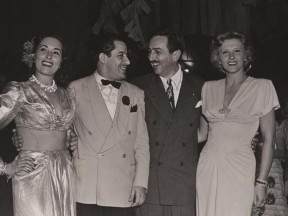
Notes about Berk Anthony’s letter: In the 1st paragraph, Anthony makes reference to Walt Disney’s trip to South America, which was happening during the time this was written. In the 2nd paragraph, Anthony mentions Carl Nater, who was the production coordinator for military films at Disney. (Nater later became the director of Disney’s 16mm film division and tried to suppress the release of Kimball’s Mars and Beyond to schools because he felt it “promoted evolution”.) In the same paragraph, Anthony also mentions his college background. If it’s not evident from his writing, he had an intellectual bent, and having seen a photo of the library in his home, it is also safe to assume that he was well read. In the 3rd paragraph, I interpreted one of his sentences to mean that he appeared in the live-action portions of Reluctant Dragon. I don’t have time to check the entire film right now but should anybody wish to search for him, I’ve included a photo of Anthony above from January 1939, dressed up for a costume party. In the 8th paragraph, he references Hardie Gramatky, the former Disney artist who became a well-known fine artist and author of the Little Toot series.

The next letter, dated November 23, 1942, is from Carl Fallberg who was stationed in Quantico, Virginia as part of the Marine Corps film unit:

Page 1:
Carl Fallberg Letter

Page 2:
Carl Fallberg Letter

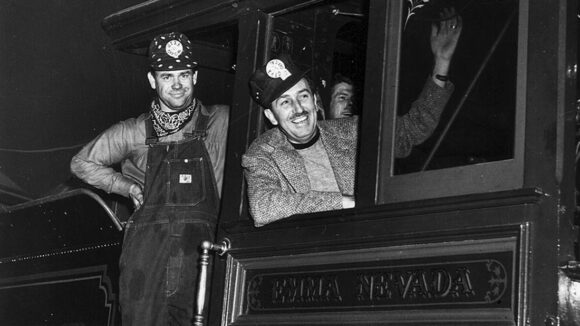
The unit housed an impressive group of people including not only the animators that Fallberg mentions in his letter but also actor Tyrone Powers, director Richard Brooks and the future Abstract Expressionist painter Richard Diebenkorn. In the 1st paragraph, Fallberg thanks Kimball for the shot of #2, in reference to the train that Kimball was restoring at his home. In the 2nd paragraph, Fallberg references a live-action feature that he had made with fellow Disney animator Lars Calonius. The one hour and fifteen minute Western parody was partly shot at Kimball’s home using his #2 train, the Emma Nevada. In the 4th paragraph, Fallberg lists the Disney artists at Quantico at the time of the letter, who were Ralph Chadwick, Keith Robinson, Walt Smith, Charles McElmurry, Art Babbitt, Nicholas J. George, Don Lusk and Jack Whitaker.

In the 5th paragraph, he says that Frank Thomas was being considered for the unit; Thomas eventually ended up directing animation in the First Motion Picture Unit of the Air Force stationed in Culver City, California. As Fallberg states in this paragraph, Disney layout artist Tom Codrick would become the head of the animation unit in Quantico. In the 6th paragraph, he thanks Ward for giving animation pointers to his sister Elinor Fallberg. In the 9th paragraph, he writes about visiting his live-action filmmaking partner, Lars Calonius, who was in the Army’s Signal Corps film unit further north on the East Coast. (Calonius stayed in New York after the war and ran a successful TV commercial studio for many years.) In the 12th paragraph, he references G.F.R.R.—the Grizzly Flats Railroad—which was the official name of Kimball’s backyard.

The final letter is from December 28, 1945 from David “Bud” Swift, who was Kimball’s top assistant on Dumbo, The Reluctant Dragon and Education for Death among other projects.

David Swift Letter

Swift’s letter, written from England, is addressed to Fred [Moore] and Tom [Oreb] as well as Ward. Unlike Anthony and Fallberg who were working in film divisions during World War II, Swift was flying a B-17 Flying Fortress in the Air Force. In fact, he flew thirty-four bombing missions into Germany in 1945; the Germans had already surrendered by the time he wrote this letter. In the 1st paragraph, Swift’s mention of “Hal” refers to Hal Adelquist, the head of Disney studio personnel. In the 3rd paragraph, he writes that he wished he were back in the States, where women didn’t “carry pro kits.” A description of pro-kits can be found in this book excerpt on Google Book Search. Swift has a way with words, and after the war, he became a writer at Warner Bros. Later, he created the TV series Mr. Peepers and directed features like The Parent Trap and How to Succeed in Business without Really Trying.

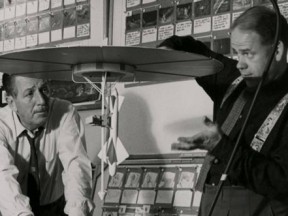
Here is a photo of Swift (standing) and Kimball during the production of The Reluctant Dragon.

Swift and Kimball

by amid
December 25, 2008 1:11 pm


Ward Kimball

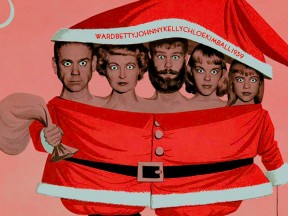
From 1959, Christmas morning at the home of Disney legend Ward Kimball along with his family—wife Betty and children Kelly, John and Chloe. Click on the image for a bigger version. And stay tuned to Cartoon Brew in 2009 to find out about the big Kimball news!

by amid
December 22, 2008 7:48 am


I can’t help it, I’m in the holiday spirit, so here’s another one for today: the Firehouse Five Plus Two, led by Disney director and animator Ward Kimball, perform holiday music with Dixie flair.

by amid
December 3, 2008 12:04 pm


Ward Kimball

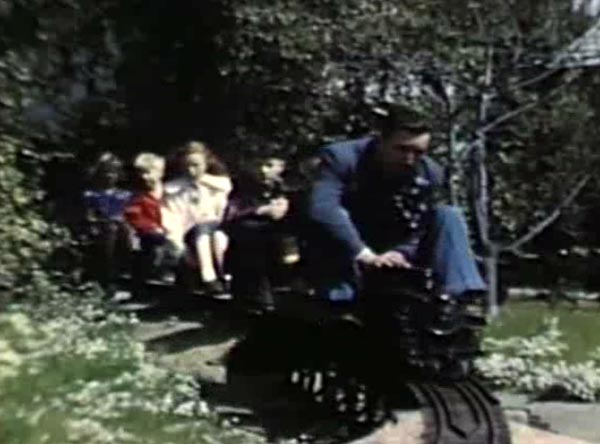
Among the discoveries in the newly available Life Magazine photo archives is this headstand by Ward Kimball during one of his steamups in the late-1950s. (A larger version is here). There are also a couple other photos from the same day: a nice panoramic shot and this one which includes Ward’s railroading friend, Gerald Best, standing on the ground and wife Betty and son John on the train with him.

(On a sidenote, the poor set-up of the Life photo archives on Google is incredibly frustrating. Many of the photos are uncaptioned—like these Kimball ones—or in some cases, incorrectly identified. They really should start allowing the public to tag and annotate the images. For example, wouldn’t it be nice for everybody to know that the artists standing with Walt in this photo are Ham Luske and Ward Kimball. A collection of images that can’t be properly searched doesn’t serve much function.)

by amid
October 31, 2008 2:23 am


Need some last-minute costume suggestions? Here are some ideas from Ward and Betty Kimball:

Ward and Betty Kimball

Or why not just decorate a pumpkin?

by amid
October 2, 2008 8:05 am


Somebody finally posted Ward Kimball’s It’s Tough to Be a Bird online. The short won the Oscar for best animated short in 1969. I’ve compiled the YouTube segments into a playlist below:

by jerry
June 26, 2008 2:00 pm


Several years ago I curated a program of CinemaScope cartoon shorts from the 1950s, which I screened at the Ottawa Animation Festival, the Museum of Modern Art and several other venues. While researching the subject, I came upon a small article by Ward Kimball, from Films In Review (March 1954), in which he discusses the subject.

Kimball makes several interesting points referencing his work on Toot Whistle Plunk and Boom and shows the thought Disney’s animators put into using this unique, new screen shape. Kimball notes how wide shots and longer scenes play better in wide screen and how, in CinemaScope, “cartoon characters no longer perform in one spot against a moving background, but are moved through the scenes.” He also makes note of the use of directional Stereophonic sound used in these shorts. (Grand CanyonScope will be released letterboxed and in stereo on the forthcoming Disney Treasures: Donald Vol. 4 later this year).

Kimball’s piece is preceeded by an overview by writer Ed Lubin entitled “Disney Is Still Creative”(!) which touts the studio’s relevancy during the changing animation scene of the early 50s. Click on the thumbnails below to read both articles.

firmarch5311.jpg firmarch532.jpg firmarch533.jpg firmarch5304.jpg