.png)
Jeffrey Katzenberg Says Artists Should Fight for AI Terms, Not Against AI
Stay informed with free updates
Sign up to get our news digest — delivered directly to your inbox twice a week.
Jeffrey Katzenberg says artists are right to worry about AI. He also thinks they need to start deciding the terms under which it enters their industry.
In a lengthy post to X, a curious platform if the medium is as important as the message, the former DreamWorks Animation CEO and current founding partner of WndrCo, an investment firm that has backed Cartwheel, a startup developing AI tools for 3D character animation, recalls watching an AI-generated animated scene that reminded him of seeing Pixar’s Luxo Jr. for the first time. Later, an artist he had known for decades asked whether a similar video meant the end of their profession. “Certainly not,” he told her.
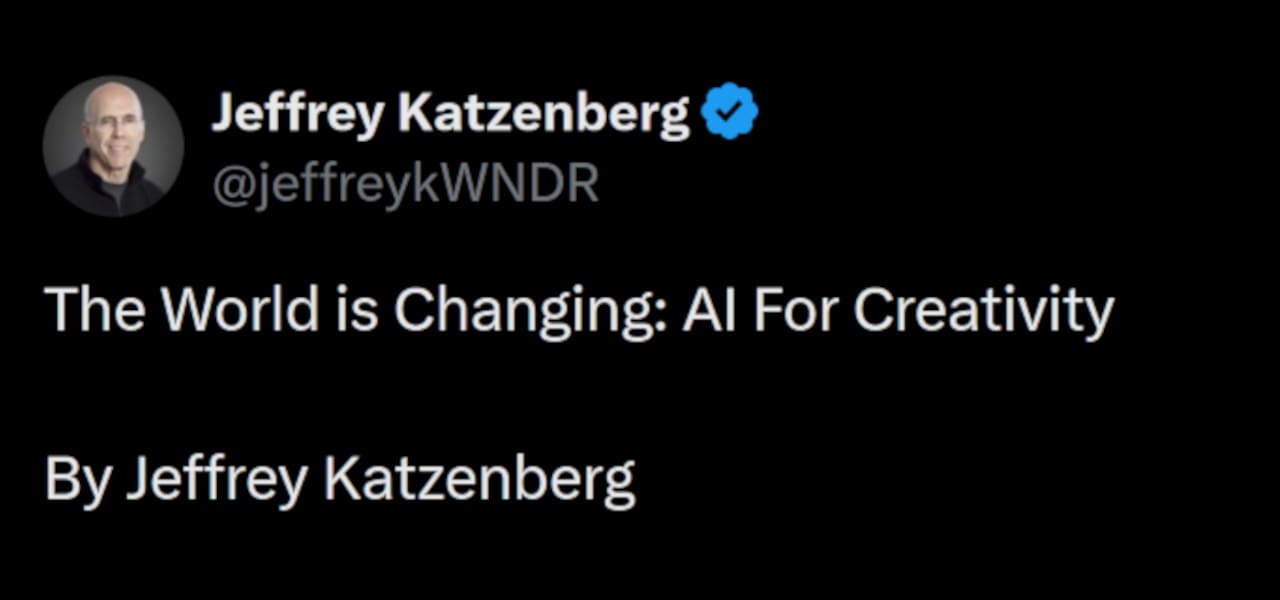
The World is Changing: AI For Creativity
By Jeffrey Katzenberg
A few months ago, I sat in my office in Silicon Valley and watched as a tech founder showed me something extraordinary. On the screen was a fully realized, beautifully lit, well-composed animated scene. It was…
— Jeffrey Katzenberg (@jeffreykWNDR) September 23, 2026
Katzenberg acknowledges the threat to jobs before launching into a familiar refrain. He points to the musicians who lost work when recorded sound came to movie theaters and to the artists displaced when DreamWorks stopped making hand-drawn features. “They were right. Those pit jobs did not come back,” he writes of the musicians. But he argues that new tools also expanded what films could do: “sound gave us the movie musical, the modern score, sfx, sound design, audio engineering, and an art form vastly larger than the one it disrupted.”
He remains bullish on AI’s potential, despite earlier predictions missing the mark. In 2023, Katzenberg predicted it could reduce the time and cost of producing animation by as much as 90% within three years. We’ll find out if he was right in… 2026.
In the new essay, Katzenberg doubles down on the forecast, however, and predicts that lower costs will mean more films, greater risks and new kinds of storytelling. He offers little explanation of how those gains would translate into work for artists whose jobs may change or disappear. Nor does he make much of a case for why producing more films more cheaply would lead to better ones.
For now, Katzenberg distinguishes between generating images and making art. AI can imitate what has been done, he argues, but “when the bot generates a piece of art, it is not trying to communicate anything. It is statistics, not soul.”
His proposed path forward asks something of both technology companies and Hollywood. Developers should include artists “with credit, with consent, and with compensation,” he writes. Artists, meanwhile, should accept that AI is here and fight over the conditions of its use. “The tools-versus-no-tools argument is a trap,” he says. “First, we must all agree that there should be terms. Then we can have the crucial debate about what fairness requires.”
He briefly conceded that his judgment is fallible, “take Quibi, for one!” but treated the streaming service’s collapse as a parenthetical aside. For animation workers being asked to trust another of his forecasts, the consequences are harder to set aside.