.png)
Canada Debates AI’s Place In Animation At OIAF’s The Animation Conference
Stay informed with free updates
Sign up to get our news digest — delivered directly to your inbox twice a week.
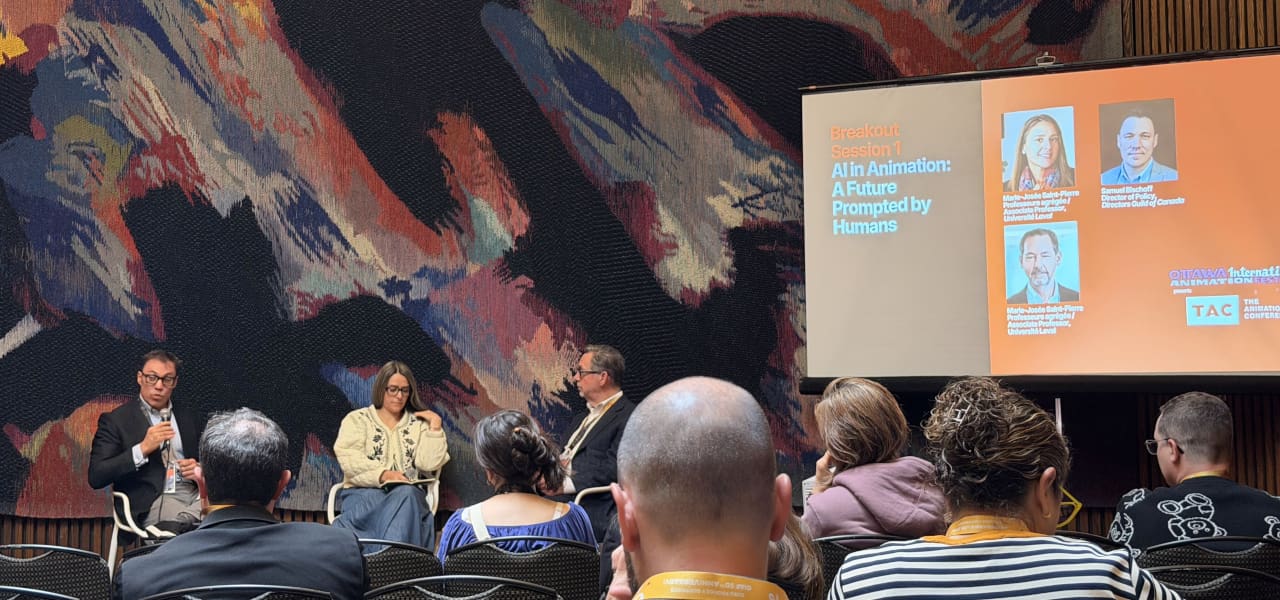
OTTAWA, Canada – What happens to the next generation of animators if AI takes over the jobs where they would have learned their craft? Where does using AI as a tool end and replacing human creativity begin? And who gets to draw that line? Those were the three questions entertainment lawyer Mark Edwards put to a panel of Canadian industry experts at Ottawa International Animation Festival’s TAC (The Animation Conference) today.
Université Laval professor and animator Marie-Josée Saint-Pierre cautioned against treating AI as a single technology with a single effect. “We always need to approach the question of which AI are we using and for what purpose,” she said.
On education, she said students’ anxiety was understandable, particularly when they hear that junior jobs could disappear. “The juniors, that’s how they learn,” she said. “If we wipe that out, who’s going to be our senior artist in 10 years?” Students still need to learn to draw and animate, she argued, because those skills give them the judgment to evaluate what AI produces.
Directors Guild of Canada (DGC) policy director Samuel Bischoff described similarly mixed reactions among guild members. Some reject AI training while welcoming information about copyright and the risks of using particular tools. Meanwhile, members are already using AI for administrative and creative tasks. “Some members would respond to us, ‘Oh, we don’t feel being at risk,’” he said. “Some other members might say, ‘It’s existential, and we need to act now.’” The effects, he added, differ across job categories.
Moderator Mark Edwards suggested that rejecting AI training “feels like they’re putting their head in the sand.” Bischoff acknowledged the tension: “AI is being used,” he said, for administrative tasks and, increasingly, creative ones. But he said resistance to training can also reflect how quickly the tools change, making it difficult to offer instruction that stays relevant.
Edwards then pushed the speakers to explain what makes a work human-created when software can automate parts of its production. Bischoff said the DGC looks at transparency: whether people can understand when AI was used and which creative decisions remained with the artist. Consent matters too. “Did you choose to use AI? Is that your own decision when you started using it?” he asked.
Saint-Pierre framed the distinction around artistic control. “Is AI helping me to execute my artistic intention? Or is it going to determine the style? Is it going to determine the animation, the movement?” she asked. “There’s a difference between automating technical operation and outsourcing artistic decision.”
Drawing a universal line would be difficult, Edwards argued. He pointed to questions about both the material used to train AI systems and the ownership of work they help produce, as well as restrictions that broadcasters and distributors may impose on productions.
Saint-Pierre said she had moved from working with large proprietary models to training a model on material whose origins she could trace. “Can I locate authorship in the workflow?” she asked. Bischoff likewise raised questions about authorization and compensation for training material, and about who should be responsible for disclosing AI use in finished work.
Saint-Pierre also warned that those models are getting worse for artists who use them. “Now it’s the shittification of AI,” she said. “They’re more and more expensive, and they’re giving less and less results,” while still carrying ethical problems. Her advice was to move away from the large models where possible and explore tools whose source material artists can identify and control.
With time running out, Edwards asked what the animation community could do to shape the discussion. “I think we need to protect the conditions for the artists to be able to make art and create,” Saint-Pierre replied. Bischoff closed with a warning about how the industry describes that work: “Art is not content.”