.png)
Cartoon Brew TV #12: Anime Trailers
(Alternate commentary-free version: This link will allow you to watch the trailers without audio commentary)
This episode from the Cartoon Brew TV Vault features three unique trailers from the “Golden Age” of anime.
First up, the 1974 Japanese animated Jack and The Beanstalk (Jack to Mame no Ki). With this film, anime veteran Gisaburo Sugii made the move from animating on artistically surreal, X-rated projects like Belladonna (Kanashimi no Belladonna, 1973) to directing family-friendly feature films like Jack. This movie was released in the U.S. in 1976 by Columbia Pictures, limiting its distribution to Saturday matinees. Jack lived on despite this, gaining its widest exposure on home video and in numerous showings on HBO. However, its greatest appeal to U.S. baby boomers is its all-star cast of voice actors including Speed Racer‘s Corrine Orr and Jack Grimes, and Astro Boy’s Billie Lou Watt and Ray Owens.
Next, Princess Knight (Ribbon no Kishi). Osamu Tezuka began this film as a serialized manga in 1954. It became a 52-episode anime series in 1967. Aimed at girls, the premise centers on a severely conflicted heroine: a princess raised as a boy, who must hide her true sex or lose the kingdom, secretly fighting crime in male guise as the “Phantom Knight”–and donning a separate feminine identity to appear as her own sister! Joe Oriolo (TV’s Felix The Cat, Hercules, etc.) bought the series in 1970 and dubbed it in English. Unfortunately the show wasn’t widely seen in the U.S. (Oriolo also edited together three episodes and tried releasing it as feature, Choppy and the Princess); this promo-trailer also doubled as the show’s U.S. opening title sequence.
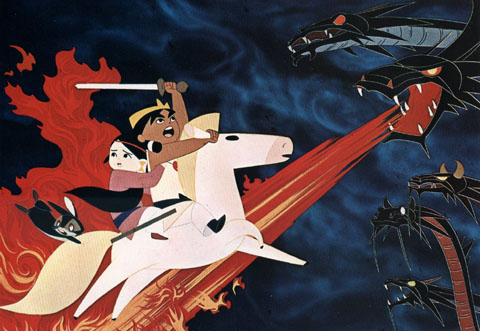
Finally, it’s a shame Little Prince and the Eight Headed Dragon (Wanpaku ôji no orochi taiji, 1963) isn’t more widely known and is so difficult to see. Genndy Tartakovsky has touted this as one of his biggest influences on Samurai Jack and you can see why in this rare American TV spot (presented here in black & white). The original was presented in vivid Fujicolor (“Magicolor!”) and wide screen ToeiScope (an anamorphic 2.35:1 screen ratio – aka “WonderScope!”), two aspects hurt in the awful U.S. dub which mainly exists today in faded Eastman Color with pan-and-scan editing. What remains visible regardless is the beautiful character design and stylized animation, years ahead of what Japanese animators were doing commercially at this time. This is a little classic that deserves wider exposure. Seek out the Japanese DVD if you can. Some great model sheets of the main characters are posted here.
Jerry Beck provides audio commentary on these trailers. Thanks to Michael Geisler for recording the commentary track, and Randall Kaplan for his expert sound and picture editing.