.png)
Before Pixar, There Was ‘The Works’: A Lost Chapter In The History Of Computer Animation
Stay informed with free updates
Sign up to get our news digest — delivered directly to your inbox twice a week.
In its first five days on YouTube, the feature-length documentary Inside The Works, produced by Ziggy Cashmere, touched a nerve with viewers and clocked up more than 12,000 views. The video is a poignant record of a unique episode in animation and computer graphics history: the creation of The Works, a long-lost, incomplete CG feature produced at the New York Institute of Technology (NYIT) in the 1970s.
Cashmere’s other videos, listed on his “Ok So…” channel, include studies of arcade games, ’80s aerobics videos, and a short history of the cymbal-playing monkey toy seen in Toy Story 3 and Close Encounters of the Third Kind. “Ziggy Cashmere” is the pseudonym of Jake Pruitt, author of the 2024 publication The Lost Media and Research Handbook: A Guide in Finding Obscure and Forgotten Information, which cataloged his interests in animation, software, and games. Pruitt’s latest production is, by far, his most accomplished –– initiated in 2020-2021 by Oliver Levine, then concluded over more than two years by Pruitt –– and reveals a curio of the early digital era that has perhaps been overshadowed by the names of the computer graphics giants involved in its creation.
In its 82-minute runtime, Inside The Works features a collage of Zoom-style videos and telephone audio comprising a who’s who of CG animation legends. Featured speakers include Ed Catmull, Alvy Smith, Garland Stern, Gordon Moore (of “Moore’s Law” fame), animators Tom Sito, Robert Stuhmer, Paul Heckbert, Chuck Jones, and Lance Williams (writer and director of The Works), as well as heartfelt testimony from Lance’s widow, fine artist Amber Denker. Surprise guests include composer Carter Burwell, who recalls his days as a 3D modeler and director of digital audio at NYIT; archival appearances from filmmaker George Lucas (who was not a fan of the institution); Disney animation legend Shamus Culhane; animators Hank Grebe and David Lubell; musician Laurie Anderson; and an explanation of where ’80s video mavens Rocky Morton and Annabel Jankel likely found inspiration for their g-g-g-glitching video emcee Max Headroom.
After an intro from a heavily toupéed William Shatner from the Star Trek: The Motion Picture era, composited in front of Walt Disney World’s EPCOT Spaceship Earth, The Works is hailed as “the world’s first computer-animated feature,” the brainchild of Alex Schure, fast-talking millionaire investor and founder of NYIT. As Ed Catmull recalls, Dr. Schure, who held NYU doctoral degrees in engineering and education, saw himself as a next-generation Walt Disney. In 1974, Schure first witnessed the University of Utah’s now-famous 3D vector graphic animation of a human hand that Catmull and Fred Parke constructed from scans of a plaster cast of Catmull’s left hand. Schure’s vision of creating a feature film using the technology was, in the eyes of Tom Sito, “like trying to draw with a missile.” But Schure invited animators and CG artists to establish NYIT’s sprawling campus amid the leafy gardens of Long Island’s Glen Cove.
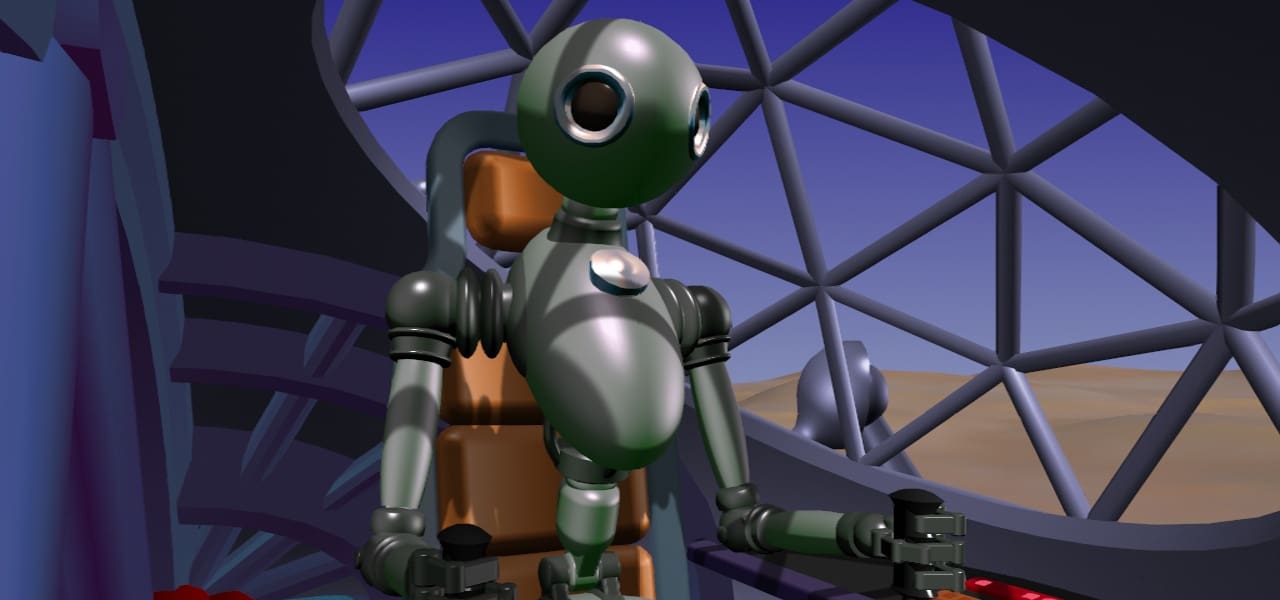
The collegiate mix of computer graphics boffins and artistically inclined animators, seeded by Schure’s financial resources, spawned innovations such as Alvy Smith’s 24-bit digital paint system Paint3, Catmull’s digital in-between tool Tween, Catmull and Smith’s Fill coloring program, and Smith and Edward Emshwiller’s eerie 3D short Sunstone. As resources blossomed, Smith recalls how Lance Williams’s arrival led to new creative experimentation that pushed NYIT beyond its initial attempts to digitally animate Tubby the Tuba and led to Williams’s proposal for a more ambitious science fiction feature, The Works, in which robots have overrun planet Earth.
Vintage video of Lance’s script, storyboards, and models is interspersed with archival clips of Dick Lundin’s 3D giant mechanical walking ant, a wonder in its day, and Rebecca Allen’s early rotoscope experiments adapting the human performance of dancer Twyla Tharp into digital kinematics. A secret visit to the lab by George Lucas and visual effects supervisor Richard Edlund, who sported an oversized Star Wars belt buckle, later led Ed Catmull and Alvy Smith to depart for California, where they co-founded the Lucasfilm Computer Division in 1979 and, seven years later, Pixar Animation Studios. On camera, Smith expresses guilt at having jumped ship from NYIT, but history was made.
By the 35-minute mark, the documentary reaches a full head of steam in the sad but fascinating tale of how Lance Williams saw The Works continue to grow, and how the undisciplined crucible of talent eventually spun out of control. We see unrealized robotic characters in sketch form, keyframe art, and wireframes, including Lundin’s giant machine ant, the film’s squat robotic hero Ipso Facto, Dick Lundin’s proto-steampunk title graphics, and the creation of the film’s only pseudo-human character, T-Square, which featured a woman’s face video-mapped into a mechanical spacesuit.
The decline and fall of NYIT is precipitated by artistic temperaments clashing with Alex Schure’s vision, as well as fear-driven ambitions to monetize the campus by courting third-party interests, including an eyeball-imploding Life Savers candy commercial, digital motion graphics, and swirling CG title sequences that were hugely popular in their day.
The NYIT swan song, an ill-advised feature film production, was heralded as a sequel to the Beatles’ Yellow Submarine, produced by Al Brodax, who also produced George Dunning’s 1968 animated Beatles classic. The NYIT project Strawberry Fields was started in 1984 and canceled eight years later, but is detailed with oddball clips from the hybrid CG/2D-animated movie directed by Dave Lubell, who comments on his task of shaping an overblown 300-page script into a montage of Beatles cover songs by artists including Cheap Trick, Cyndi Lauper, Michael Jackson, and Robert Palmer. Nobody was happy.
It’s a heartbreaking end to this wannabe Camelot of digital ambition, which shuttered in May 1992, as seen in lackluster video footage in which surviving members share gooey slices of a sheet cake depicting their studio. The final words are given to a pair of chatty animated digital emcees hosting the Max Headroom-like “DynaDigiDataVac” show, and to Lance Williams, who, in an archival presentation of NYIT’s achievements, noted that the studio was a magnet for talent celebrating “the genius of the human mind.”