.png)
The Strange Gravity Of Chris Sullivan’s Annecy-Bound ‘The Orbit Of Minor Satellites’
Stay informed with free updates
Sign up to get our news digest — delivered directly to your inbox twice a week.
Chicago animator Chris Sullivan has never been one to rush things.
His previous feature, Consuming Spirits, took roughly fourteen years to make and emerged like some warped transmission from the edge of industrial America: funny, wounded, handmade, strange, and full of people left alone with their damage for too long. In 2013, Sullivan was already talking about The Orbit of Minor Satellites. “Some ask me if Consuming Spirits is a hard act to follow,” he said then, “and I say no. It gives you faith when your strange and awkward Frankenstein’s monster reaches people.”
More than a decade later, the monster has returned in another form.
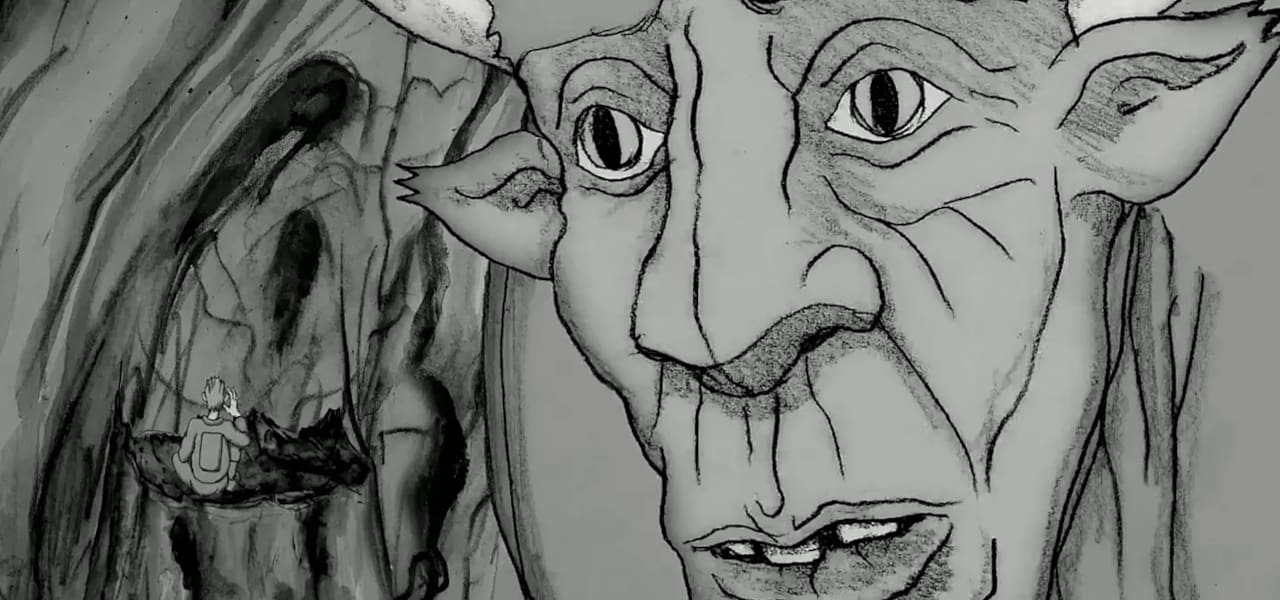
The Orbit of Minor Satellites, which premieres in the Contrechamp competition at this year’s Annecy Festival, is unmistakably Sullivan: hand-drawn animation, painted backgrounds, models, digital compositing, live action, old radio plays, psychiatric rooms, Cold War dread, family grief, Nancy Drew-like mysteries, and Boris Karloff as a talking buffalo. It sounds impossible because, well, it sort of is. A psychiatrist’s office sits beside, or inside, or around, a Soviet-American space station. A doctor and patient are trying to end a long therapeutic relationship. A woman grieves her dead sister. A Cold War relic drifts above a planet where the Cold War is no longer cold.
The surface story is about Derwood Richards, a psychiatrist, and Rosemary Hamm, his patient. Rosemary has lost her sister, Ruth, and is nearing the end of her time in Derwood’s care. That should be a triumph. Treatment worked, or worked enough. But Sullivan is drawn to the emotional residue of that ending: what happens when a relationship has been built, encouraged, paid for, structured, and then stopped?
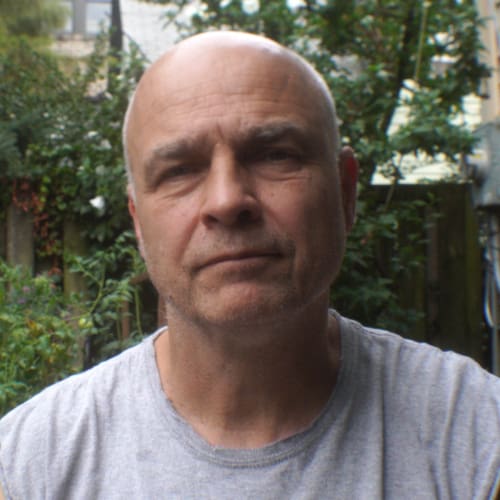
“I’m really interested in the idea that psychiatrists, much like teachers or doctors, have this kind of purchased intimacy,” Sullivan says. “But it’s still real. And what happens when it ends?”
As a teacher, Sullivan recognizes that unstable territory from another angle. Some relationships can shift into friendship. Others end, as they are meant to. “There is this sense of letting go of people,” he says, “and building this intense relationship that is designed to end. And that’s just kind of a very odd torture to give yourself and to give the subject of your care, and creative compassion.”
The origins of The Orbit of Minor Satellites reach back years, to a book Sullivan read called The Autobiography of a Schizophrenic Girl. What stayed with him was not the romantic cliché of madness producing genius, but something quieter. “One of the things about that book that I really liked,” he says, “is this woman didn’t grow up to be an artist or a writer, she just grew up to be reasonably sane.”
In the book, the young woman imagines a planet that governs her life. That private celestial body became one of the early sparks for Orbit. Another origin was closer to home. Sullivan’s sister Franny was born and died before he was born, killed by a truck in front of the family house in 1955. “It definitely haunts him still,” Sullivan says of the brother who had been watching her. “There’s definitely this part of him that’s permanently marked.” The history he lived through still shaped the house he grew up in.
From there, Sullivan began looking at accidental disasters involving children and families. Chicago kept coming back: the Iroquois Theatre fire, the Eastland disaster, and the Our Lady of Angels fire. Derwood, we learn early in the film, survived Our Lady of Angels. He is not simply the stable professional holding Rosemary’s illness at a distance. He has his own catastrophe in orbit.
The space-station story came from another childhood anxiety: the Cold War. “The idea of Russia, or USSR, depending on how smart you were at that moment, being at any point in a potential nuclear war was something that haunted my childhood,” he says. So he made the station a Soviet-American collaboration, a relic of an old dread now floating above a world where war has returned in another form.
For Sullivan, the station is also a kind of school. He intentionally made it resemble an elementary school, “our first introduction to this space where you go and live with strangers to become yourself.” In Orbit, the psychiatrist’s office, the halfway house, and the space station are all places built to contain people, guide them, and make relationships official. “As is likely to happen,” Sullivan says, “these things break down because of personal goals, or even the chemistry of personalities.”
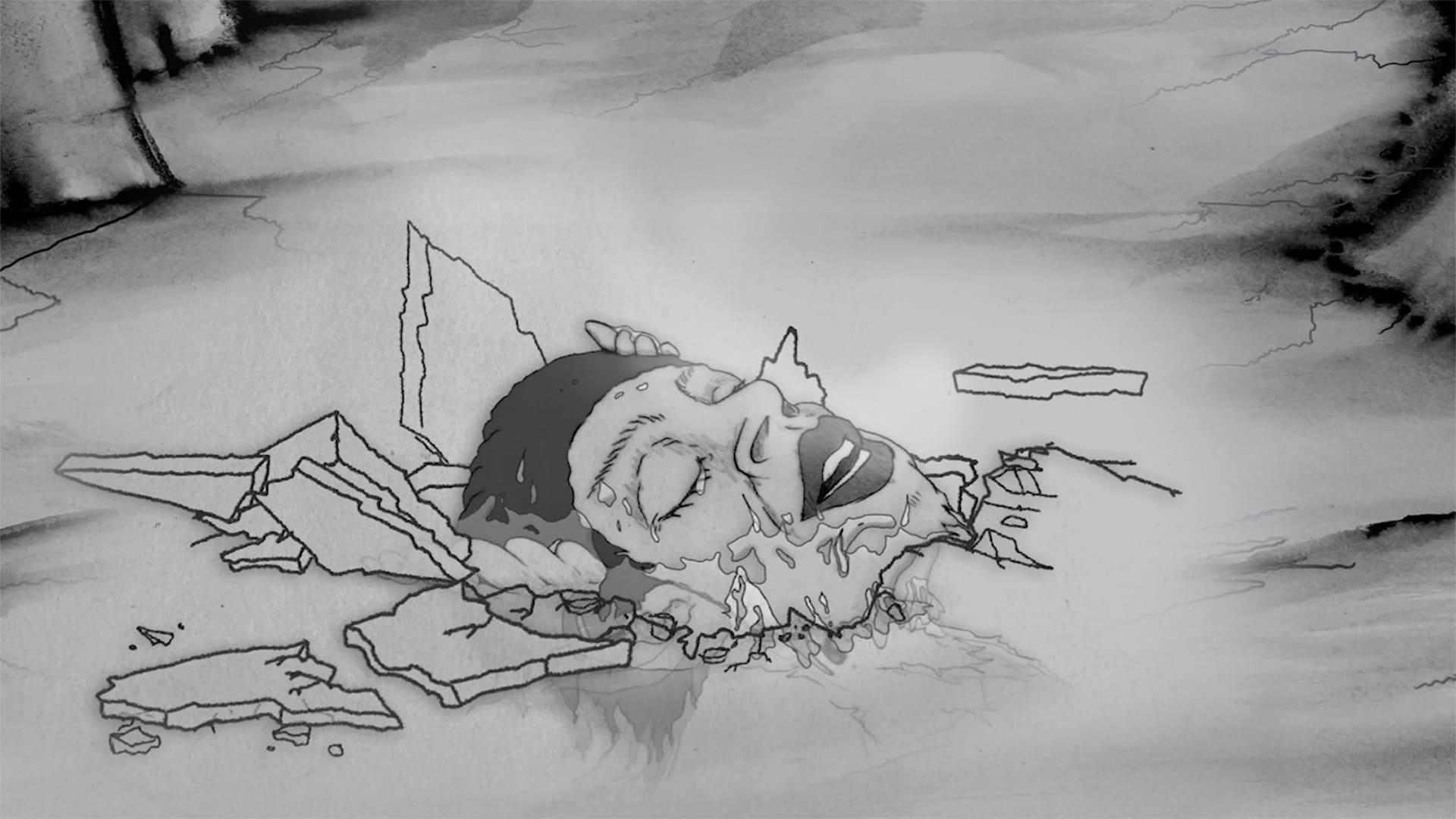
That breakdown is built into the film’s shape. Orbit does not unfold like a conventional story. It drifts and darts between voices, times, textures, and realities. Sometimes the film seems to unfold inside Rosemary’s mind. Sometimes it seems to come from Derwood’s writing life. Sometimes it is not clear who is imagining whom.
“I’ve always been interested in creating parallel narratives,” Sullivan says, “and stories that unfold without a kind of objective desire or straightforward three-act goal.” The fractured structure was there from the start, but it also came from the pressure of making a feature on limited resources. “You just run out of time making a film,” he says, “and you have to decide when the thing is visible enough for you to move on.” He calls Orbit “a three-hour idea” squeezed into a two-hour film.
After the largely cutout world of Consuming Spirits, Sullivan wanted to return to drawing. “I wanted to return to the 2D drawing,” he says, “but that also is a much slower process… But I do like something about the drawn line and something about the space that it creates that you cannot do with cutouts.”
The live-action passages were the bigger challenge. Silvia Abelson plays Rosemary, and T.J. Jagodowski plays Derwood. Sullivan considered rotoscoping them, but came to like the blunt presence of live bodies inside the animated world. “I ended up kind of actually really liking having these live-action passages in the film,” he says.
In a stairway scene, the characters shift from animation into live action, scrambling the film’s logic. “The idea,” Sullivan says, “is that the real world is animated and their private world is the live-action world.”
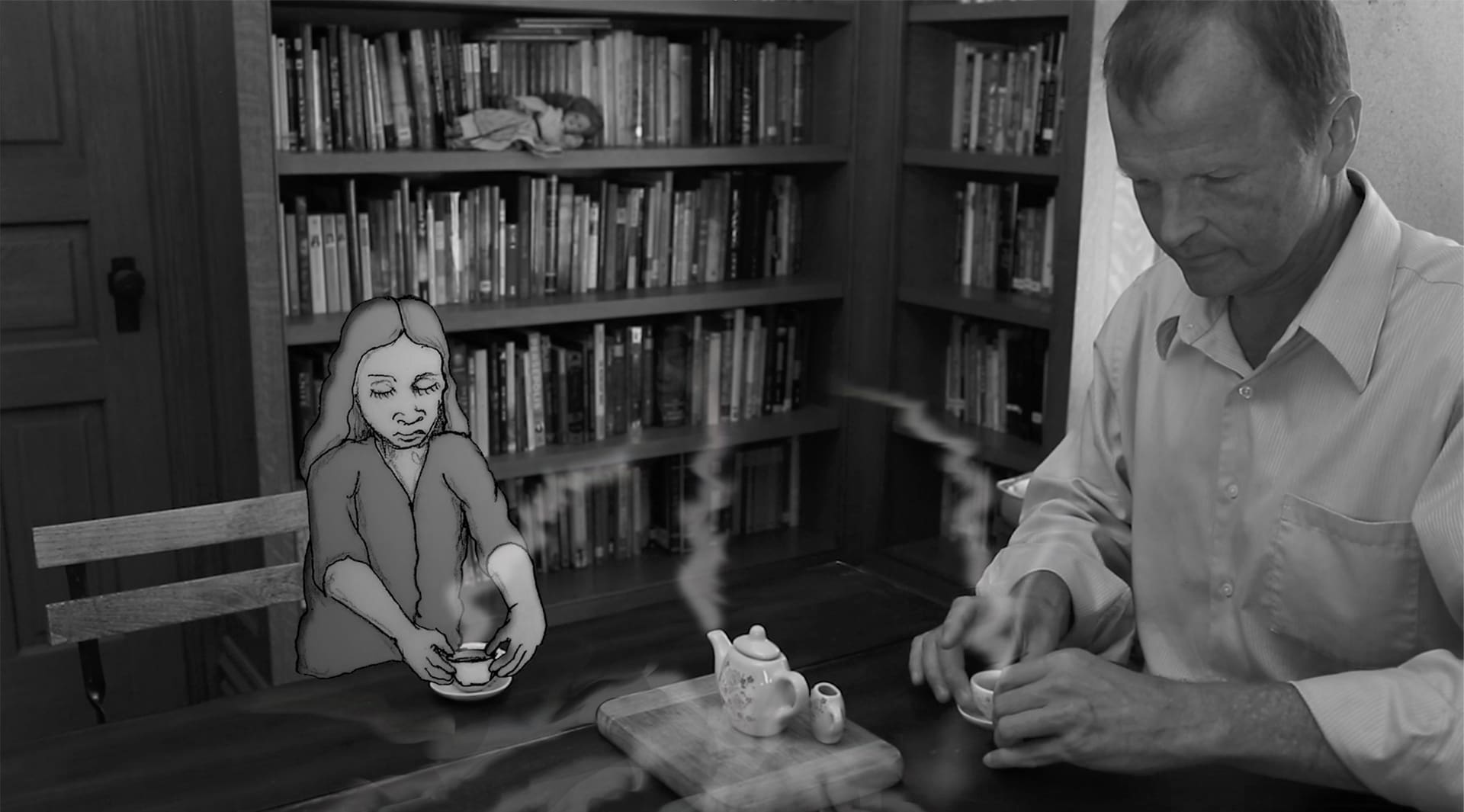
Derwood’s second life as a co-author of Nancy Drew-like books deepens the instability. Is Rosemary one of his fictional creations? “I think it’s obvious that Rosemary is the character of these books,” he says, “but that’s not completely articulated. And so I think that is a soft reality that is fine.”
The Nancy Drew element also gave Sullivan another useful contrast. “Nancy Drew lives in the world that we wish we lived in,” he says, “where it’s all adventure, no danger.” In those books, girls are sent into abandoned houses and threatened by bad men, but the danger stays tidy. In Orbit, that fantasy of safe peril sits beside accidents, fires, illness, war, grief, and the damage people actually carry.
That suspension of logic also explains the buffalo. Sort of. Sullivan had drawn a giant buffalo on the planet and realized it looked like Boris Karloff. “It was a totally weird accident,” he says. “I had this buffalo, I was listening to these old radio plays, and suddenly I saw this little frame, and I was like, oh wait, this buffalo kinda looks like Boris Karloff.”
He tried one of Karloff’s lines against the image and, as he remembers it, “it magically synced up.” From there, Sullivan began writing scenes around Karloff’s existing dialogue, often pulled from radio stories of haunting, murder, remorse, and guilt. “A lot of these plays are about murder or haunting,” he says, “but they worked really well for me to be about shame and guilt, to have caused harm.”
For years, he built the film without knowing whether he could use Karloff’s voice. He eventually contacted Sara Karloff, Boris’s daughter, who controls her father’s visual and audio rights, and explained that most of the material came not from the famous horror roles but from radio performances. He framed it as a tribute to a part of Karloff’s acting that people rarely focus on. Her reply stunned him. “Your email took my breath away,” she wrote, before giving him her blessing.
The handmade quality of Sullivan’s films is often treated as a signature, and it is. He likes paper, scanning, texture, boiling cycles, physical space, and the feel of a world made by hands. But some roughness comes from limits. “I have to finish this thing,” he says, “and these are the nails and hammers that I have.”
He works from what he calls “a liberal script.” Some parts remain. Others bend as the film grows. “I let things enter into the narrative,” he says, “which is one of the things that makes things take way too long. And that is both a blessing and a curse of my process.”
The long production came from funding, labor, and temperament. Sullivan did not have a big studio crew. But the other reason is that he thinks like a writer. “You write a page, and, oh, I like all these words,” he says, “and it’s like, oh, wait a second, that’s six minutes of screen time.” He knows this is not efficient. “I don’t recommend it,” he says. “Perhaps it’s like people who fish with their hands.”
What does he hope audiences leave with? Not a solution, exactly. More like a release.
“I hope that they get a sense of forgiving themselves for being survivors,” Sullivan says, “and also forgiving themselves for being the person they ended up being instead of that magical human they thought they were going to become.”