
Meltdown Memories: ‘When The Wind Blows’ At 40
Stay informed with free updates
Sign up to get our news digest — delivered directly to your inbox twice a week.
In 1983, animation producer John Coates issued a one-page pitch for a new project developed with executive producer Iain Harvey. The document was typed beneath the sweet, fuzzy letterhead of “Snowman Enterprises,” the then-current name for TV Cartoons’ production wing, which had recently produced the Oscar-nominated animated short based on Raymond Briggs’ illustrated children’s book, The Snowman. The plan, this time, was for a much darker, feature-length adaptation of a 1982 Briggs creation.
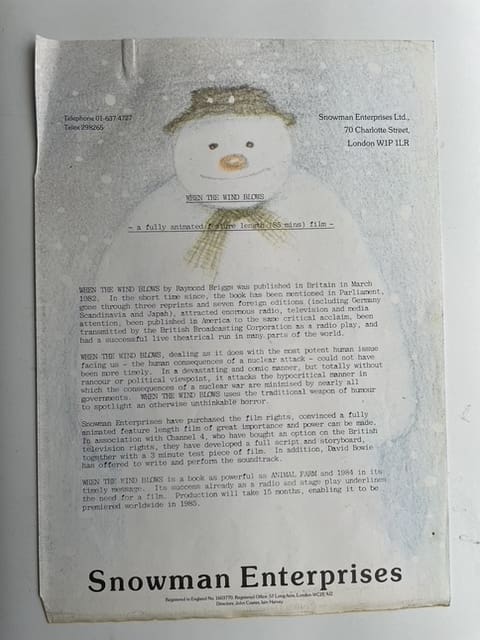
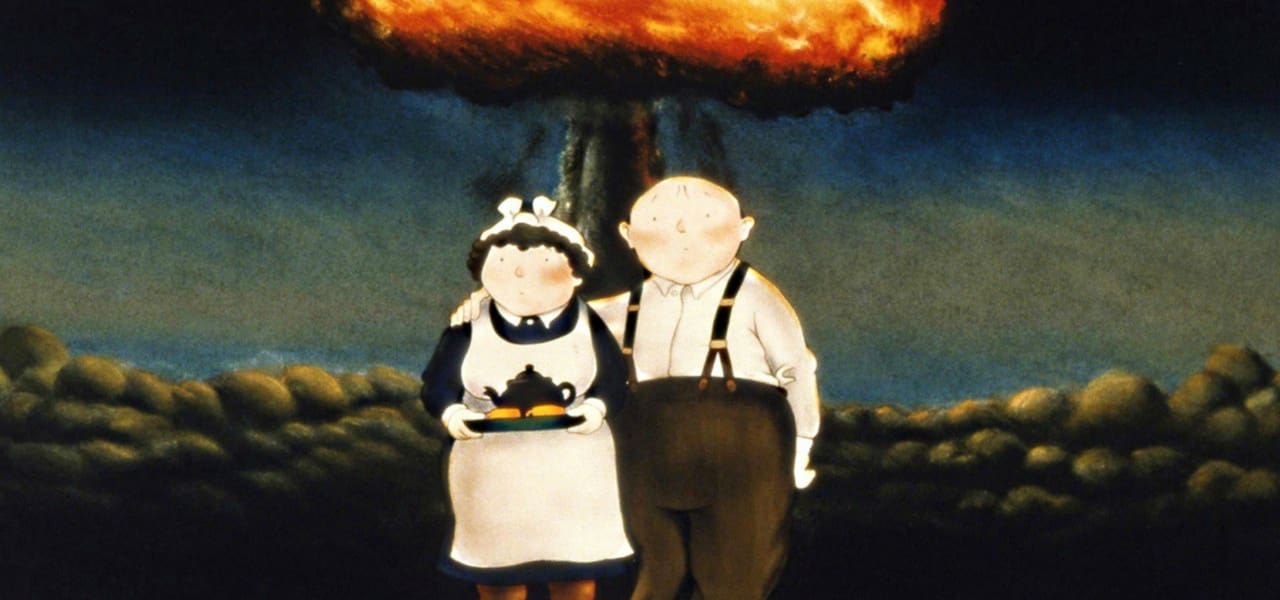
When the Wind Blows was a deadpan, adult-themed comic strip about a homey elderly couple, Jim and Hilda Bloggs, experiencing a nuclear attack. As outlined in the pitch, the 85-minute film dealt with “the most potent human issue facing us—the human consequences of a nuclear attack.” The pitch went on to describe the tenor of Briggs’ vision: “In a devastating and comic manner, but totally without rancor or political viewpoint, it attacks the hypocritical manner in which the consequences of a nuclear war are minimized by nearly all governments.”
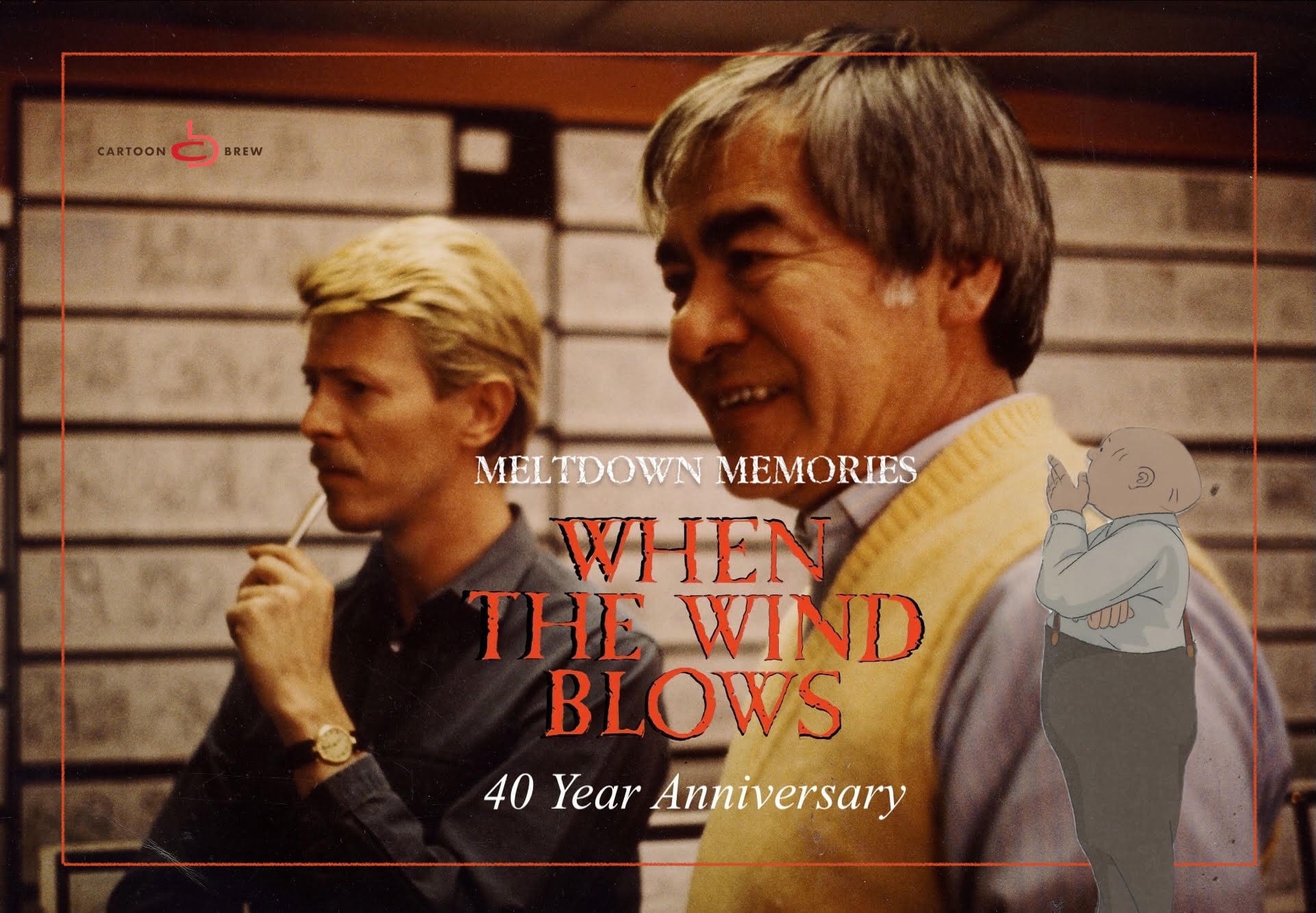
To direct the film, Coates enlisted his longtime collaborator Jimmy T. Murakami. The stout and silver-haired Japanese American, Oscar-nominated for his 1967 animated short Breath, had been supervising director of The Snowman (with Dianne Jackson), director of TVC’s “Soft Landing” opening for the animated sci-fi film Heavy Metal (1981), and director of Roger Corman’s live-action Star Wars/Seven Samurai mashup, Battle Beyond the Stars (1980).
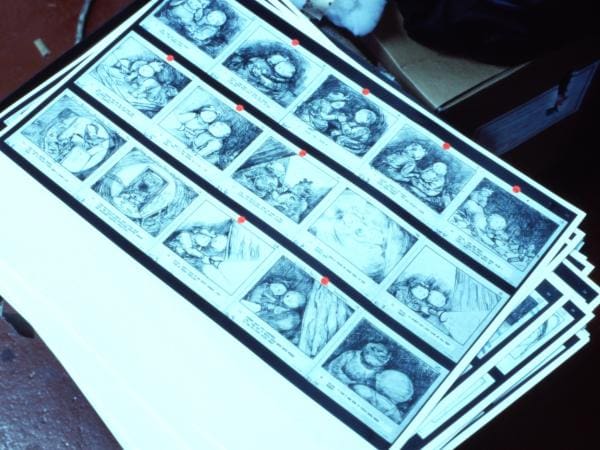
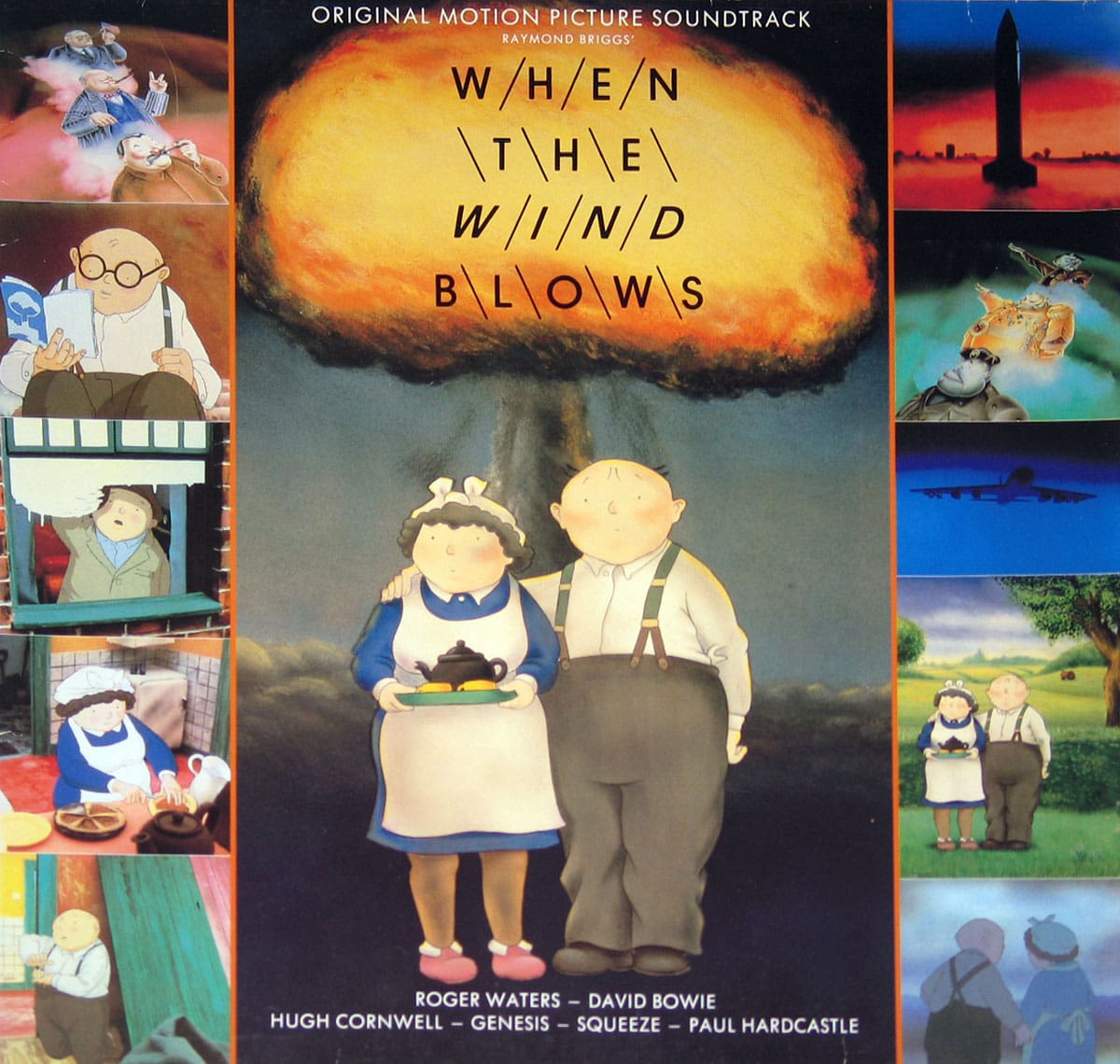
Murakami was drawn to the dark wit and trenchant themes of Briggs’ book. Working from Briggs’ screenplay, Murakami roughed out storyboards, and TVC produced a three-minute test. Murakami proposed a bold visual treatment. Inspired by Fleischer Studios’ “Stereoptical” or “setback” process—developed nearly four decades earlier for Betty Boop, Popeye, and Superman cartoons—the film physically layered hand-drawn 2D cel animation over stop-motion-animated 3D model backgrounds.
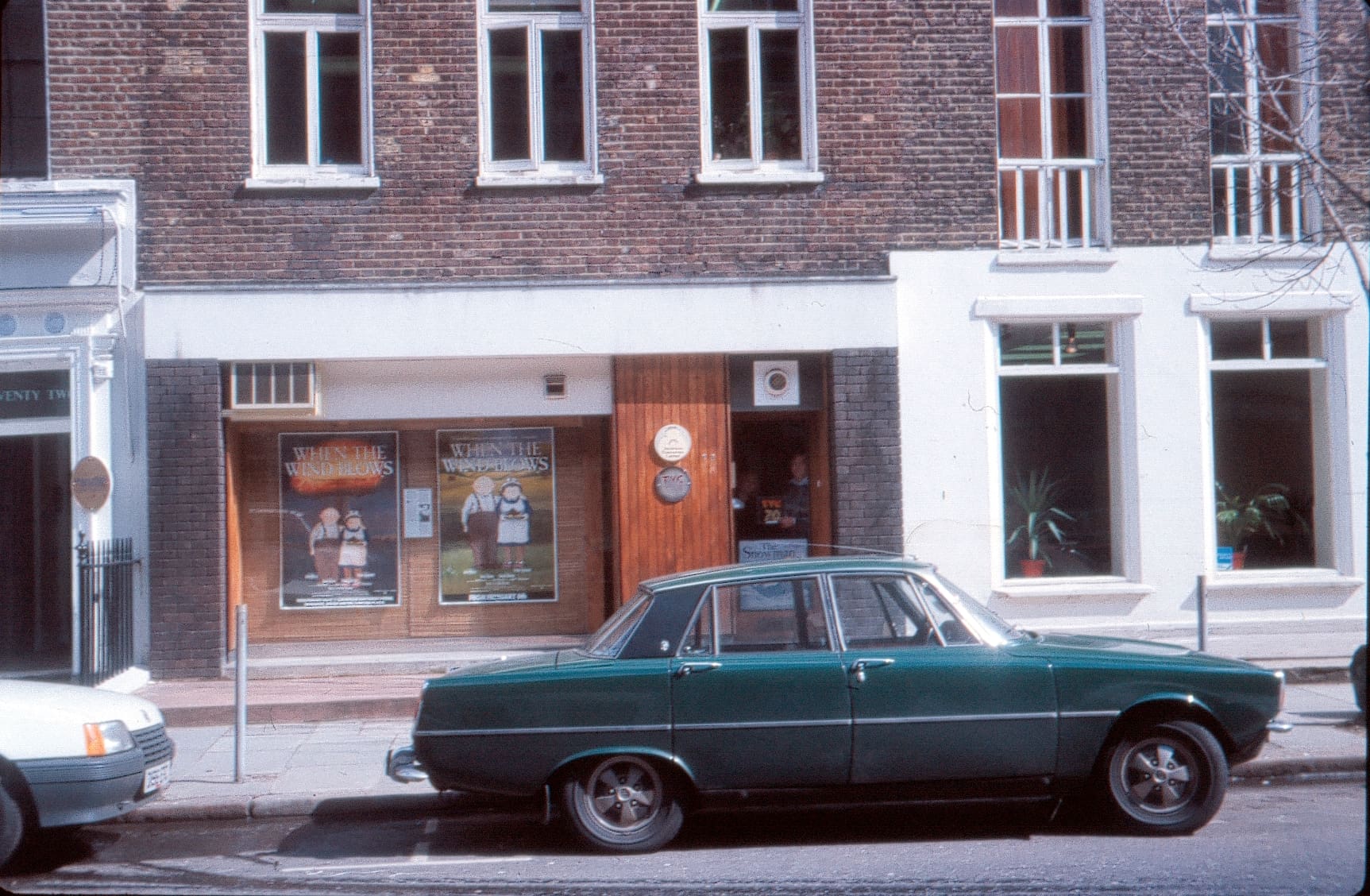
When the Wind Blows went on to win the Grand Prix at Annecy in 1987. Briggs, Coates, and Murakami are no longer with us, but their work went on to achieve cult status and still lives today in TikTok memes. To mark the 40th anniversary of the film’s U.K. release on October 24, Cartoon Brew persuaded one of its staff writers (who toiled in the When the Wind Blows cutting room) to hunt down other survivors of TVC’s animation crew. Read on, in this special two-part story, to learn from animation art director Richard Fawdry and then-animation assistant Paul Donnellon (now co-founder of Voodoodog) what went down at Meltdown Productions.
Part One: Backgrounds
Cartoon Brew (Joe Fordham): Richard, you wore many hats at Meltdown, including animation designer, layout designer, storyboard artist, and art director with Errol Bryant. How did you get started at TVC?
Richard Fawdry: I joined TVC in 1979. It was my first job out of college. I did a little animation on Heavy Metal, and I was working on a show called Castles (1983) when they made The Snowman. That was exciting to watch because it was evident Snowman was going to be really good. Toward the end of that, I did some uncredited rendering—I’m not going to say which bits because my work was horrendous [laughs]. They were so desperate at the end to get it done, they let anyone work on it.
Was that your doorway into When the Wind Blows?
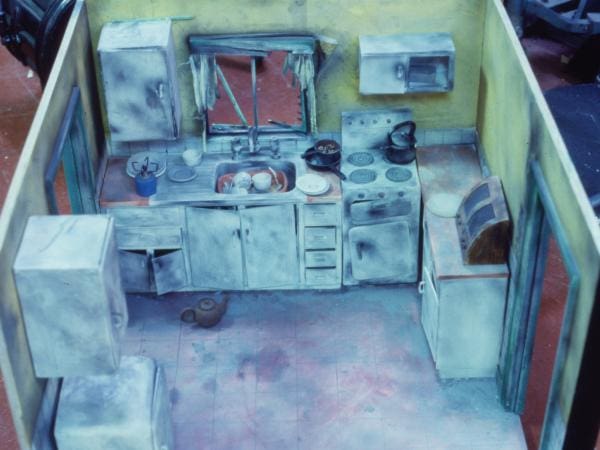
Fawdry: That’s right. I did cleanup on Jimmy’s storyboards. I then went away for a year to get married. I was on an island when I got a phone call to come back. That’s when they announced how they were going to shoot the backgrounds. Before I went away, I’d done a plan of Jim and Hilda’s house to help with traditional painted layouts. When I returned, I discovered that someone must have found that handy as a starting point for the model backgrounds.
What was it like working with Jimmy Murakami?
Fawdry: Out of all the directors I’ve worked with, he was the most enterprising with all the different techniques that he came up with for the film. He was very easygoing, but he knew what he wanted. He was in control all the time. And he was quite firm.
Paul, you met Jimmy when you were at school in Ireland. How did that happen?
Paul Donnellon: Jimmy had a studio in Dublin doing commercials. I was at the Institute of Art, Design and Technology, the only one doing animation on their graphic design course when Jimmy visited as a lecturer. I became his stalker. For a year, I worked for free at his studio, helping out in my spare time, and I used to go on shoots. When I graduated from IADT, Jimmy took me to London. It was my first job. I’d never been to London before. It was mad, in crowded Soho.
How did the idea of shooting miniature backgrounds come about?
Fawdry: Well, Jimmy did that lot. On Heavy Metal, he directed the opening sequence with a car falling down from space, where he shot a live-action car. As a live-action director, he liked to set up a camera. So, even though the house was in miniature, he set up all the scenes how he wanted.
Donnellon: He also told me he loved the Fleischer Superman cartoons from the 1930s that had real model sets. That influenced him, I think.
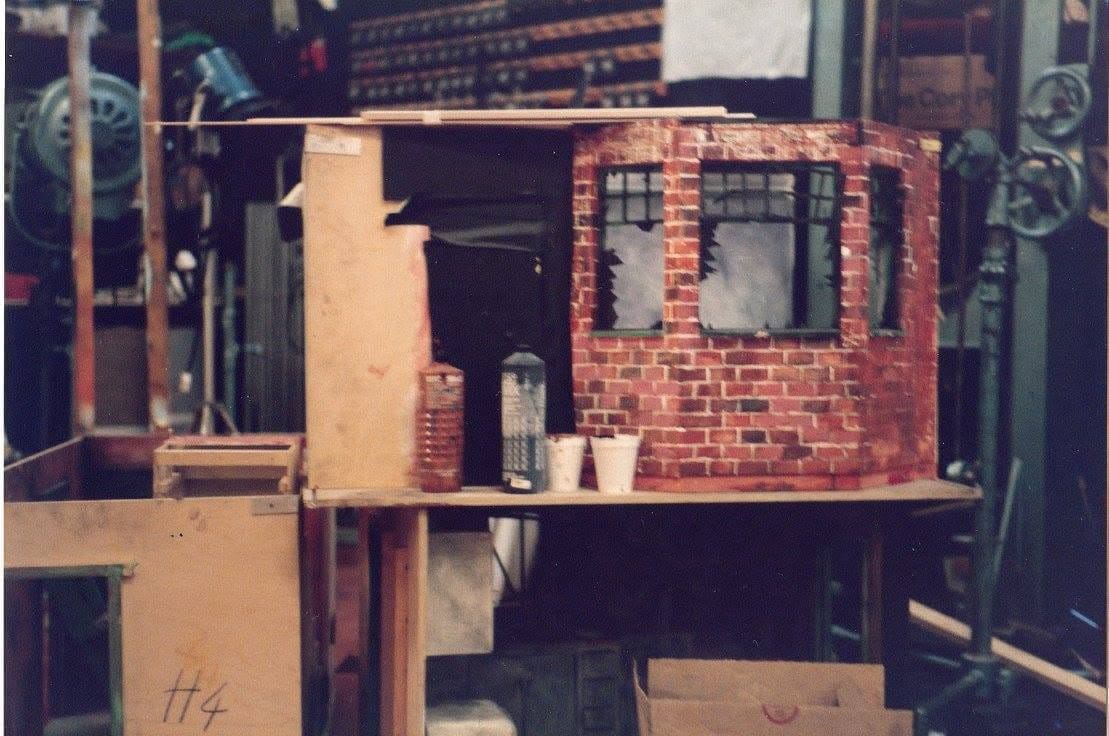
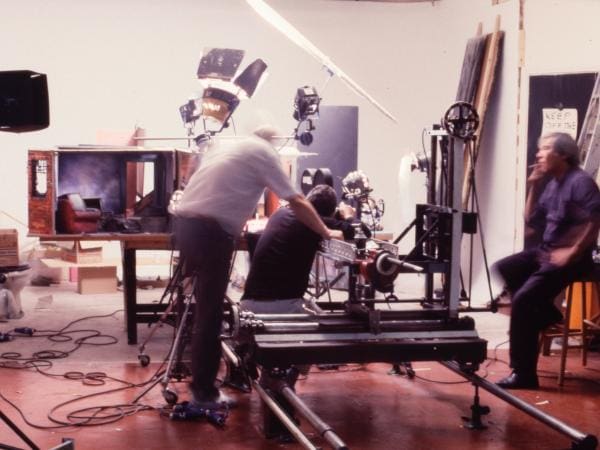
The “A.R.S.” photo-background process has been well documented—with Peter Turner and lighting director Ken Friswell on the model shoot, making 17,000 glossy, 12-by-10-inch 3M prints pin-registered for Peter’s rostrum camera at TVC. What do you remember about that—and was “A.R.S.” really an acronym, or Pete’s rude joke?
Donnellon: [Laughs] I don’t know. Martin Howard was the photo man who used to come into TVC. He organized all the printing.
Fawdry: There was a cost consideration to that. I remember it was going to be £100 or £500 per [painted] background, and when they added it up, doing the photo prints was £75,000. So, it was half the price to print photo backgrounds.
Donnellon: They printed black-and-white Xeroxes of the photographs so the animators wouldn’t ruin them. We ended up getting Xeroxes punched and registered for each background. The line tests all had Xerox backgrounds of photo plates, which gave them a “Xeroxey” look with the line test on top.
Fawdry: Yes, that was important for moving shots.
Did either of you attend the miniature shoot?
Fawdry: I visited once. All I remember is they had some really nice food.
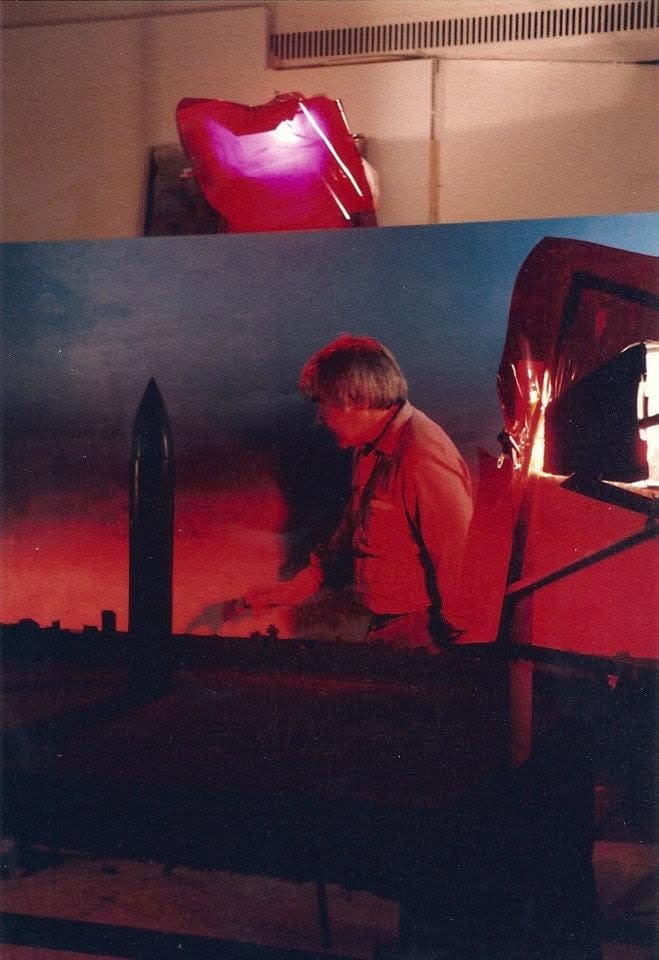
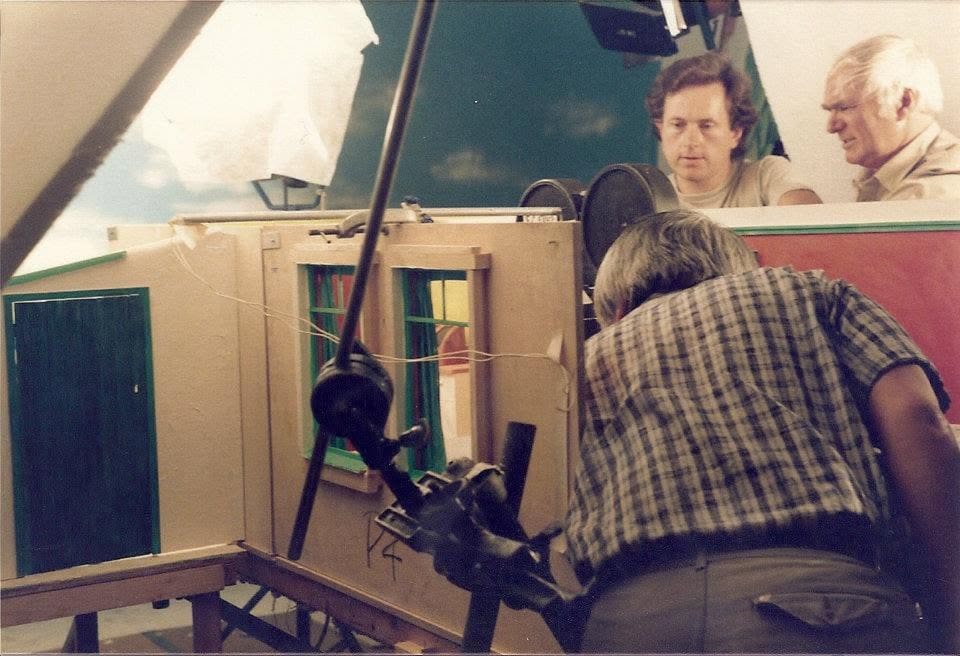
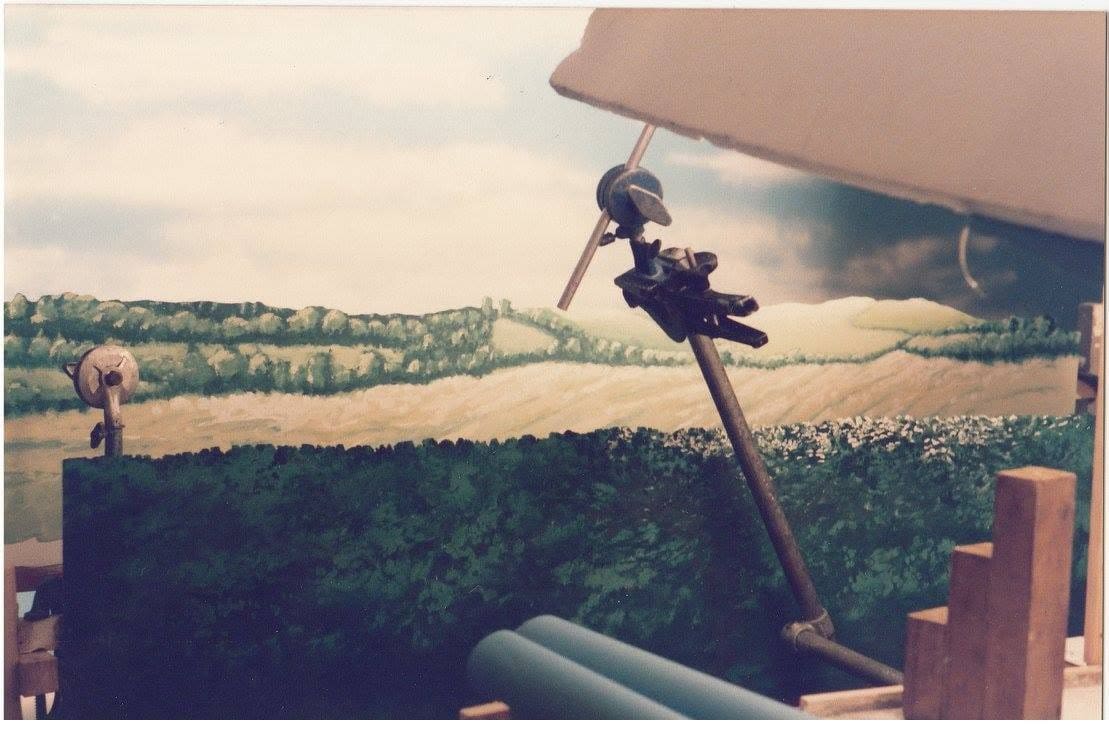
Donnellon: Oh, yeah, they had a buffet, and [production coordinator] Anne Goodall was there. Jimmy took me because I was his assistant. We spent ages there [10 weeks]. It was interesting because they had the model on a big turntable. To get a moving shot, they rotated the set frame by frame. It wasn’t motion control. It was an ancient [hybrid Bell/Mitchell] camera from 1916.
Who built the miniatures?
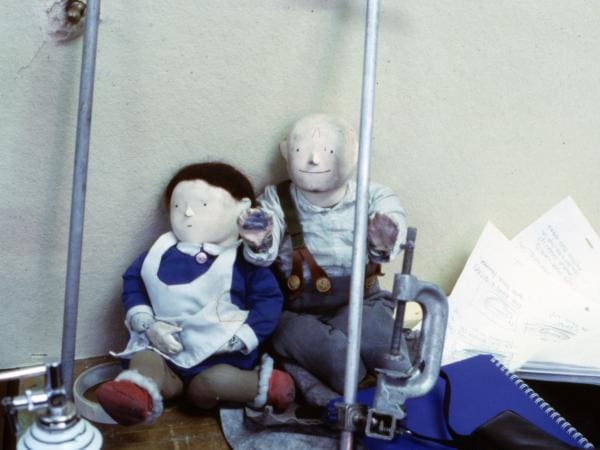
Fawdry: That was Errol Bryant. I went to his house while he was building those. His whole house was full of models that he was making. My friend Joan Ashworth made little stuffed dolls of Jim and Hilda [used for blocking].
They also had models for interstitial scenes of a B-52 bomber, an ICBM rocket, and a nuclear submarine—did Errol make those, too?
Fawdry: Yes, he made all those. I remember when they brought back that film—it was either the bomber or the submarine—it came up to camera, it looked really good—and then it went bonk on the camera lens. They were really well made.
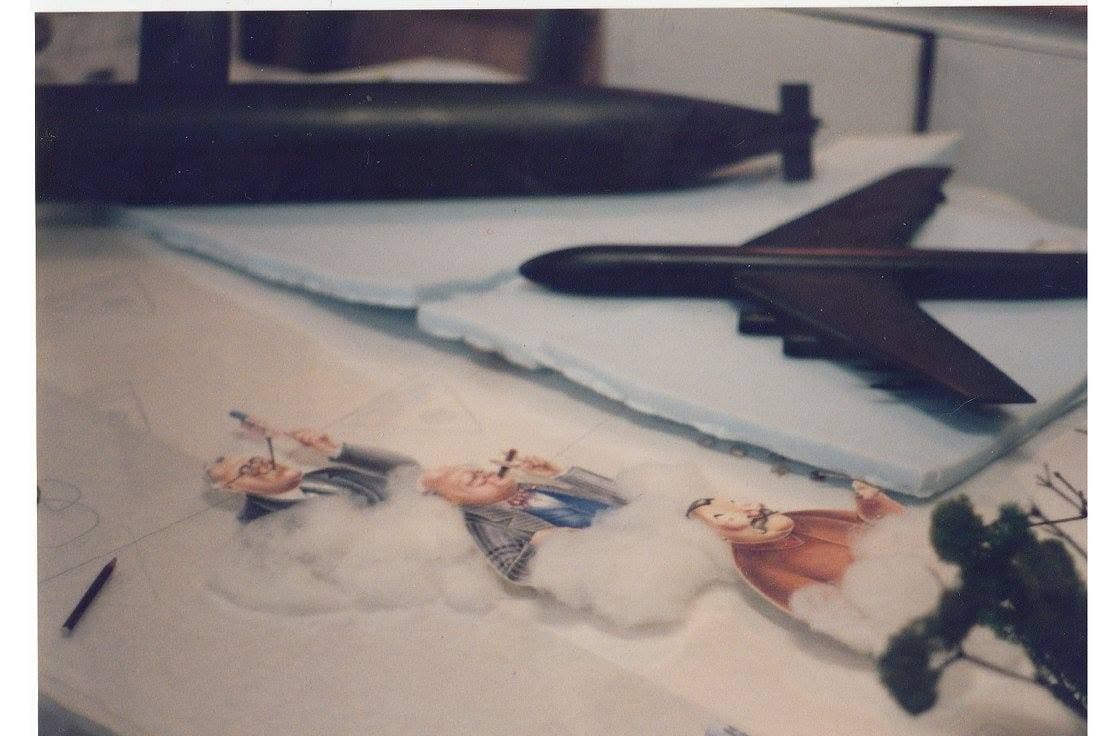
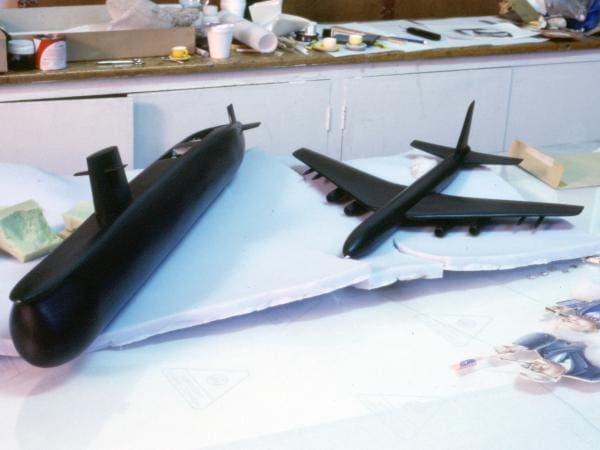
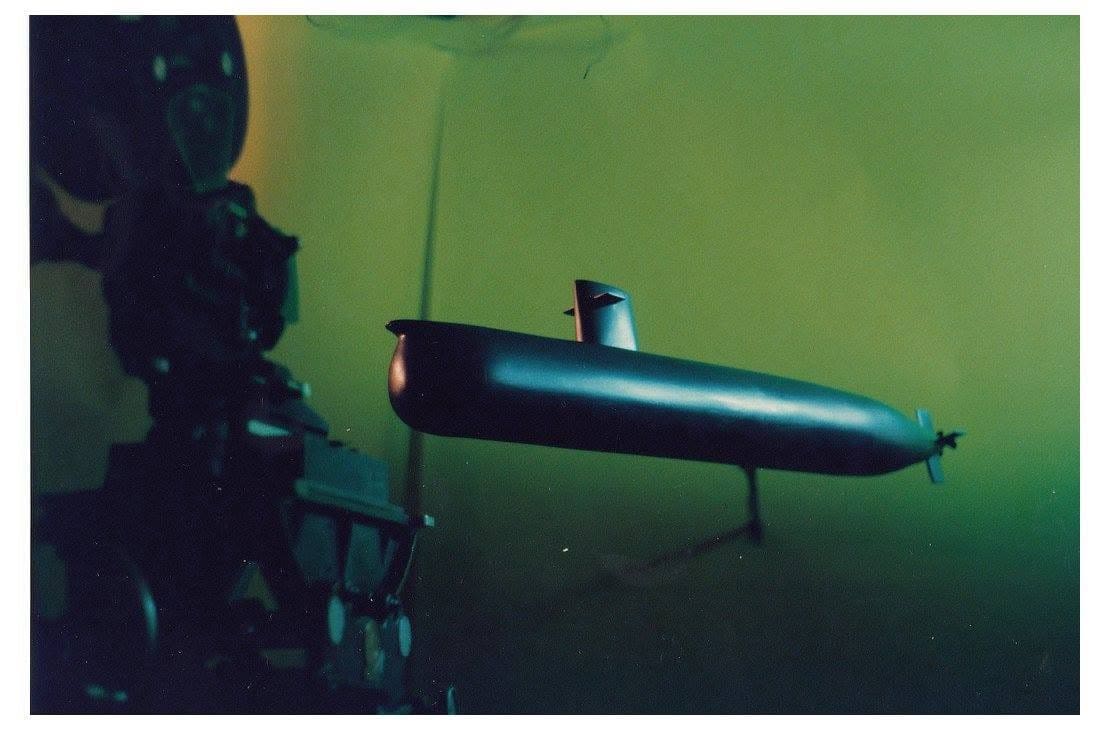
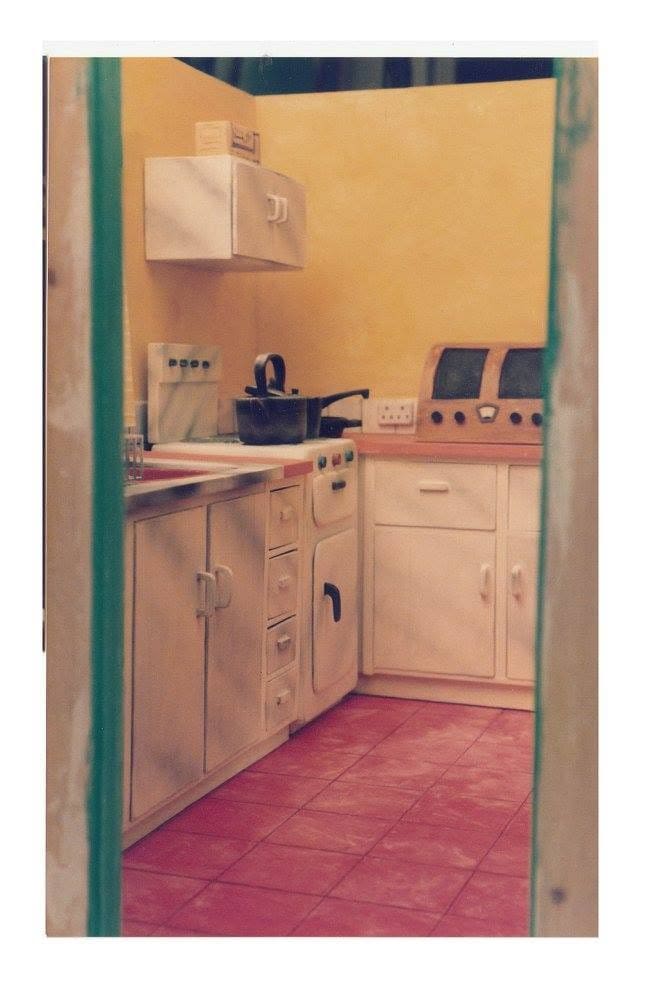
I was impressed by how the house had a painterly finish like Raymond Briggs’ drawings. Was that Errol’s doing?
Fawdry: Yes. That was a huge amount of work. I believe Errol had some help, maybe from his wife, and he sent away for details like cutlery. He was also a background artist [on this film, Heavy Metal, and Watership Down (1978)].
Part Two: Animation
To appreciate how this 40-year-old movie was made, we should note that every frame of Jim and Hilda was hand-drawn and painted—correct?
Donnellon: Yes. It was all inked by hand, wasn’t it, Richard?
Fawdry: Yes, we had lots of inkers at TVC. And the characters were animated on twos.
Were the model backgrounds also shot on twos?
Donnellon: Yeah, they shot the model on twos, but then they printed every second photograph to save money on the prints. Except panning shots and camera moves [characters and backgrounds] were animated on ones, weren’t they, Richard?
Fawdry: They had to be; otherwise, they’d strobe.
TVC had a superstar lineup of animators. Back then, I was surprised by how many Canadians there were. They were a great bunch, but how come?
Donnellon: Sheridan [College in Ontario] was the best animation school at the time. I now think Gobelins [School of Imagery] has the lead in Paris; they have trained so many really good animators. Jimmy was always moaning about U.K. animators. He liked Canadian animation because it wasn’t clichéd, or he thought they had more acting ability—I don’t think that was necessarily true, but Jimmy thought that way.
Do you recall who animated which sequences?
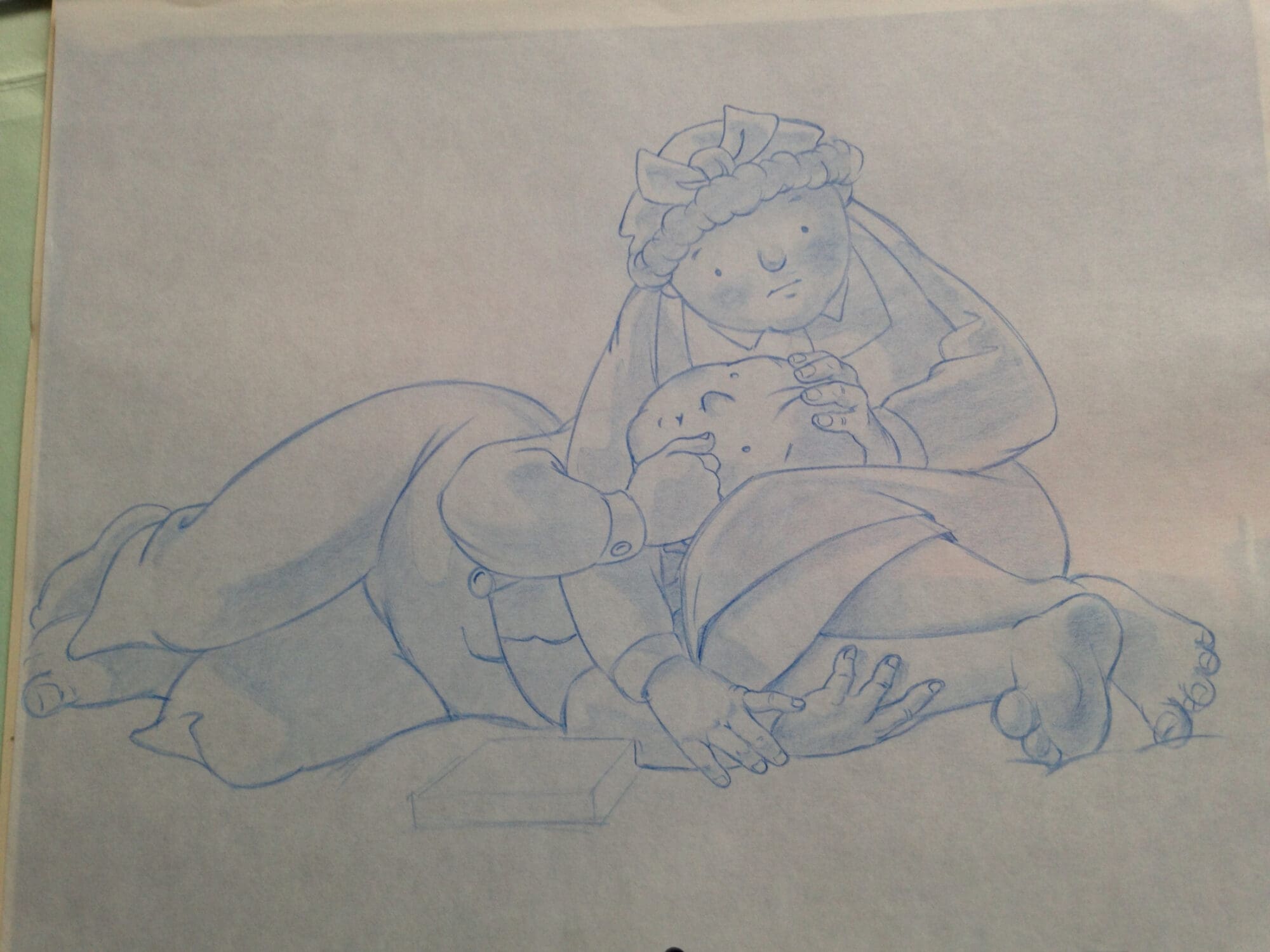
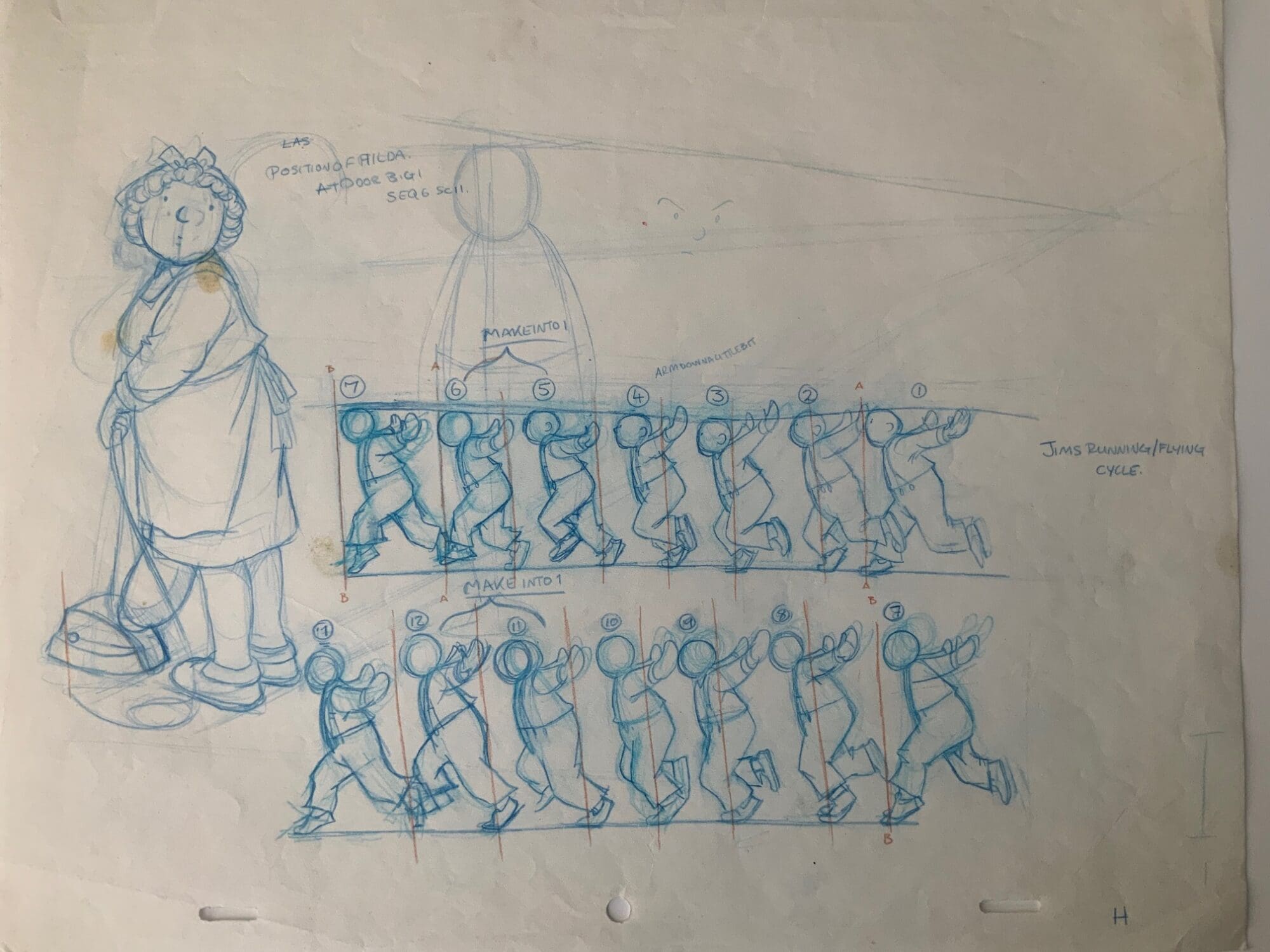
Fawdry: Yes, I made a list. Malcolm Draper did the early scenes in the bus, and with Jim at home with Hilda [saying “Crumbs!”] at the threat-of-war announcement. Dave Unwin did Jim painting the windows, which I thought was lovely. Tony Guy did a lot of wonderful work with Hilda ironing and saying, “It’s going to be drafty with no doors.” He was animation director on Watership Down, a really good animator.
Donnellon: Who was the man who developed his line tests in a bucket? And he lived in Stroud?
Fawdry: Dave Unwin and Tony Guy lived there. But I believe you’re thinking of Harold Whitaker. He did scenes just after the bomb. Harold was probably one of the best animators ever. He worked on Animal Farm (1954), and he wrote a textbook on animation [Timing for Animation, co-authored with John Halas in 1981]. His timing and acting were the best.
Bill Speers was another Canadian. He lived on a barge at Canary Wharf. He did the scary scenes just prior to and including the three-minute warning—from Jim saying, “Who’s in charge now?” to Hilda saying, “The cake will be burned.”
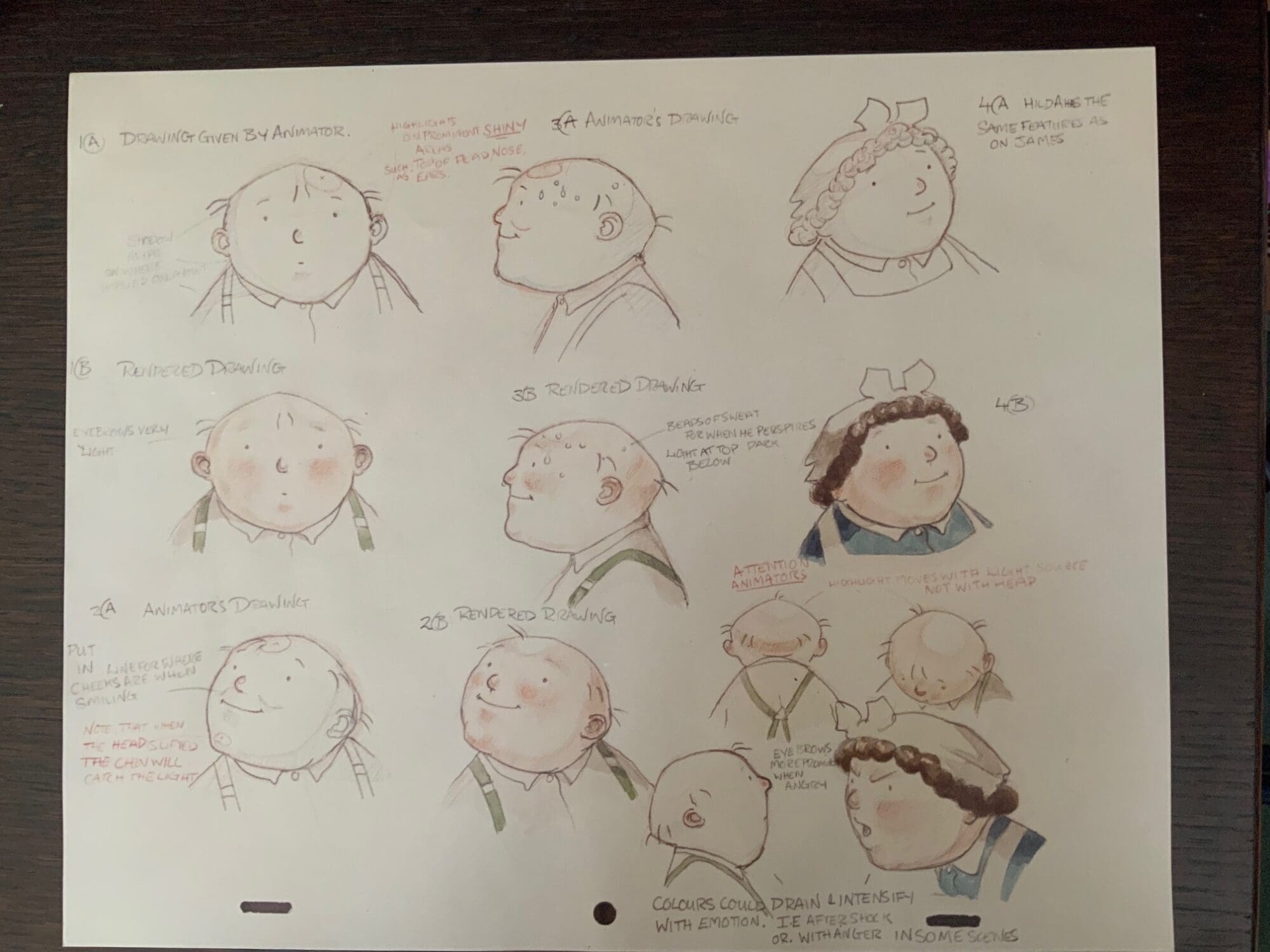
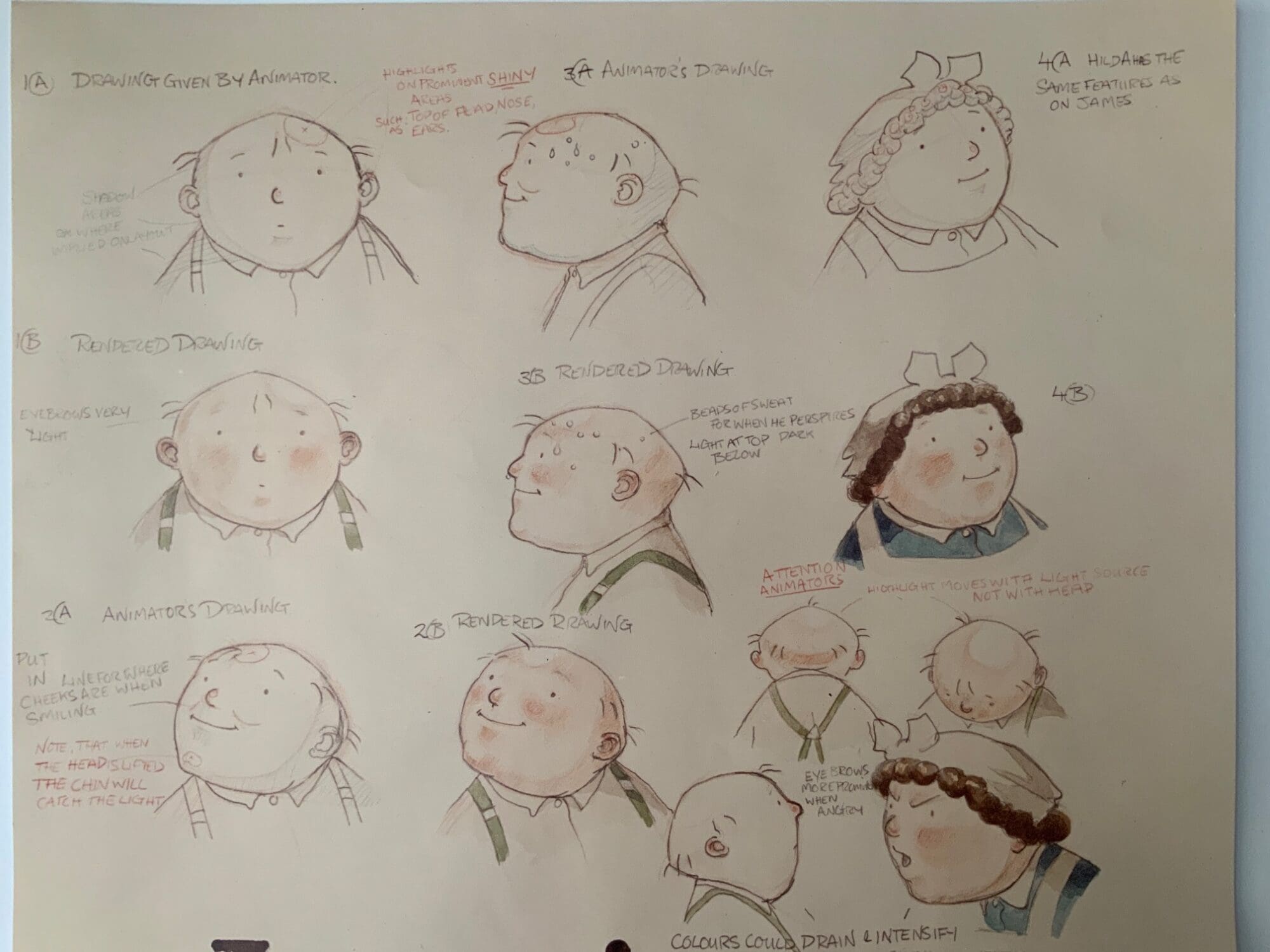
John McGuire was Australian and did scenes of Jim and Hilda in the shelter. He had the derring-do attitude of an adventurer, a buccaneering spirit. He got me the job at TVC, actually. And then, when I was still at college, he asked me to design some characters, and he left the country before he paid me! [Laughs] But he came back and paid me what he owed me. There was a rumor he was sick. I remember his assistant, who was also a Canadian, told me John was worried about his health. As it turned out, sadly, John died of cancer.
Was it John McGuire who made that fantastic dessert for the TVC Christmas party? That trifle had more rum in it than trifle!
Fawdry: Yes, that was a proper trifle.
Donnellon: I remember Roger Mainwood. He went on to direct Ethel & Ernest [the 2016 animated feature from Raymond Briggs’ memoir].
Fawdry: That’s right. Roger animated the very first scenes with Jim reading the newspaper in the library and coming back from shopping to buy a set square to measure the angle of the “inner core or refuge” [bomb shelter]. Hilary Audus did scenes where Jim walks up the pathway to the house and inside their hallway. Jo Harrison—née Fryer—did exteriors with Jim and Hilda walking in their garden before and after the bomb [and Jim as a truck driver in the Blitz, with other scenes by Michael Salkeld and Vanessa Clegg]. And Stephen Weston was a fantastic animator. He did the bomb blast.
Steve also did the flying sequence on Snowman, but the bomb sequence was something else. It was extraordinary how Steve animated geometric objects. Do you know how he did that?
Fawdry: He used models so he could turn them around [for perspectives]. I remember the models were plastic because he used one as an ashtray. Steve worked at the top of TVC, up in the attic, and at some point he stubbed a cigarette out in his model and it started a fire [laughs]. He used to blow things up. He filmed lots of explosions as reference for the bomb. Or maybe that was an excuse! He did that with [TVC in-house film editor] Taylor Grant. They enjoyed themselves.
It surprised me when they rendered that bomb sequence with a raw, scratchy quality—what inspired that choice?
Fawdry: It was something to do with [documentary] footage they had of a nuclear explosion. They took that as reference for the effects of the blast on houses, trees, and other things. At least, that’s how it looked to me. And then they rendered it to show the tremendous heat in the blast.
Donnellon: Yeah, they shaded that on paper, Xeroxed it onto cels, and then they rubbed bits off the cels to distress it. I remember Steve doing something with a Brillo pad [dishwashing scourer] to scratch up the surfaces.
Fawdry: That’s right. But no sheep were hurt in this film.
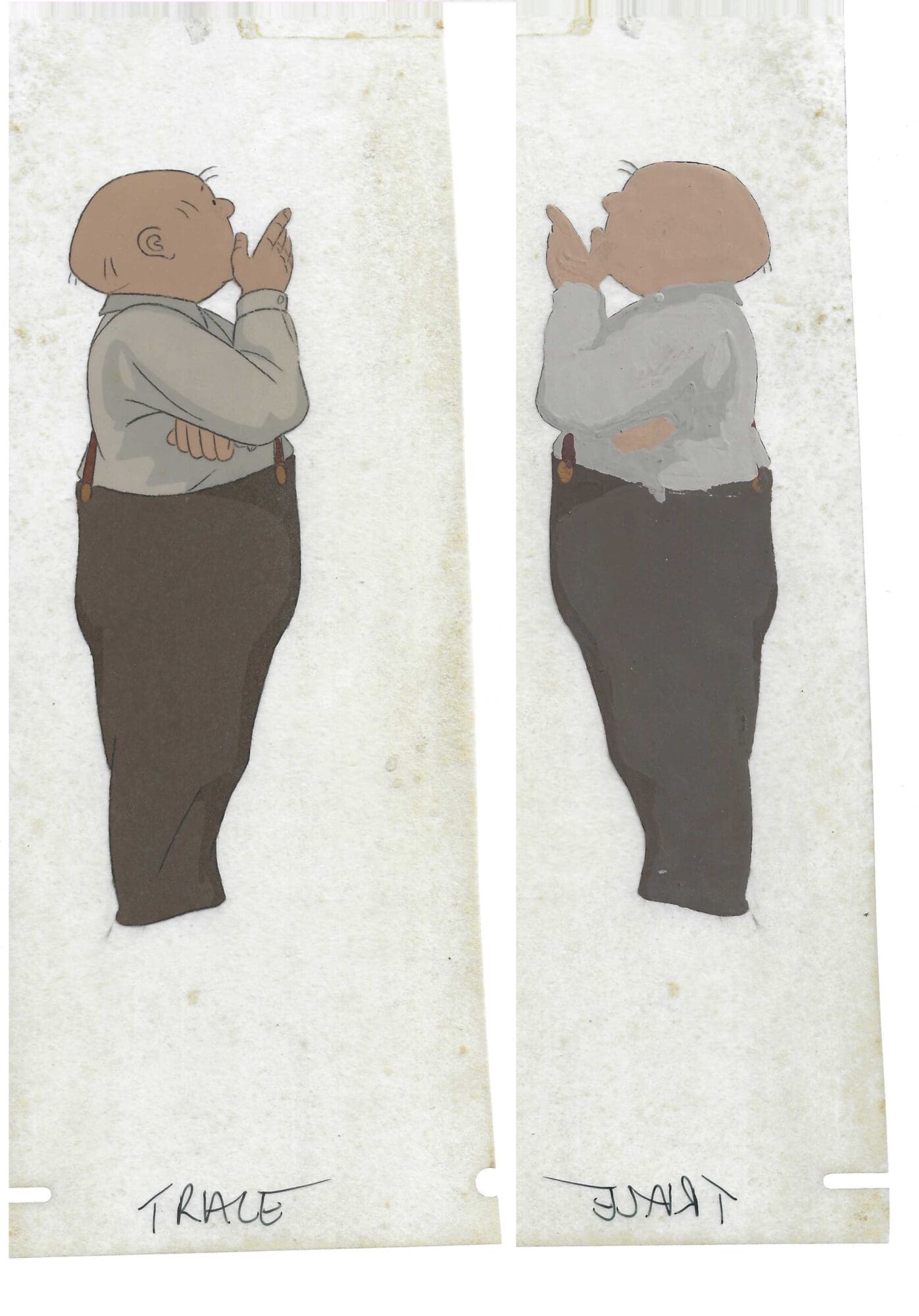
When the blast hits, you had a fantastic sequence, Richard, that I always thought was so quintessentially you—where Jim and Hilda’s old wedding photos come alive in a sweet and nostalgic way. How did you translate that from Raymond Briggs’ drawings?
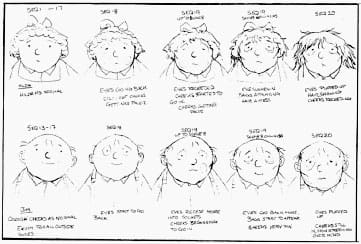
Fawdry: That sequence wasn’t in Raymond Briggs’ book. It was another of Jimmy’s inspired ideas. He briefed me verbally with a quick outline, no drawings, and I went ahead and drew Jim and Hilda’s past, trying to keep to Raymond Briggs’ style. Loraine Marshall [and Milly McMillan] then rendered that to look like old photos.
Donnellon: You also animated Monty [World War II Field Marshal Bernard Law Montgomery]. Was he in that sequence?
Fawdry: Oh, I animated Monty for another scene. I did that after I finished all the animation layouts. And, of course, you worked on the Russian with Joe Ekers.
Donnellon: Yes, bursting through the door. I did all the inbetweens on that.
Paul, I know you were close with people in the layout team, weren’t you?
Donnellon: Oh, yeah. Giorgio Mardegan, John Watkiss, Dassos Petrou. Das had a blazing row with Jimmy about three-point perspective. They argued for ages about some technical Renaissance idea of perspective—both were correct, but using different terms. John Watkiss did storyboards and layouts. He was too good an artist to draw Jim and Hilda as pinheads, so in his drawings he gave them proper skull shapes. John did concept work for Disney’s Tarzan (1999). He was also a very famous comic book artist [The Sandman (1992)]. He was 55 when he died.
Dianne Jackson—who also sadly died too young—had another highlight of the film: Hilda’s dream, which showed Hilda’s inner life of naughty little cherubs. Do you remember how she animated that, and were you part of that, Richard?
Fawdry: No, that was all Dianne’s. Jimmy was quite surprised when he got that back. He asked her about it, and she said, “Oh, you wouldn’t understand, you’re not a woman.” It was very personal to her. She did that by drawing straight onto paper, I think in crayon. I’m wondering now if Jill Brooks, the wife of Stuart Brooks, might have helped. But I didn’t storyboard any of that. Dianne did that on her own.
That was especially lovely with Roger Waters’ music. Roger was one of many famous people who visited TVC. Do you remember that celebrity parade?
Fawdry: Yes, [actors] Sir John Mills and Dame Peggy Ashcroft came to visit, and we showed them storyboards. Jeremy Isaacs, the chief of Channel 4, stopped by. And Paul and Linda McCartney. I remember Paul stroking Joe Ekers’ long, frizzy hair. He’d worked with Joe before on Rupert and the Frog Song [a music video directed by Geoff Dunbar in 1984].
Was it Joe who did some funny sketches of Jim and Hilda?
Donnellon: I think so. There was a wall where people would stick drawings. There was one of them in the bathtub together.
Moving quickly past that, I have to ask: What do you think has kept this film in public consciousness after 40 years?
Donnellon: I think Russia going to war with Ukraine has brought it back, and the threat of nuclear war. Do you remember, Richard, when the Chernobyl disaster happened [April 26, 1986]? We were scared because it was all about radiation coming in and acid rain in Wales.
Fawdry: Yes. I do remember when détente happened [Gorbachev mellowing Soviet relations with Europe], I was thankful and relieved, like the rest of the world, but that was just before When the Wind Blows’ release, and I think Russia’s reduced hostility affected the impact of the film. There were protests against the film because some people thought we were “anti-bomb.” Well, the story is about using a bomb, and that was what it’s meant to be: a deterrent. I couldn’t understand the uproar.
How do you two look back on the film, and have you shown it to your kids?
Donnellon: Richard and I went to a screening last year. In June 2025, there was a “Bleak Week” festival of depressing films here in London. It was really good to see it fresh. I’ve not shown it to my sons yet. My wife says if our boys are annoying, I’ll make them watch it one day [laughs].
Fawdry: My children haven’t seen it either, and they are 37! I do look back on the film with pride. It was great making friends, and the camaraderie was good. We’ve stayed friends since then. It’s still one of the few adult animated films made here in the U.K.
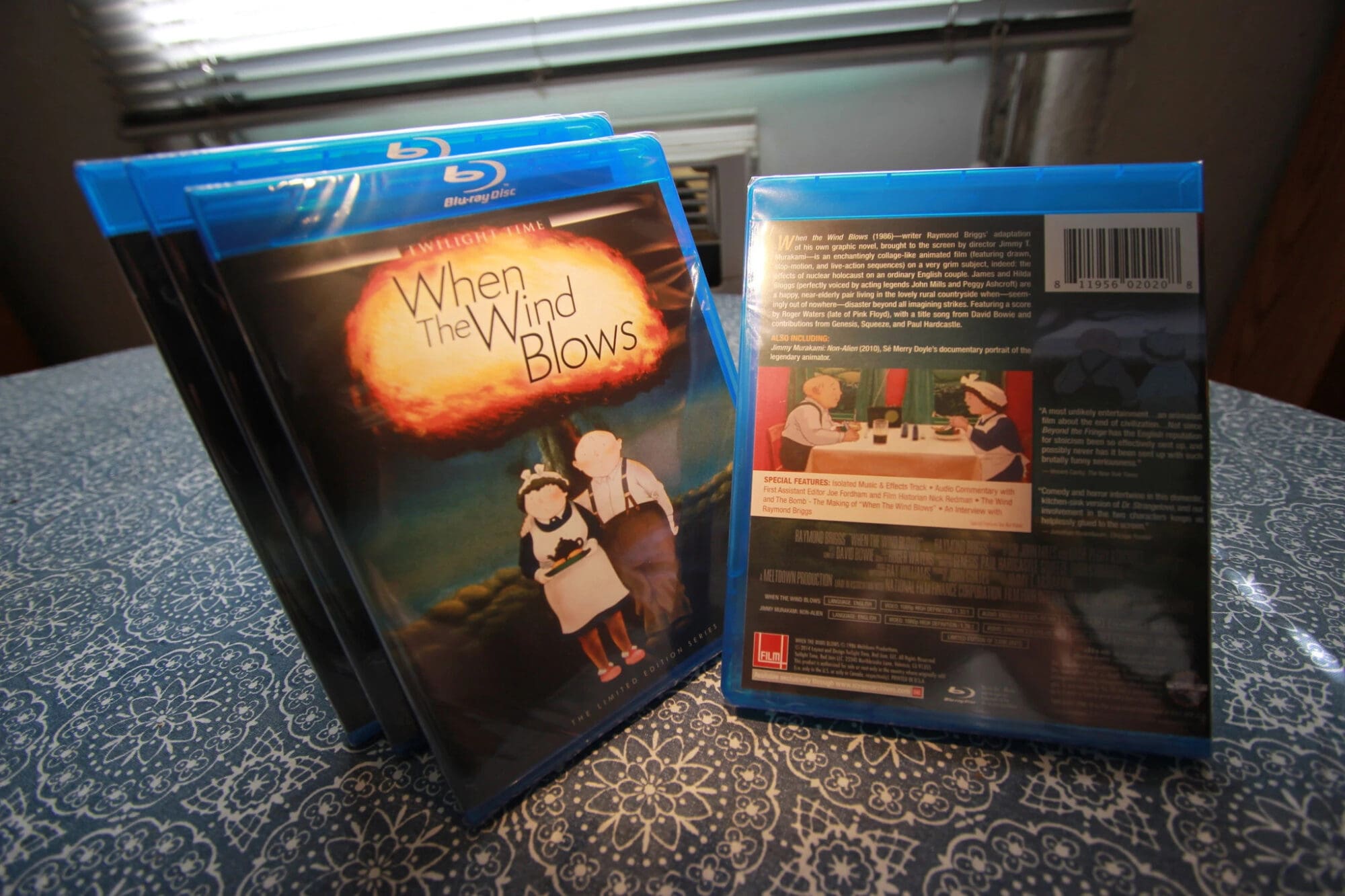
When the Wind Blows is available on DVD and Blu-ray from the British Film Institute.
Meltdown Editorial – A Sidebar With TVC Editor Taylor Grant
As When the Wind Blows took shape in TV Cartoons’ editorial basement, producer John Coates’ longtime in-house film editor, Taylor Grant, ran the studio’s main cutting room upstairs. If I was the meek dormouse down below, Taylor was John’s Mad Hatter—a tall, creative fellow with a rich Canadian accent, wonderful red hair, an artistic eye, and a wicked sense of humor. Taylor kept an eye on me, and at the end of the production, he produced a brilliant music video of David Bowie’s title song, which Jimmy Murakami directed.
While helping me fact-check my story, Taylor furnished a cavalcade of details. The following are highlights:
TVC was the creative hub of the animation industry in London for nearly four decades. The studio was the ‘Fisher’s Folly’ of our time [an expansive home to great talent in 16th-century London]… It functioned as a significant cultural node within an expanding network of just about anyone in the business of film production at a time that predated the mouse and keyboard—all before closing time on the last years of the ‘golden age of handmade British animation.’
During the making of the film, the rendering technique that followed on from The Snowman brought about the first ‘strike’ in [U.K.] animation employment history by the newly formed rendering crew. Rendering became a recognized skill acquired through experience and the discipline of animating color in much the same way as animating line created the illusion of movement; however, the combination of the two unique skills kept the action in tune with the illustrated narrative of Briggs’ work. TVC inherited the reputation of ‘rendering color’ by way of the late Jill Brooks (1948–2025), who brought her experience of working on the copulating flowers sequence in Pink Floyd: The Wall (1982) to Dianne Jackson’s superbly directed The Snowman.
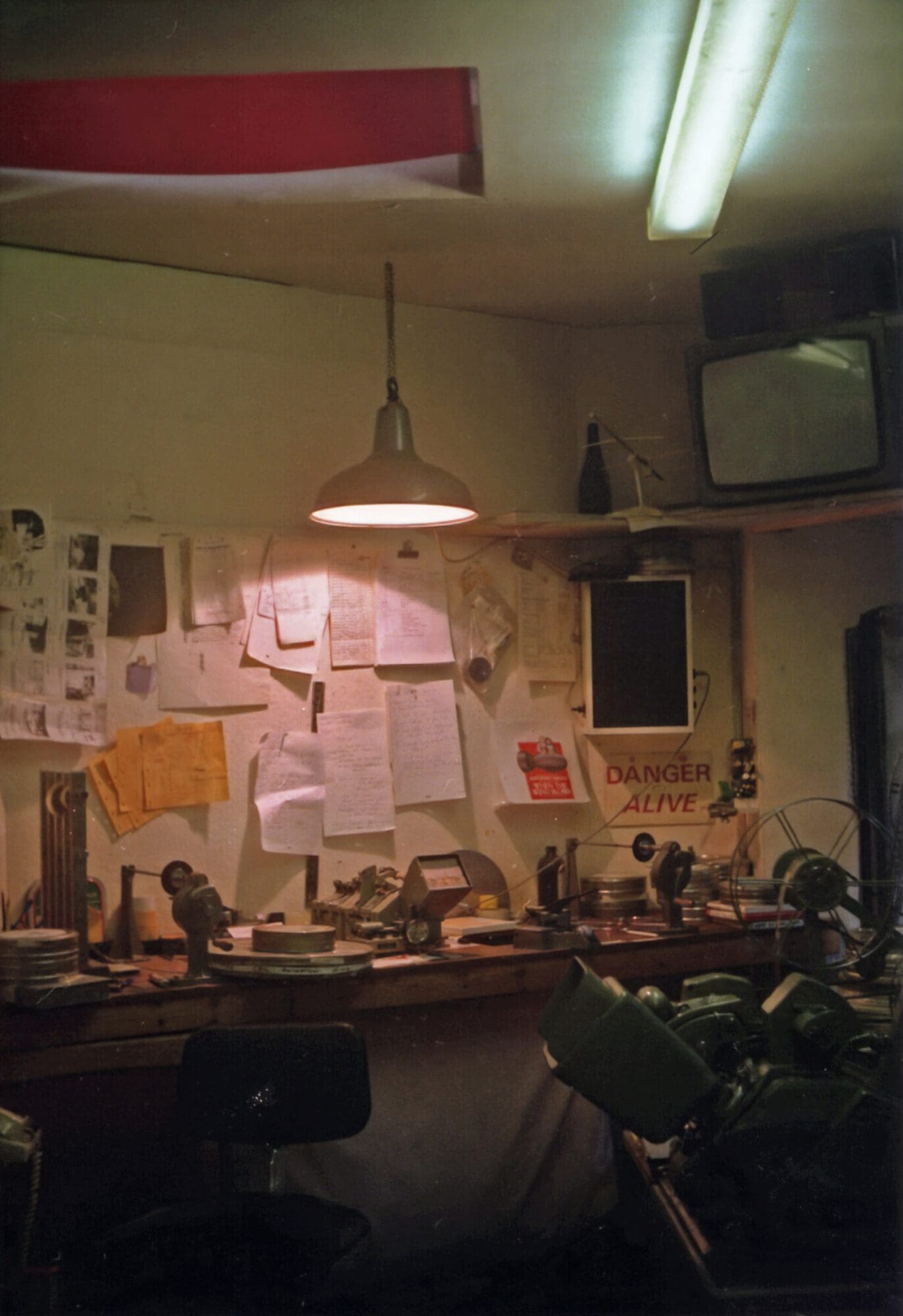
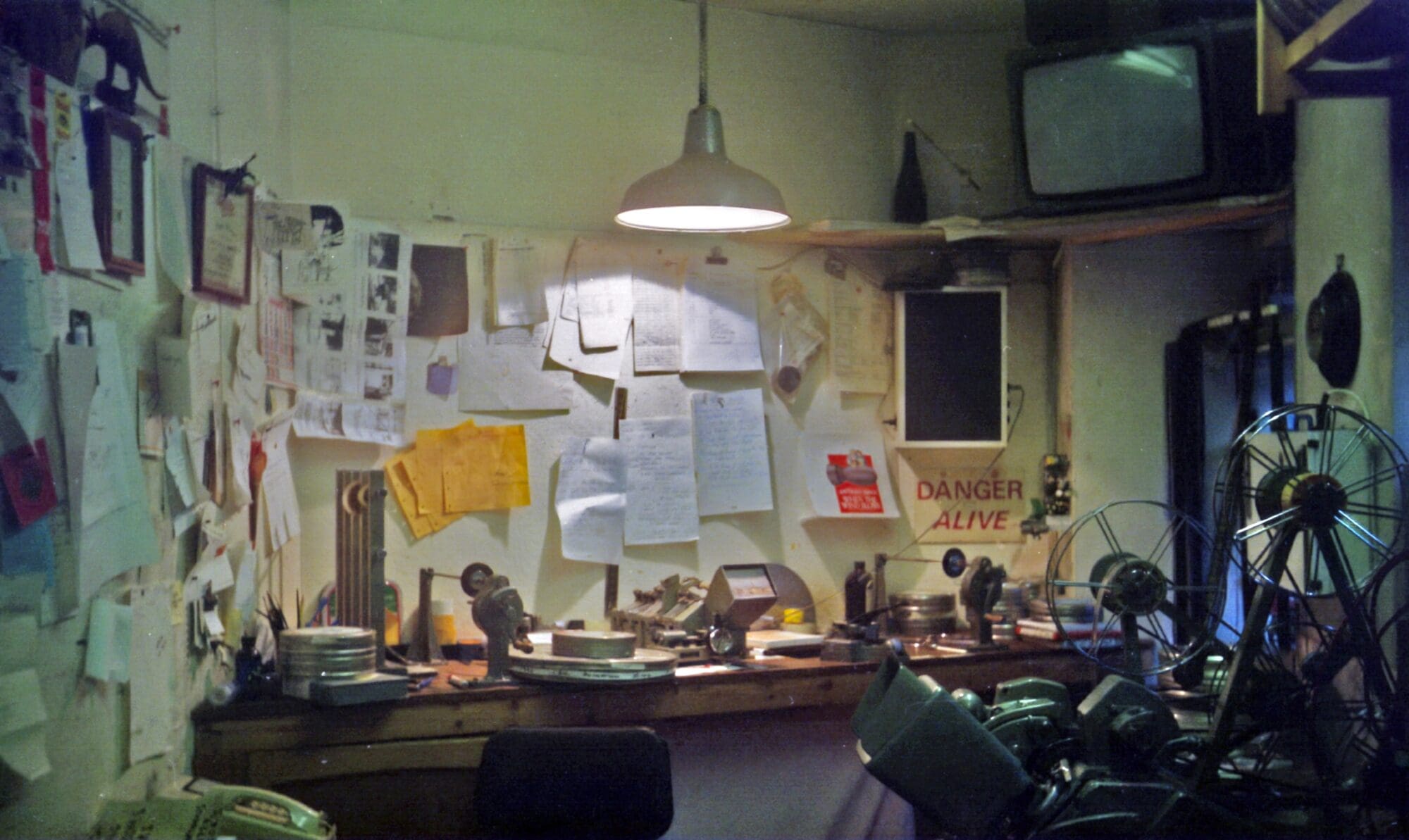
From the start, When the Wind Blows was John Coates’ personal project. When acquiring the rights to The Snowman, John astutely acquired first option on all of Briggs’ work, which in 1979 had yet to be fully appreciated and [was] technically far from easily adapted. Lee Stork, a maverick producer of commercials and short films, often lunched with John at the Gay Hussar [a Hungarian restaurant in Soho], and he gave John the confidence to single-handedly tackle a feature film that had serious social and political overtones. To John’s credit, he remained politically neutral throughout, claiming the film—faithful to Briggs’ book—didn’t need to be associated with any one organization. I thought that was particularly representative of his true charismatic character, which, although affable on the surface, was made of stern stuff. Even though TVC suffered from the lack of support from the anti-nuke movements and seemingly was in the lee of that network, When the Wind Blows fortunately, but slowly, gained the respect of the establishment that later backed the Peter Rabbit series (2012) and two features, The Wind in the Willows (1995) and The Willows in Winter (1996).
As an aside, When the Wind Blows is dedicated to [seven] children born during the making, one of whom was my eldest son, William. There were many artists I could single out [for praise], but it’s their personalities and talents that make them the mysterious Shakespeares of the golden age whose work will be their mark.