.png)
Peering Through the Cracks: How Sun Xun Spent A Decade Creating The Chinese Epic ‘Magic Atlas’ With 500 Artists
Stay informed with free updates
Sign up to get our news digest — delivered directly to your inbox twice a week.
Sun Xun’s Magic Atlas could prove to be the most intriguing animated feature of 2026. It is set to have its world premiere at the 79th Locarno Film Festival on August 13, followed by a screening in competition at the Ottawa International Animation Festival in September.
A decade in the making, Magic Atlas is an imposing, often bewildering collision of spiritual odyssey, political parable, folk tale, and art history. Guided by a magical star atlas, a young apprentice named Xiaozhi moves through different identities, incarnations, and imaginary territories. Among them is Luocha, a coal empire without history or memory, where inhabitants are forbidden to fly.
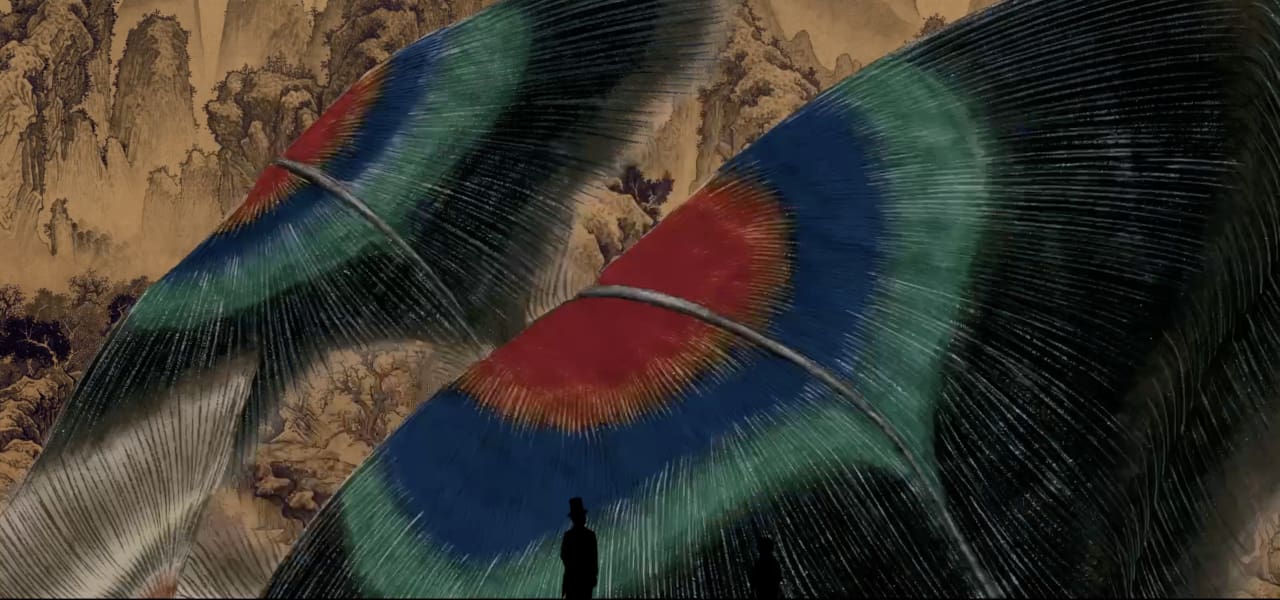
Across these shifting worlds, Sun moves between woodcut animation, ink painting, contemporary painting, and Persian miniature. Rather than following a conventional narrative, Magic Atlas unfolds as an intricate cosmology of power, exploitation, reincarnation, cultural memory, and the search for an authentic self.
Sun is primarily known as a gallery artist, although animation has long occupied a central place in his work. Before embarking on Magic Atlas, his first feature, he had completed 25 animated shorts. Nothing, however, prepared him for the scale of the undertaking.
Sun’s studio had a permanent staff of just five, but over the course of production he enlisted approximately 500 art-school students. Professional post-production artists eventually joined the project, while musicians from China and Japan contributed to the score and songs.
The pace was dictated as much by money as by visual complexity. Judith Neilson of Sydney’s White Rabbit Gallery provided $1 million in start-up funding. After that, Sun largely financed Magic Atlas through sales of his own artwork.
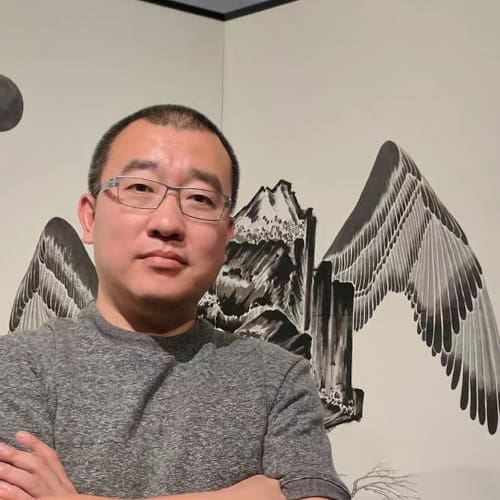
“An animated film such as Magic Atlas has one advantage: the entire budget does not have to be available at once,” he says. “The disadvantage is that the production period becomes very long. I could sell some artwork and then use the money to produce another section. When I had more money, the work went faster; when I had less, it slowed down.”
The final cost was approximately 40 million RMB.
“It was essentially financed and assembled little by little.”
Then came COVID-19.
“The impact was enormous,” Sun recalls. “I received no support from the government. The rent on my studio still had to be paid, while the gallery representing me was closed for an entire year. I therefore lost all my sources of funding and had to take out a bank loan to keep the project going.”
The pandemic also entered the work itself. Through Instagram, Sun invited people confined to their homes around the world to contribute drawings to a special sequence.
“I believe that our state of mind can change our circumstances,” he says. “An individual cannot alter the objective course of events on a larger scale, but we can still discover and fight for opportunities that improve things at the individual and local levels.”
The resulting collaboration transformed isolation into a collective monument to an extraordinary historical moment.
Defending the Handmade Image
Although Magic Atlas incorporates several visual languages, its central section is rendered in dense, stark woodcut imagery. Sun describes the technique itself as the production’s principal practical challenge.
“It required training, communication and time for everyone to learn how to work together, because woodcut is not a widely used form of animation.”
A conventionally styled commercial feature would have been far easier to organize. Art schools generally train animation students to work within established industrial forms, giving producers access to teams that already share a familiar technical vocabulary.
Sun is suspicious of this standardization.
“Contemporary Chinese animation has become highly Japanese in style because large numbers of Chinese animators worked for Japanese animation companies during the 1990s,” he says. “Although this may have been commercially profitable, it did not produce much progress in terms of artistic exploration.”
His concern is not with Japanese animation itself, but with an industry’s tendency to repeat whatever has already proved dependable.
“The problem with commercialization is that it pursues stability rather than risk. But when we look back through art history, we see that art requires uncertainty and risk-taking.”
Animation, in Sun’s view, must first discover its own graphic language, then make that language function through movement and time.
“A good drawing does not necessarily become good animation when it begins to move,” he says. “Many elements have to be coordinated, and this requires careful thought—especially when the images are complex.”
The irregular flow of financing also forced Sun to improvise during production, sometimes determining the framing of individual shots.
“When I had enough money, I would stage a scene in a medium shot and draw the legs,” he explains. “When money was short, I would use a close-up and show only the upper body. I would then adjust the rhythm between the different shots so that the sequence still felt natural.”
That may be the most spot-on explanation of independent animation economics: whether a character possesses legs depends on the available budget.
Sun could reduce the amount of visible movement, alter a composition or change the editing rhythm. What he would not do was adopt shortcuts that violated his understanding of the handmade image.
He is particularly resistant to rotoscoping: filming live actors and digitally tracing their movements. Although he respects artists who use the method, he compares it to printing a photograph onto canvas, covering the corresponding areas with paint and then presenting the result as an oil painting.
“For Magic Atlas, I insisted that all animated movement had to be designed by us,” he says. “We could not film something first and then trace it. All the original animation drawings had to be created by hand, without machine assistance.”
At a moment of rapidly advancing digital tools and generative artificial intelligence, that position may sound reactionary. Sun regards it instead as an artistic responsibility.
“Technology continues to advance, but certain things still need someone to defend them.”
View this post on Instagram
Feeling Rather Than Understanding
Magic Atlas does not offer viewers an easy route through its narrative. Characters, creatures, political systems, spiritual guides and visual styles arrive with little explanation. Images follow the shifting logic of myths and dreams.
Sun wants audiences to enter the work, but he questions the assumption that there is a single entity called “the general public” whose needs can be anticipated and satisfied.
“Who, exactly, is the general public?” he asks. “Perhaps everyone considers themselves different from everyone else.”
No filmmaker, he argues, sets out to make something nobody can understand. At the same time, some works inevitably make greater demands upon a viewer’s cultural knowledge and lived experience.
Sun points to his own encounters with Western cinema. Religious references that may seem obvious to a Western audience can remain mysterious to him, but that does not prevent him from sensing meanings beneath the visible surface.
“I draw upon my own sensibilities to experience those additional layers,” he says. “This does not interfere with my appreciation of the film.”
The same applies in reverse. Magic Atlas draws heavily upon Buddhist cosmology, Northeast Chinese regional culture and Tungusic shamanism. Viewers unfamiliar with those traditions may miss some of its meanings. For Sun, that need not constitute a failure.
“When people encounter a work of art, they often worry about whether they understand it. But what is more important is what they feel.”
He compares art to food. A person does not need to understand how a meal was prepared to recognize that it tastes good. Someone may never learn to cook but can still experience pleasure from eating.
“It is like falling in love,” Sun says. “That is the most beautiful period because both people exist in a state of certainty and uncertainty, each trying to sense the other. At that moment, understanding is unnecessary. Feeling is enough. Feeling is more romantic than understanding.”
That tension—between a desire to communicate and an acceptance of uncertainty—runs throughout Magic Atlas.
The opening sequence presents several worlds that initially appear disconnected from the central narrative. Sun explains that it introduces the Buddhist idea of reincarnation. A soul may be reborn as a human or an animal, in another country, another historical period or even on another planet.
“Our present life may have come from the future,” he says. “After we die, our next life may take place in ancient times.”
Magic Atlas therefore rejects a linear understanding of time. Reincarnation does not necessarily carry the soul forward. It may send it backwards, sideways or into an entirely different dimension.
The principal woodcut section represents reality—or, more specifically, the environment and historical moment in which Sun finds himself. Here, the spiritual journey becomes entangled with political and material conditions.
Sun believes that every life offers experiences through which people might discover their authentic selves. He connects this search to the familiar Western philosophical questions: Who am I? Where am I? Why am I here?
The animals and magical figures emerge partly from the culture of Northeast China, where Sun was born. He was especially influenced by shamanic traditions within the wider Tungusic cultural world, in which all things possess souls capable of communicating with one another. This is why a weasel can communicate with the magician, while Xiaozhi communicates with a fox.
The final section moves beyond the present life and into another dimension, where spiritual mentors prepare souls for their next incarnations. The one-eyed, eagle-beaked Master was partly inspired by Horus, the ancient Egyptian god, although Sun’s first visual reference was the Eye of Providence on the reverse of the US one-dollar bill.
“I wanted this chapter to feel as ancient and unfamiliar as possible,” he says.
Cold War-era West German newspapers provide another unexplained historical layer. Chinese calligraphy becomes a form of divine language, offering meaning that can be sensed without necessarily being read.
“I wanted the Master to speak the language of the gods,” Sun explains, “a language that people within our dimension of time and space cannot understand, but from which they can nevertheless receive a general impression. It is best to exist in a state of partial understanding.”
Many contemporary Chinese viewers cannot easily read traditional calligraphic characters, yet calligraphy retains cultural authority and prestige. Sun compares this relationship to that of contemporary Egyptians confronting ancient hieroglyphs: the writing belongs to their cultural inheritance while remaining the language of a distant, inaccessible world.
In the final shot, Xiaozhi and the magician enter another world together. Although they appear to be separate characters, Sun says they belong, in some sense, to the same higher-dimensional soul.
“They share a common mission.”
The Legitimate Liar
Beneath its mythology and metaphysics, Magic Atlas is also a political work. Luocha is a brutal industrial state built upon exploitation, enforced forgetting and restrictions on freedom. Its inhabitants are denied both history and the possibility of flight.
At one point, an oligarch declares that there will always be new emperors. The remark suggests an endless cycle in which emperors, dictators, presidents and politicians—whether on the left or the right—remain performers. The official leader may merely be the visible representative of systems and interests operating beyond public view.
Sun does not offer a program for escaping this cycle. Instead, he returns to one of the central figures in Magic Atlas: the magician.
“The magician is such an important character in my work,” he says. “He is the only ‘legitimate liar.’ Lying is his profession.”
Politicians, governments and historical narratives conceal their deceptions beneath claims of authority and truth. The magician is different because his dishonesty is declared. The audience knowingly enters into a relationship with his illusions.
“But are the magician’s lies credible?” Sun asks. “Perhaps the only lies we can trust are those of the magician, because the magician’s lies may contain the highest proportion of truth.”
Art cannot necessarily overthrow the emperor or expose every invisible system. It may, however, create a small opening in the surface of accepted reality.
“Whether we accept this situation as a consequence of human nature or hope to break the cycle, the only thing we can do is pry open a crack and peer through it at the truth—not simply to look, but to peer.”
For all its political and philosophical ambitions, Magic Atlas also grew from Sun’s dissatisfaction with the physical and temporal limits of painting.
“I love painting, but it is too limited for me,” he says. “It cannot completely satisfy me. I am also fascinated by the possibilities of film.”
Animation allows him to move between gallery and cinema, between a single image and an extended experience. Yet the attraction of making a feature is not simply that it provides a larger canvas. What animation offers Sun has changed as he has aged.
“When I was younger, I emphasized explosive energy, novelty, short cycles and excitement,” he says. “But as I have grown older, the question of how to complete and cultivate one’s life has become increasingly important.”
The prolonged labor of Magic Atlas became a form of spiritual practice. “You must mobilize your entire being in order to confront the world,” Sun says. “That is the fundamental question of art.”
The most startling departure from the predominantly monochromatic world of Magic Atlas is a sudden, ecstatic eruption of color. For a moment, art and culture appear to become the only remaining sources of vitality within an otherwise gray and oppressive system.
Asked about the sequence, Sun does not explain its production or symbolism directly. Instead, he offers another riddle.
“People need air just as fish need water. But can fish see the water? Are fish conscious of its existence?”
Art may be essential precisely because we are not always conscious of its presence. Recognizing it requires something more active than passive looking.
“What we need is vigilance and skepticism,” Sun says. “We must recognize that nothing should be taken for granted. Only then will we possess the eyes necessary to discover and appreciate art.”
This may be the most direct path into Magic Atlas. It does not ask to be deciphered into a single, stable meaning. It asks viewers to distrust what appears self-evident, accept uncertainty and peer through the cracks it opens.
“The least important thing in art is its form,” Sun says. “The most important thing is the texture of life.”