.png)
Vergine Keaton’s Cannes-Pitched Project ‘Bataille’ Explores War, Power, And Humanity Through Animated Renaissance Art
Stay informed with free updates
Sign up to get our news digest — delivered directly to your inbox twice a week.
By her own admission, Vergine Keaton knew very little about animation when she began her artistic journey. The director studied graphic design and illustration before discovering animation almost by accident. Curiosity led her to experiment with the medium and eventually create her first short film, I Was Crying Out at Life. Or For It., in 2009. Built from a corpus of one hundred popular 19th-century engravings, the film premiered in the ACID selection at the Cannes Film Festival.
Keaton, who chose her surname as an homage to silent film icon Buster Keaton, returned to Cannes more than fifteen years later with her proposed feature directorial debut, Bataille, one of the standout projects from this year’s Annecy Animation Showcase.
For the event, Keaton spoke with Brew alongside producers Vanessa Buttin Labarthe (Les Astronautes) and Manon Messiant (Iliade Films) about the ambitious new project, the evolution of her technique, and what animation means to her today.
Cartoon Brew: What led you to animation in the first place?
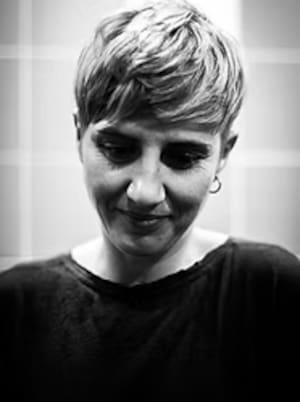
Keaton: It was a bit of a coincidence. I already had a strong interest in the history of painting and, later, cinema, but I knew very little about animation. I started tinkering with animated films without any specific method, using only a scanner and Photoshop at four frames per second. My goal was to help friends or experiment with music videos, and I immediately loved both the ability to develop narratives over time and the handcrafted nature of animation.
From then on, I watched stop-motion films frame by frame, taking notes (for example, how background scenery scrolls more slowly than foreground scenery) to understand how movement was created. To me, it was a revelation. Over time, I tried to improve, learning with each project and inventing my own way of making films.
Bataille is your first feature project. What compelled you to tell this story?
Keaton: That, too, was a coincidence. My artistic world until then had been very mineral, with occasional glimpses of flora and fauna, but almost no human figures.
I came across Jean Giono’s The Disaster of Pavia, which recounts the 1525 battle between the armies of Charles V and Francis I during the Italian Wars. To my surprise, I was swept away by this epic political tale. It isn’t far removed from my more nature-driven subjects, where I try to understand how elements interact and how the world unfolds.
Here, it’s about observing a human group composed of different social strata that, during an exceptional event, must organize itself. That’s what interests me: the mechanisms, the interactions, the choices each individual makes, and, of course, the central question of power and how a group structures itself around authority, even when that authority proves to be failing.
From that starting point, how did you craft the narrative?
Keaton: I really wanted to make an epic film that explored the mechanics and behind-the-scenes aspects of a battle unfolding over a single day. For that, the narrative thread had to be very clear: what happens, who is in charge, how the battle goes off the rails, and how each character experiences the event.
I read many other war stories from that era — the battles of Pavia, San Romano, Marignano, Agincourt, Crécy — which helped me define what a typical battle looked like at the time while remaining as historically accurate as possible. Within that clear, classical battle framework, I wanted viewers to dive into the details, follow the characters, and understand what each person experienced depending on their rank and role, from the high nobility holding power to the mercenaries paid to carry out orders, to the ordinary soldiers caught in a battle they neither understood nor stood to gain anything from.
The film is structured around this large-scale choreography and the individuals within it.
Visually, you also chose a very singular approach, drawing from Renaissance paintings. Could you walk us through your artistic process?
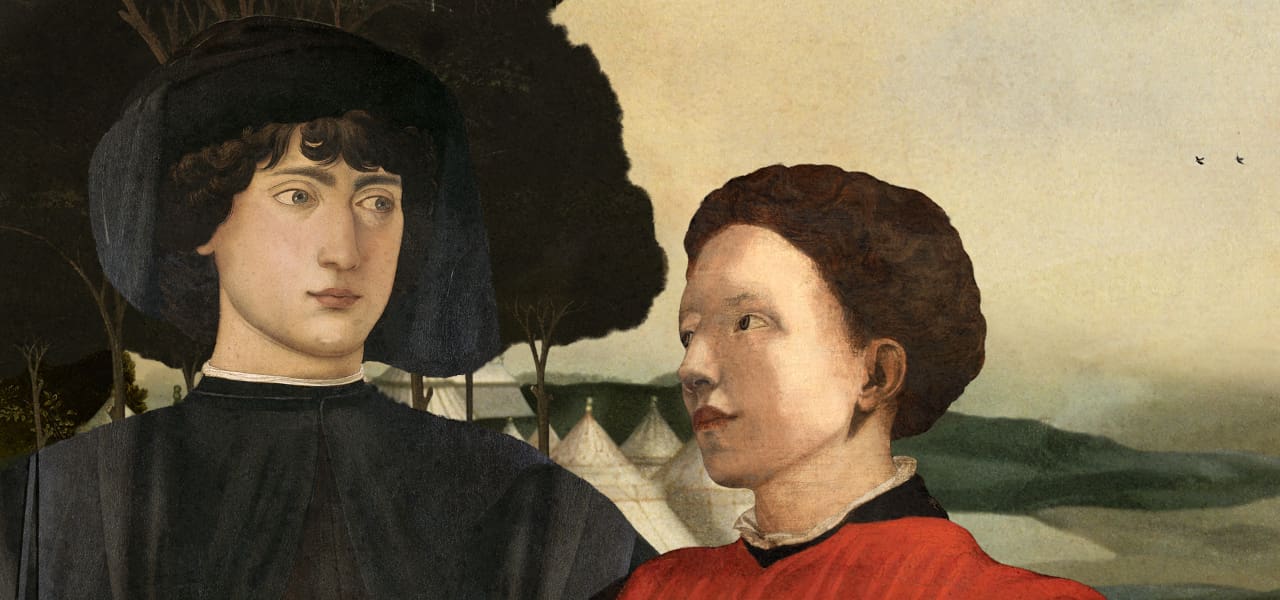
Keaton: I like working with pre-existing images that carry a classic, universal quality and belong to our collective memory. These are images that seem to contain the whole history of humankind and can be endlessly reinterpreted. In a way, they’re like fairy tales or mythological stories, which may appear simple at first glance, yet we continue to revisit them because they contain something more complex, universal, and still relevant today.
When I have a project in mind, I search for images — in this case, Renaissance paintings — and look within them for narrative possibilities. For example, it was after discovering a portrait at the Louvre that one of the film’s characters, the Black Knight, was born.
From there, I organize all of this documentation into a corpus from which I extract elements, materials, and details to recreate a new universe that feels both familiar and strange because it is built from such diverse sources.
I enjoy it when the images unfolding before our eyes seem self-evident, as if they had always existed. I also like taking great care in how they unfold, carefully controlling the rhythm so that small details become events we later rediscover from another perspective.
From a production standpoint, where does the project currently stand?
Messiant and Buttin Labarthe: We are currently in development and in the final stages of the animatic. Right now, the priority is locking the film’s narrative, staging, and editing. We are working closely with Heloïse Pelloquet, the live-action editor who recently worked on Cannes 2025 opener Partir un Jour, and she is helping Vergine finalize this crucial step. Vergine has also begun collaborating with composer Lucie Antunes, and we expect to complete the development phase this summer.
What production challenges have you faced so far?
Messiant and Buttin Labarthe: Initially, the film was conceived as a silent musical piece. Today, we want the main characters to be portrayed by actors, although the film will remain dialogue-free. We already have a preliminary agreement with French actress and musician Pomme, but that still raises many questions: Who is the audience for a dialogue-free musical about knights? Is the feature format the right one?
Even so, we secured the CNC’s “avance sur recettes,” which reassured potential partners.
We are now moving forward with three international co-producers: Embuscade Films (Félix and Nicolas Dufour-Laperrière) in Canada, Umedia (Julia Gabreau) in Belgium, and Altara Films (Giovanni Donfrancesco) in Italy.
We are also very fortunate to already have the French distributor UFO on board, which recently demonstrated with Flow that atypical films like this can find an audience.
The project was selected for the Cannes Annecy Animation Showcase. How does this double recognition feel?
Messiant and Buttin Labarthe: It’s wonderful because it aligns with what we stand for in all of our productions, and especially with Battle: animated cinema is, first and foremost, cinema.
Vergine, as a multidisciplinary artist, what does animation mean to you today?
Keaton: Making animated films is about deconstructing time and movement. I love the internal musicality within the image — I always work with a metronome. I think of my films as grand choreographies unfolding within a block of time. I like to say that making a film is sculpting time. That’s always how I begin: images run through my head, and I try to organize them, to imagine what happens before and after, and little by little I understand what I’m making.
Animation is extremely precise because you dissect movement frame by frame. But my initial impulse is always intuitive. Whether I’m working on feature films or installations, I think about movement, variations in rhythm, and how those rhythms shape emotion. My stories are very simple, but I love animation immensely for the trust it places in images to carry narrative.